Montañita – Day 1: The Art of the Wave
MONTAÑITA
Day 1: The Art of the Wave
October 18, 2025
PART I
After another short and uneventful layover in Quito, followed by a flight and a ridiculously expensive three-hour taxi ride, I finally arrived at my next destination: Montañita.
Often described as one of Ecuador’s surfing capitals, this village lies along the Pacific coast in Santa Elena Province and is famous for its consistent waves and laid-back atmosphere. I, for one, had come for the surfing. Much like at several of my previous stops, I had booked a package at Balsa Surf Camp that included early-morning yoga sessions and surfing lessons – the perfect combination for me.
I wanted to take my practice of both sports to the next level, and spending a few days here seemed like the perfect way to do it – or so I hoped. I would’ve loved to spend a few months in a place like this, but for the time being, a few days would have to do!


Back on the Board
Once I’d settled into my gorgeous cabaña, I was introduced to Carlos, a local surfing instructor who would be teaching me throughout my stay. Over the next hour and a half, we revisited the same fundamentals I had practised in El Tunco in El Salvador and Siargao in the Philippines. I completed a few dry runs on the sand before heading into the water. It took me a while to catch my first wave, but with Carlos’s help, I eventually managed to ride a few.
By the end of the lesson, I was catching most of the waves, although many still required his assistance. It felt as though I had resumed exactly where I’d left off. As always, catching even a few baby waves made me feel like the king of the world. Exhausting though it might be, surfing may genuinely be my favourite sport, assuming we’re not counting diving. I might suck at it, but that was the entire point of coming here. If I could notice even a tiny improvement in my abilities by the end of my stay, perhaps my idea to go on a proper surf camp wouldn’t be too unrealistic.
For now, though, I had three more lessons ahead of me, and I really wanted to make them count. I never wanted to be the best, nor did I have any intention of becoming a professional, but I certainly wanted to master the basics.
Pacific Freedom
After the class, I chilled on the beach with a beer and a cigarette, trying to take everything in. I was beside the Pacific once again, feeling as free and happy as I had during my gap year.

Somewhat tipsy, I headed back to Balsa Surf Camp, where I met Pedro, an Ecuadorian guy from Quito. He told me about his many experiences with ayahuasca and how he believed it had changed his life for the better – although his most recent ceremony had involved a terrifying confrontation with his innermost demons. Afterwards, he had abandoned his former lifestyle and what he described as his addictions to alcohol, sex, drugs, cigarettes and even his phone. As I lay there with a cigarette in one hand and my phone in the other, I figured I could probably do with cutting back on both myself. Perhaps a third ceremony could be fruitful after all…
PART II
Where Balsa Becomes Art
Up next was the surfboard-making class. César ‘Rasty’ Moreira, the owner of Balsa Surf Camp and creator of Balsa House surfboards, would be giving a couple of other guests and me a tour of his workshop.
Rasty began by telling us that the gorgeous guesthouse was a dream come true for him and his wife. He was a talented carpenter, while Yuyu was an artist with an extraordinary eye for detail. Together with a dedicated team of local craftspeople, they had built the camp as a tribute to ancestral cultures and nature itself. Its lush gardens, traditional architecture fashioned from bamboo, wood and cade, statues inspired by pre-Inca cultures, and artwork contributed by travelling artists and friends blended seamlessly together. All of this made Balsa Surf Camp a truly unique place – a little village where life simply felt good.
He then told us about the balsa tree – the Ochroma pyramidale. Native to tropical areas of the Americas, it is a remarkably fast-growing tree that can reach close to 30 metres in height. Its wood is incredibly lightweight while retaining an impressive strength-to-weight ratio, making it suitable for surfboards, rafts, models and other lightweight structures. Balsa, he went on, is a pioneer species, meaning it rapidly colonises forest clearings and disturbed ground, helping begin the process of ecological regeneration. It can also be harvested after only a few years, with commercial rotations sometimes lasting around four to six years.
Rasty owned a balsa plantation around an hour from the surf camp, close to a lake and river. He selected trees during the half-moon, performed a short ceremony honouring his ancestors and Pachamama, and then replanted them after every harvest so that the cycle could continue. The number of trees he cut depended on what was available – sometimes only one and occasionally as many as fifty per season. For his plantation and current production model, making around four surfboards each month felt sustainable. Producing more would require him to take on additional work and resources, whereas he now preferred to protect the time he spent with his family.
Inside the Balsa Temple
After the introduction, he led us into his workshop – or, as he liked to call it, his temple. Here, he began explaining the surfboard-making process – his one true passion.
For each board, he needed at least seven pieces of balsa, each measuring a minimum of five inches across. Every piece has its own grain, density and characteristics, so he carefully selects and balances them to create the right final shape and weight. As a result, no two boards could ever be identical. Any leftover wood, he explained, is saved for other carpentry projects rather than being thrown away.
Thin cedar strips are then inserted between the balsa pieces, providing visual contrast, structural reinforcement and reference lines during shaping. Once he selects the pieces, he joins them using a mixture of approximately 90% glue and 10% water before clamping everything tightly under pressure for around three days so that the glue sets and the surfboard blank takes shape.

Rasty then took us into the shaping room, where the second and most labour-intensive stage takes place. Here, he uses a handheld electric planer to gradually cut and shape the board. Special lights are positioned at around waist height so that the shadows and reflections cast across the wood reveal any uneven curves or imperfections. Once the rough shape is complete, he sands the wood until everything is perfectly smooth. The sound of the sandpaper moving across the board, he told us, is his music. He then adds the final elements of the design – including any commissioned artwork and his Balsa House logo. These are carefully carved into the wood using a scalpel before the removed section is replaced with a contrasting piece of thin veneer.
Around 80% of the work happens inside the shaping room, with the shaping stage alone taking between one and three days. Before acquiring his current tools and lighting, Rasty had worked entirely by hand around sunset, using the angled natural light to reveal the board’s contours. He told us that, back then, completing a single board could sometimes take him as long as a year.
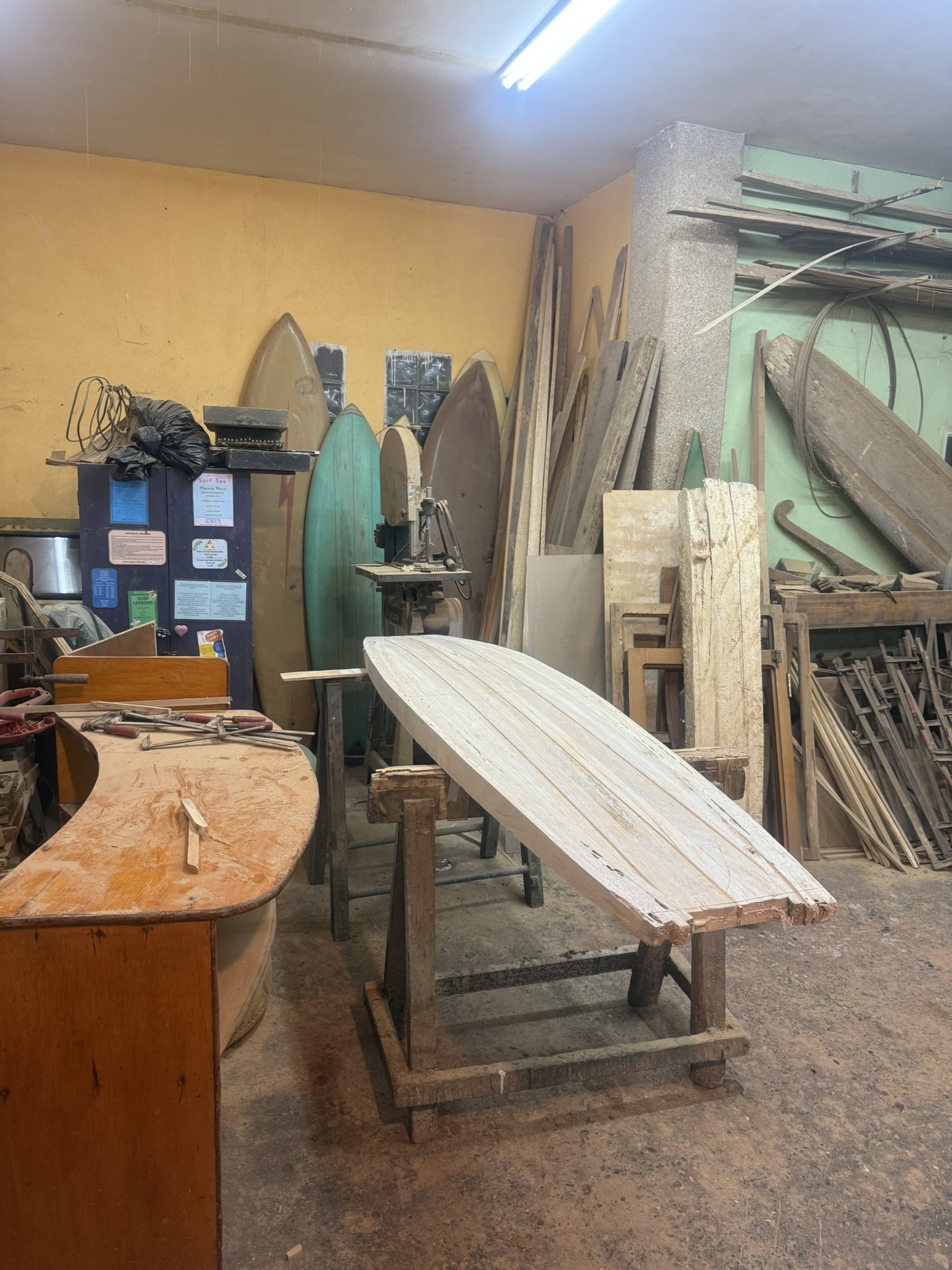
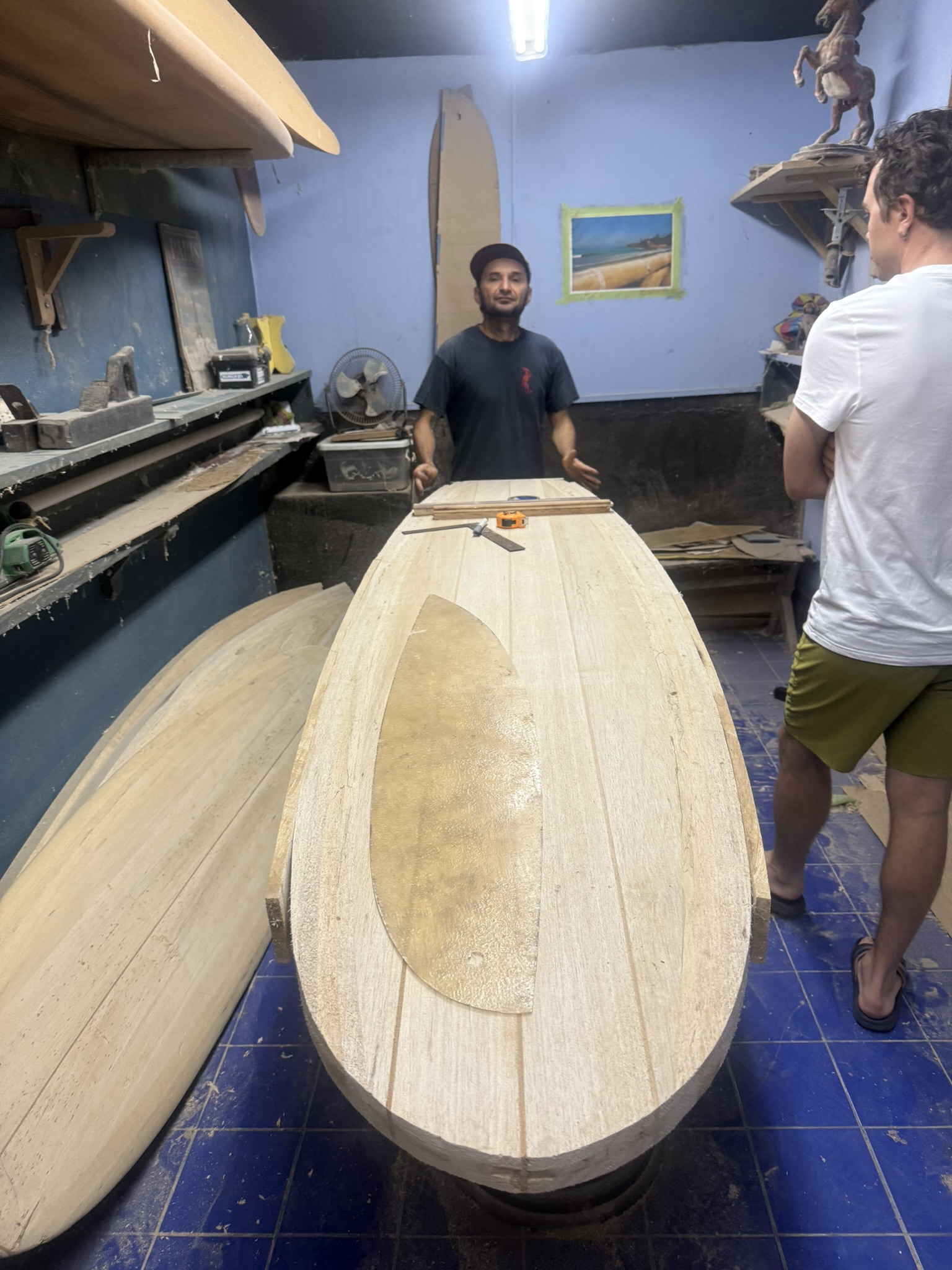
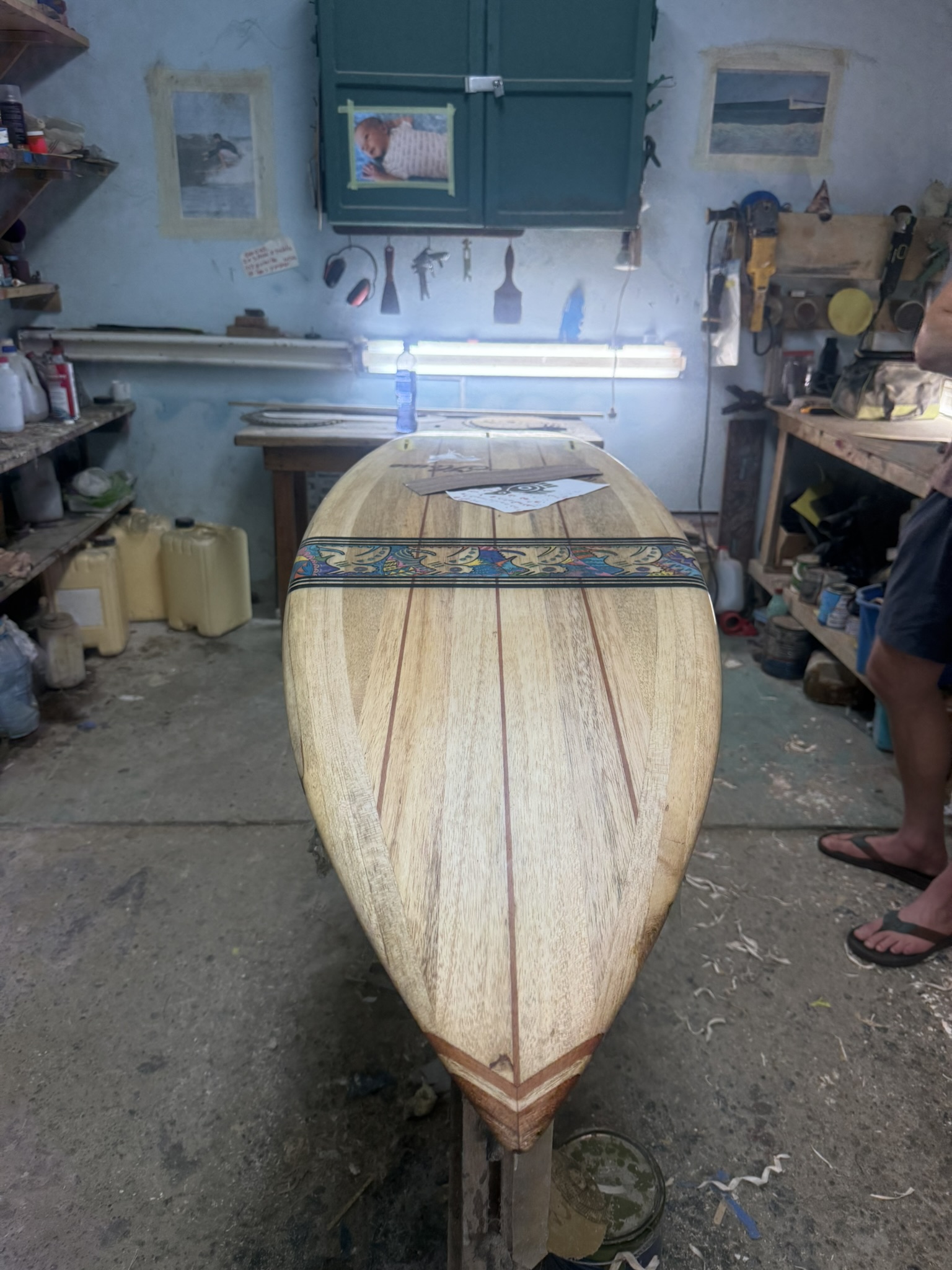
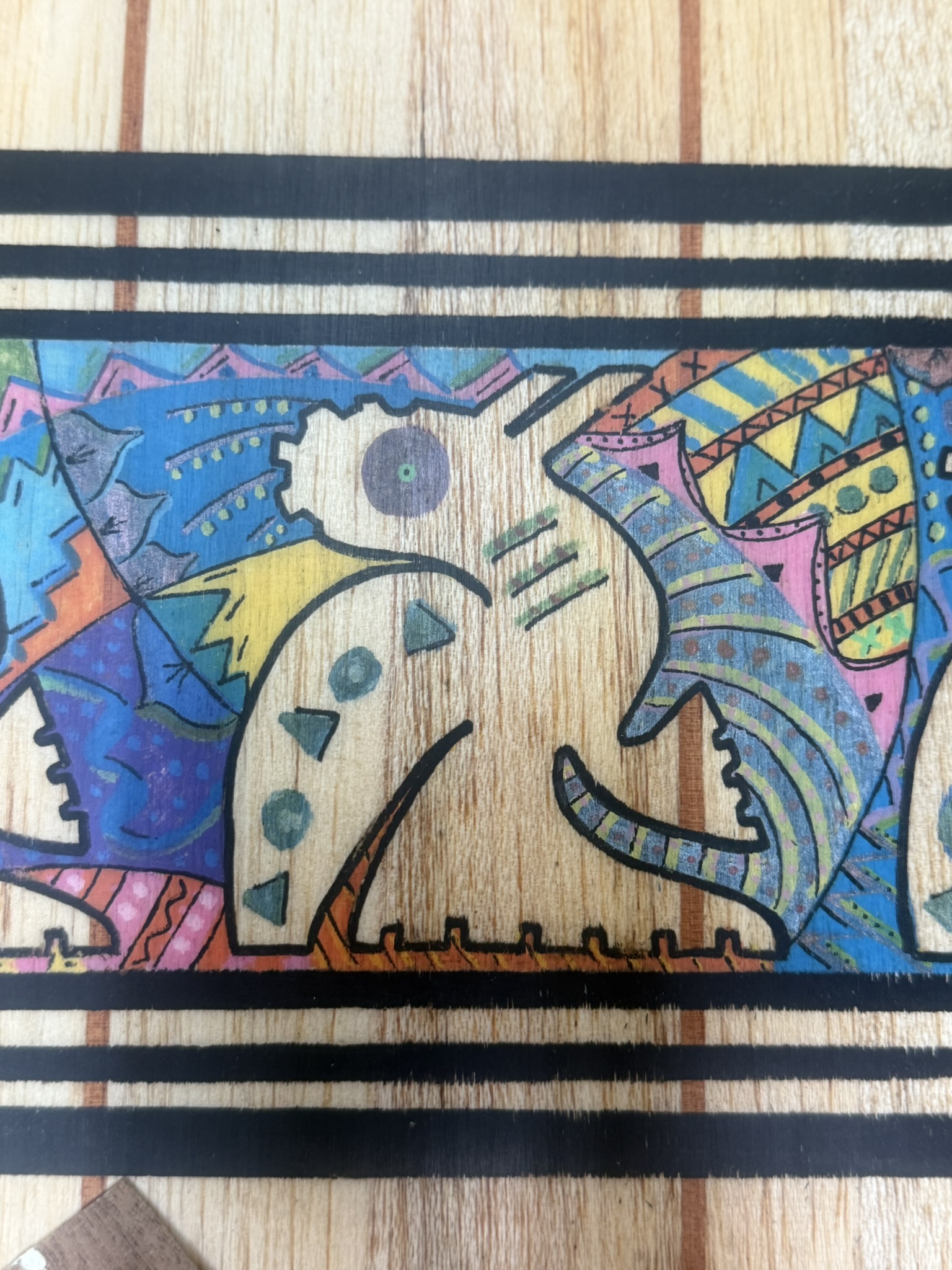
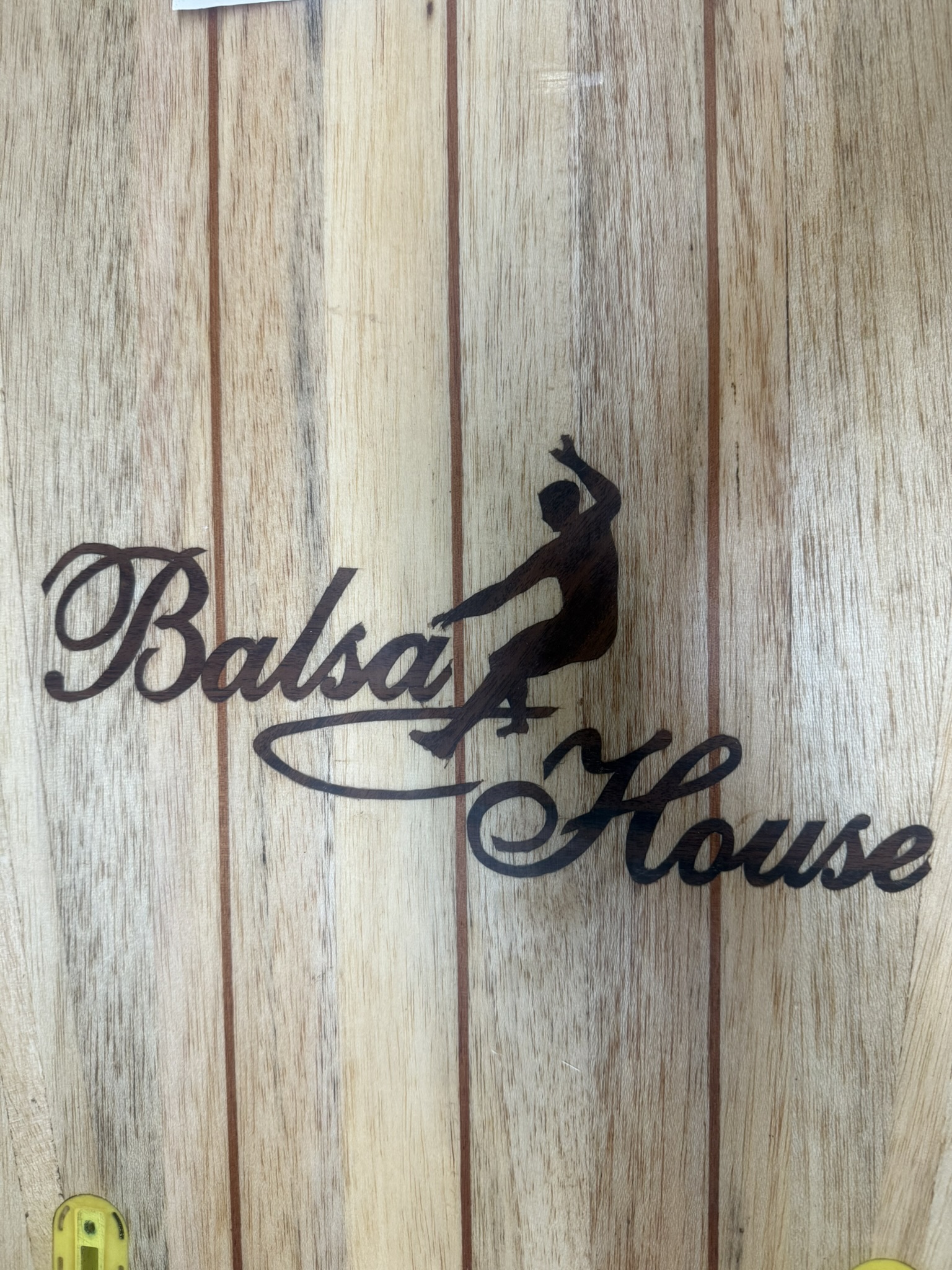
The final stage takes place in yet another room and involves laminating the board with fibreglass – usually with one layer underneath and two across the deck. The fibreglass is saturated with resin and spread evenly across the surface using a squeegee or scraper. Throughout this process, Rasty wears a protective mask and works beneath a ventilation fan, completing each application quickly before repeating the process on the opposite side. Once the resin has cured properly, the board is ready to use. Like any wooden surfboard, a balsa board would need appropriate aftercare. It has to be rinsed, dried and stored somewhere shaded and well ventilated rather than being left in direct sunlight or exposed to rain. Properly maintained, however, it could last for years.
Rasty told us that the entire process usually took around two weeks, representing approximately 90 hours of work. Conversely, a machine could shape an industrial surfboard blank within a few hours – though a completed factory-made board still required lamination, finishing and curing. Despite the enormous difference in labour, an industrial board could cost as much as, or sometimes more than, one of his handmade creations.
No Secrets, Just Experience
Needless to say, Rasty takes immense pride in his work. His philosophy, he told us, was to create something that would last, make somebody happy and carry a small part of his story – the complete opposite of a disposable industrial product.
He works alone, obsessing over every line and detail until the finished board matches what he had initially imagined. With most professional surfers no longer using balsa boards, Rasty’s craft is slowly dying out. Even so, he continues entering competitions and exhibitions in an effort to keep it alive. Over the years, he has made more than 1,400 boards, which are now scattered across the world. His dream has always been for his art to travel, even when he couldn’t. Now, he simply wants to pass on everything he has learnt. With tears in his eyes, he told us that there was something deeply special about watching his students create their own boards and gradually develop artistic styles of their own. ‘There are no secrets,’ he told us, ‘just experience!’.
Throughout the tour, Rasty repeatedly referred to his boards as his ‘art’ and his work as his ‘passion’. I could tell that he wasn’t simply putting on a performance for us tourists. The sincerity with which he spoke about his craft was so moving that I felt my own eyes beginning to tear up. It might have seemed strange, but when the tour ended, I gave him the tightest hug. I just love meeting people who are genuinely passionate about what they do!