Tromsø – Day 3: Into the Arctic
TROMSØ
Day 3: Into the Arctic
November 30, 2024
PART I
By this point, I had lost all semblance of time. It might have had something to do with the polar night. It might also have had something to do with us waking up insanely early to embark on yet another adventure.
Under the blanket of darkness, we made our way to the harbour, where we boarded one of Brim Explorer’s modern hybrid-electric vessels, purpose-built for sightseeing and whale watching in Arctic waters. We’d be setting out on an expedition along the fjords for something super cool – whale watching!

Briefing on the Brim
Once aboard, we scuttled around in search of a table large enough to fit us all, given that the boat was at full capacity. Once everyone had settled in, Lotte, our cruise guide, introduced herself and gave us a short briefing about the vessel and the expedition ahead.
We’d be cruising through the coastal waters connected to the Norwegian Sea, itself part of the North Atlantic. These northern waters, she explained, are strongly influenced by the Norwegian Atlantic Current, an extension of the wider Gulf Stream system that carries relatively warm, saline water northwards. This moderates the coastal climate and helps keep much of Norway’s coastline and many of its fjords largely ice-free throughout winter, although shallower and more sheltered inlets can still freeze. The resulting marine environment supports enormous numbers of fish, seabirds and marine mammals.
We’d be sailing north-east through the fjords towards the waters surrounding Skjervøy, which had become one of northern Norway’s principal winter whale-watching areas after vast schools of herring shifted northwards. The herring’s location varies from year to year, and the whales follow them in search of food, meaning the precise destination of each expedition can change with the season.

Our journey would begin through Grøtsundet near Tromsø, where the waters were calmer and more sheltered than the exposed seas farther north. From there, we’d be able to admire the Lyngen Alps, the dramatic mountain range stretching along the Lyngen Peninsula, as well as Lyngstuva at its northern tip. We would then continue through the channels surrounding islands such as Kågen and Arnøya, heading towards the deeper fjord systems near Skjervøy, where herring gather and whales can feed efficiently. After roughly three hours, we’d finally reach our destination.
Christmas in the City
I couldn’t wait any longer for any of it! In fact, the second Lotte’s briefing was over, I rushed outside towards the deck, braving the freezing wind and driving snow while leaving the rest of the gang to enjoy the warm and cosy interior of the boat.
Freezing though it might’ve been, I couldn’t help but feel that burning passion for adventure once again. Alone on the deck, I was suddenly back aboard the G Expedition in the Antarctic wilderness. I felt more alive than ever. I remembered how I had felt in Antarctica – how that one week hadn’t been nearly enough. Three hours here in the Arctic certainly weren’t gonna be enough either. I swore that I’d eventually have to return and go on an all-out expedition.
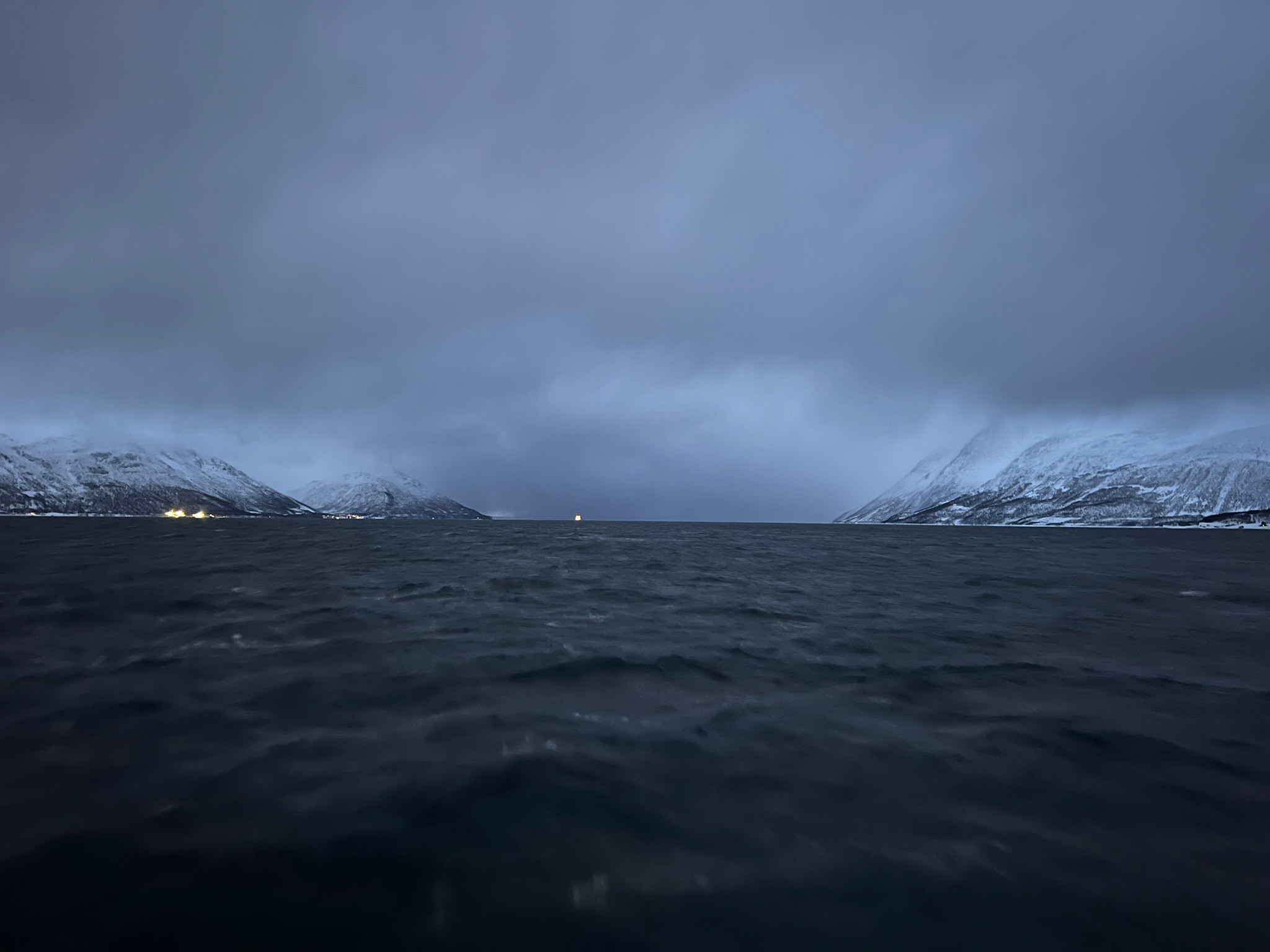
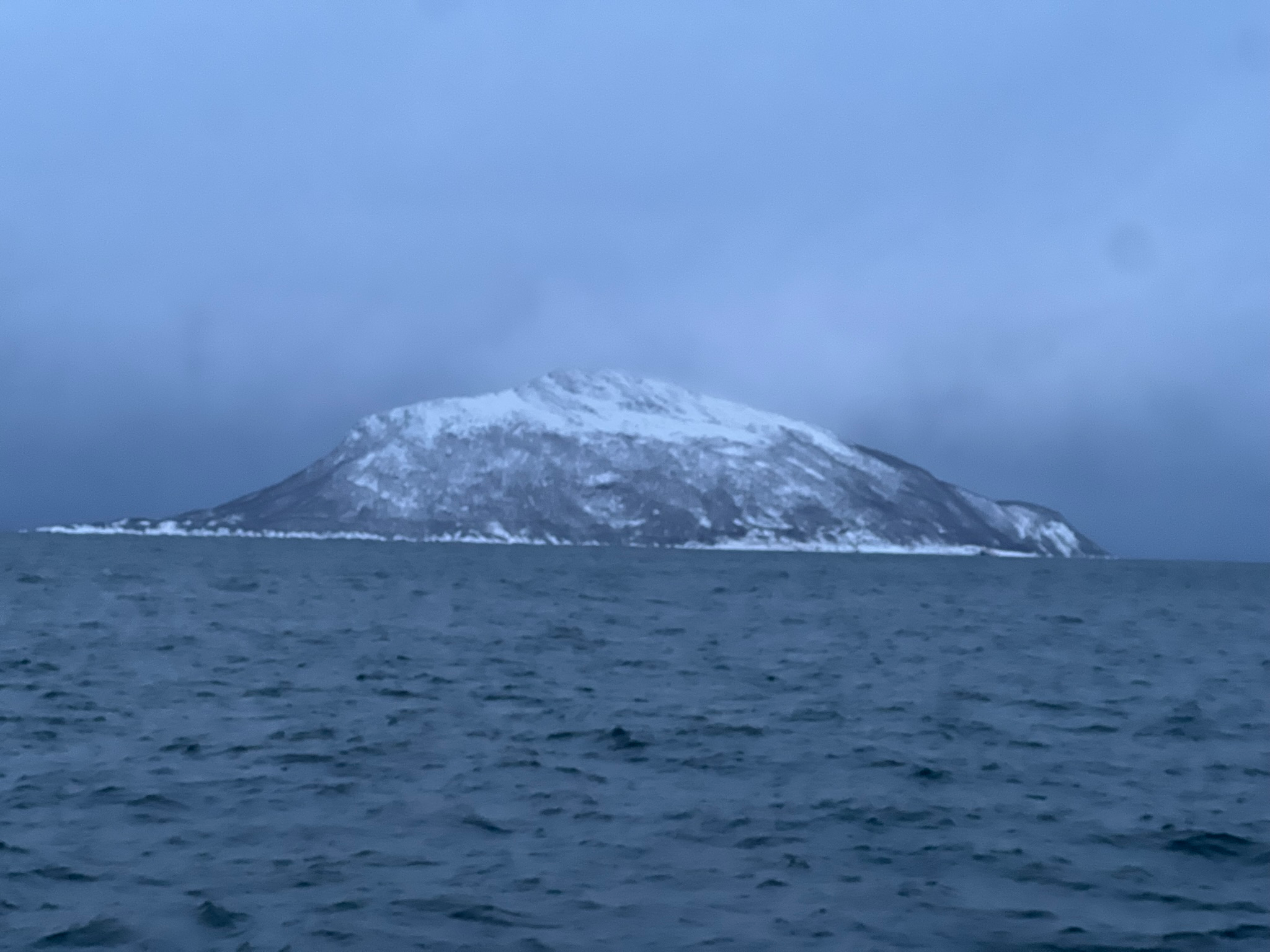
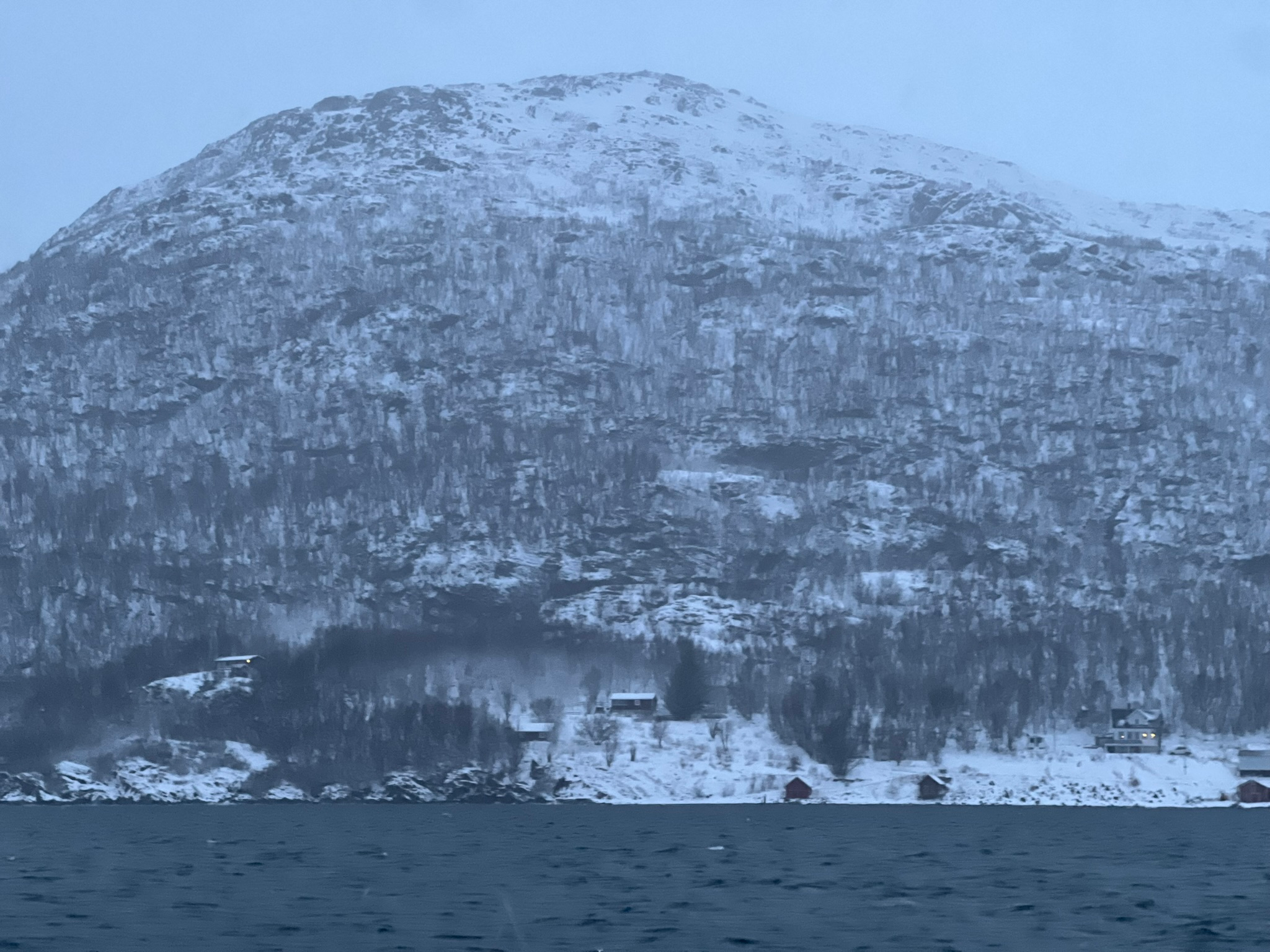
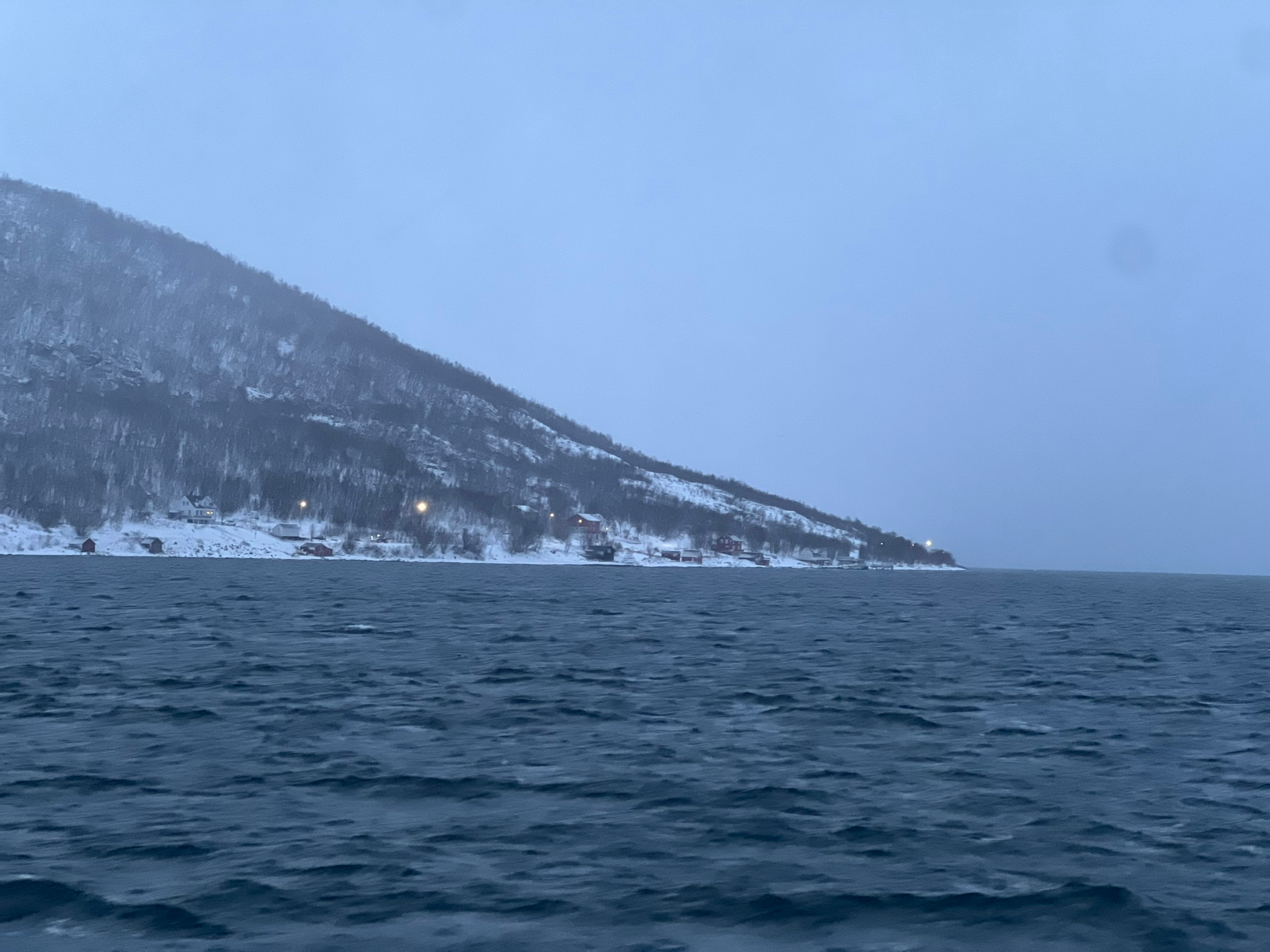
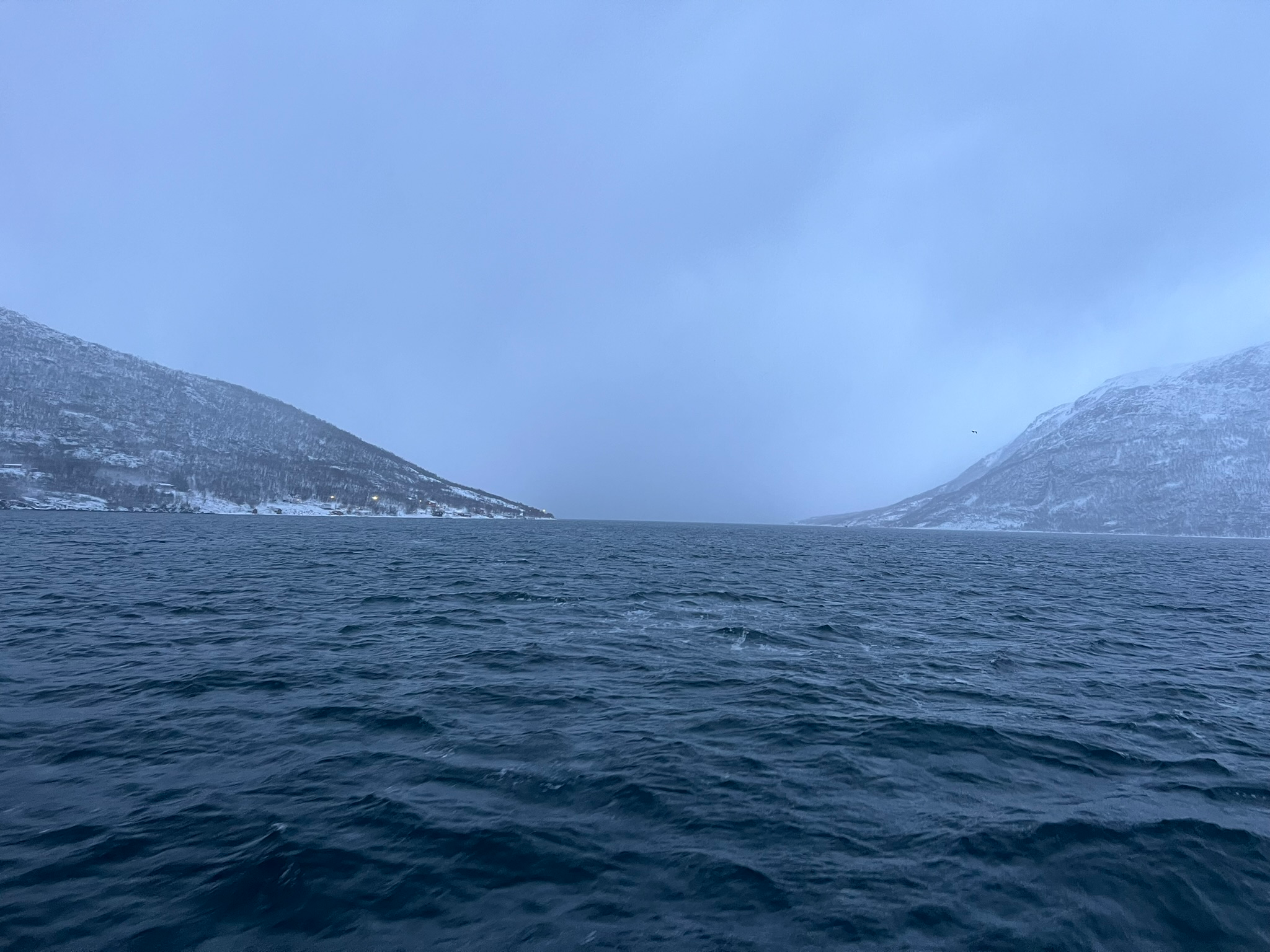
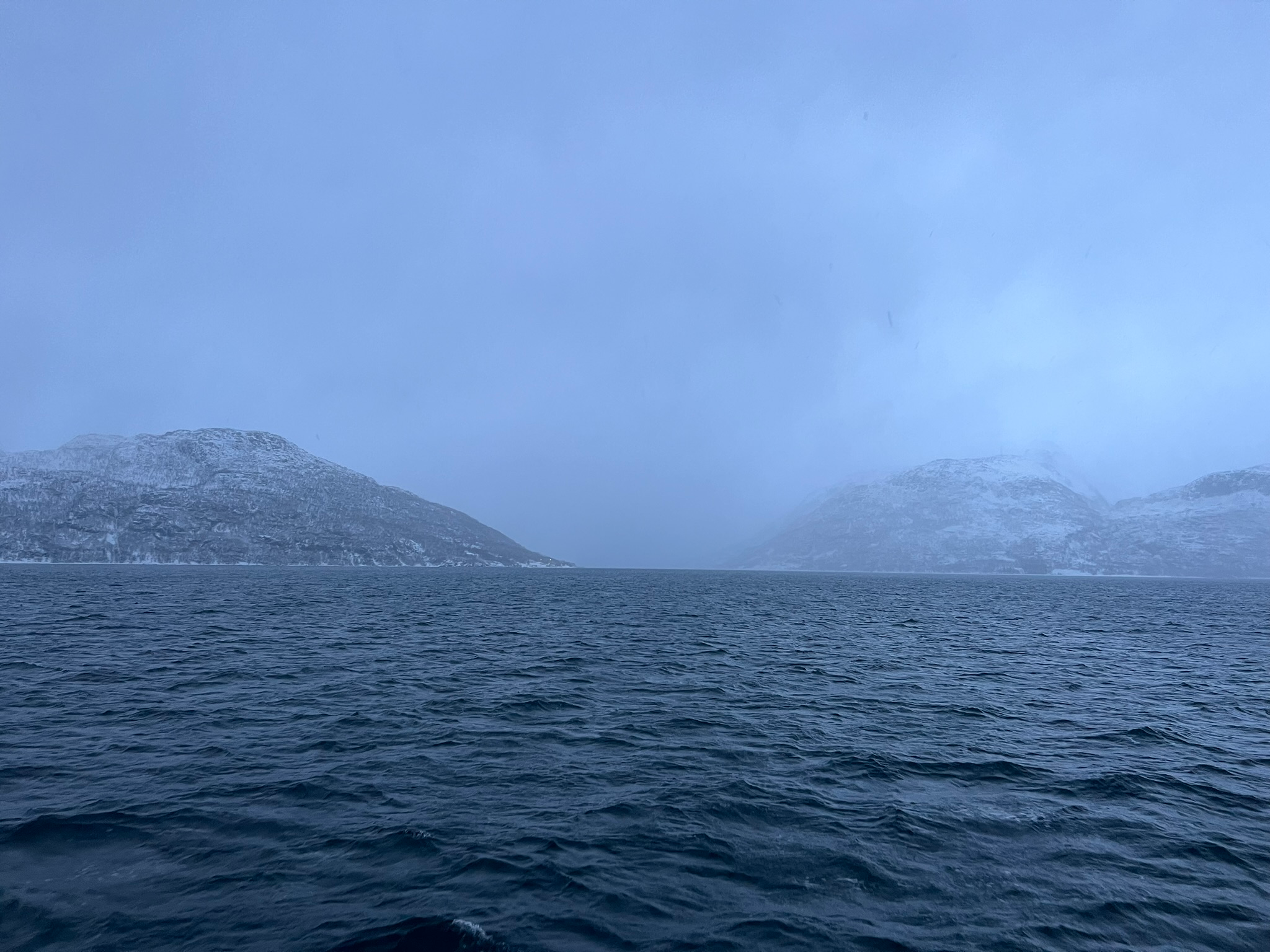
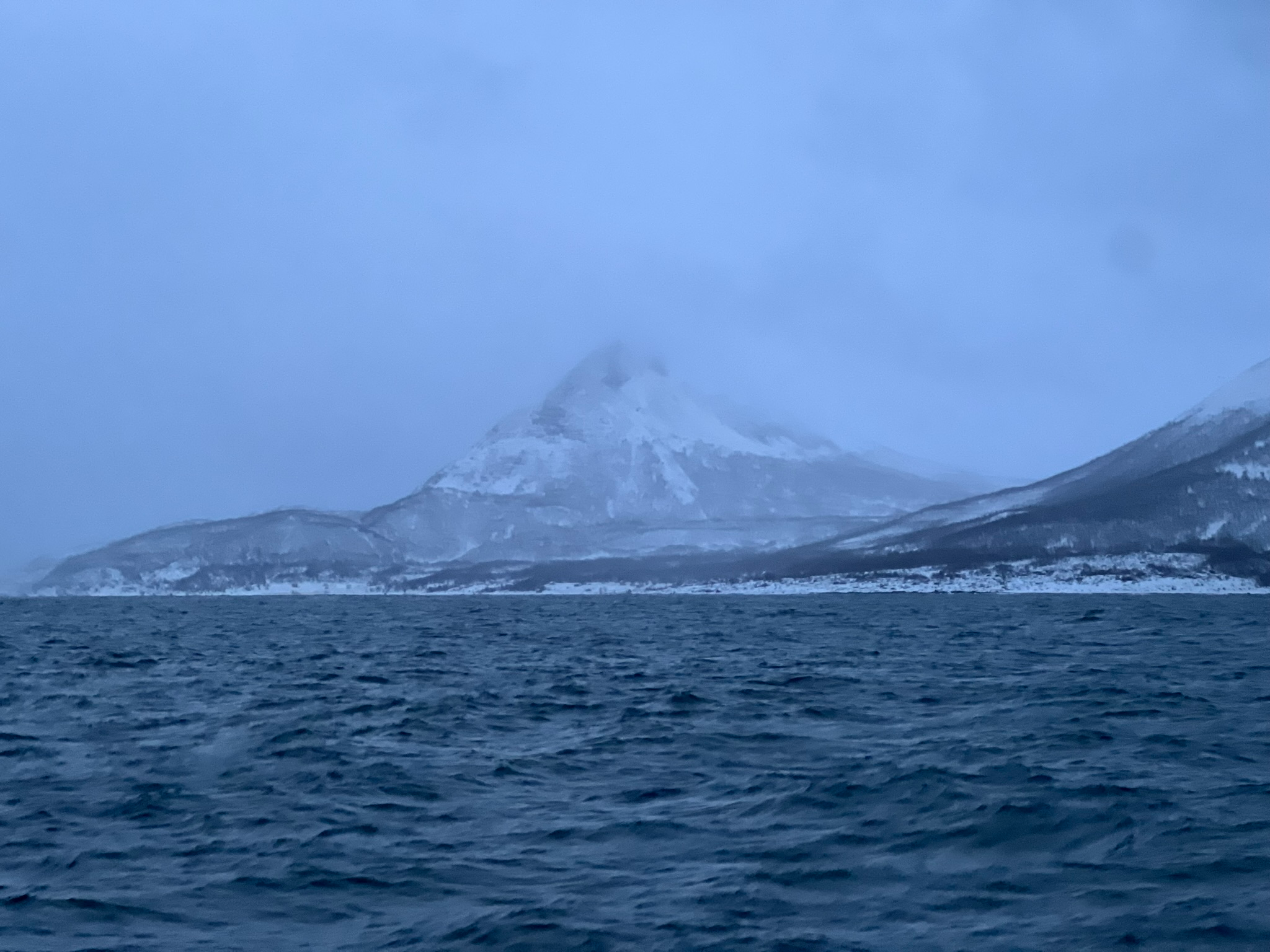
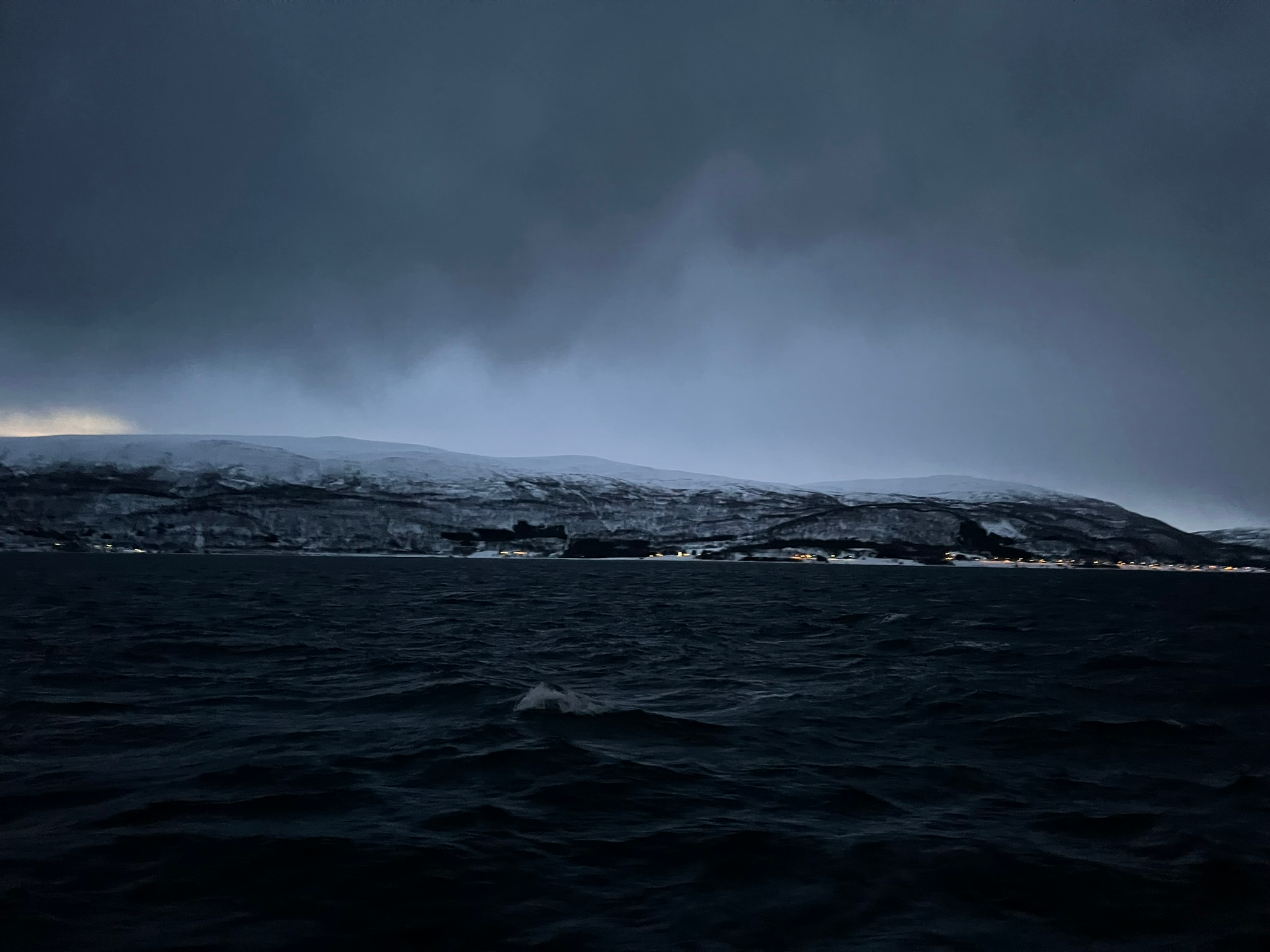
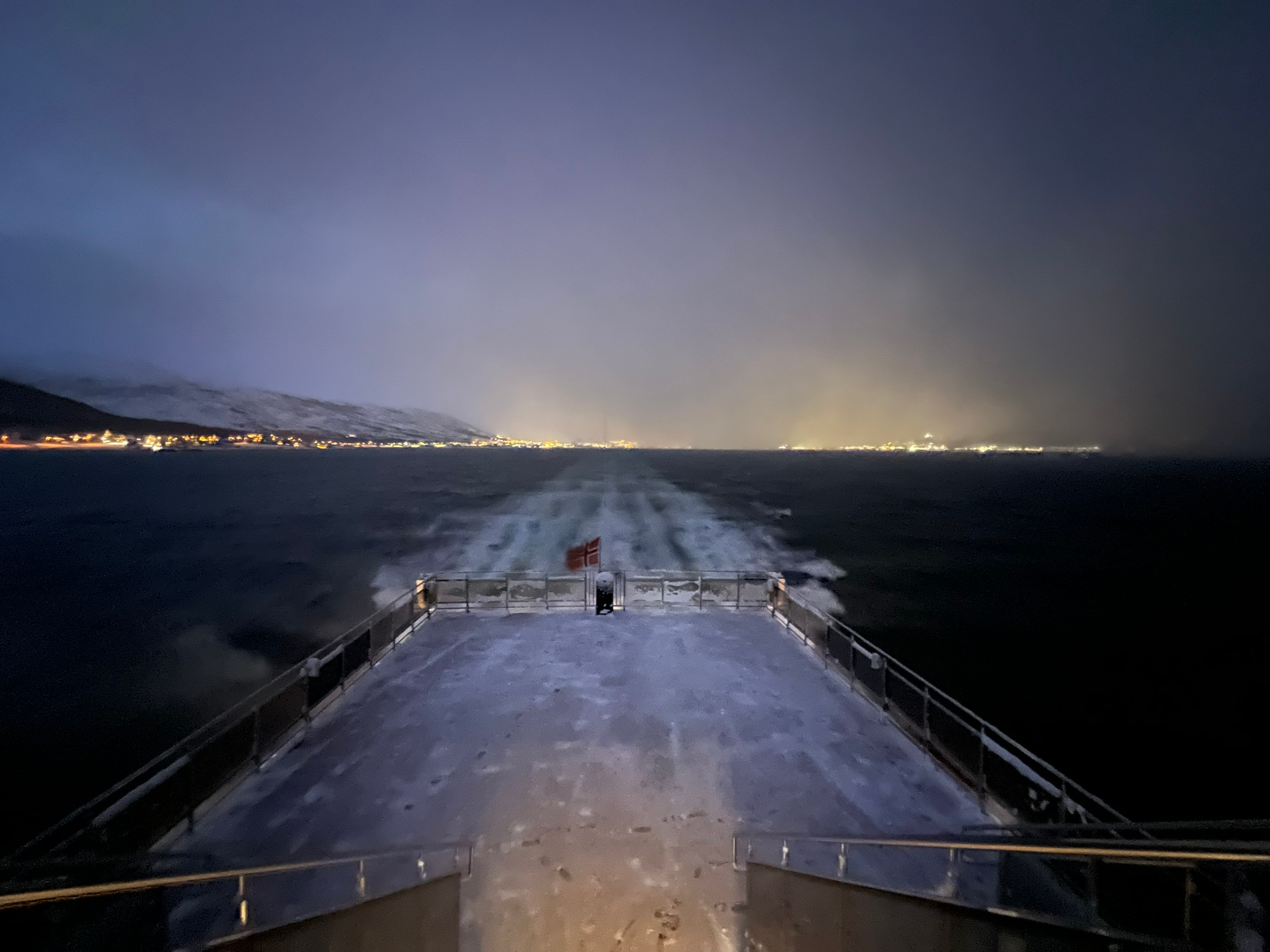

The views as we made our way through Grøtsundet were simply surreal. As the dimly lit cityscape of Tromsø faded from view, the snow-capped hills and mountains of the Lyngen Peninsula began to dominate the landscape, their peaks shrouded in clouds and mist. It was just like being in Antarctica again, only the conditions here somehow seemed even harsher as we coursed through the snowstorm and I slowly froze out on deck.
PART II
Lessons from the Frozen North
Much like my adventure aboard the Little Red Ship in Antarctica, this expedition also featured several lectures by experts as we sailed onwards.
First up was a lecture on how the fjords had formed. According to the lecturer, whose name I unfortunately missed, they were the result of immense glacial activity during repeated ice ages, particularly the most recent glacial period. That period ended around 11,700 years ago, with glaciers retreating from much of Norway during the millennia that followed.
As massive glaciers moved slowly towards the sea, their sheer weight, combined with the rocks and sediment trapped beneath them, carved deep U-shaped valleys into the landscape. Unlike rivers, glaciers can erode far below sea level, grinding away the underlying bedrock and producing the steep cliffs, deep basins and narrow profiles for which fjords are now famous.
When the climate warmed and the glaciers retreated, seawater flooded the abandoned valleys. Many fjords also developed a shallow threshold, or sill, near their entrance, formed either by reduced glacial erosion or by rock and sediment deposited near the glacier’s former edge. The result was the spectacular landscape now seen across Norway, Iceland, Alaska and New Zealand – long, deep waterways surrounded by towering cliffs and shaped almost entirely by ice.
Norway still contains an extraordinary number of glaciers. An inventory published by the Norwegian Water Resources and Energy Directorate mapped 2,534 separate glaciers and 3,143 glacier units across mainland Norway, although their size and classification continue to change as the ice retreats. Lyngenfjord, meanwhile, remains one of the most dramatic fjord landscapes in northern Norway.
The second presentation focused on the wildlife of the north and the remarkable ecosystem sustained by Norway’s coastal waters. Many of the fjords rarely freeze completely because their salt content, tidal mixing and the continued inflow of relatively warm Atlantic water help keep them above the freezing point of fresh water. Combined with nutrient-rich currents, these conditions support vast kelp forests and an extraordinary abundance of marine life, even during the darkness and bitter cold of winter.
Beneath the surface, the kelp forests provide shelter and feeding grounds for cod, wolffish, halibut and countless colourful invertebrates. In winter, huge schools of migrating herring gather in the fjords around Skjervøy, attracting orcas, humpback whales and, occasionally, other large whale species. Harbour porpoises and seals can be encountered throughout much of the year, while white-tailed sea eagles patrol the coast from above. Puffins are mainly summer visitors, but kittiwakes, guillemots, cormorants and other seabirds remain an important part of the wider coastal ecosystem. Reindeer can also be spotted along the fjord edges and surrounding valleys, while Arctic foxes are far rarer and generally confined to remote mountain and tundra habitats.
Given the richness of these waters and the sheer length of Norway’s coastline, it was hardly surprising to learn that fishing and whaling played such an important role in the country’s early development. In fact, a playful phrase sometimes used to describe Norway’s relationship with the sea is: “In cod we trust.” Each winter, north-east Arctic cod, known in Norway as skrei, migrate towards their spawning grounds along the northern coast and around Lofoten, historically drawing fishermen from across the country. Dried cod went on to become one of Norway’s most valuable and recognisable exports.
That maritime tradition remains just as important today. Norway is the world’s leading producer of farmed Atlantic salmon, accounting for more than half of global production, while also remaining one of the world’s major suppliers of cod and other seafood.
The third and final lecture was devoted exclusively to the MVP of the tour – the one animal practically everyone aboard had come to see – the orca.
Orcas are the largest members of the dolphin family and the most widely distributed of all cetaceans, inhabiting every ocean on Earth. They are especially common in productive temperate and polar waters, including the North Atlantic around Norway and Iceland. Large males can approach nine metres in length, with towering dorsal fins reaching up to 1.8 metres, while females are generally smaller. Researchers can identify individuals by the shape of their dorsal fin, the grey saddle patch behind it and the markings around their eyes.
They live in complex, often matrilineal family groups centred around older females and their descendants. Knowledge, vocalisations and hunting techniques are passed down through generations, allowing each group to develop its own distinct culture. Females typically live for around 50 years, although some can survive into their 80s or even 90s, while males tend to have shorter lifespans.
Scientists have identified several orca ecotypes and morphotypes around the world, although their precise classification remains the subject of ongoing research. These different populations vary in appearance, diet, behaviour, vocalisations and hunting strategies. Some Antarctic orcas, for example, appear slightly yellow or brown because microscopic diatoms grow on their skin.
Their hunting methods are just as diverse. Here in northern Norway, orcas are particularly famous for carousel feeding, during which they work together to herd herring into a tightly packed ball near the surface. They then strike the school with powerful tail slaps, stunning the fish and making them easier to catch. Elsewhere, different populations deliberately beach themselves to seize seals or sea lions, create waves to wash seals from ice floes or ram larger prey to stun and incapacitate it. They can also be seen spyhopping, rising vertically from the water to inspect their surroundings, although this is an observational behaviour rather than a hunting technique. Bubble-net feeding, which had also been mentioned during the lectures, is mainly associated with humpback whales rather than orcas.
From four-legged early cetaceans such as Pakicetus, which lived along the shores of the ancient Tethys Sea around 50 million years ago, to the apex predators now ruling the world’s oceans, their evolutionary journey is utterly extraordinary. Orcas were pure awe in motion, and although wildlife sightings could never truly be guaranteed, the crew sounded pretty confident that we were gonna find them.
Another Bucket-List Moment
In between the lectures, I’d guzzle gallons of coffee and step outside to admire the views. Apart from the occasional cormorants, fulmars and other seabirds, we were also graced by a couple of humpback whales at one point.
That would’ve been the highlight of the expedition had I not already seen humpbacks during a couple of previous tours and expeditions. My eyes were firmly set on the orcas this time round, having failed to spot a single one back in Antarctica. Lo and behold, Lotte hadn’t even finished announcing that we were approaching the waters near Skjervøy when we had our first sighting.
A solitary black dorsal fin sliced through the surface of the sea, followed by a low puff of breath. Moments later, the awe-inspiring creature rolled and dived, its crisp white eye patch flashing against its otherwise black body before it vanished beneath the water. I could hardly believe my eyes. Such a friggin’ awesome creature!
By the time we reached Skjervøy, we had seen at least a dozen of them – some travelling alone and others moving in pods of up to six. At times, they looked like synchronised swimmers, lining up beside one another before diving beneath the surface in near-perfect unison. I remained in awe throughout, almost in complete disbelief that the animal I had sought for so long was finally right there in front of me. With many of the other tourists retreating to the comfort of the cabin after seeing a few orcas, I was left outside with only a handful of others. Clearly, none of us could get enough of watching these majestic creatures. I mean, we had come all this way for them, after all!
Despite what had already been an incredibly successful expedition, seeing them up close only left me wanting more. Not only did I now want to return for a longer Arctic expedition, but I also wanted to explore farther beyond the Arctic Circle – perhaps even making it all the way to the North Pole one day!