Jordan Trail – Day 5: The Rose City
JORDAN TRAIL
Day 5: The Rose City
April 03, 2025
PART I
Another shower, check. Breakfast buffet, check. One final ‘Time on!’? Check… I could hardly believe that this was it. The final day. Or the penultimate one, I guess. Still, knowing that this would be John’s last day with us felt like a heavy blow. We had become a family indeed.
And so, with the most bittersweet of feelings, we began our day. After a quick stop at the ticket office, we were officially on our way to Petra. Before that, however, we still had quite a distance to cover and several stops to keep us entertained – the first of which was Al-Beidha, the remains of one of the oldest known Neolithic villages in the region.
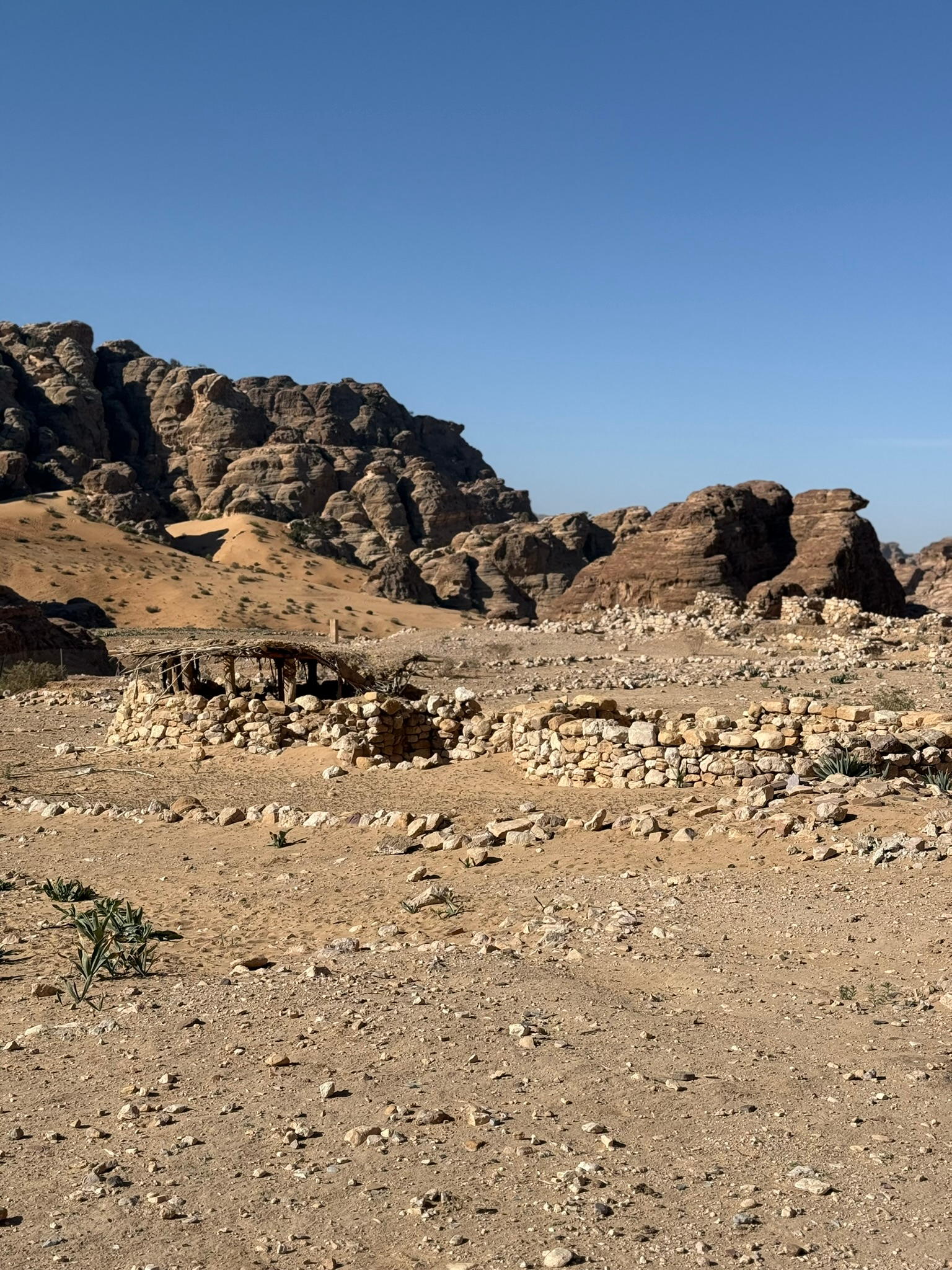
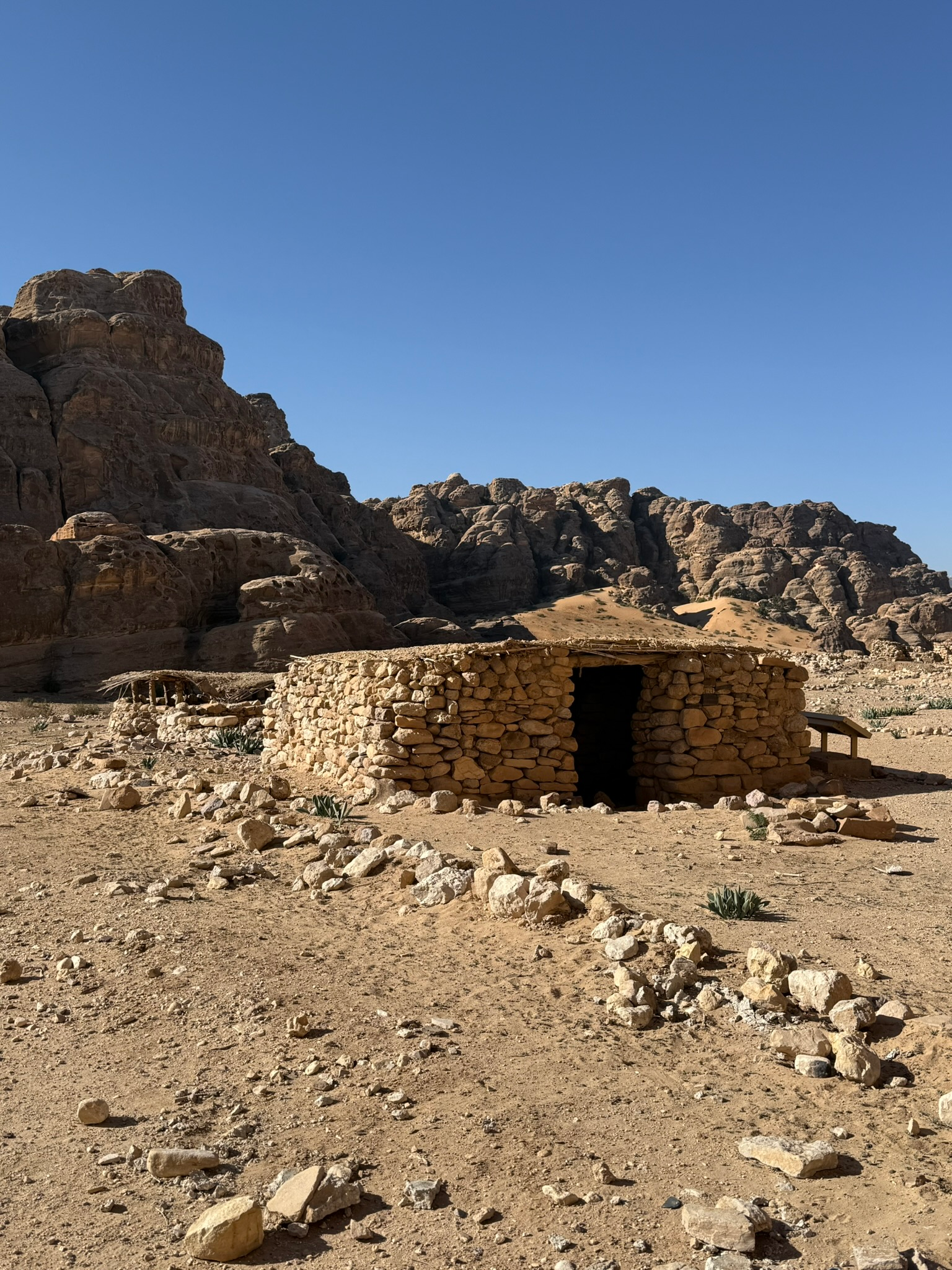
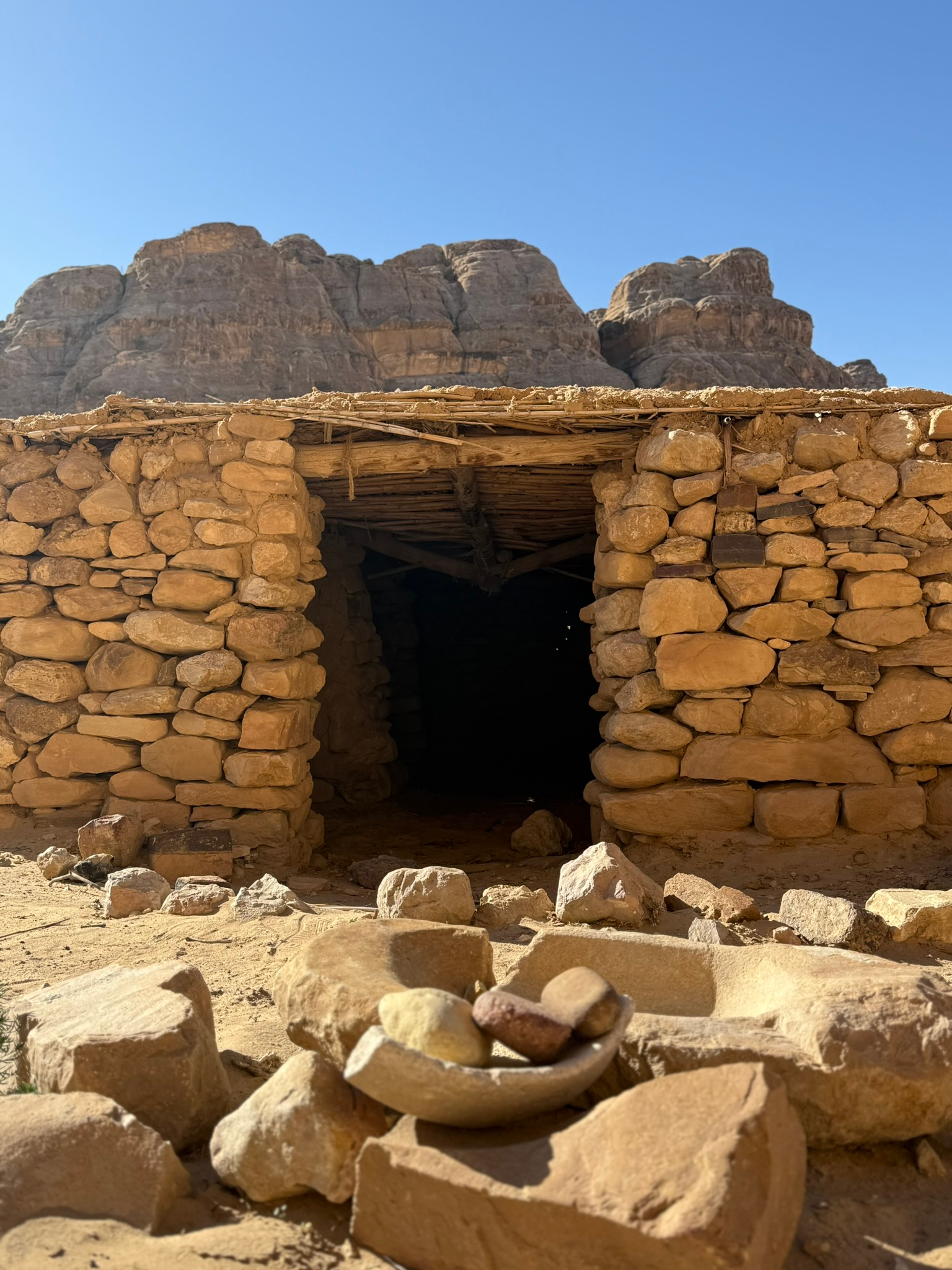
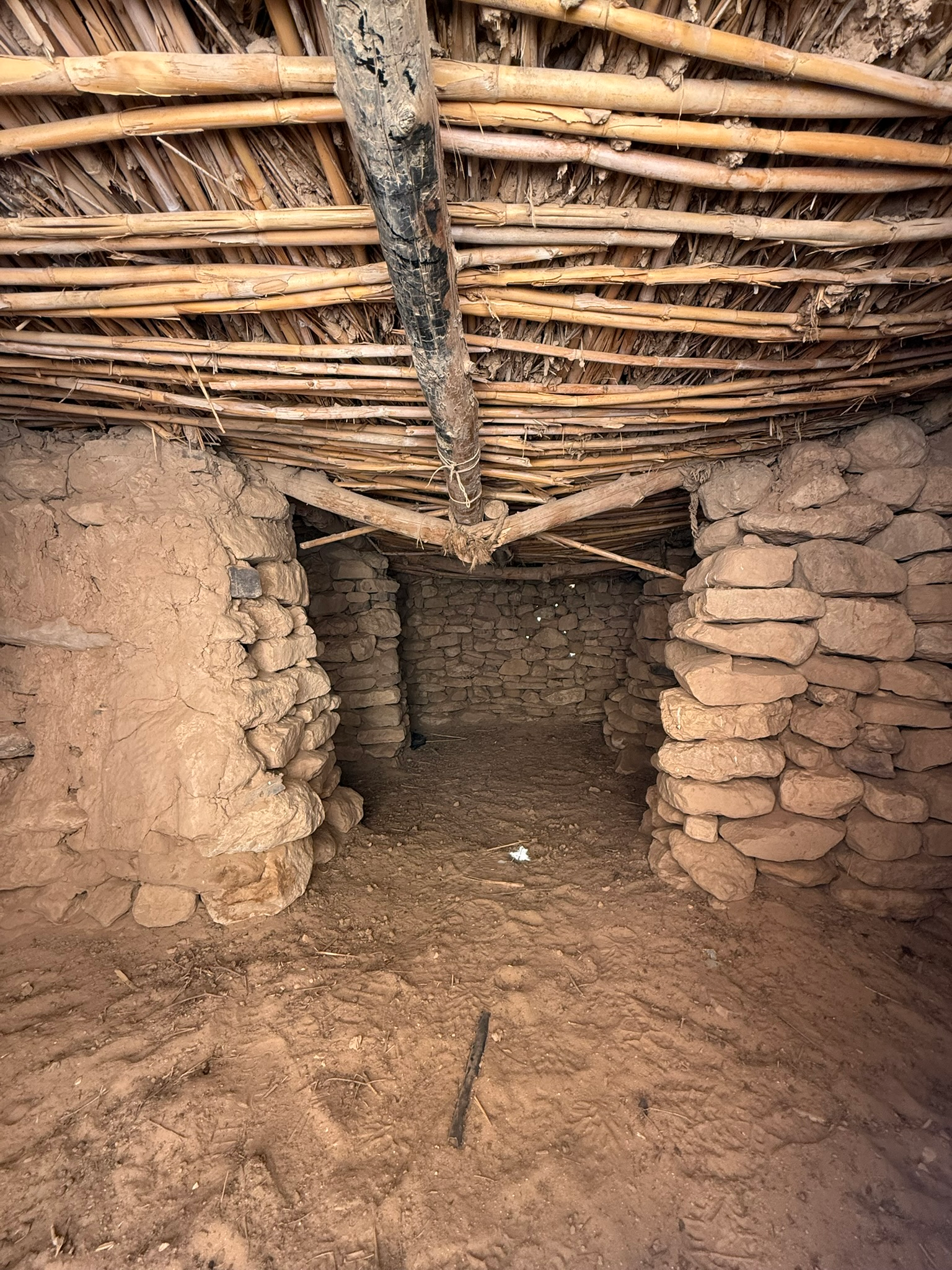
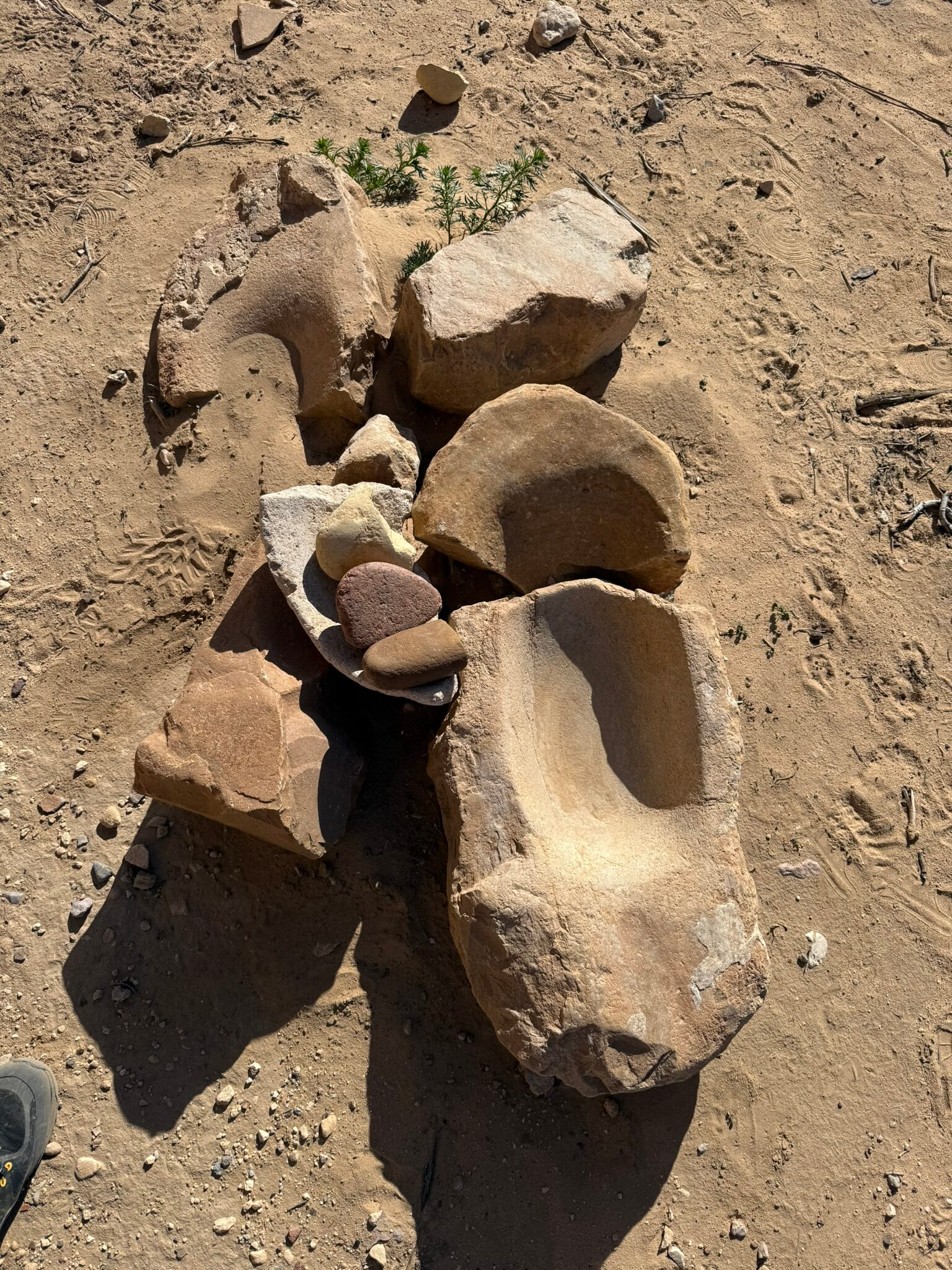
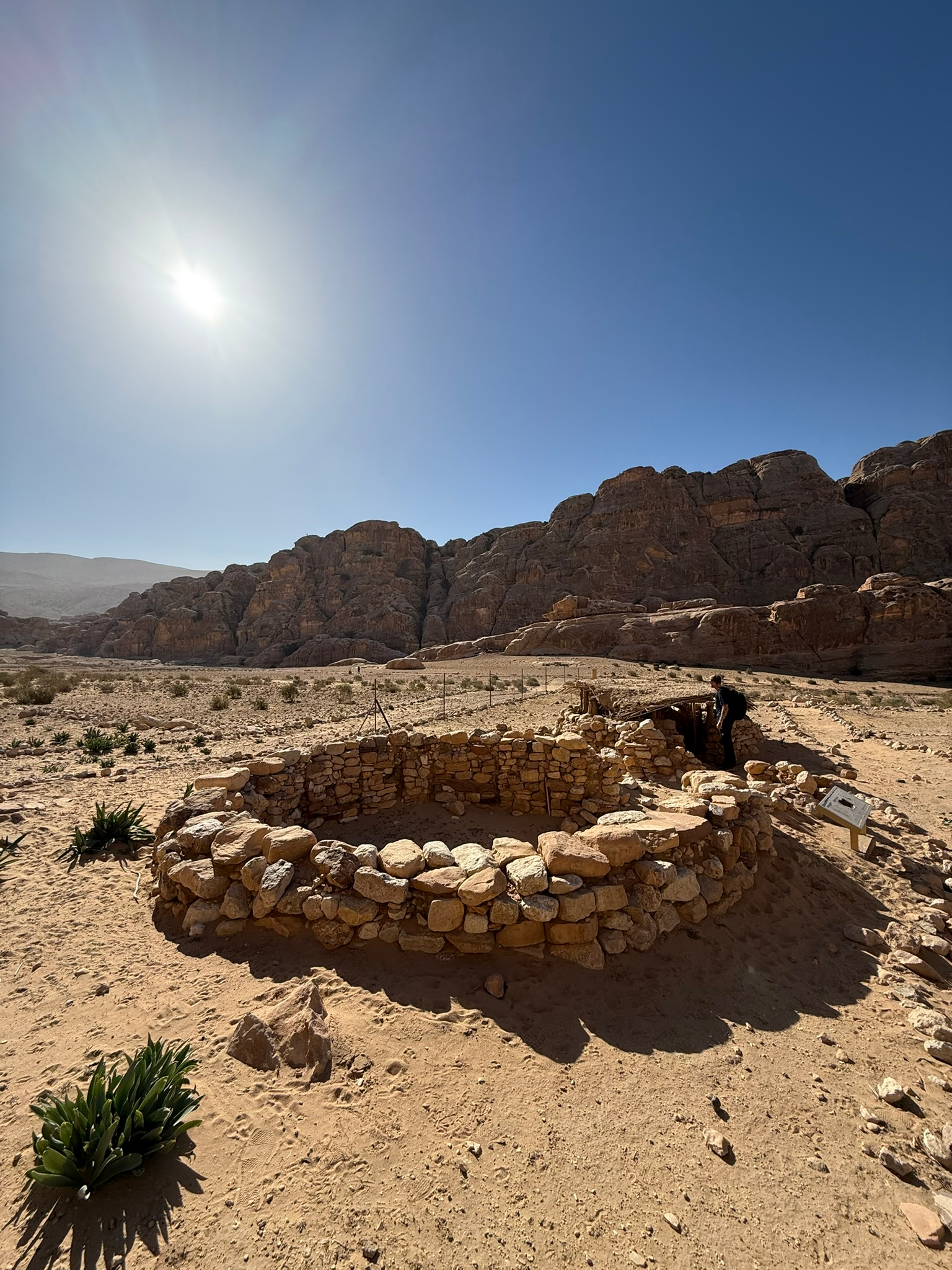
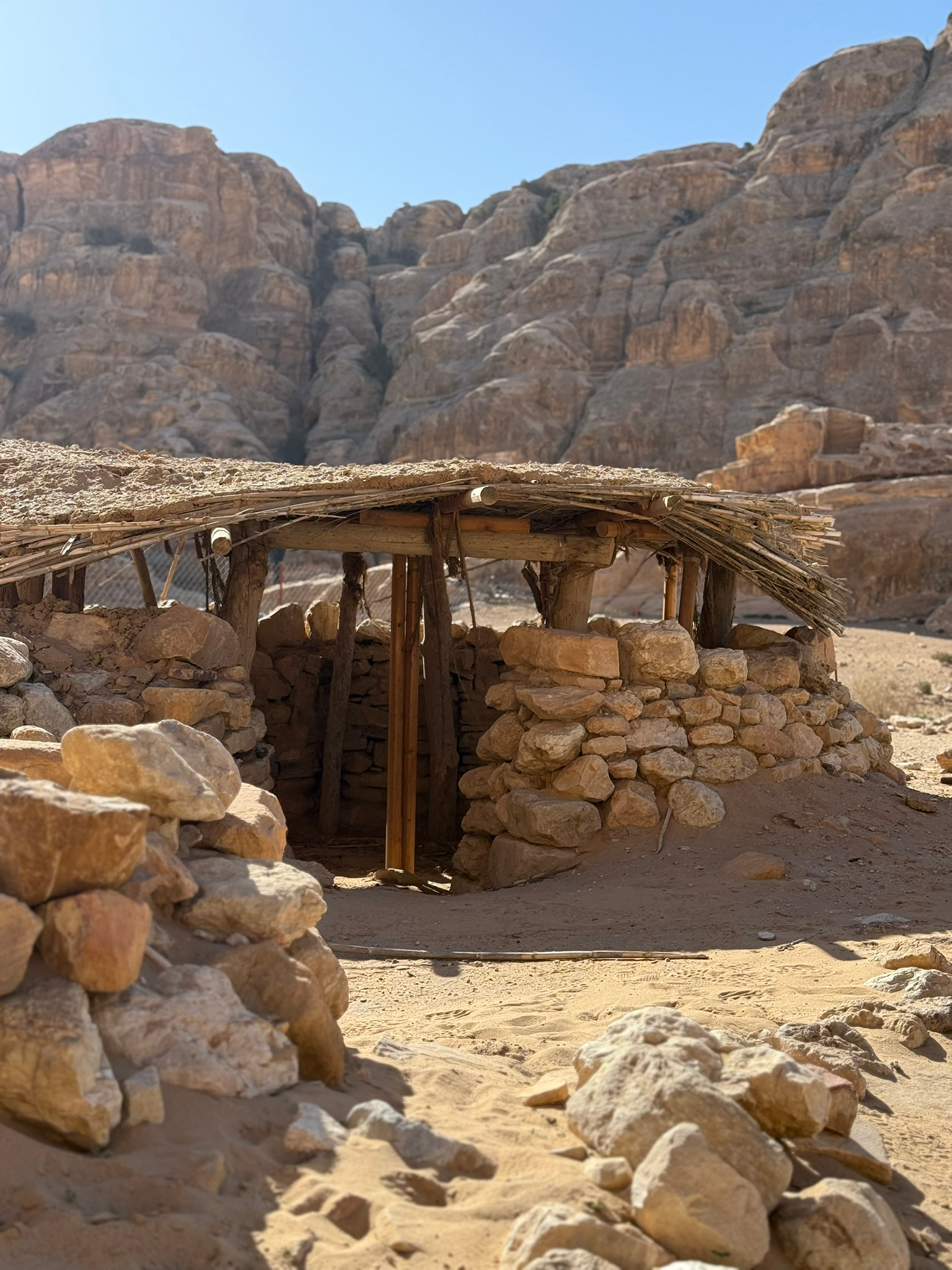
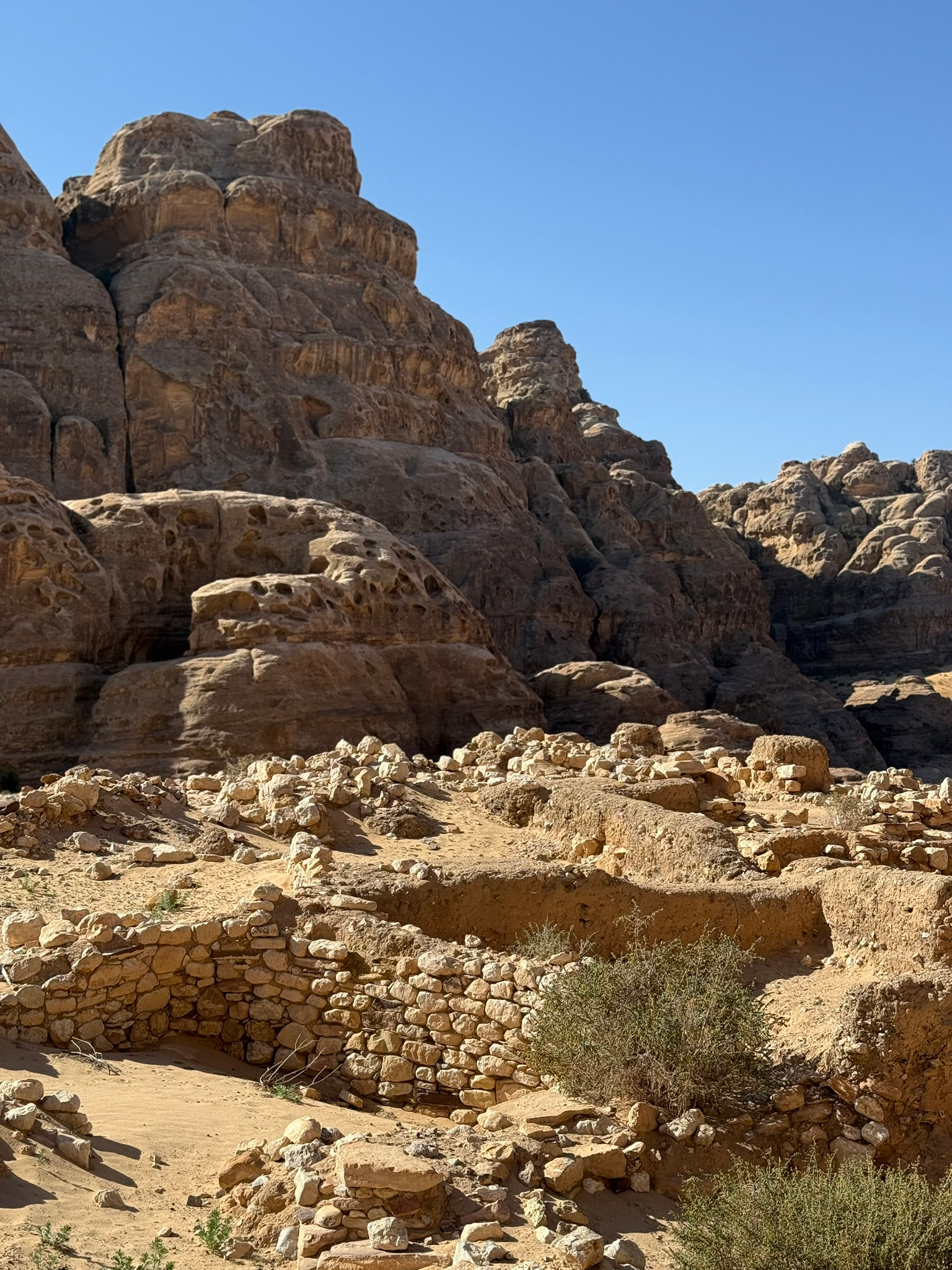
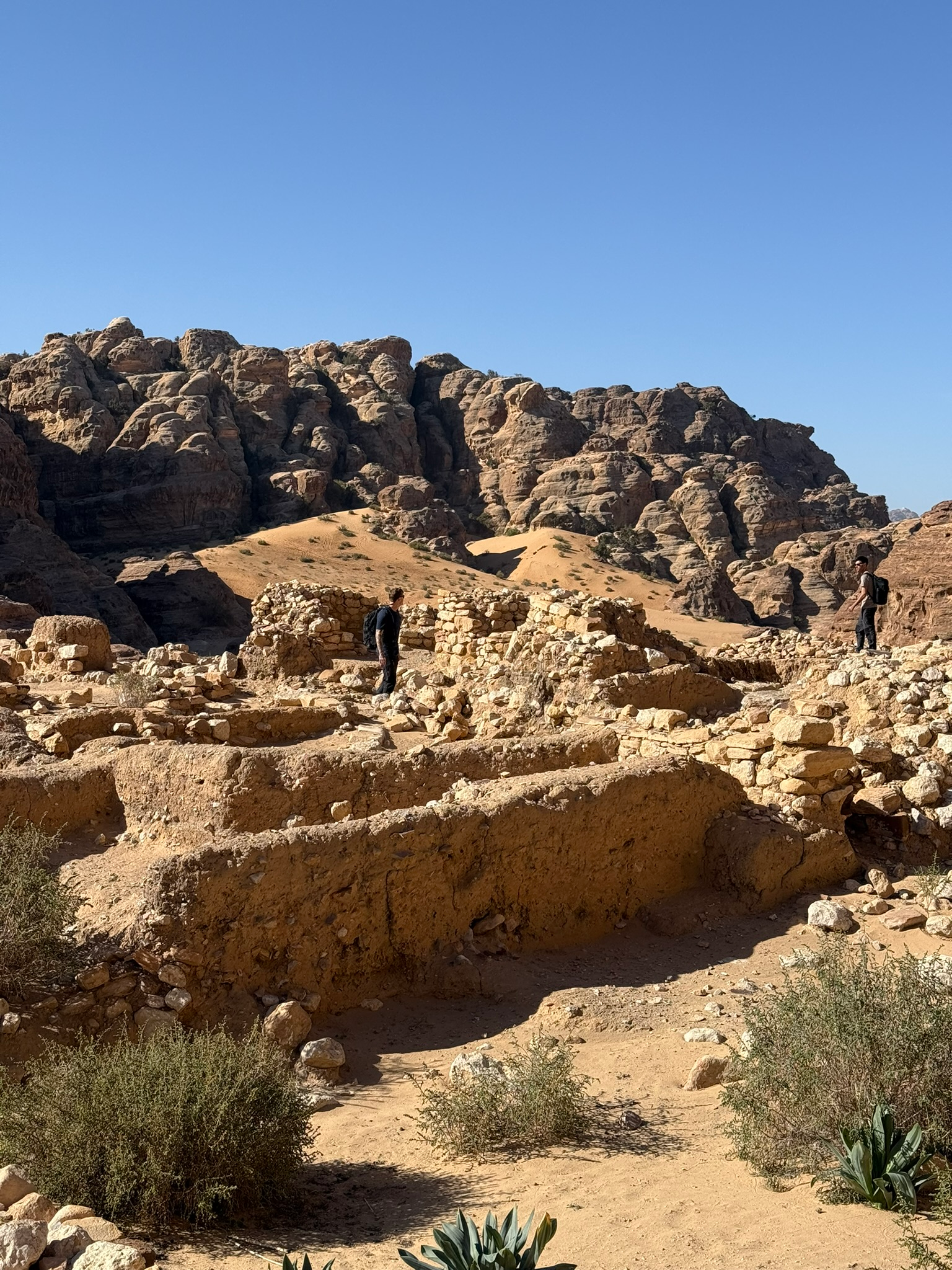
The settlement, Delia explained, was occupied during different phases of the early Neolithic period, broadly between around 8500 and 5500 BC. It offers valuable insight into the gradual transition from mobile hunter-gatherer communities towards permanent village life, agriculture and animal domestication. Although little of the original village remains standing above ground, reconstructed buildings demonstrate how its architecture changed over time. Earlier residents lived in small, circular or rounded houses built from stone and mud, often with central hearths. These were gradually replaced by larger, more rectangular structures divided into several rooms and storage areas.
Seeing those changes laid out in front of us made it easier to imagine just how revolutionary permanent settlement must have been. These people were not merely building bigger houses. They were completely transforming how human beings lived, stored food and organised themselves as communities.
The Old Caravan Road
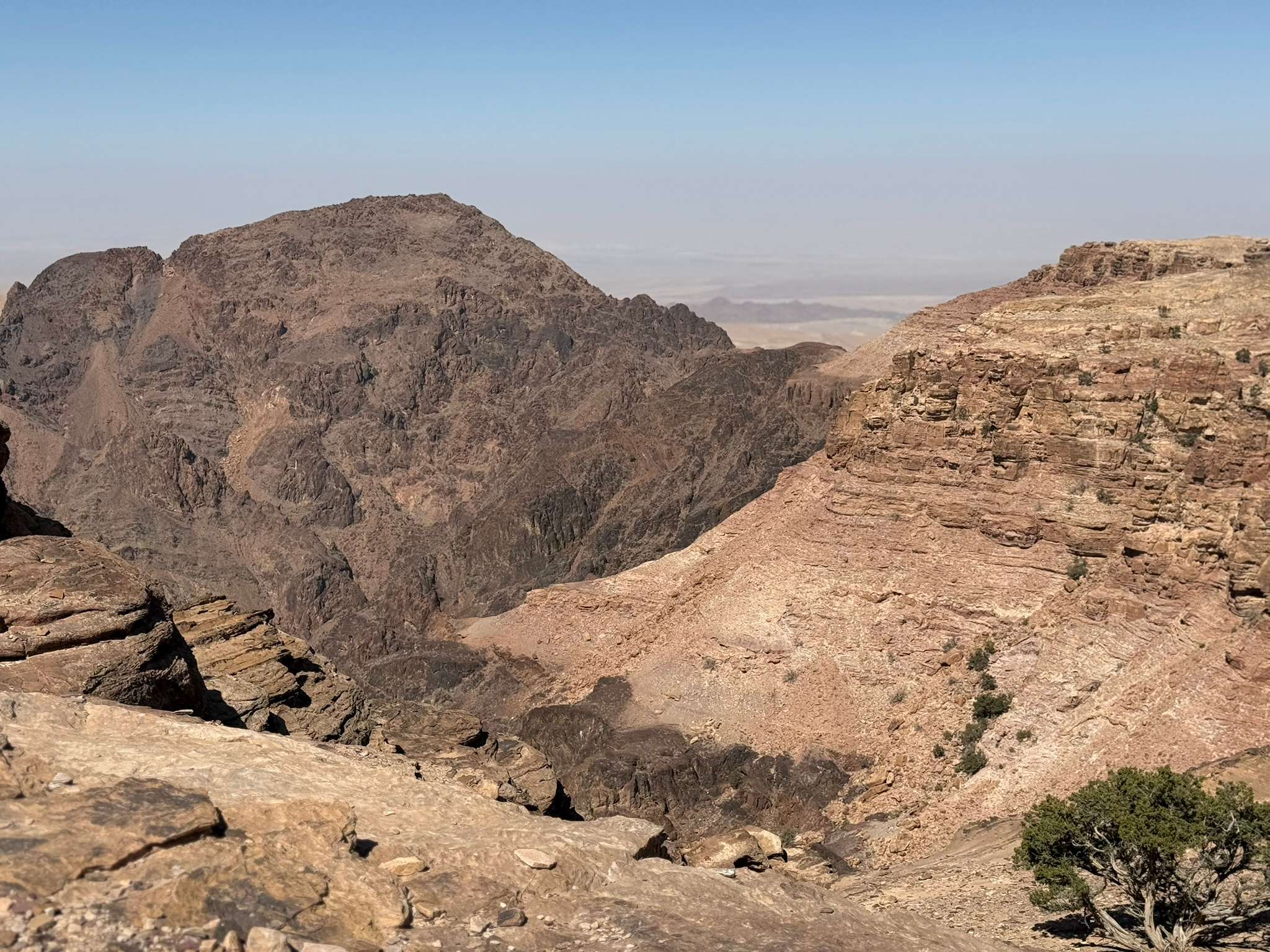
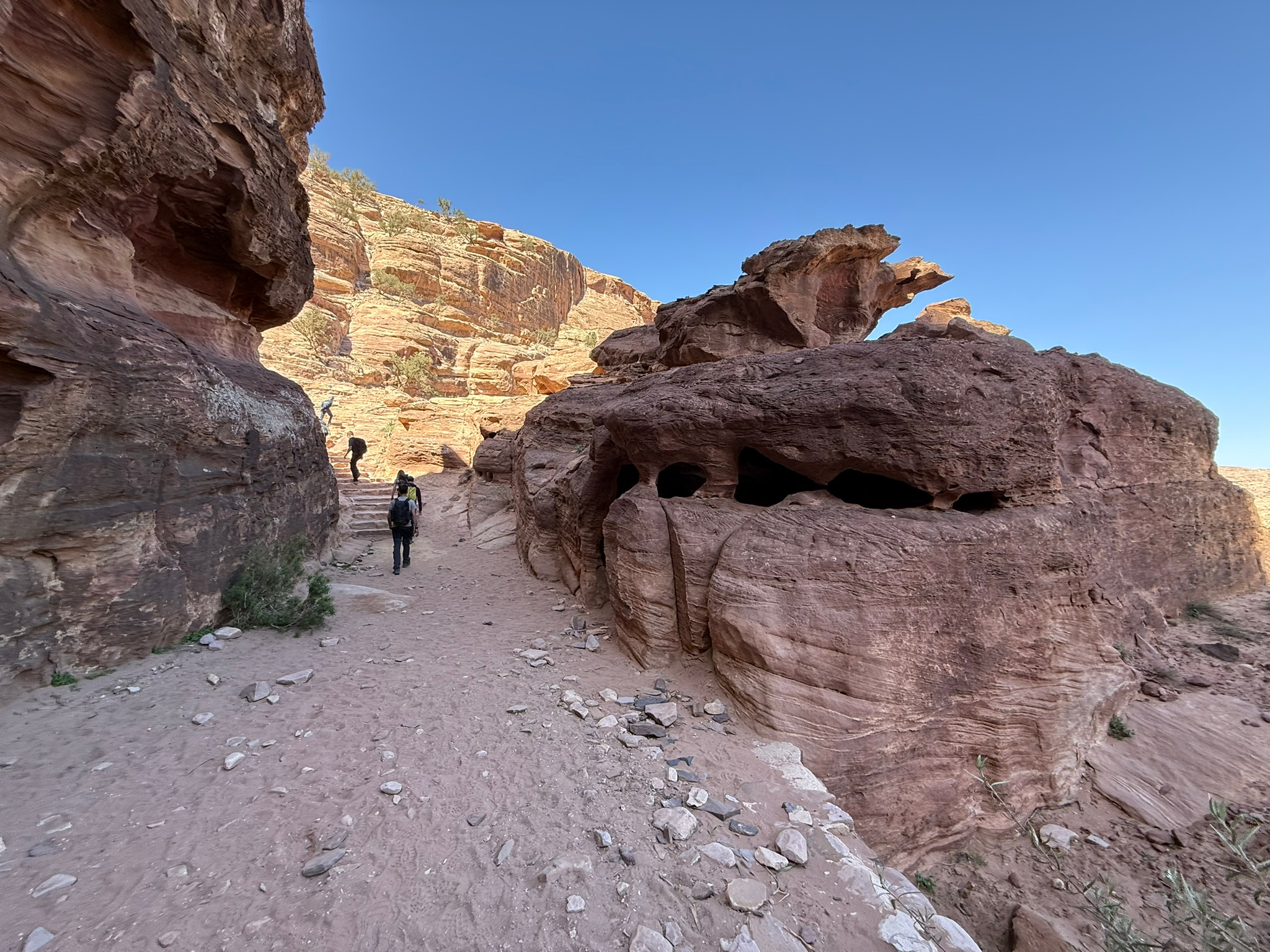
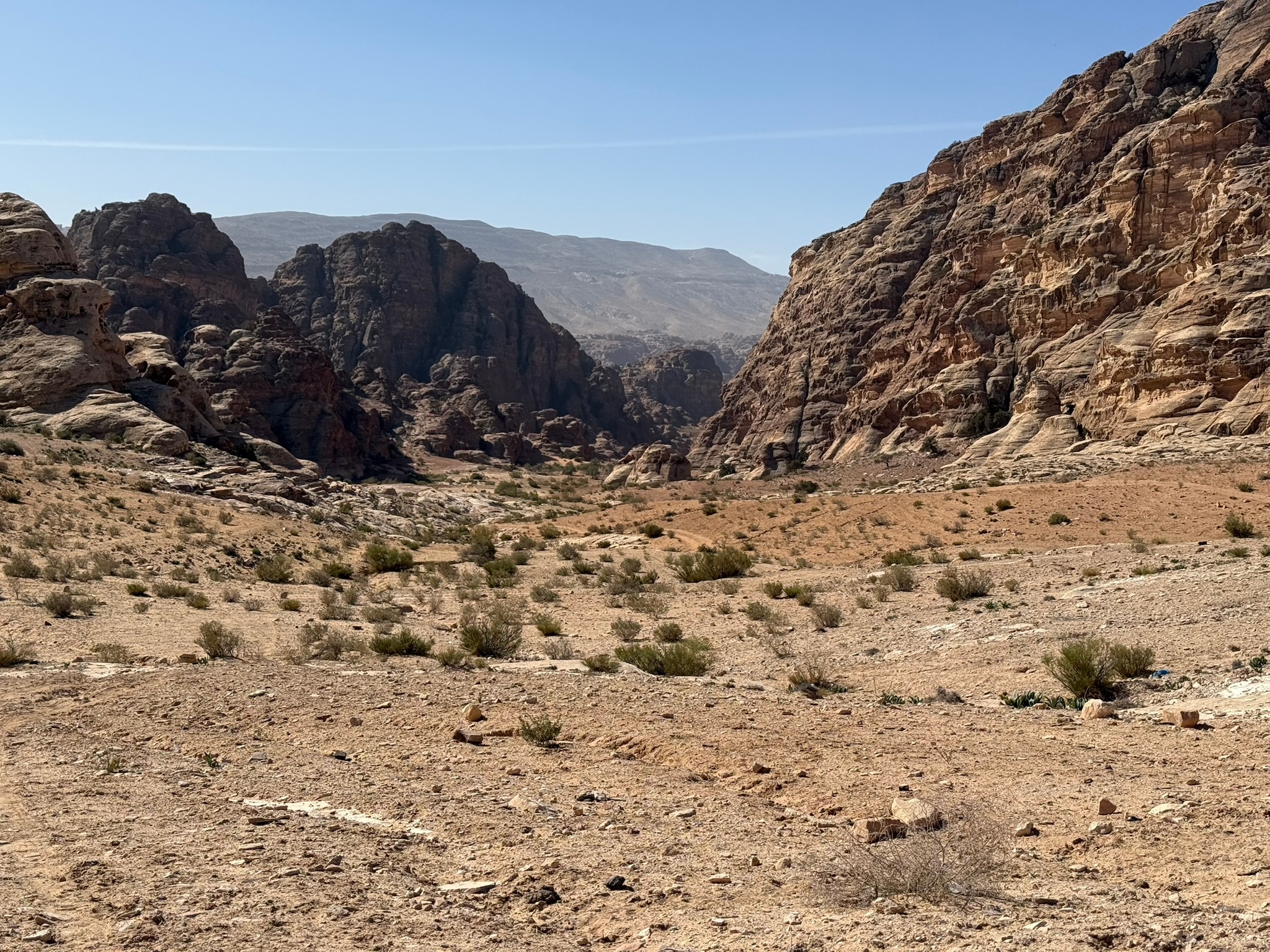
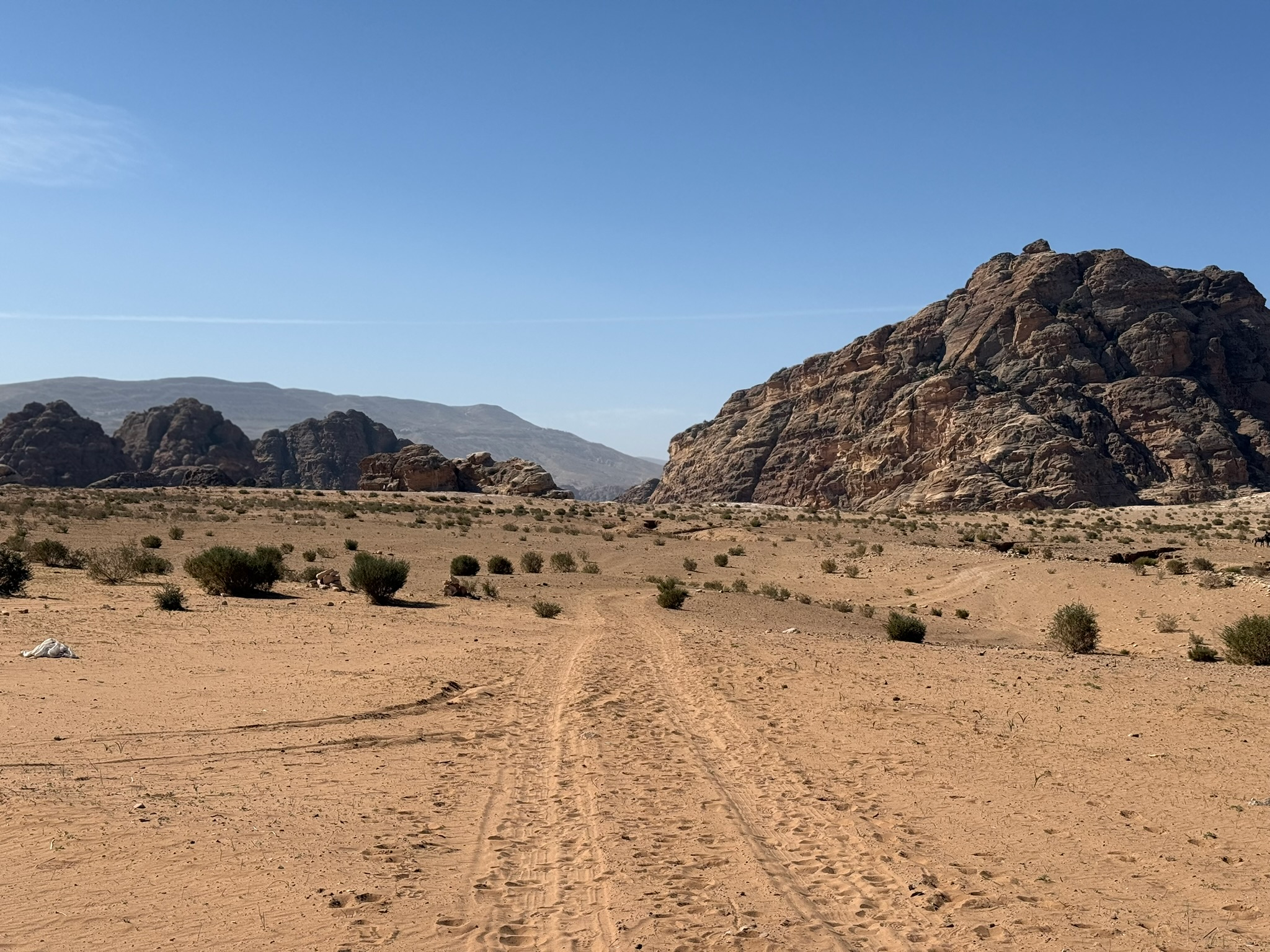
Surrounded by towering sandstone mountains, we followed the trail through Wadi Ghurab and into the rugged terrain separating Little Petra from the main city.
Surrounded by sandstone mountains, a trail led us down Wadi Ghurab via part of the Silk Road – a historically important trading route that connected Asia, Africa, and Europe. From that point onwards, we were definitely no longer alone. We collected several lost strangers along the way, together with a random child whom Delia seemed to know, and found ourselves repeatedly refusing offers of horse rides towards Petra. Imagine walking around 80 kilometres only to give up at the very end!
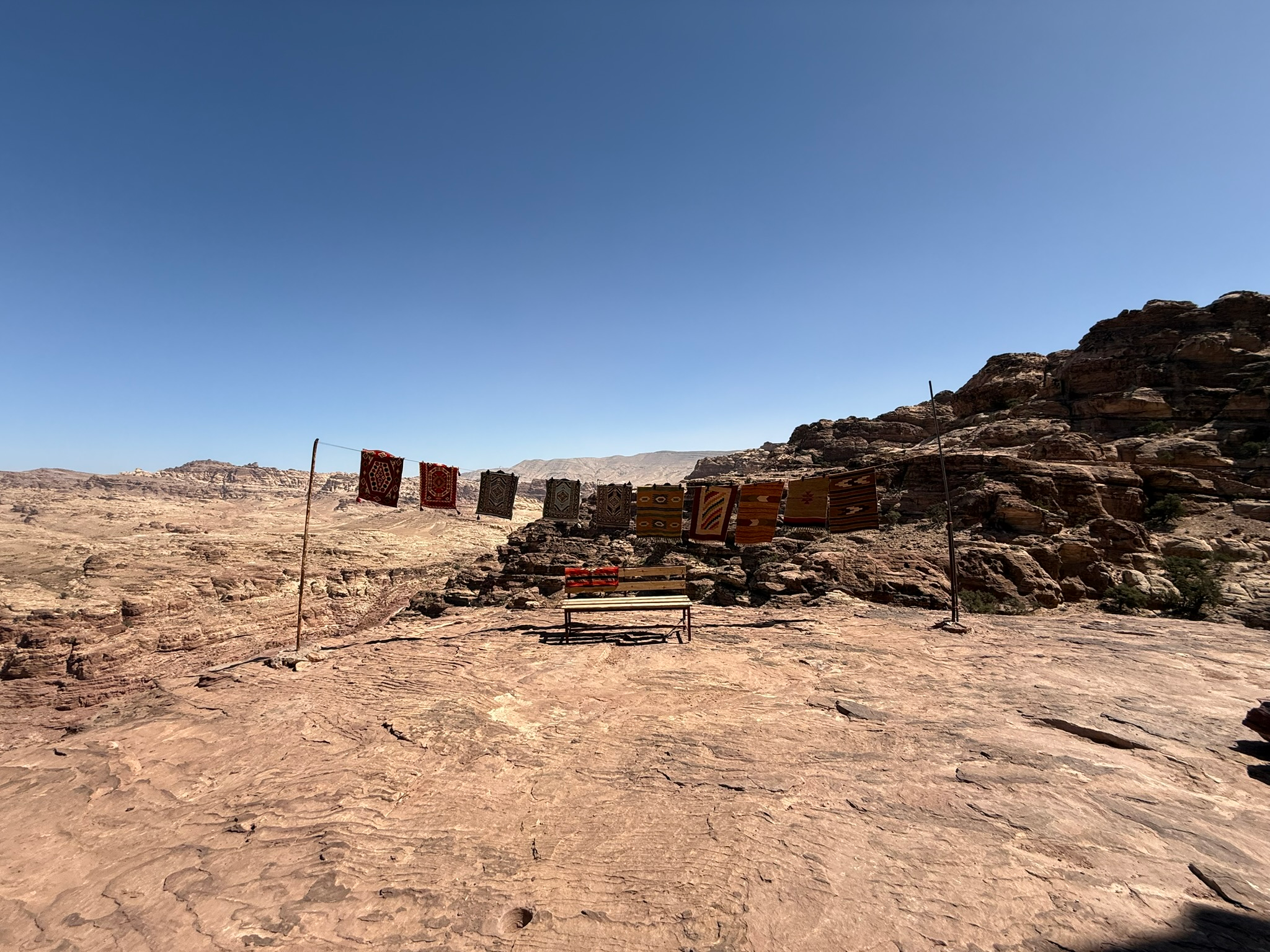
And so, we walked on. Eventually, we reached an old Nabataean route climbing out of the valley and curving around the final mountain we would have to cross. Parts of the natural rock terrace had been reinforced and improved to make the path safer and smoother – something we didn’t exactly need.
The Big Picture
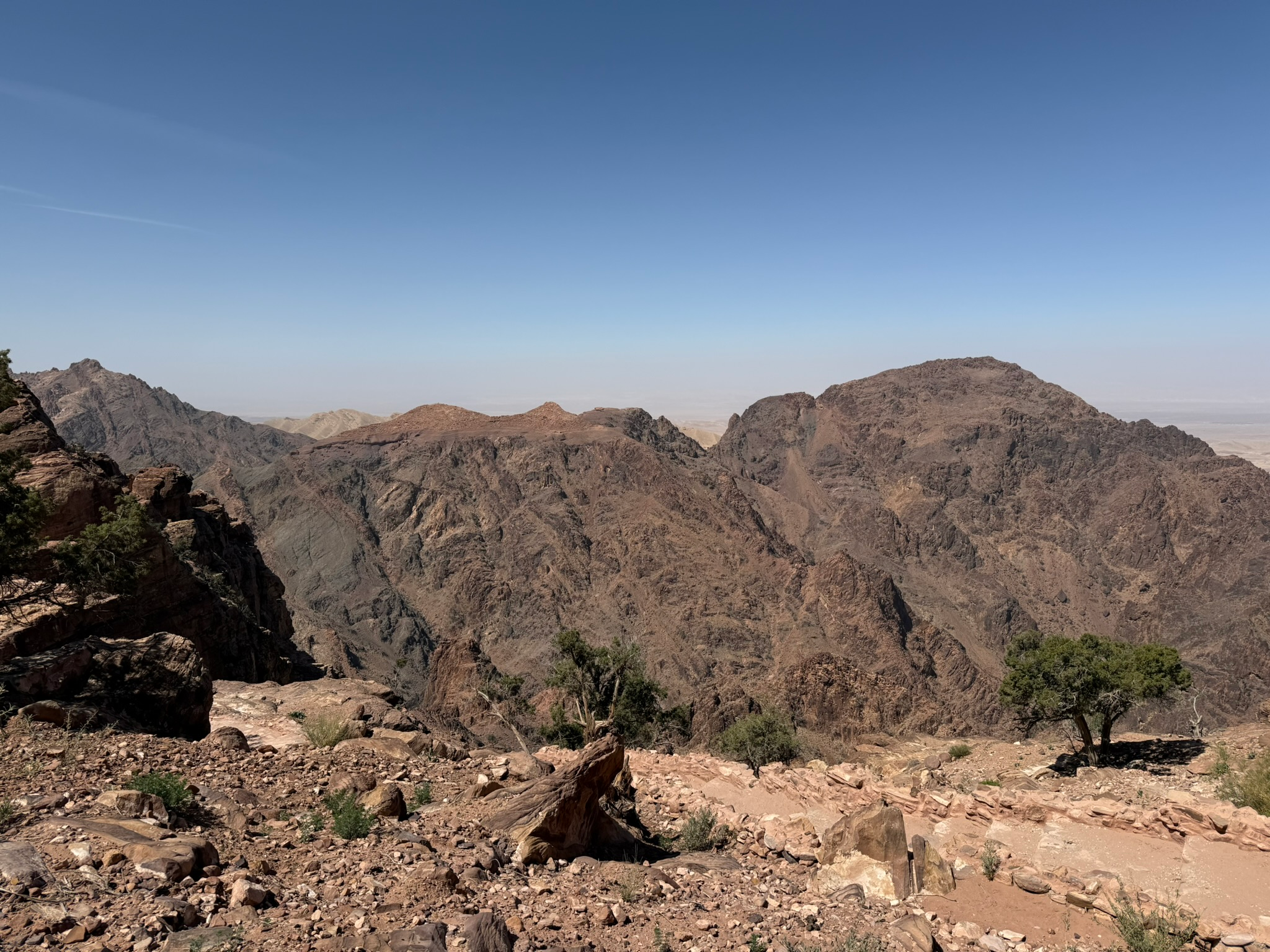
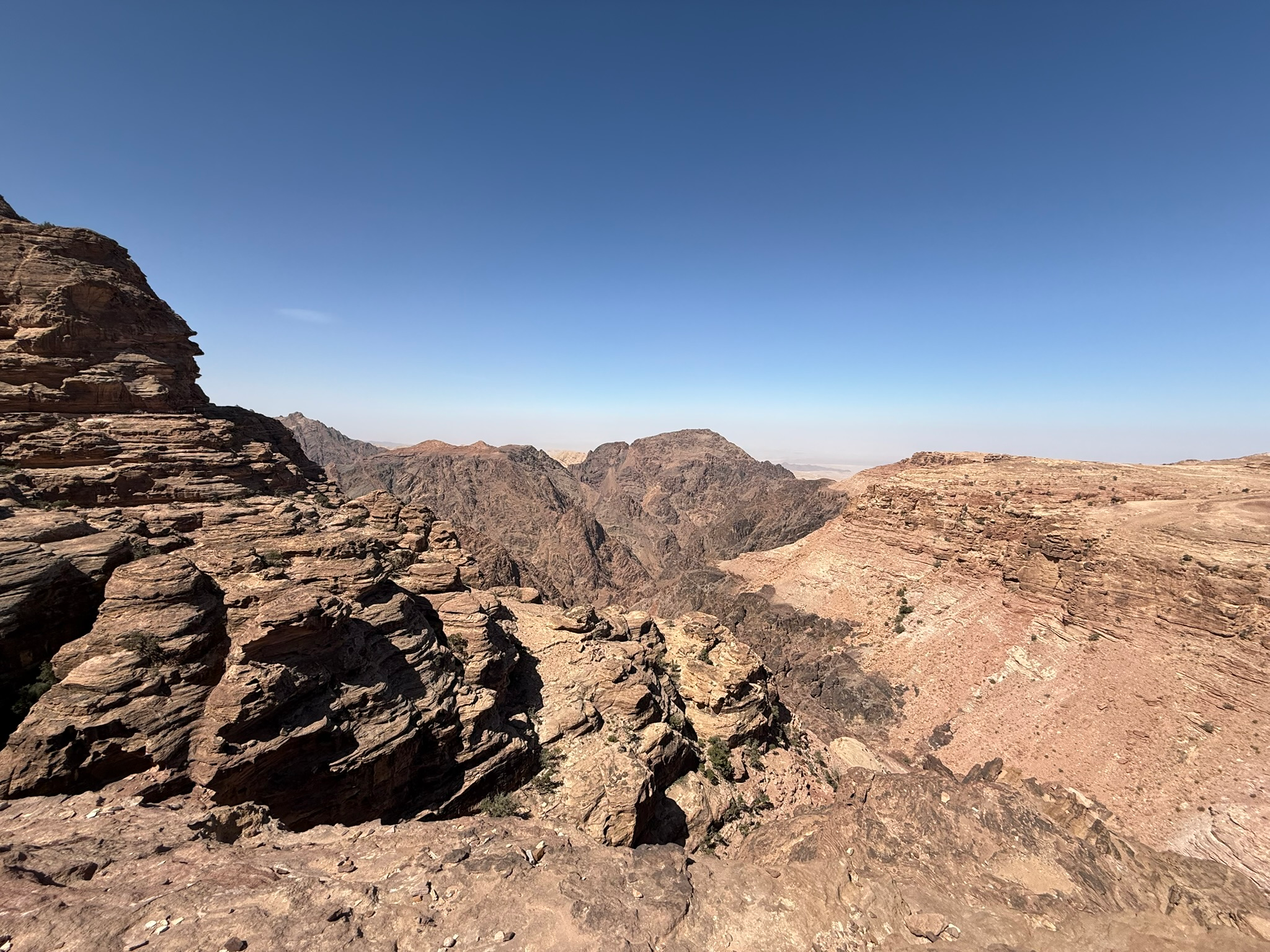
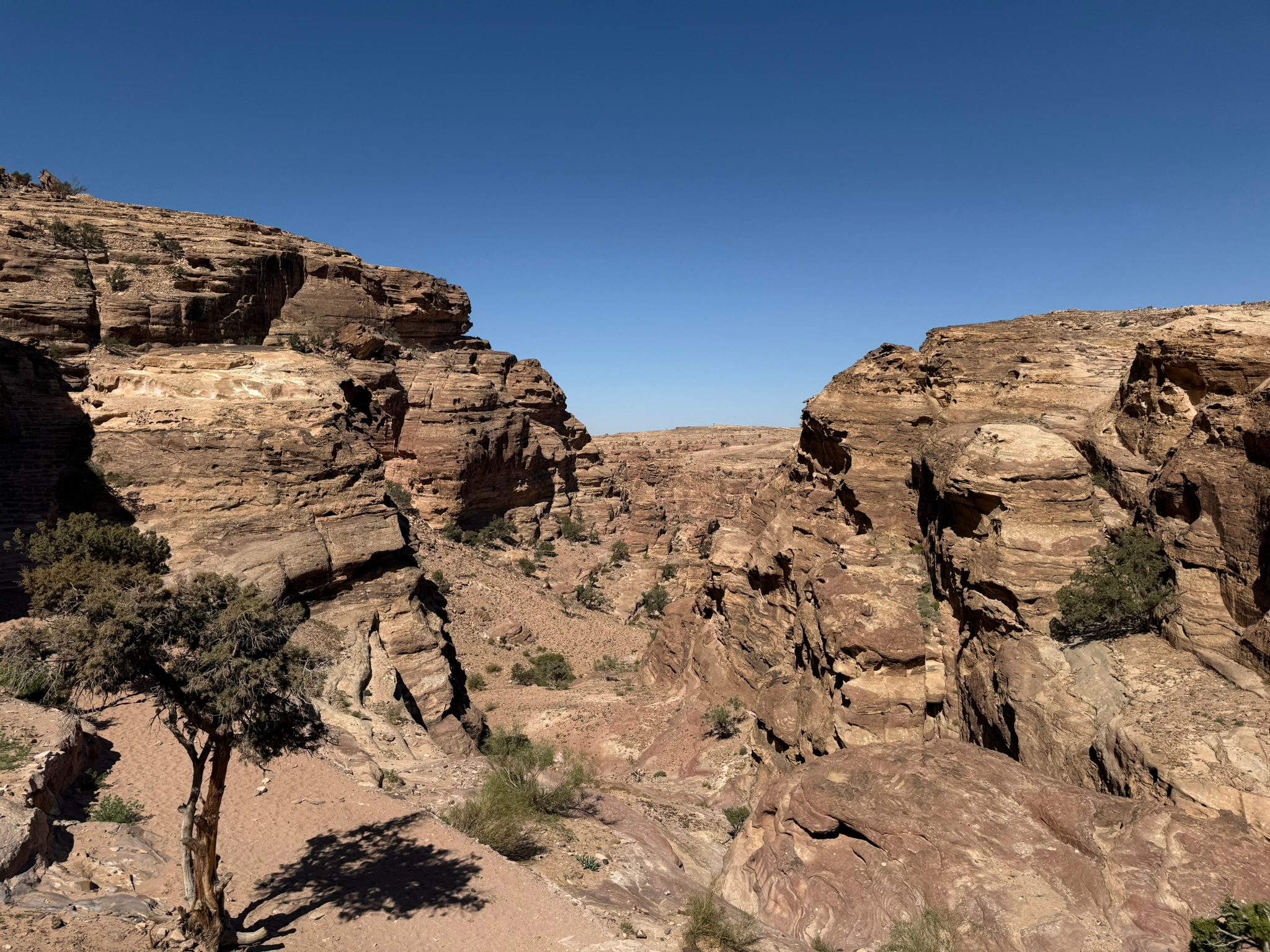
The trail then gradually narrowed before emerging onto a hidden plateau high above the impressive chasm of Wadi as-Siyyagh. Just beyond it, Delia stopped and asked us to stare into the distance.
‘Can you see it?’ she asked, after a few minutes of staring blankly into space. Forever hyper-focusing on the smallest details and missing the big picture directly in front of me, I began meticulously inspecting the surrounding rock formations. While trying to identify some obscure geological marvel, I somehow completely overlooked the well-camoflauged yet enormous portico of the friggin’ Monastery. The moment it finally registered, I had to stop, take a deep breath and compose myself.

This was it. This was what we had worked so hard for. We had finally arrived at Petra through the back entrance. I was so proud of us. It might not have been the most difficult trek I had ever completed, but still, not just anyone can do these things. I had to take a moment to appreciate what my body had allowed me to accomplish.
I was grateful for being able to power through inclines that would once have killed me, for being able to continue despite the blisters covering my feet and for enduring the scorching sun against my burnt skin. Then there were Rafael’s bad knees and Hans’ bad back. Can’t forget them either!
PART II
The Rose City
We had finally made it to Petra, the Rose City. Before actually stepping any further, Delia took us under the shade of a tree and gave us a bit of an introduction to the splendour we were just about to witness.
Known to the Nabataeans as Raqmu, Petra had been inhabited long before their arrival, but it was they who transformed it into a major caravan city from around the fourth century BC. By the second century BC, it had become the political and religious centre of their kingdom, later flourishing as a major trading hub at the crossroads between Arabia, Egypt and the Levant. Its wealth was closely tied to the wider incense and spice routes that carried frankincense, myrrh and other luxury goods from southern Arabia towards the Mediterranean. At its peak, Petra may have supported a population of around 20,000 inhabitants. The Nabataeans were masters of agriculture, architecture and engineering, particularly when it came to water conservation – no small achievement when you have decided to make the desert your home.
In AD 106, the Roman Empire annexed the Nabataean Kingdom under Emperor Trajan and incorporated it into the newly established province of Arabia Petraea. Petra did not simply collapse overnight. Changes in regional trade gradually weakened its importance, while a major earthquake in AD 363 caused extensive damage. The city remained inhabited during the Byzantine period, when several churches were constructed, and continued on a smaller scale for centuries afterwards. Although local Bedouin communities never forgot it, Petra returned to widespread European attention in 1812 when the Swiss traveller Johann Ludwig Burckhardt deliberately sought out the ruins while travelling in disguise – rather than merely stumbling across them.
The Monastery
The few minutes it took for us to reach the Monastery were practically a blur. I remember passing a few tombs and façades etched into the mountainsides along the way, but little more than that – I was too excited to memorise any details!
In fact, it was all I could do not to cry the second we came face-to-face with the impressive Monastery. Also known as Ad-Deir, it has one of the largest façades in all of Petra, measuring roughly 47 metres across and 48 metres high. Carved directly into the rock during the early second century AD, it was probably used for religious gatherings, ritual meals or ceremonies associated with the Nabataean king Obodas I. It was later reused as a Christian chapel, which is how it acquired the name Monastery.
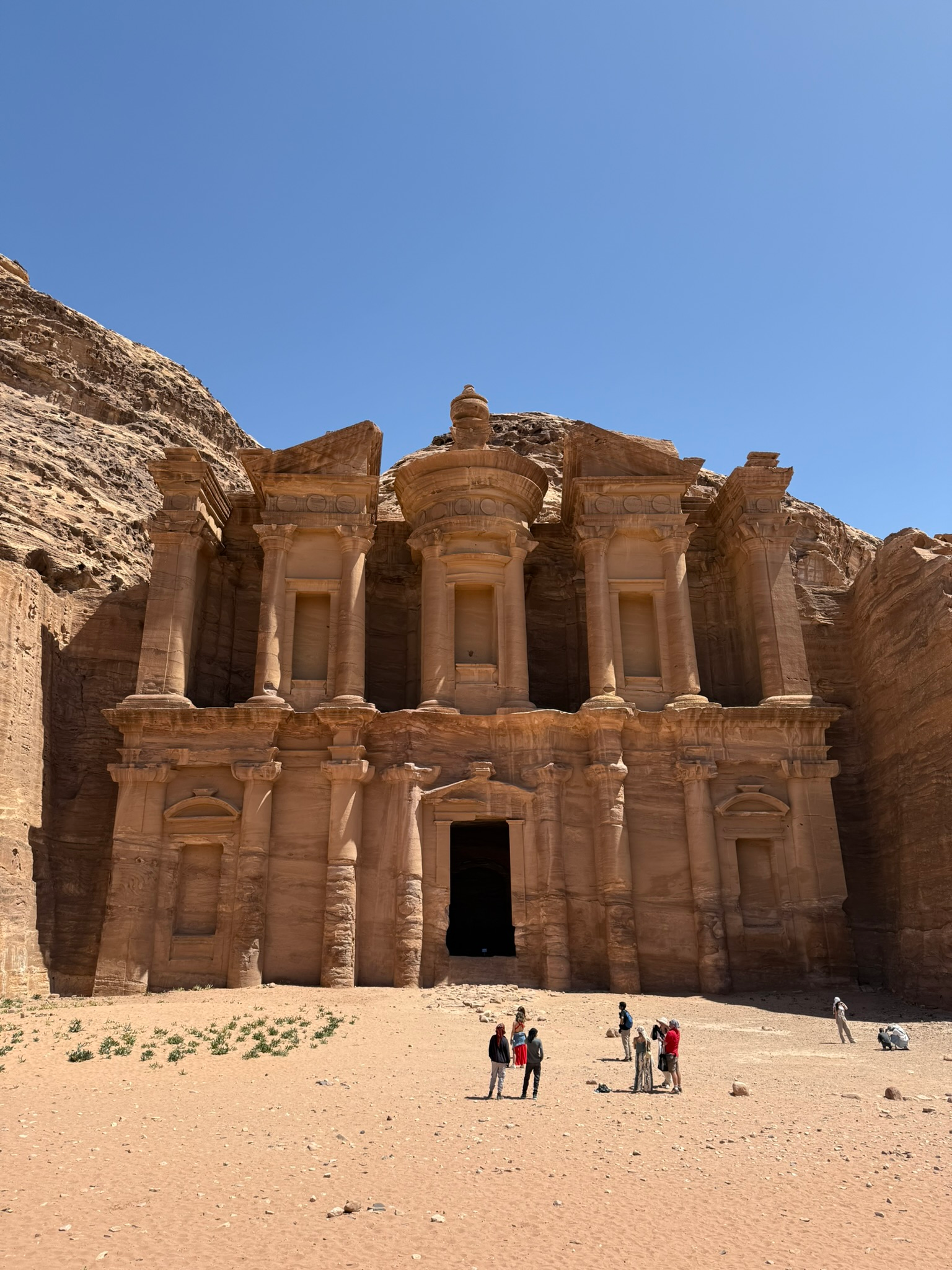
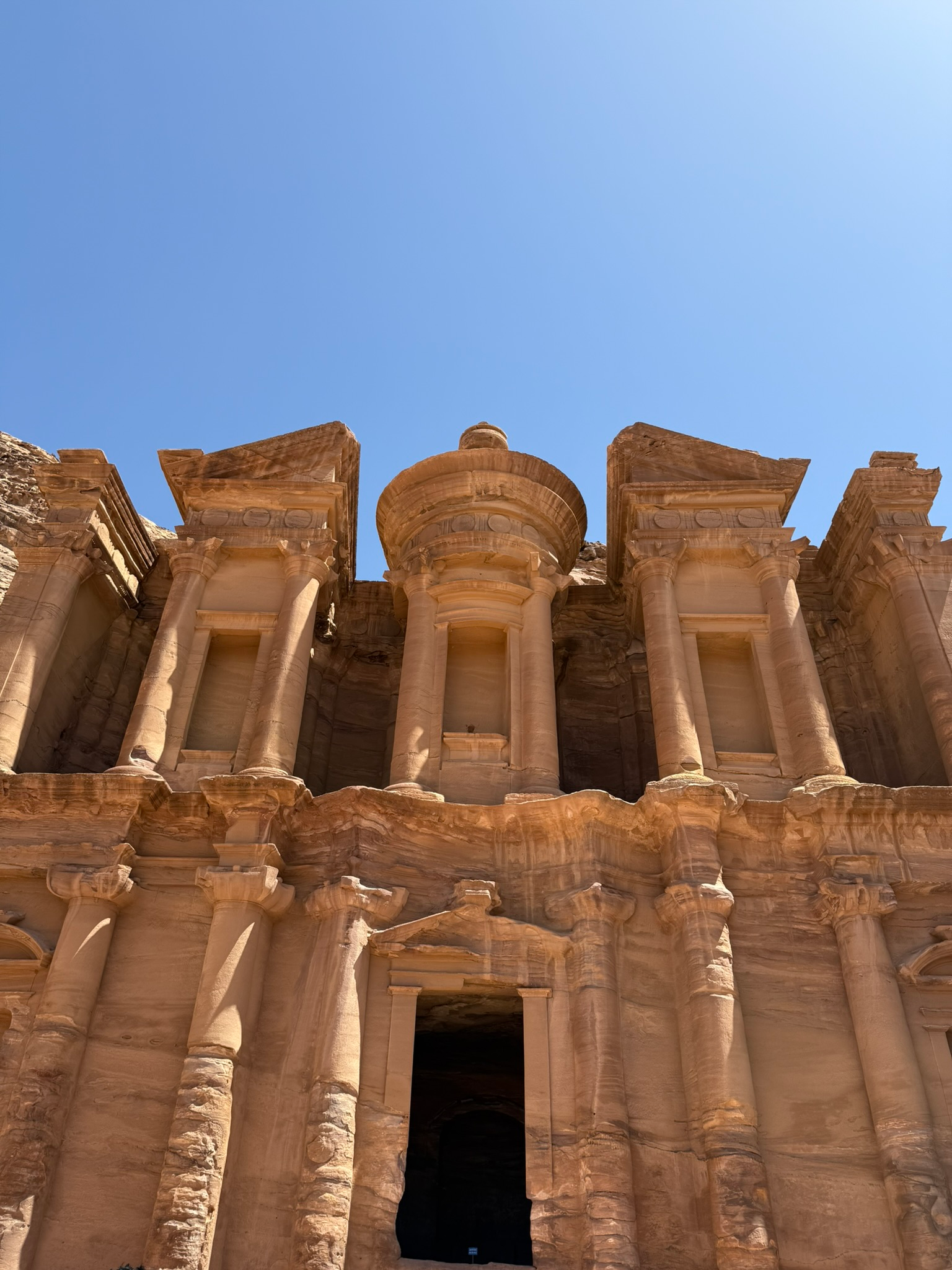
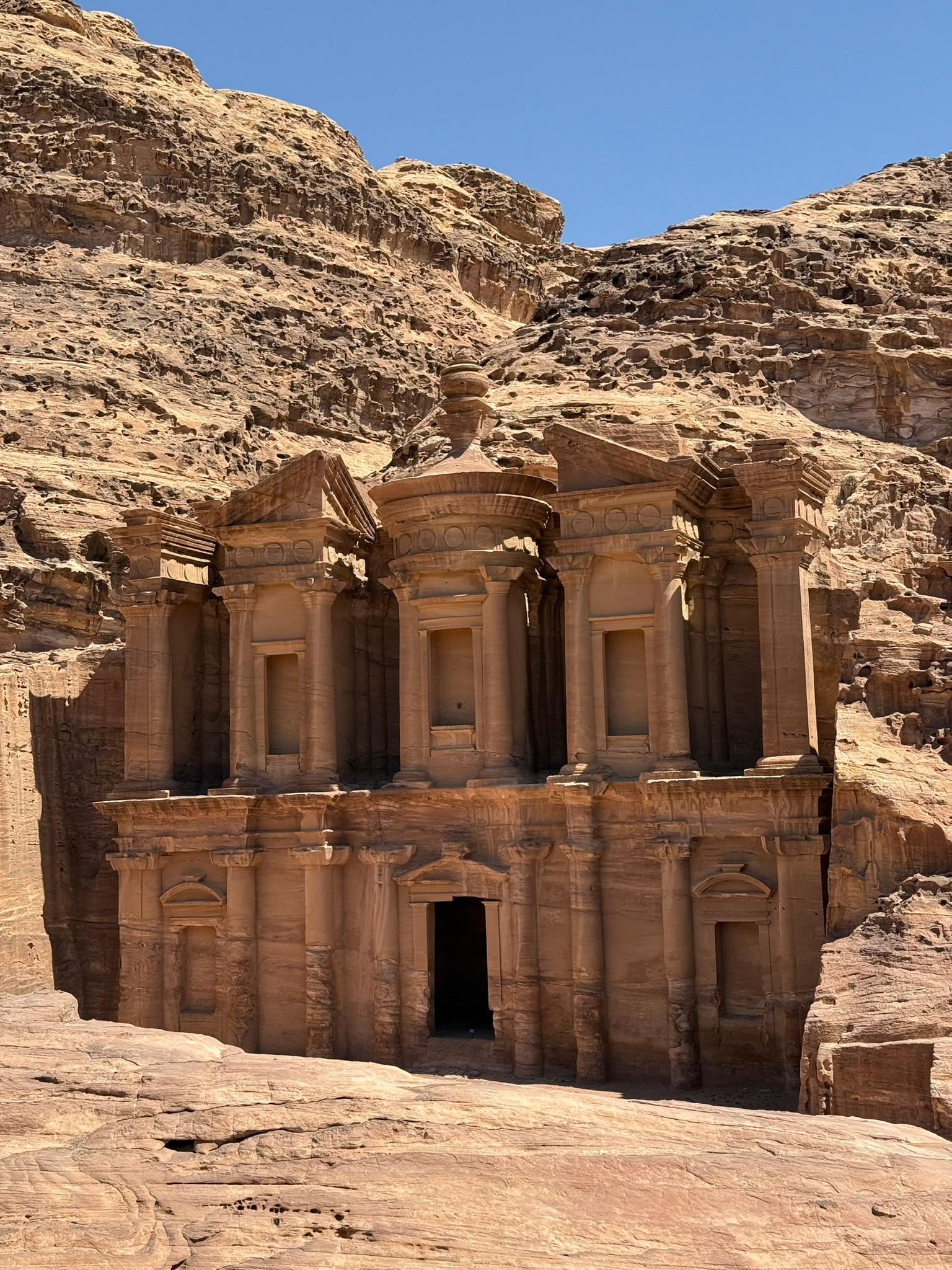
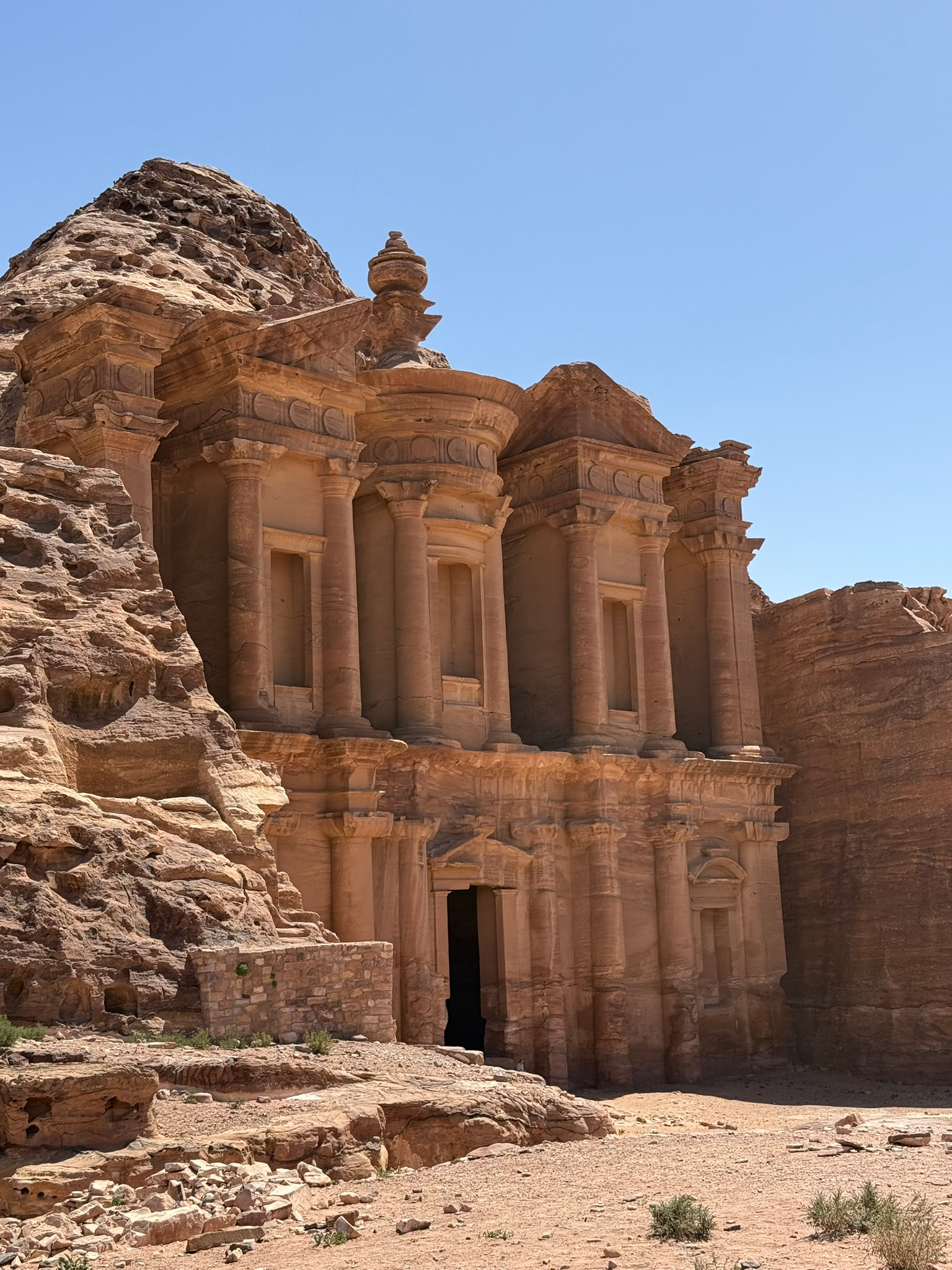
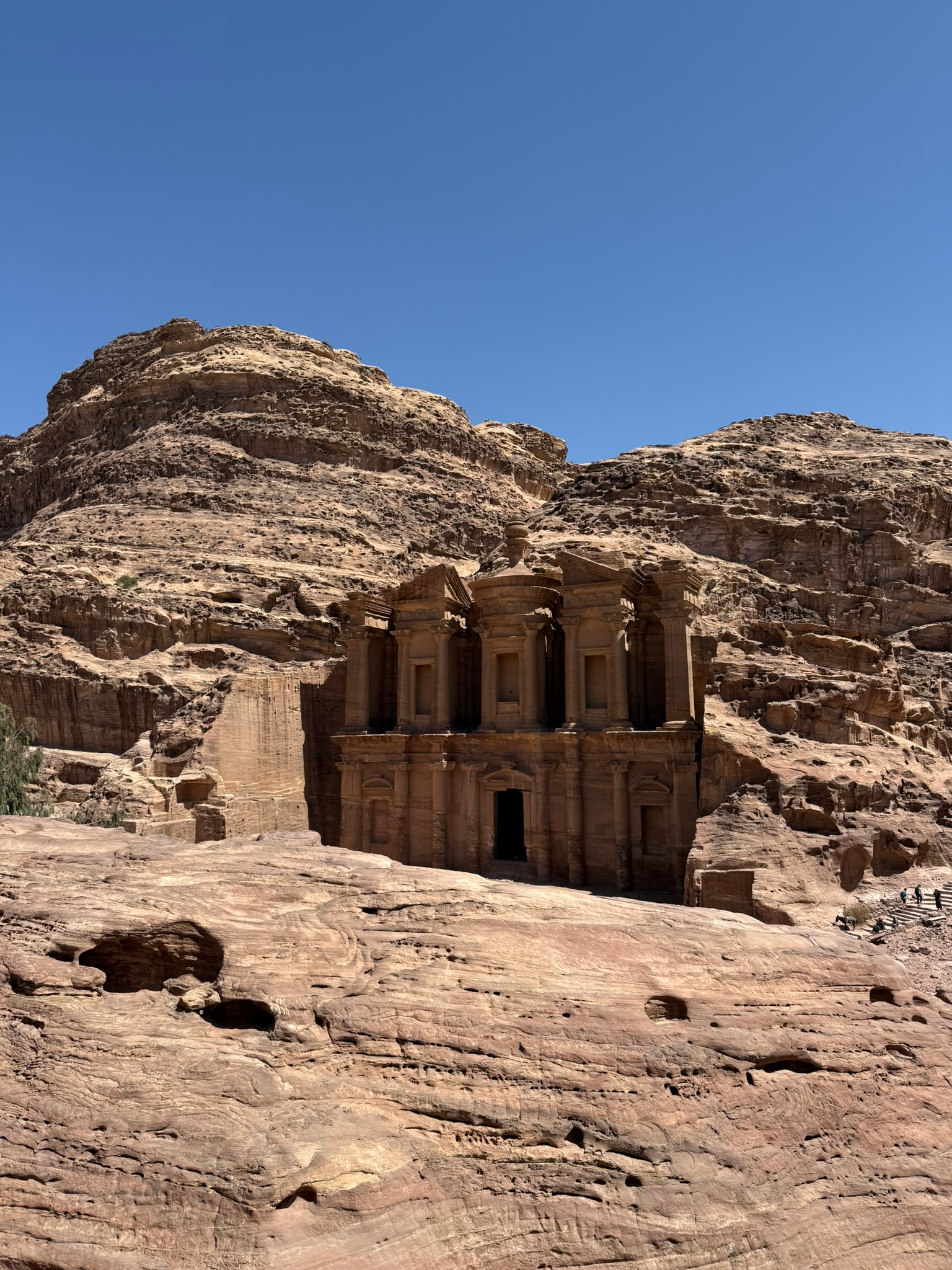
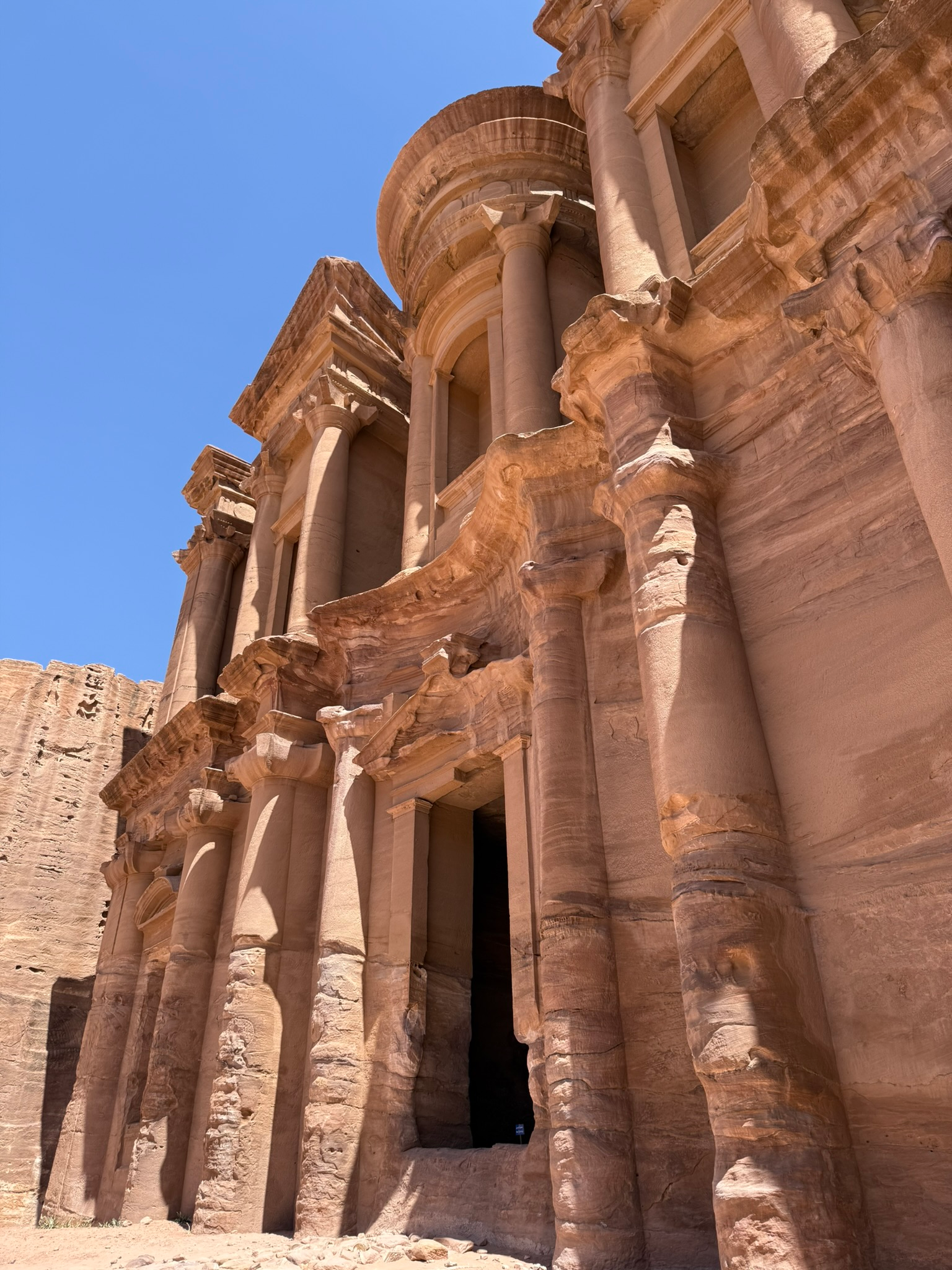
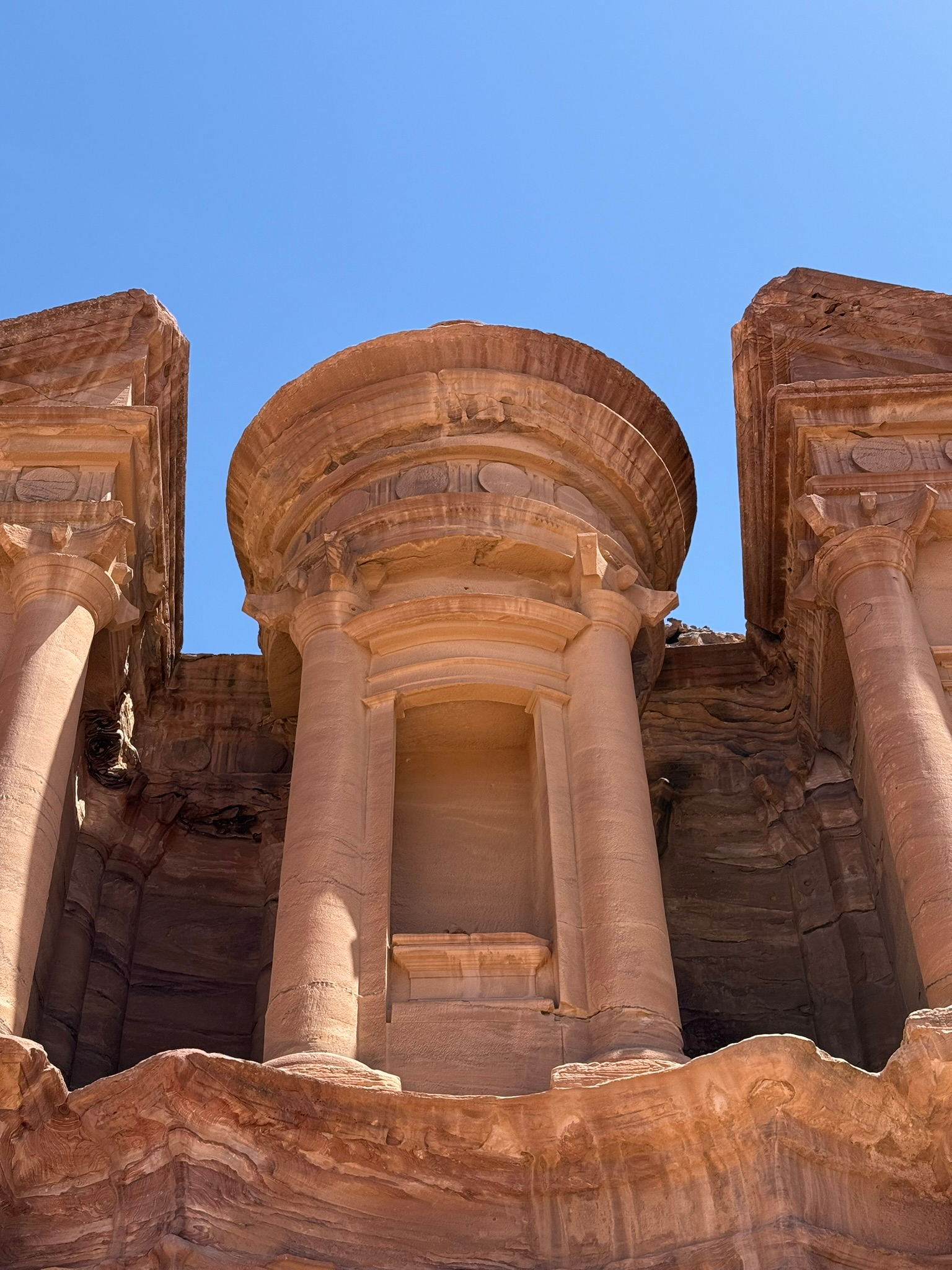
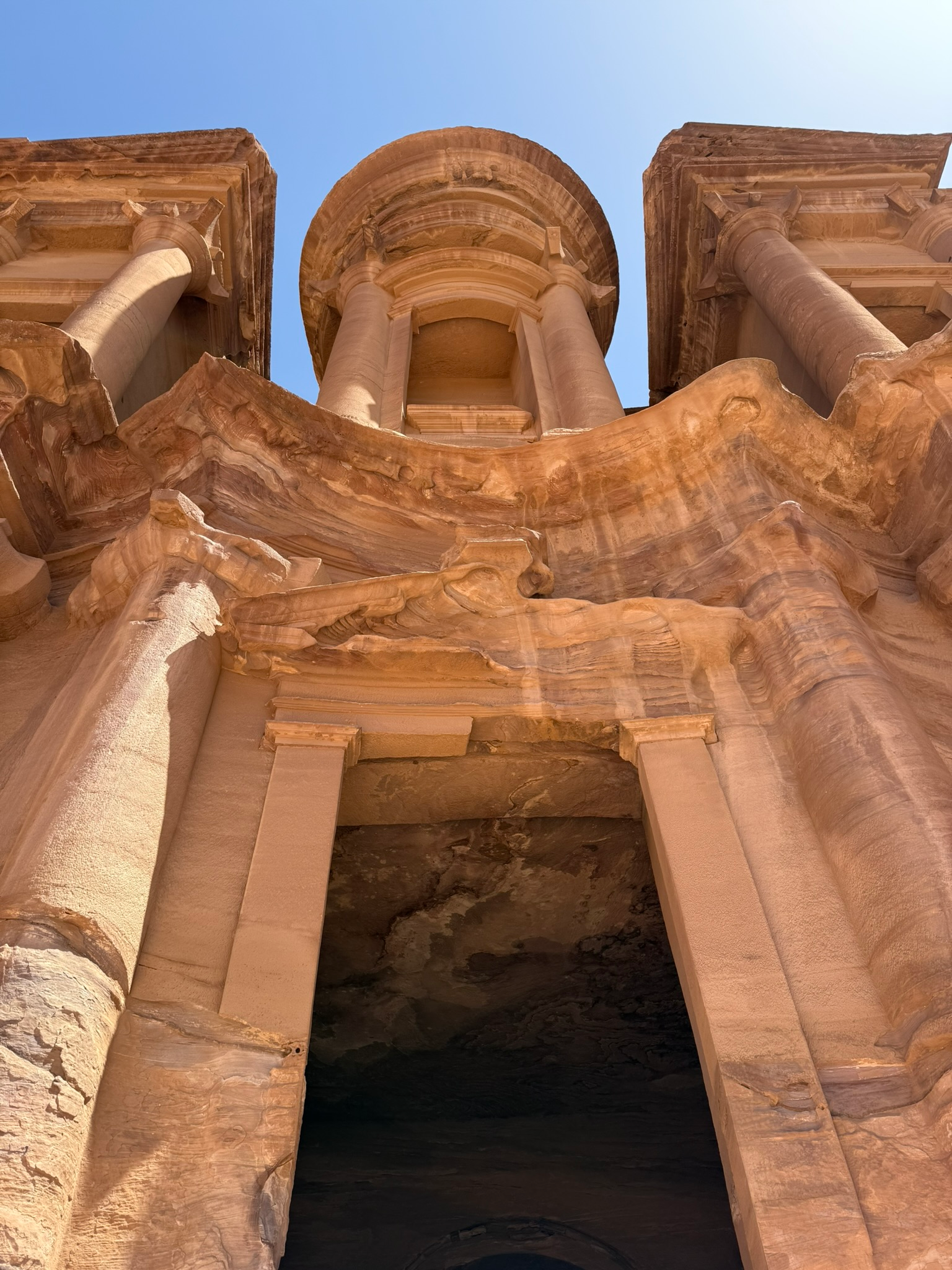
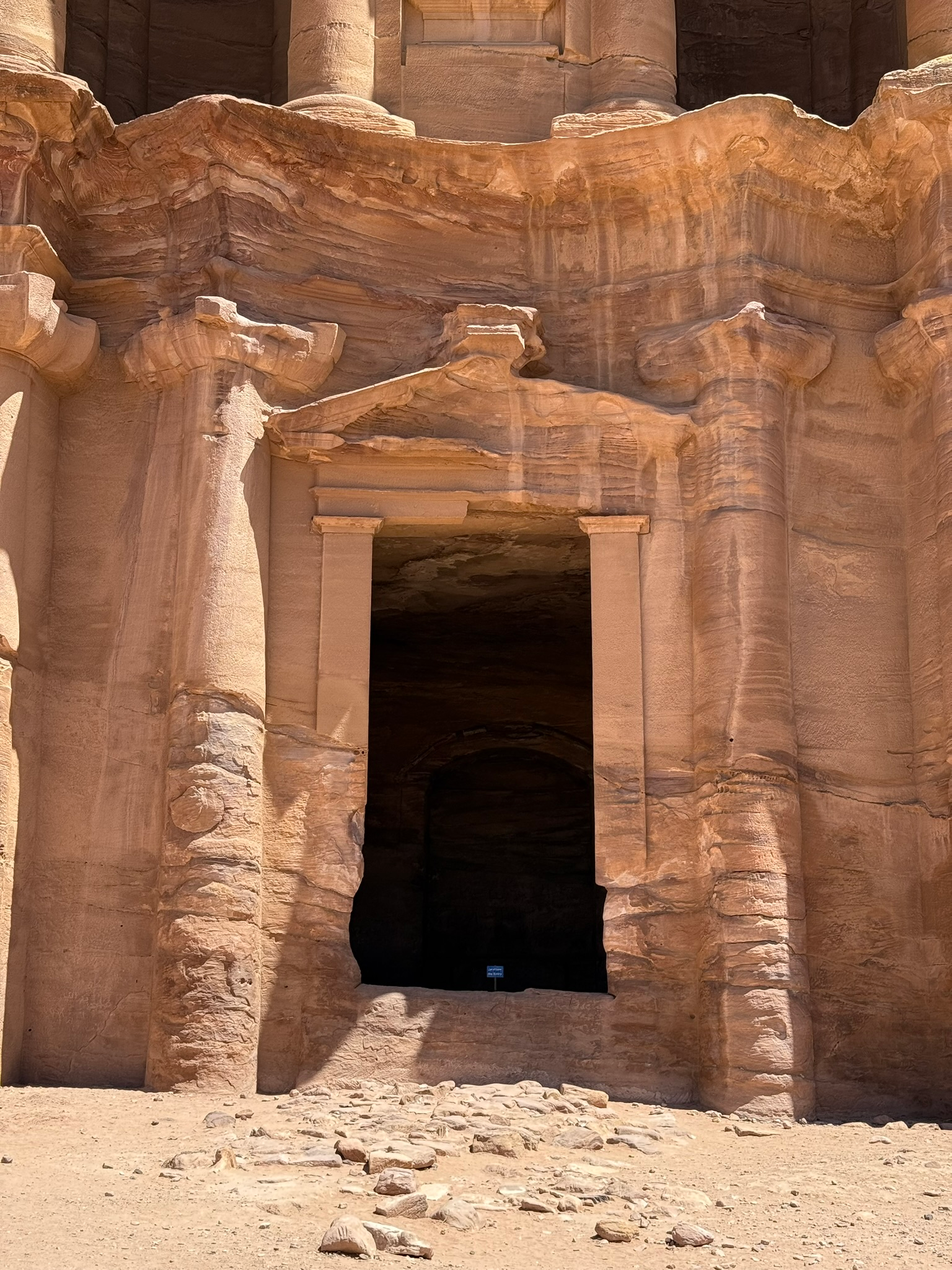
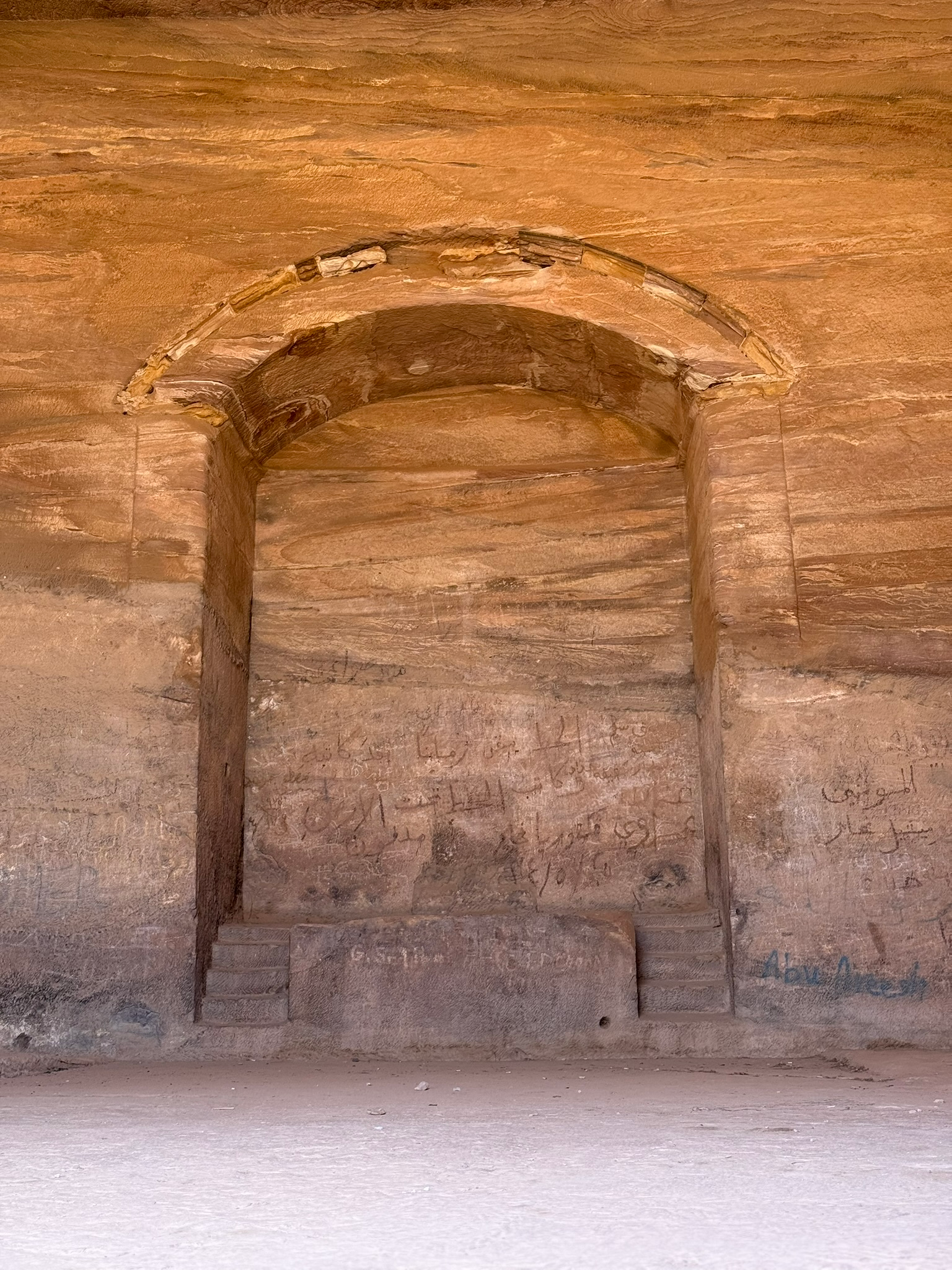
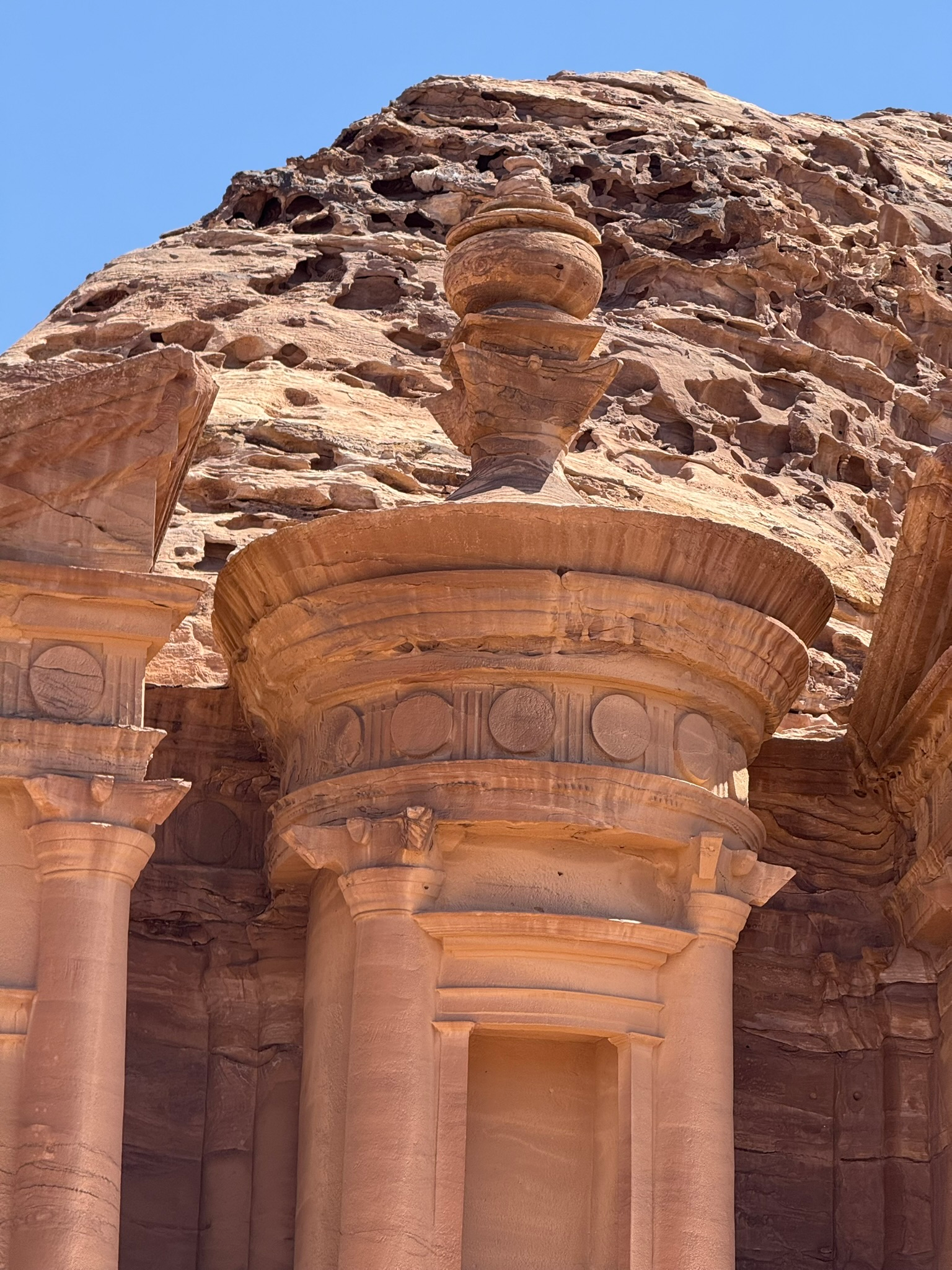
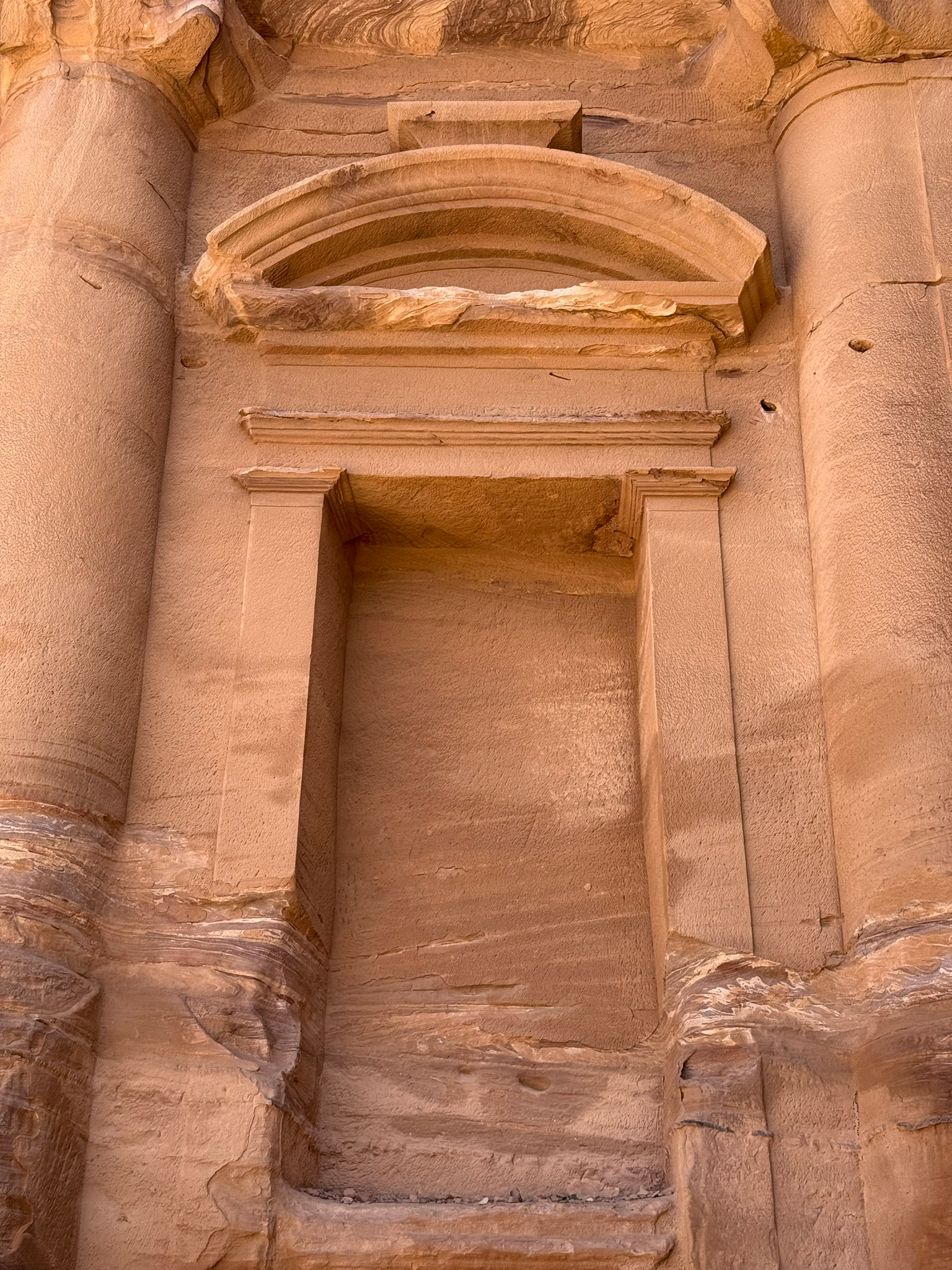
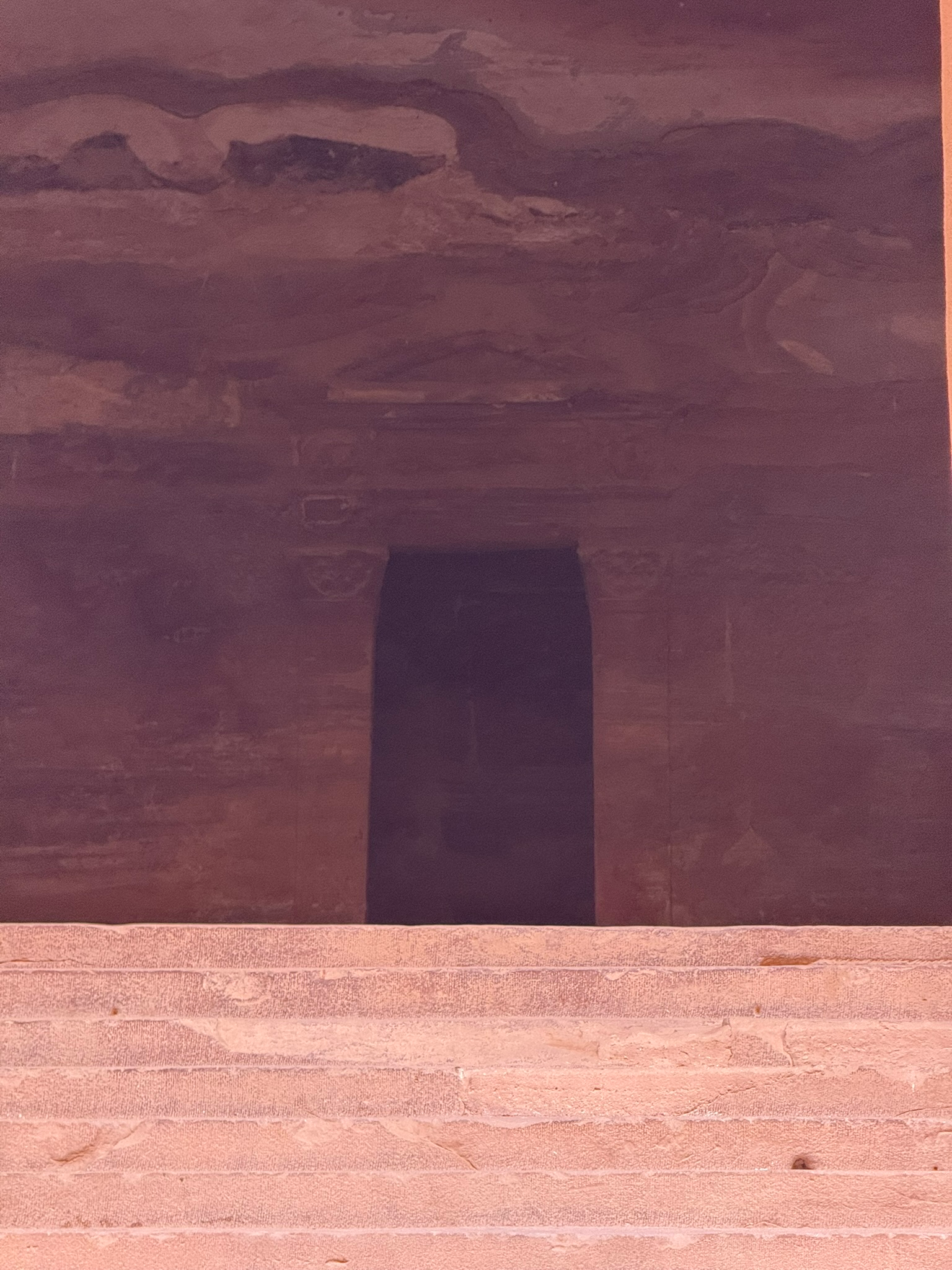
Though eroded and worn down, the façade still retains much of its original design. As was probably customary among the Nabataeans, the craftsmen are believed to have worked downwards from the top, using scaffolding and tools such as chisels to gradually carve the monument from the cliff face. The lower level features a central doorway leading into the inner chamber, with niches and columns arranged on either side. Those niches likely once held sculptures, though these have long since disappeared. Inside, an altar and stone benches can still be found, along with crosses and later Arabic markings that hint at the monument’s many different lives after the Nabataeans.
The upper level features three separate architectural sections, each framed by columns and broken pediments. At the centre stands a circular tholos crowned by the enormous urn that has become one of the monument’s defining features. The design is less intricately decorated than that of the Treasury, but its sheer size and isolated setting make it no less imposing.
Influencers Set Loose
Though we had become accustomed to enjoying incredible mountain views during lunch, I have to admit that this one wasn’t too shabby. The second Delia told us we had an hour or so to eat and explore the site, I pulled a Doug and practically ran off.
First of all, I wanted to be far, far away from the crowds and the wannabe influencers. Throughout the entire trek, I had been expecting to encounter a White Gurl in a red summer dress posing in front of the ancient city. Needless to say, there were already a couple of them standing in front of the Monastery. They were ‘so, so Jordan!’ – another catchphrase to add to our list.
I’d seen this before – millions of tourists taking selfies and glamour shots in front of incredible remnants of history without giving a damn about their story, just so they could check them off a bucket list. I might be a judgemental jackass sitting on a moral high horse, but it does kinda get to me, especially when such works of art are reduced to nothing more than nice-looking backdrops. Maybe I’m just bitter cause I always end up arriving at these places unwashed and dressed in my worst attire after several days of trekking. Or maybe I’m just full of it. Who knows?
So yeah, I ran off in search of solitude and, most importantly, different viewpoints from which I could admire the monument in all its glory. Perched atop a hill directly opposite the Monastery, I could finally sit back and indulge in my hummus. As I sat there, I was very conscious of the fact that, although this had already left me completely in awe, there was still so much more to come.
Hundreds of Steps into History
After our lunch break, we had hundreds of steps ahead of us before reaching Petra’s main archaeological area. Luckily, we would be going down them. Unluckily, we would be pestered by street vendors practically the entire way. The final part of the trail featured dozens of rock-cut tombs and façades, which we kinda zipped past given that there was still so much to see and so little time left in the main site.


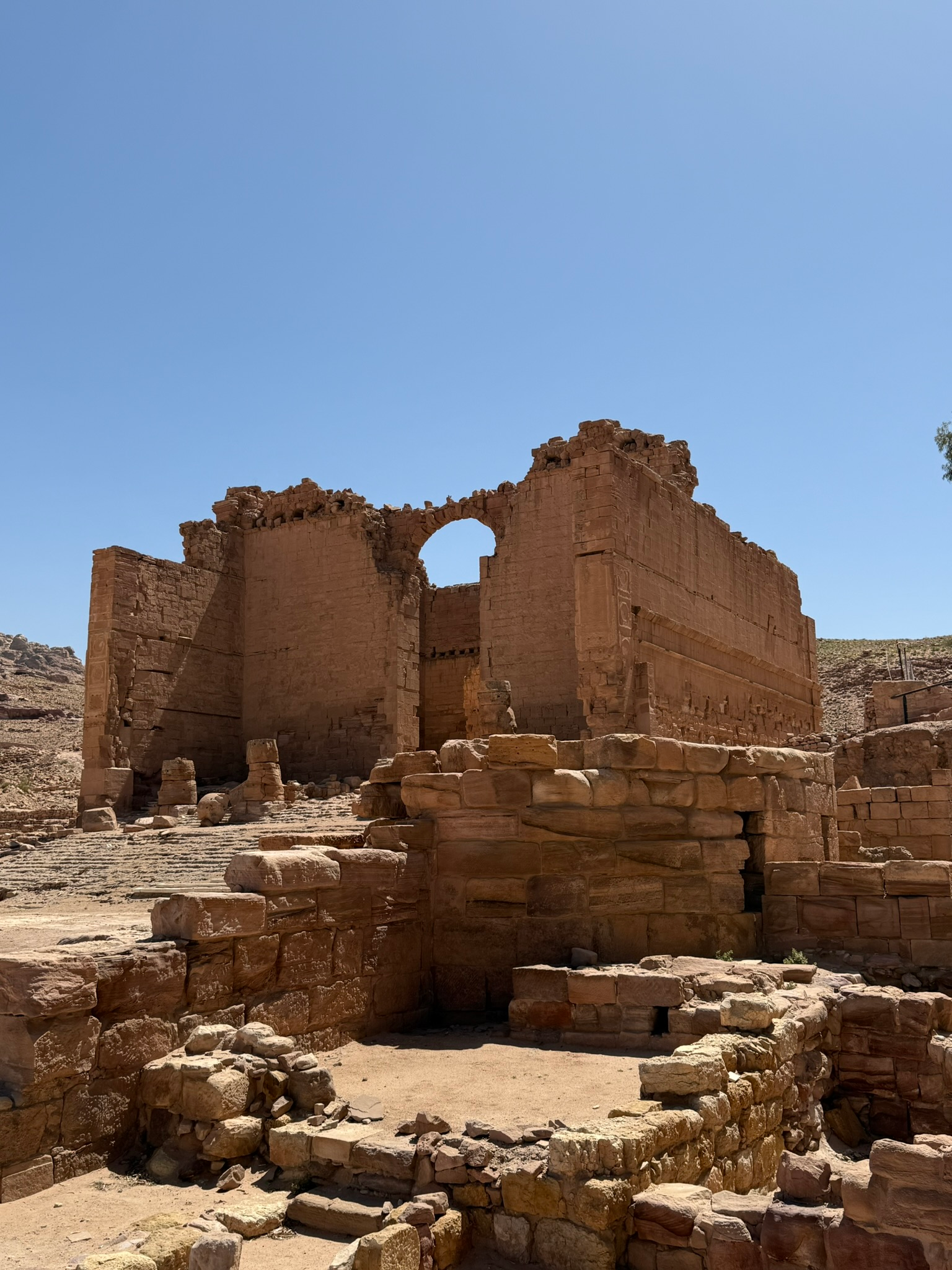
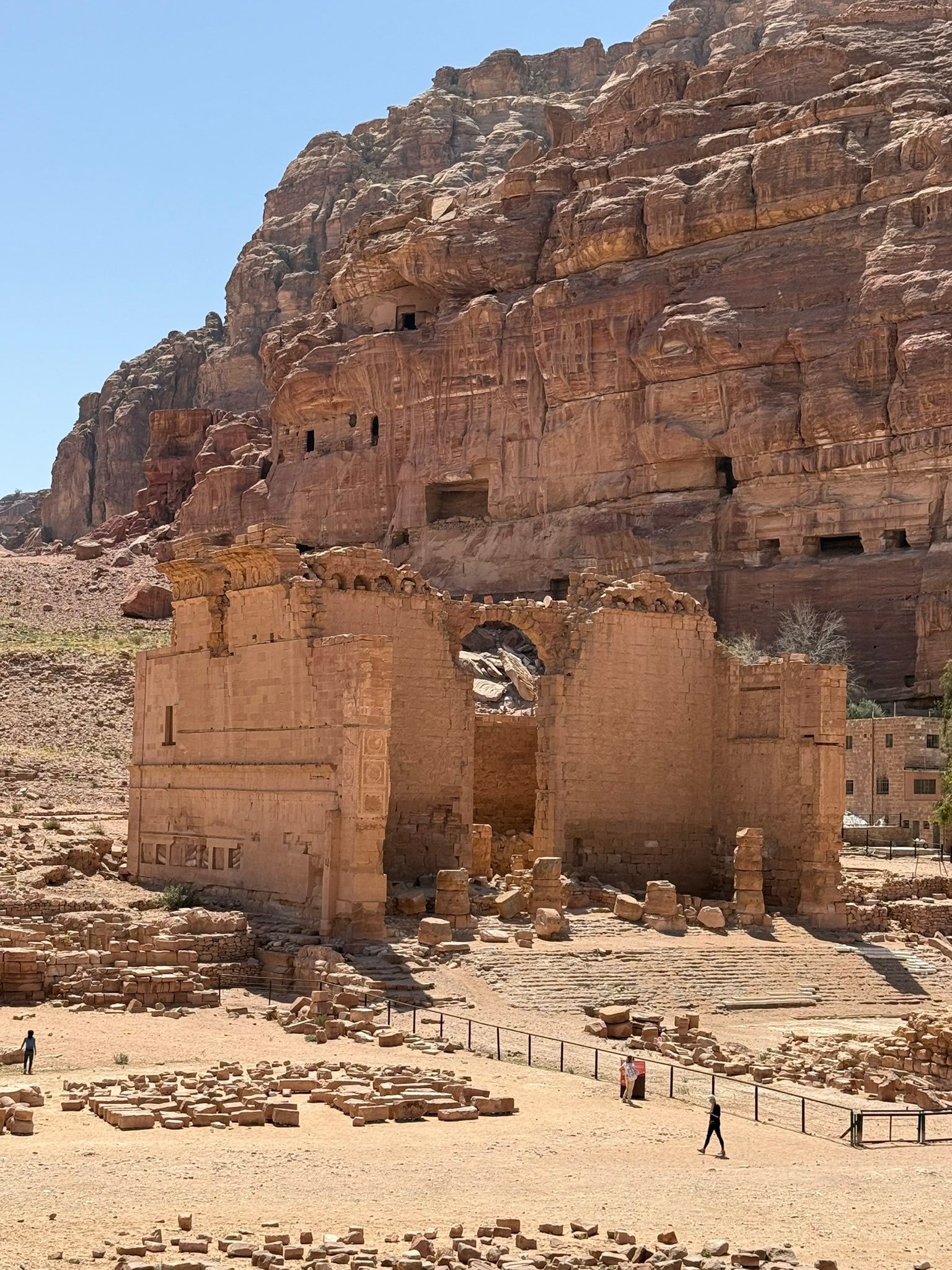
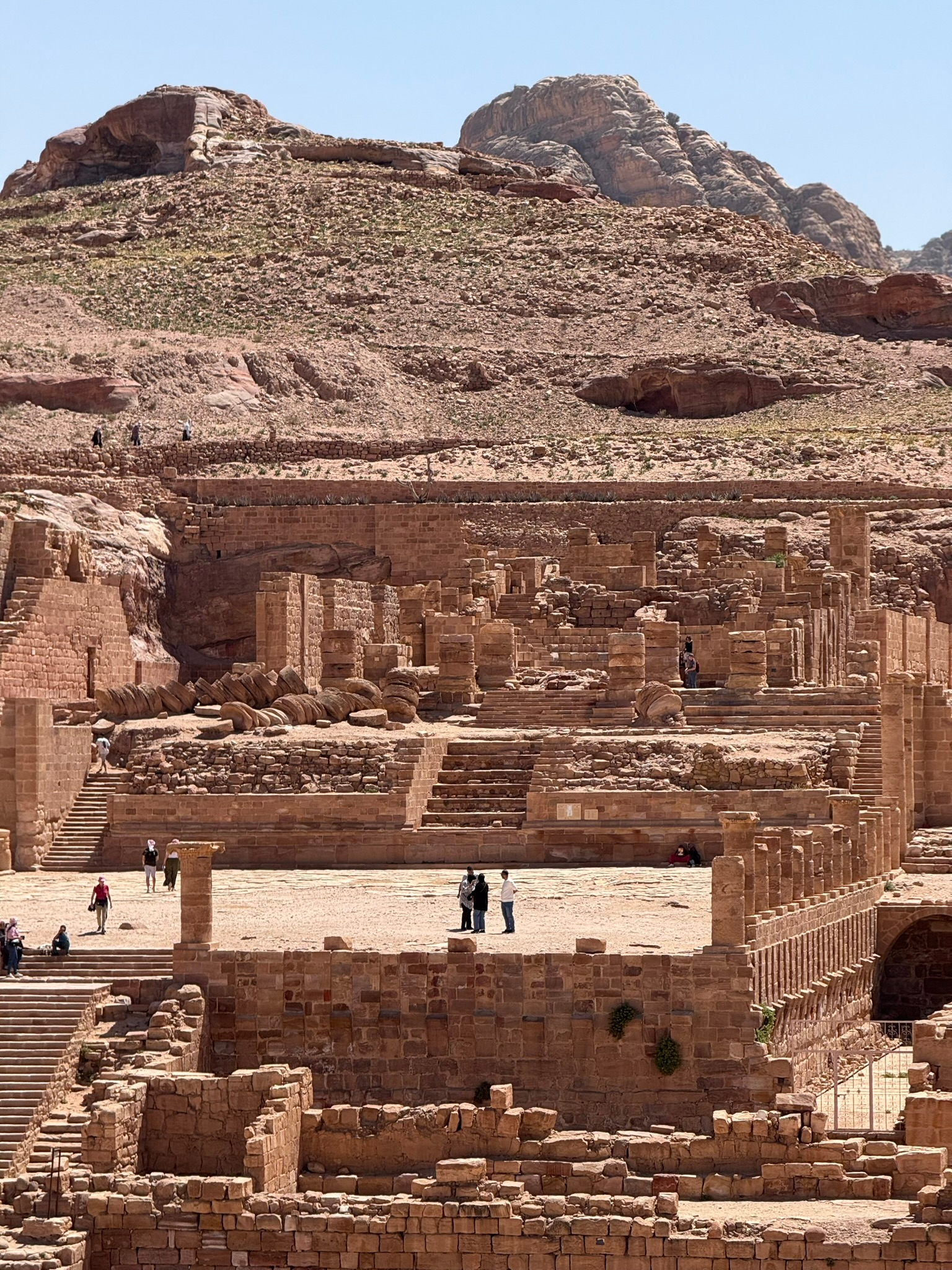
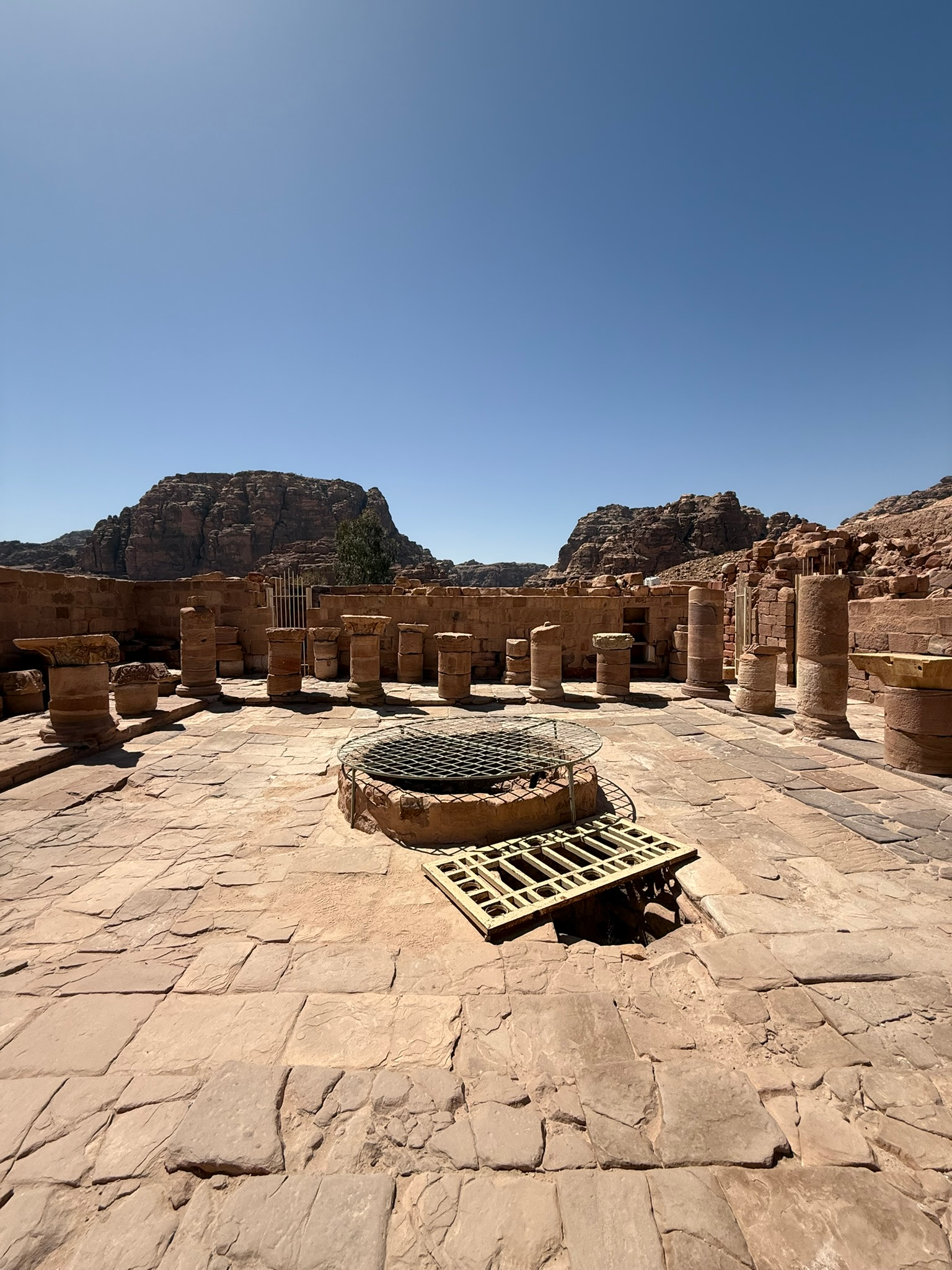
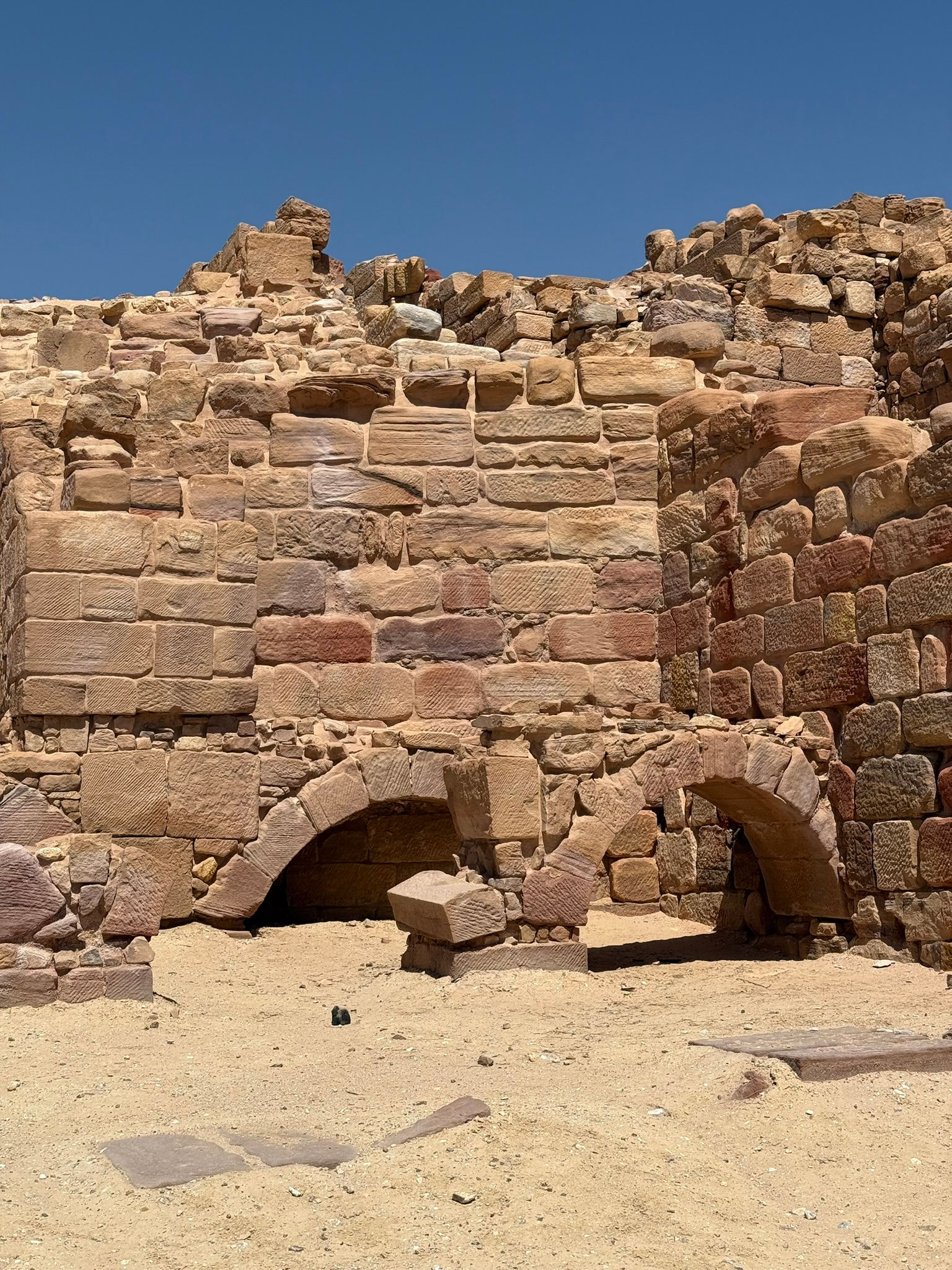
Once there, we got to feast our eyes on a number of very different constructions. First up was Qasr al-Bint, Petra’s best-preserved freestanding temple and one of the city’s most important religious buildings. It was probably dedicated to Dushara, the principal male deity of the Nabataeans. Then came the Temple of the Winged Lions, a ritual complex commonly believed to have been associated with al-Uzza, although its precise dedication remains uncertain.
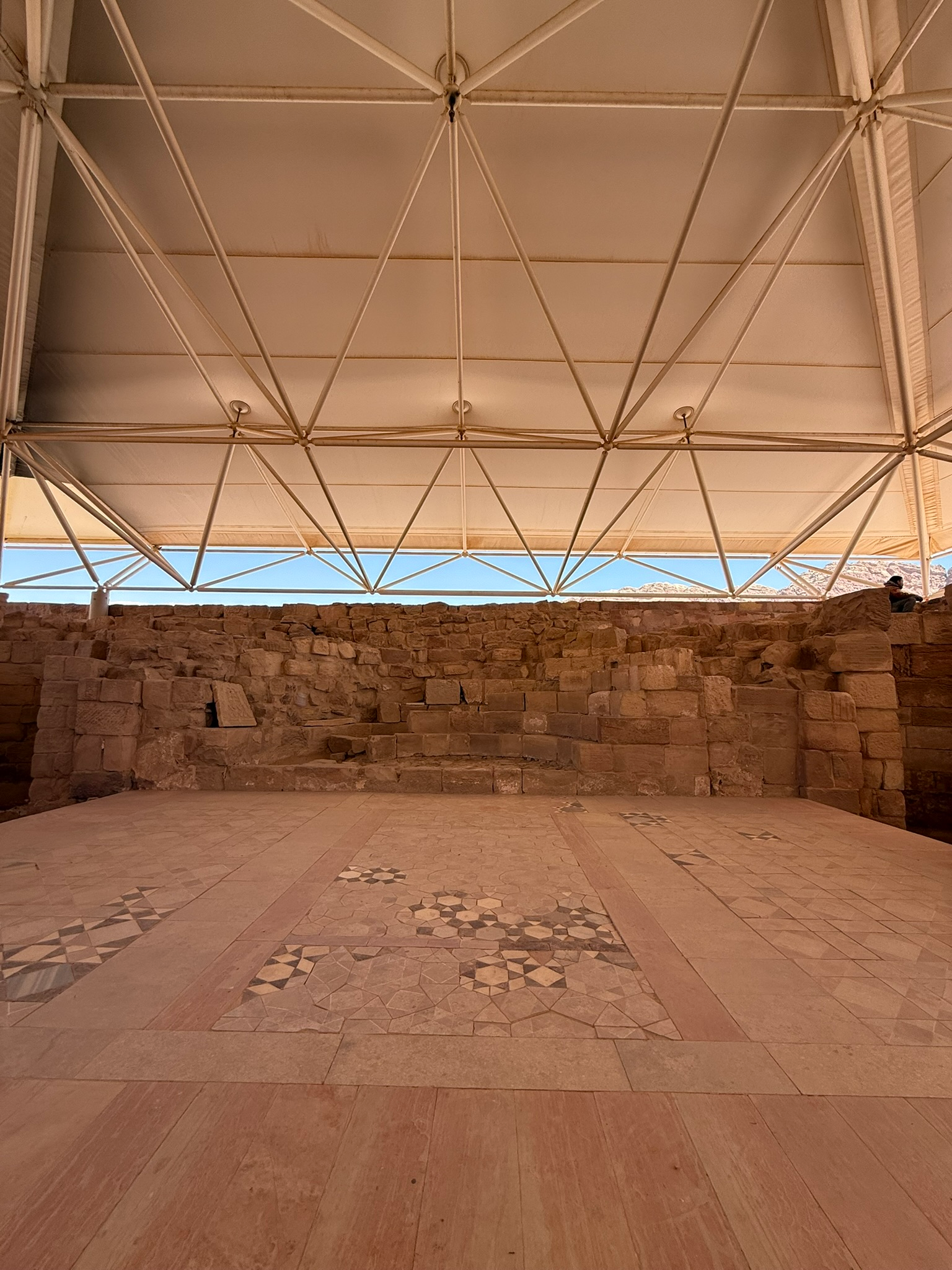
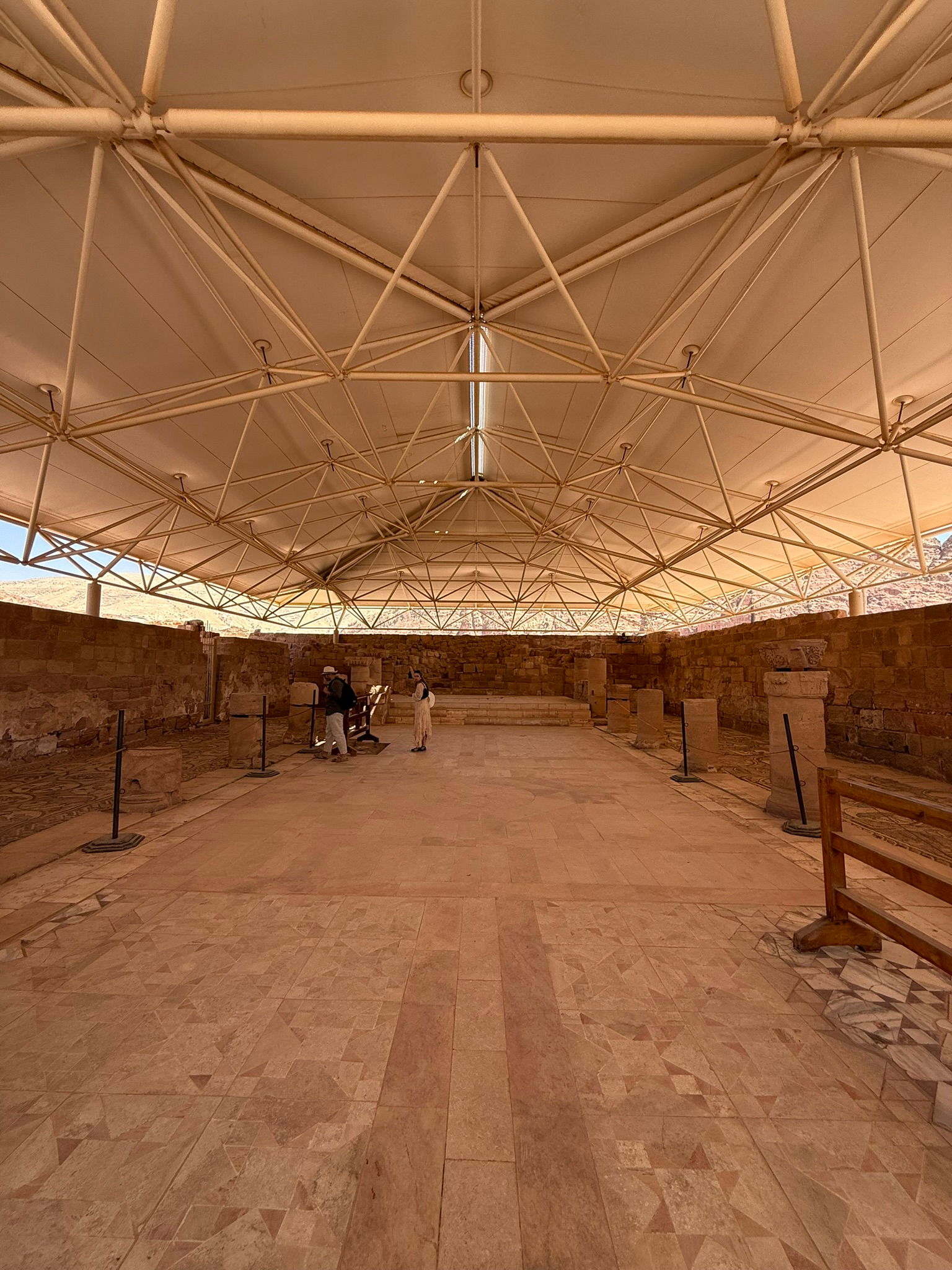
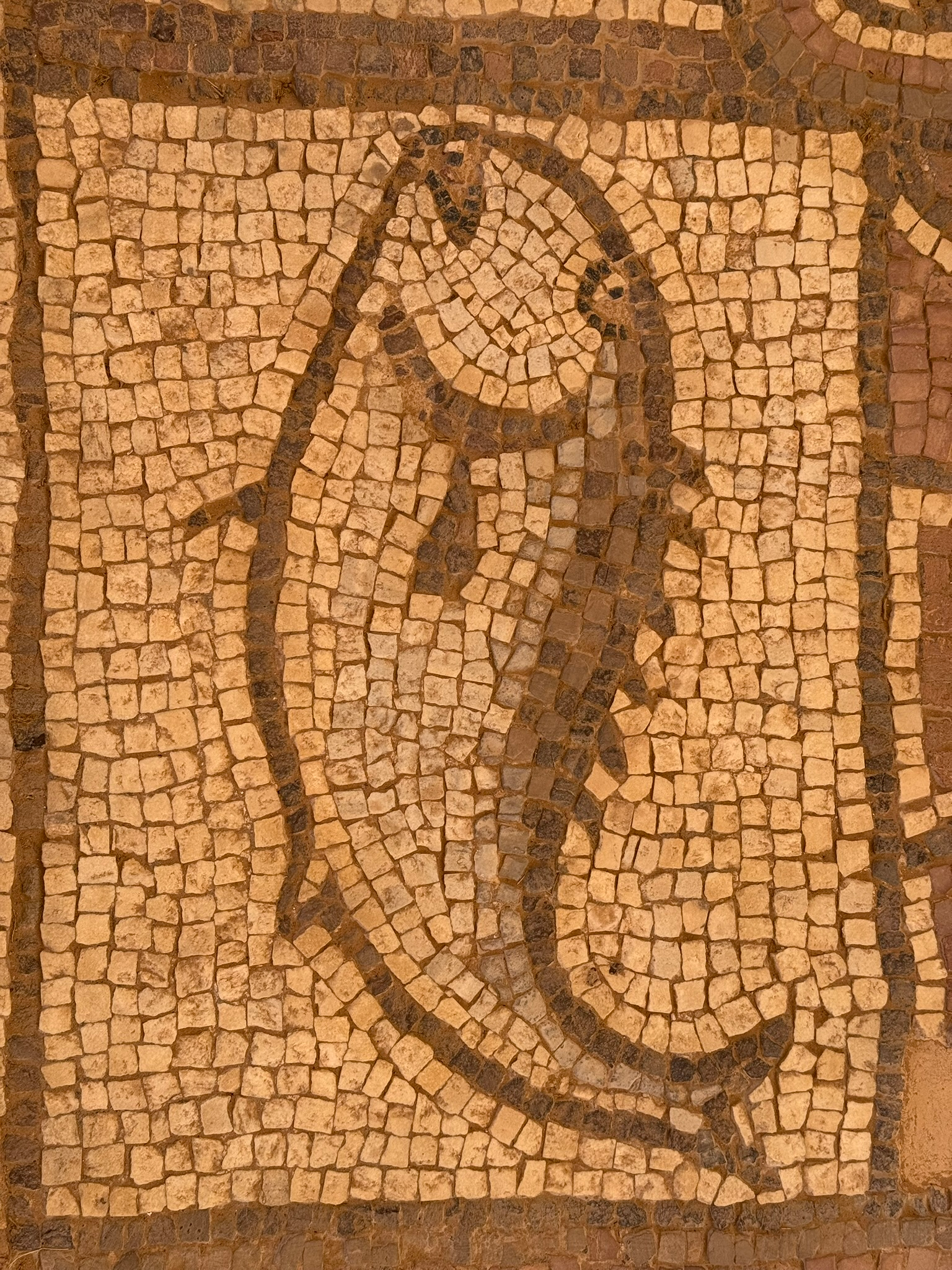
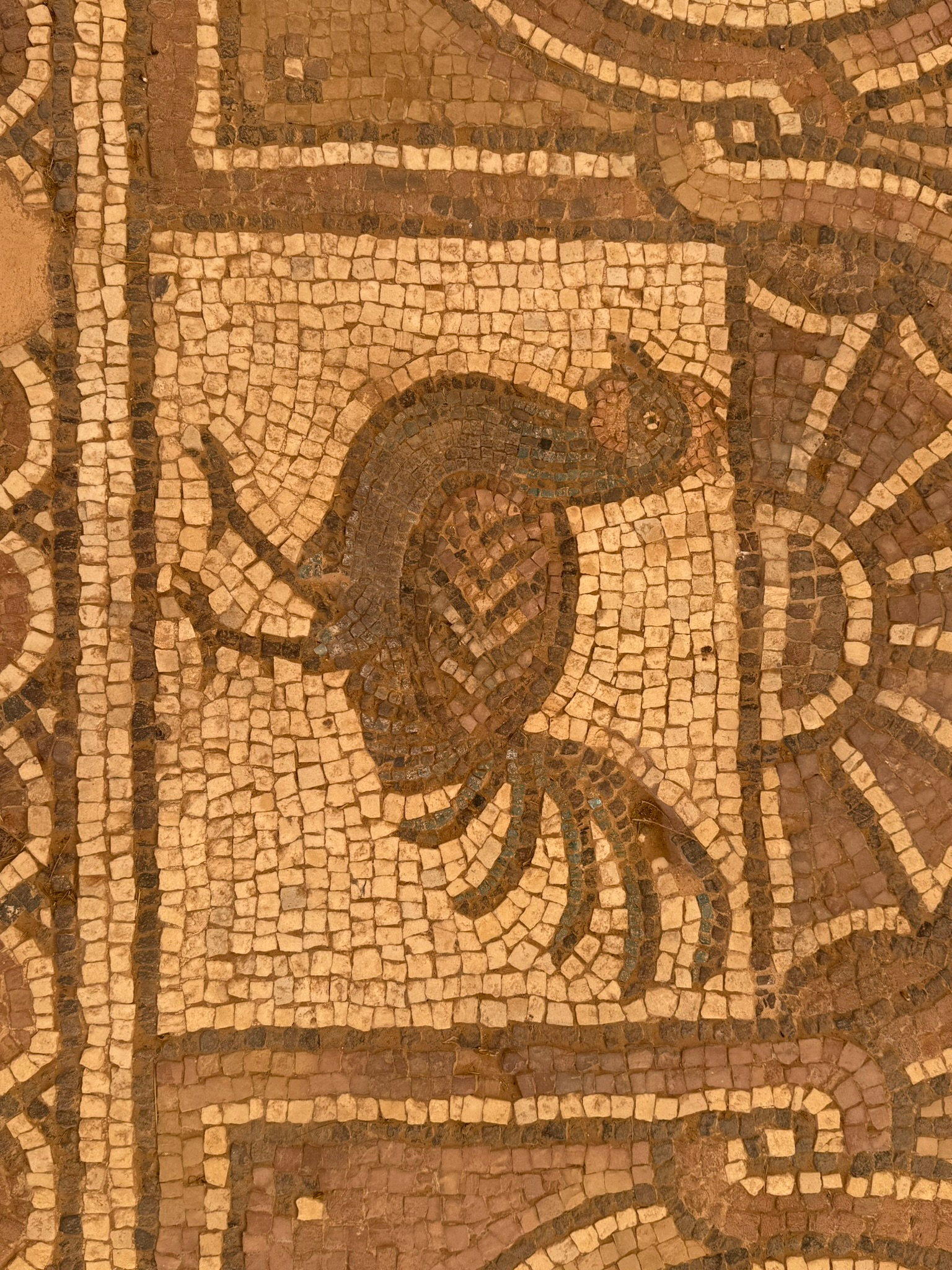
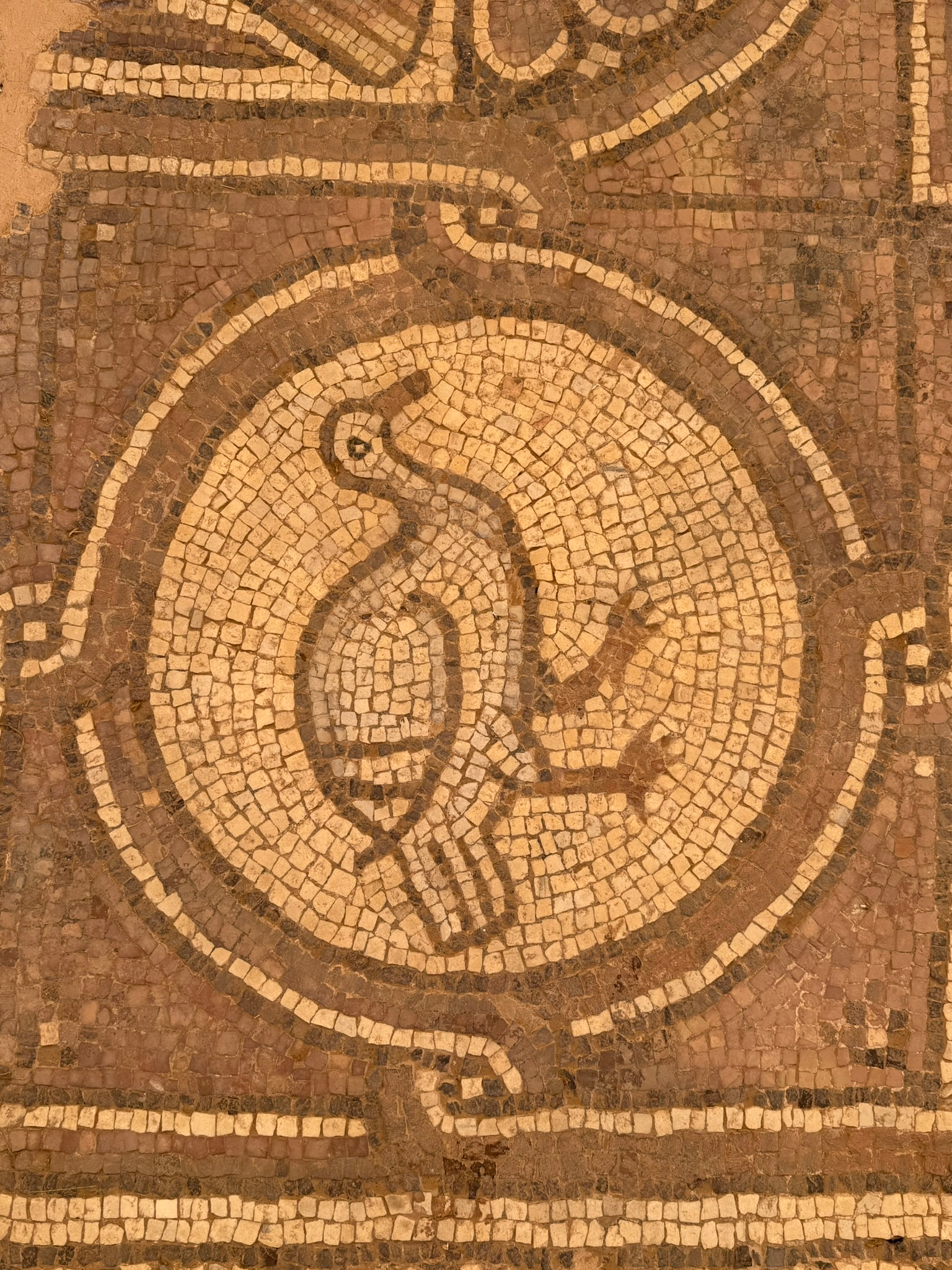
Most remarkable of all, at least to me, was the Petra Church. It features some extraordinarily well-preserved floor mosaics, and it was here that archaeologists discovered more than 140 carbonised papyrus scrolls. Dating from the sixth century AD, the documents include contracts, property records, marriage arrangements and legal disputes, offering an incredibly rare glimpse into everyday life in Byzantine Petra.
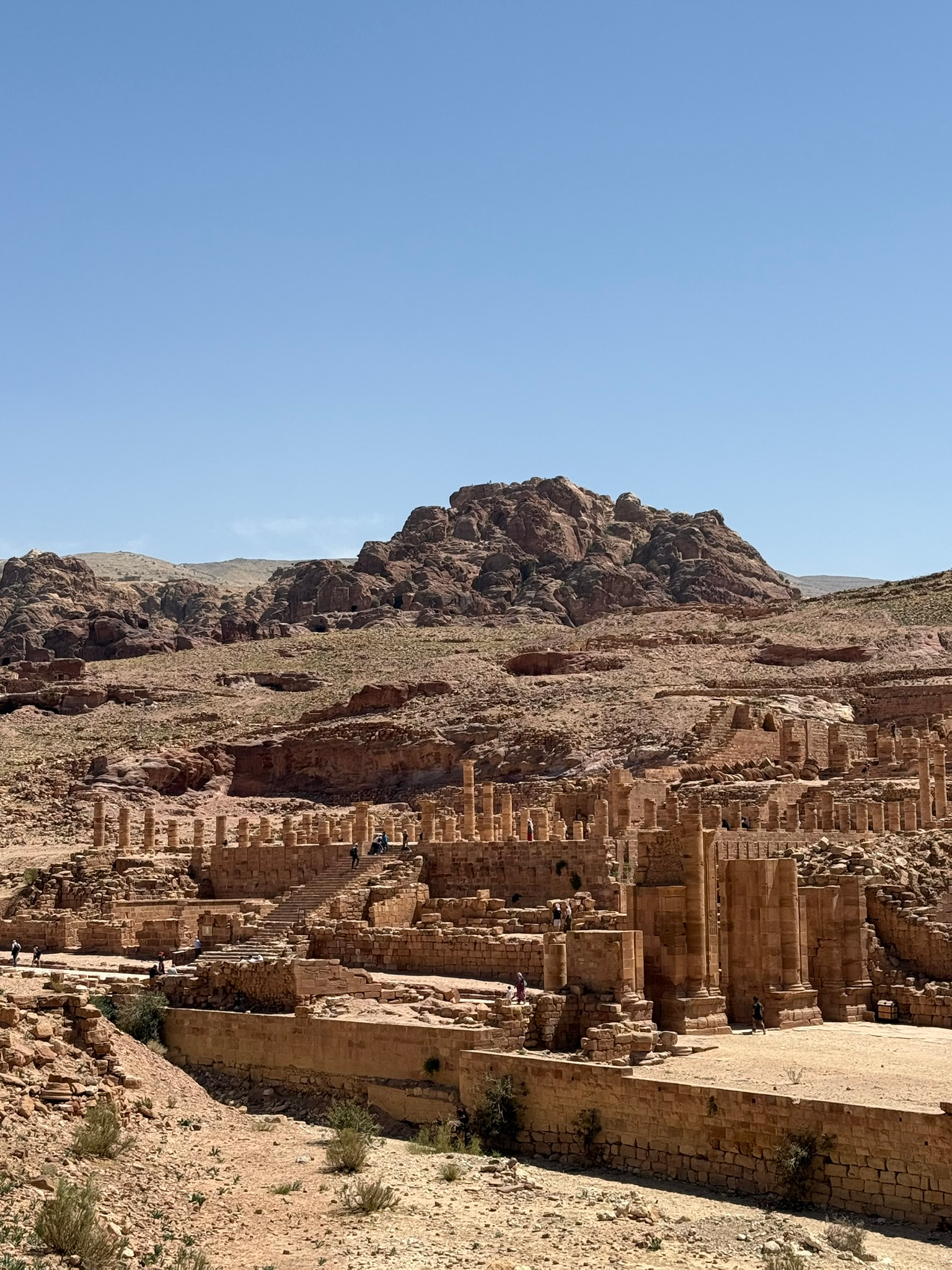
Other important sites we saw from a distance, in an effort to save time for the areas we were most excited about, included the Great Temple, the Nymphaeum, the Colonnaded Street and the Theatre, as well as the High Place of Sacrifice atop the mountain towering over the city.
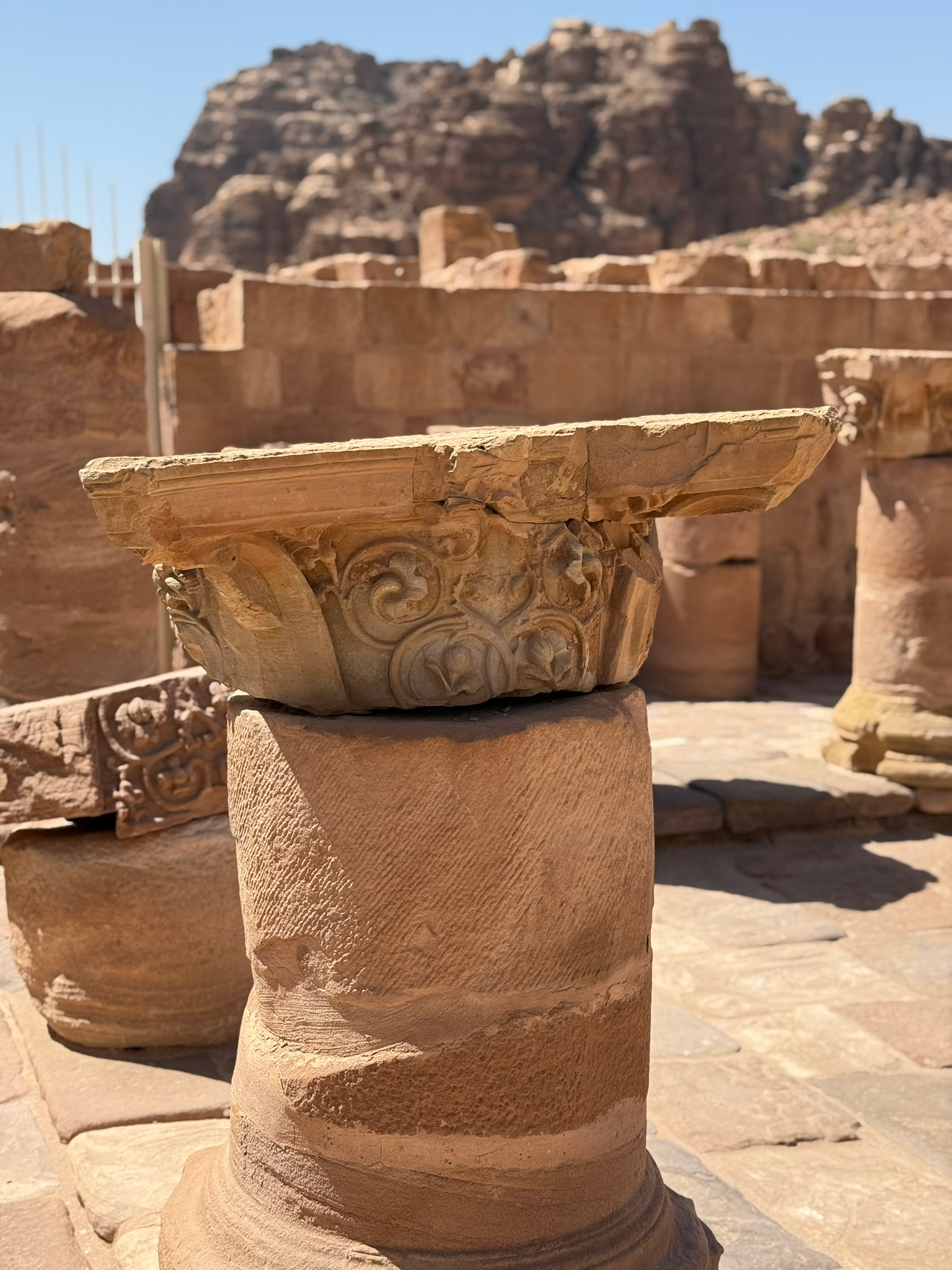
The Royal Tombs & the Theatre
Up next was definitely one of the highlights of Petra – the Royal Tombs. Overlooking the city centre from the western side of Jabal al-Khubtha, the area consists of a series of enormous mausoleums with majestic façades hewn into the mountainside.
Although they are collectively known as the Royal Tombs, the identities of the people buried inside them remain uncertain. Their scale and prominent position nevertheless suggest that they belonged to members of Petra’s royal family or upper social classes. Given the enormity of the place, Delia chose a few of the tombs for us to visit:
- Palace Tomb: One of the largest façades in the city. Its elaborate, multi-level design resembles that of a Hellenistic or Roman palace, although its precise purpose remains debated. It may have been used for funerary ceremonies, ritual banquets or the burial of members of Petra’s elite.
- Corinthian Tomb: Although its exterior is severely weathered, its Hellenistic design is quite clearly modelled on that of the Treasury – so I’m not gonna go into it just yet.
- Silk Tomb: Famous for its gorgeous, iridescent façade featuring swirling streaks of red, orange, yellow, beige, brown and white.
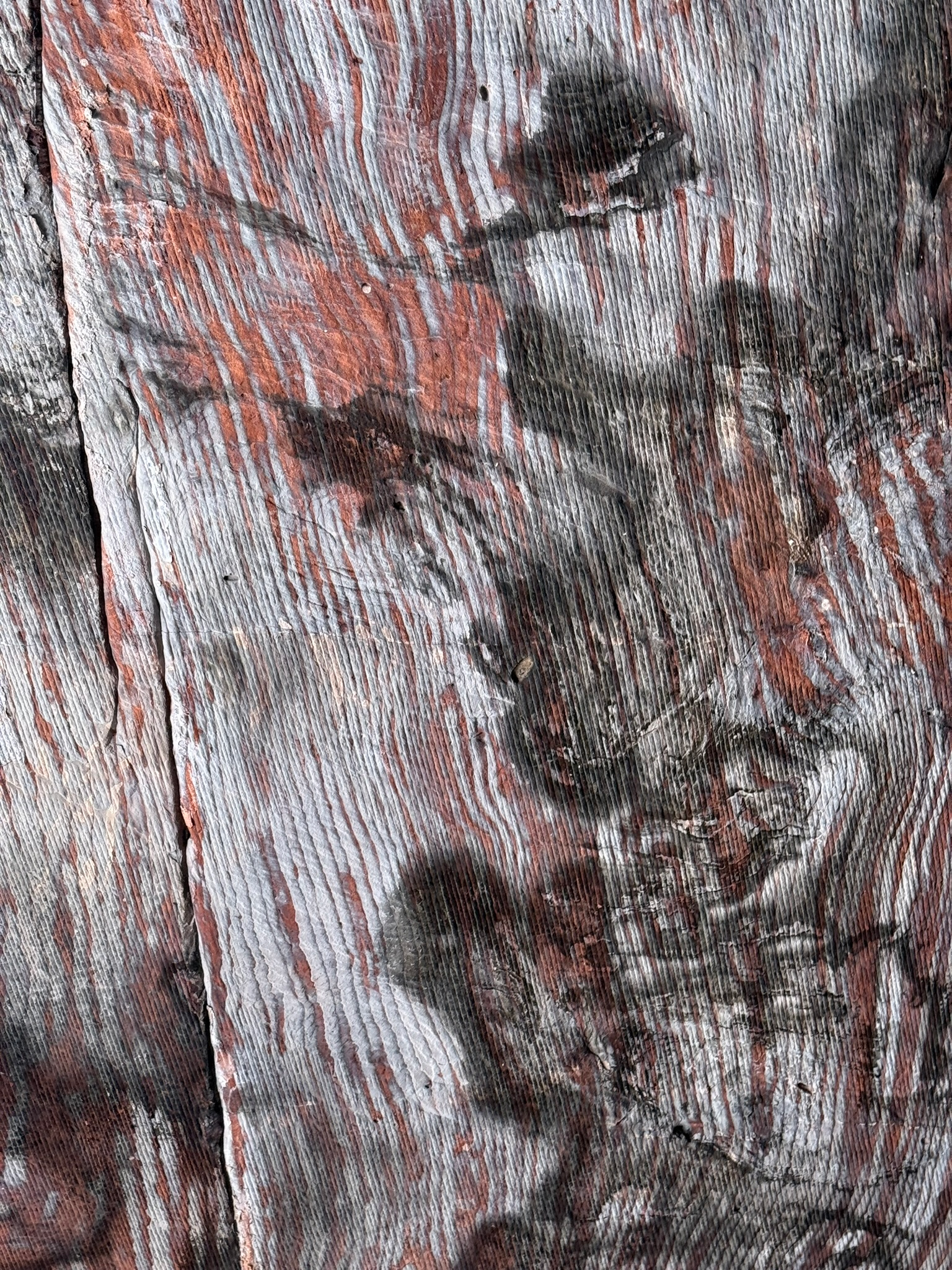
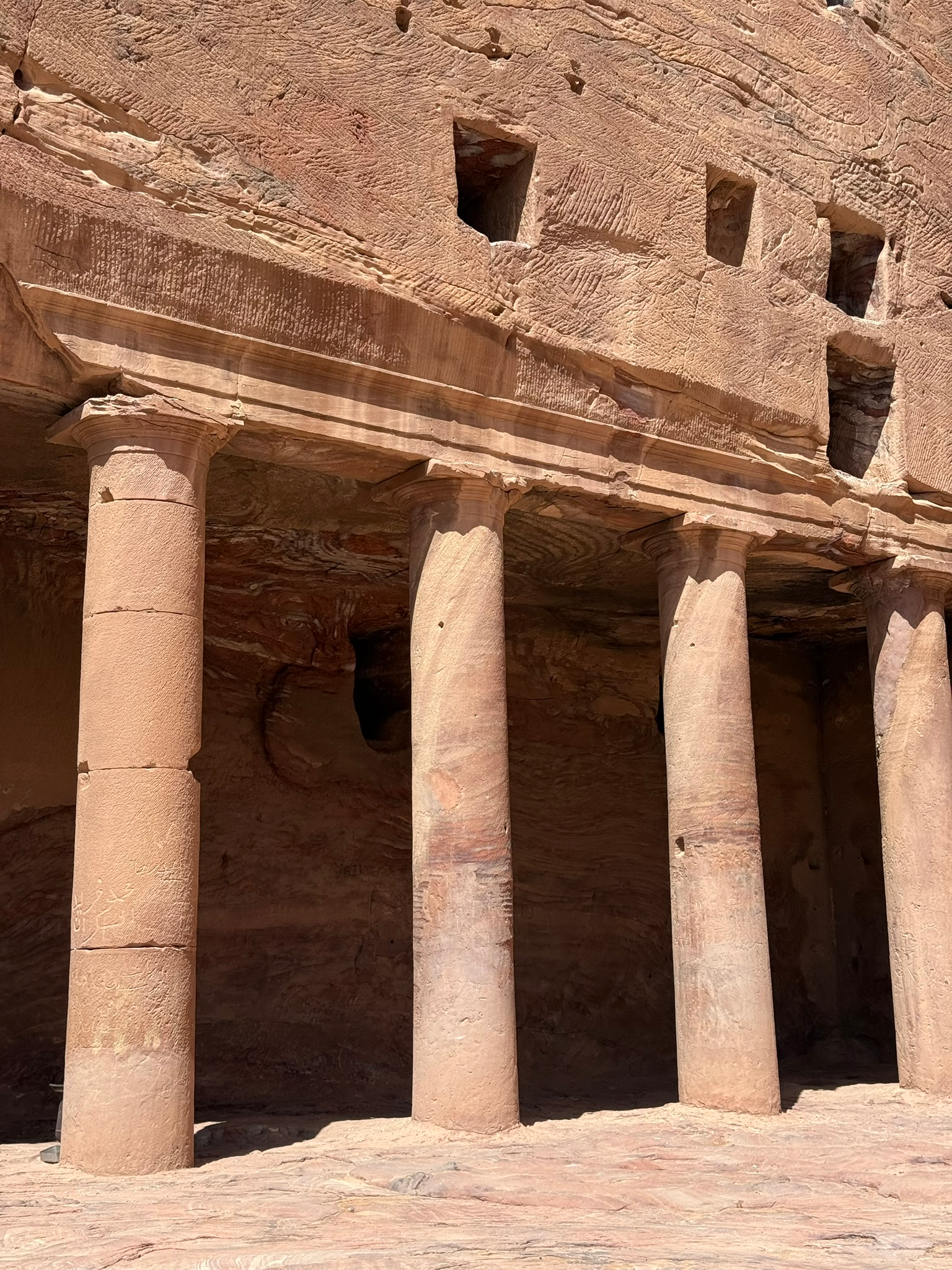
- Urn Tomb: This features an enormous colonnaded courtyard and a relatively well-preserved façade, partly protected by its position within a deep recess in the mountainside. Its vast internal chamber was converted into a Byzantine church in AD 447, when three apses were carved into the rear wall.
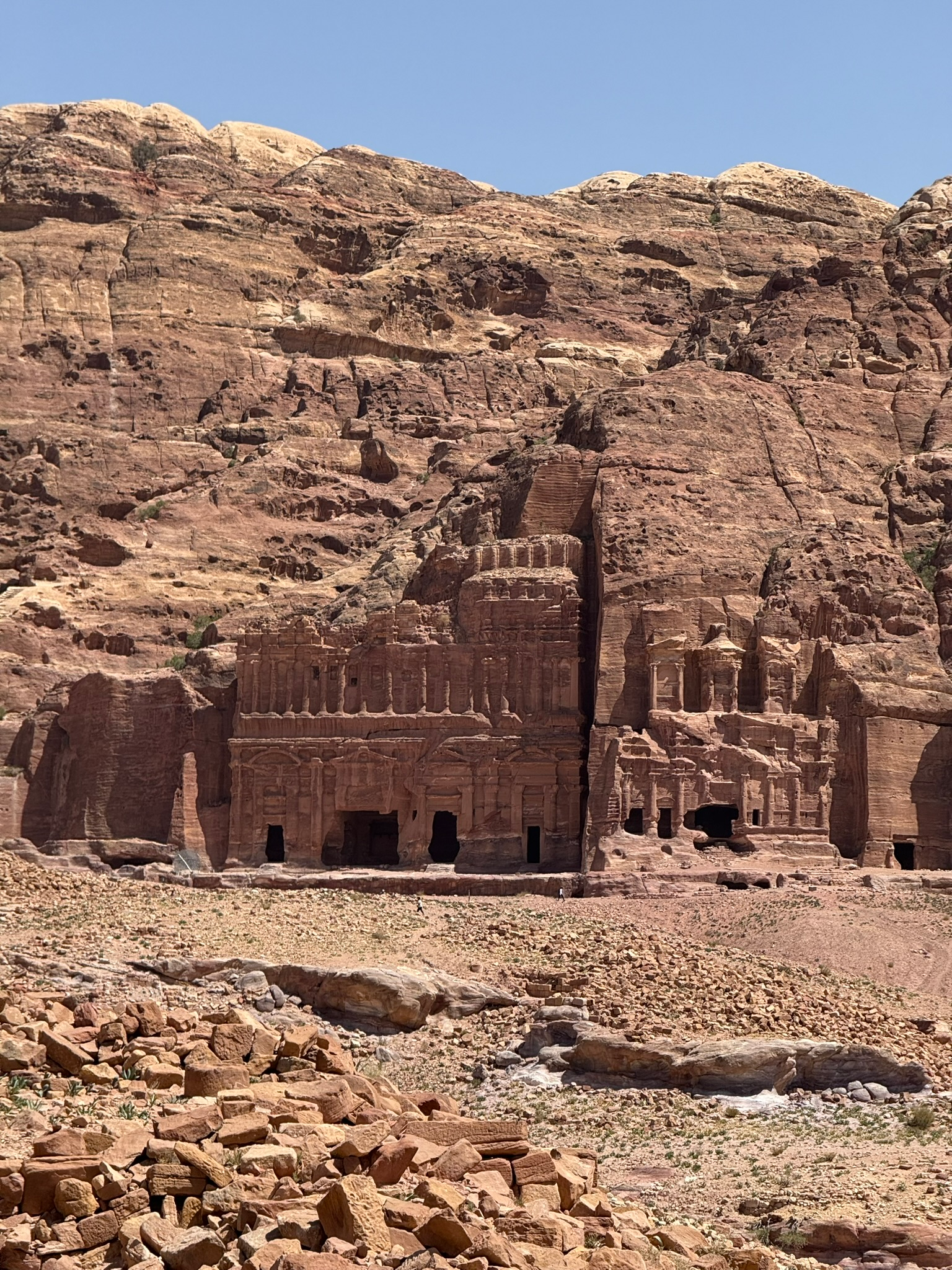
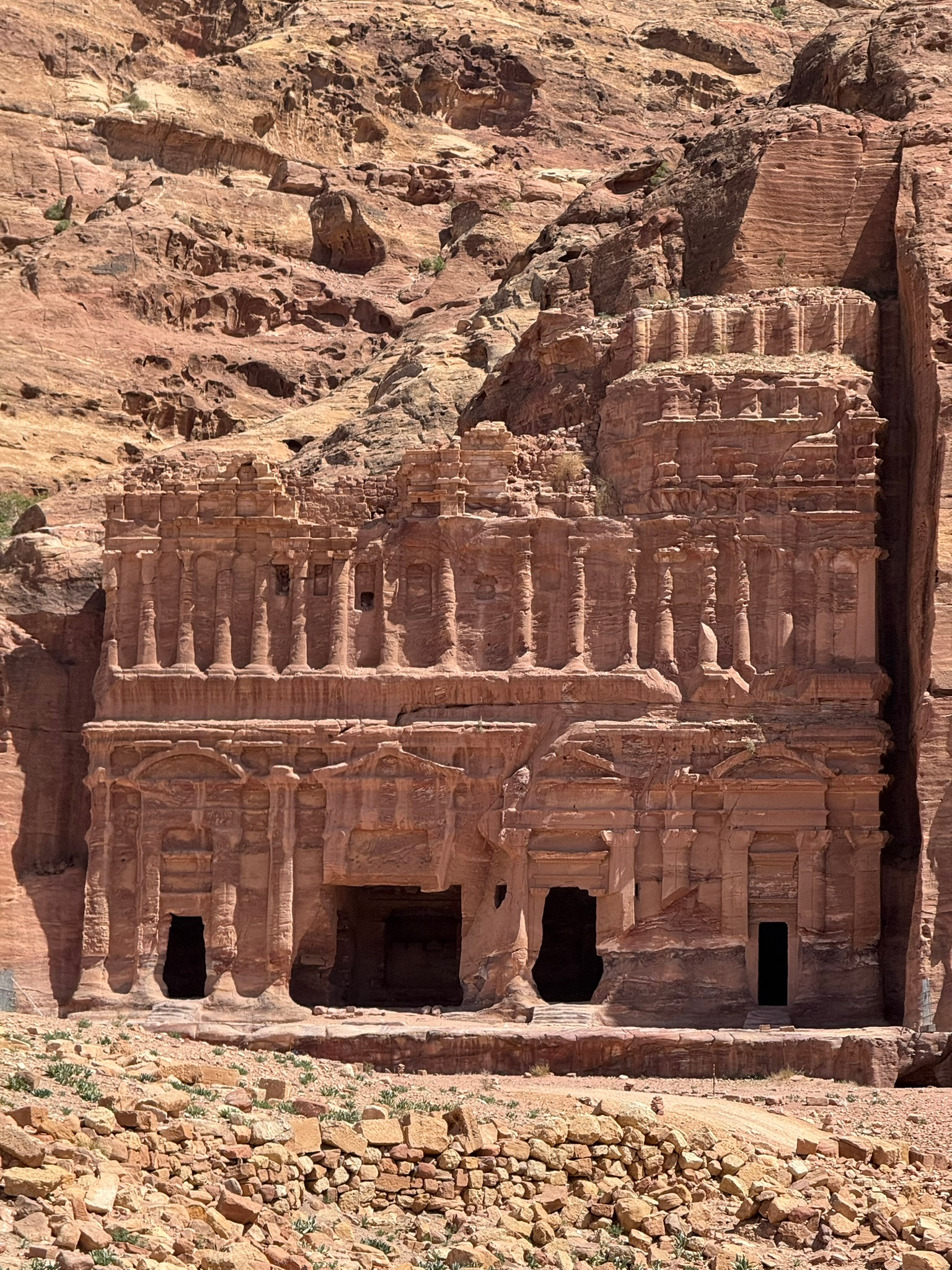
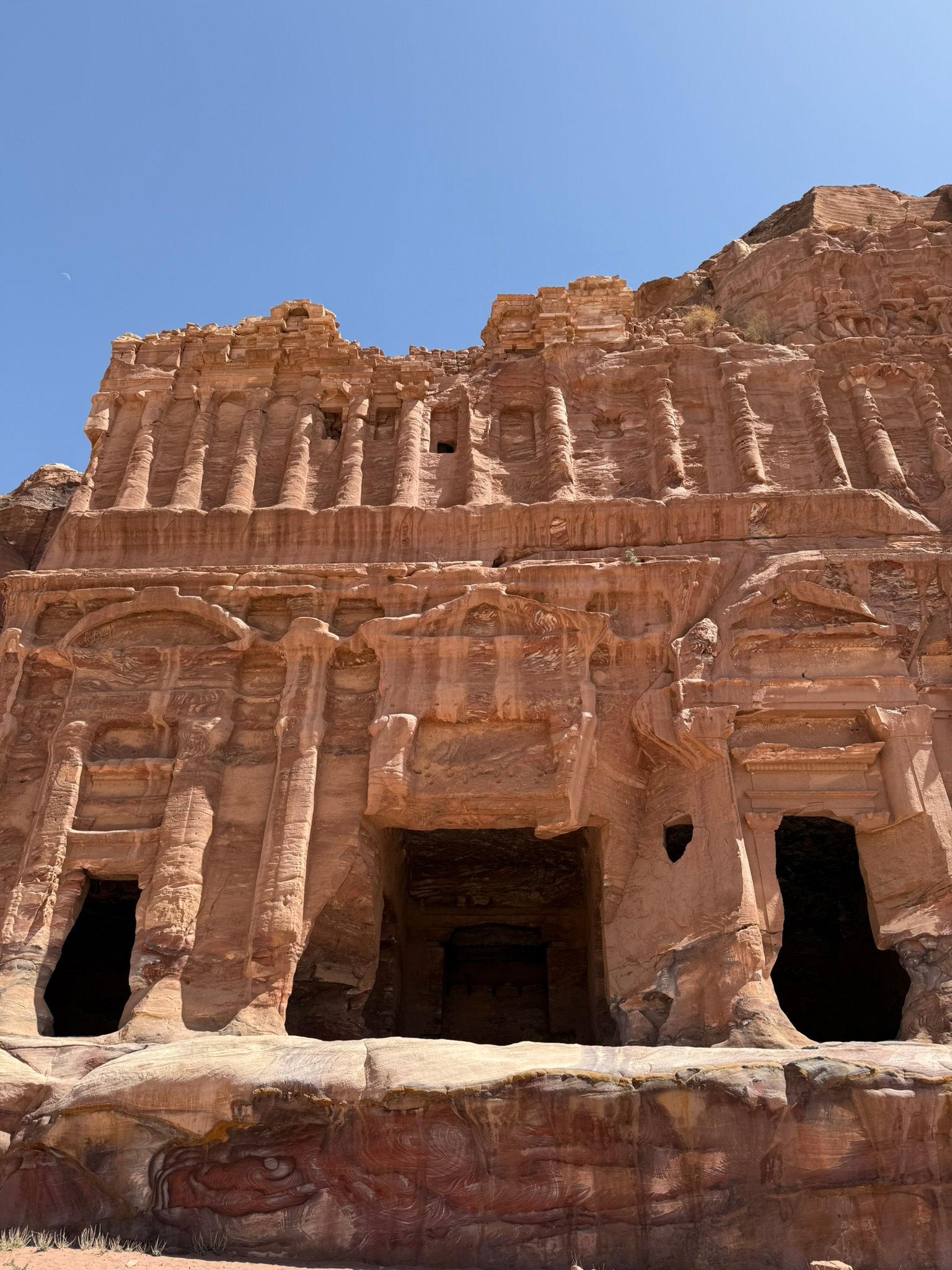
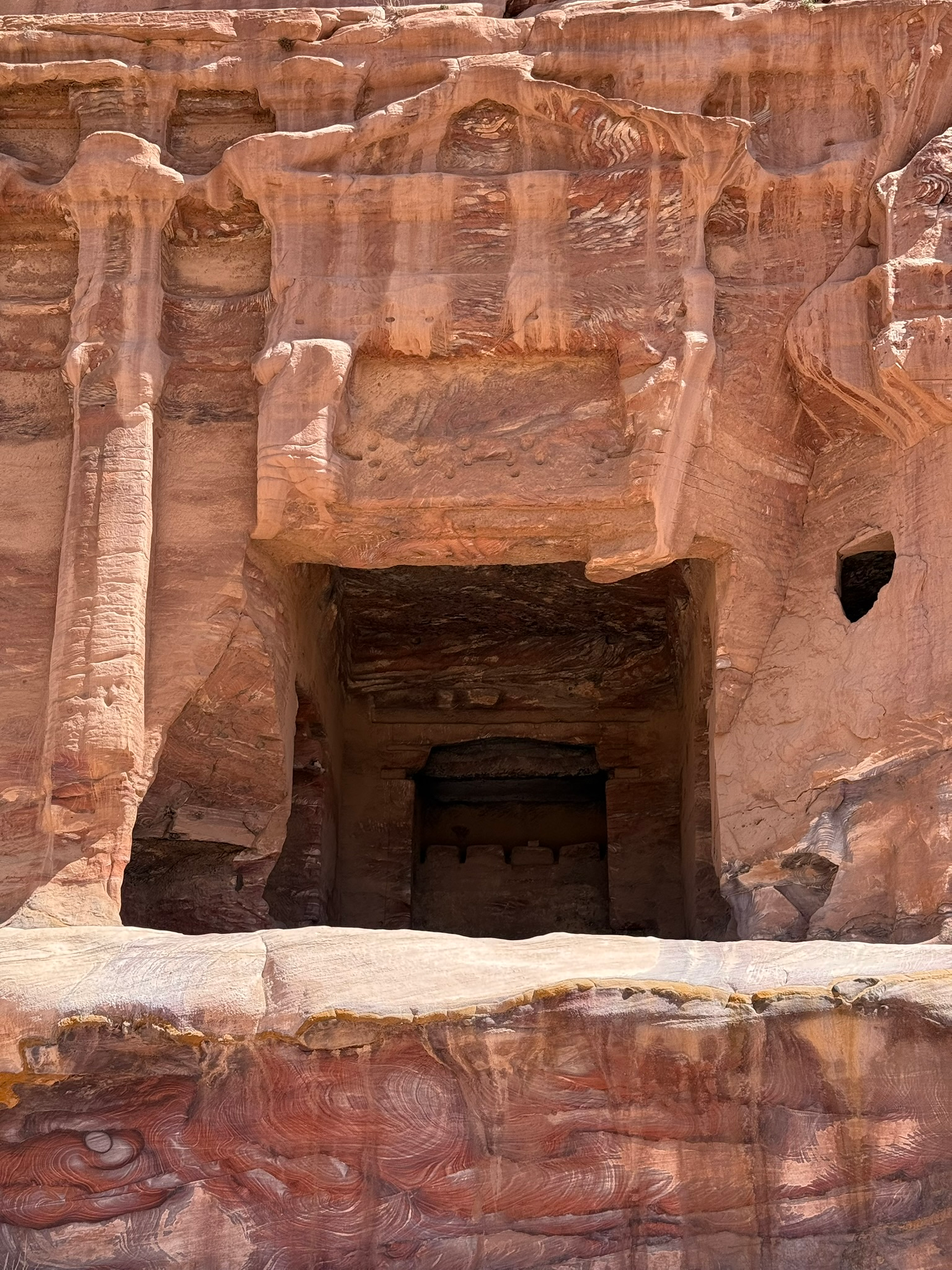
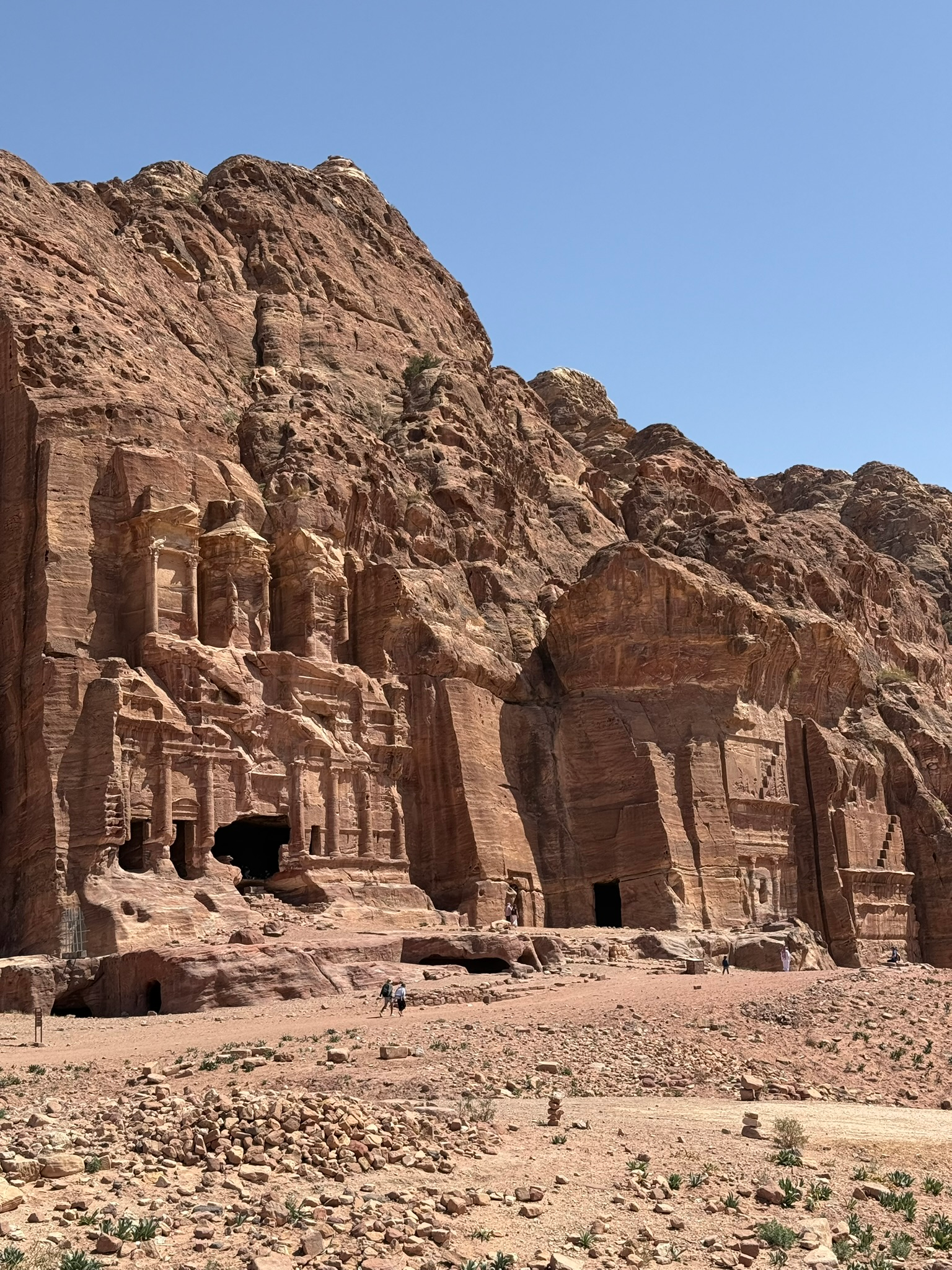
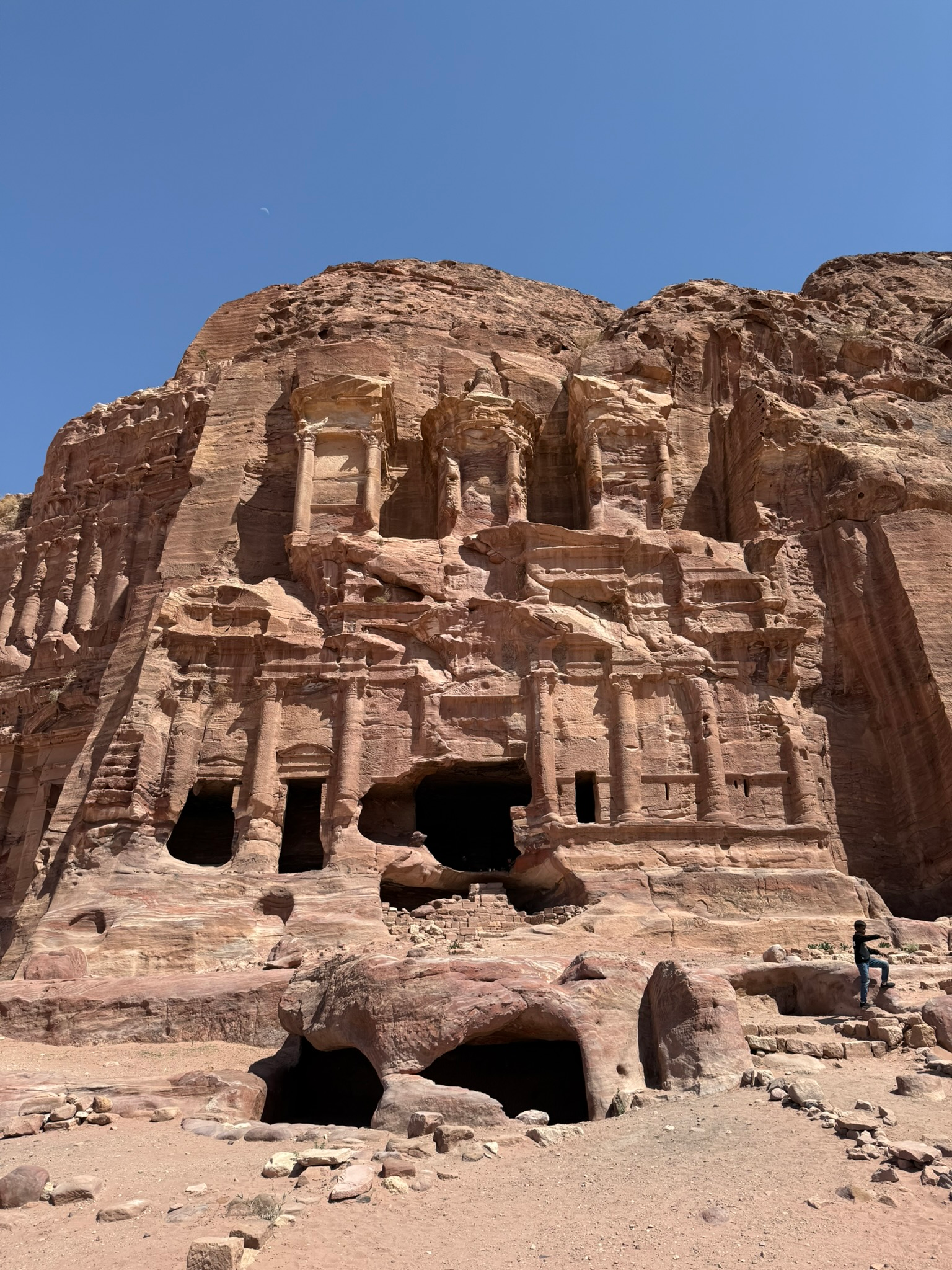
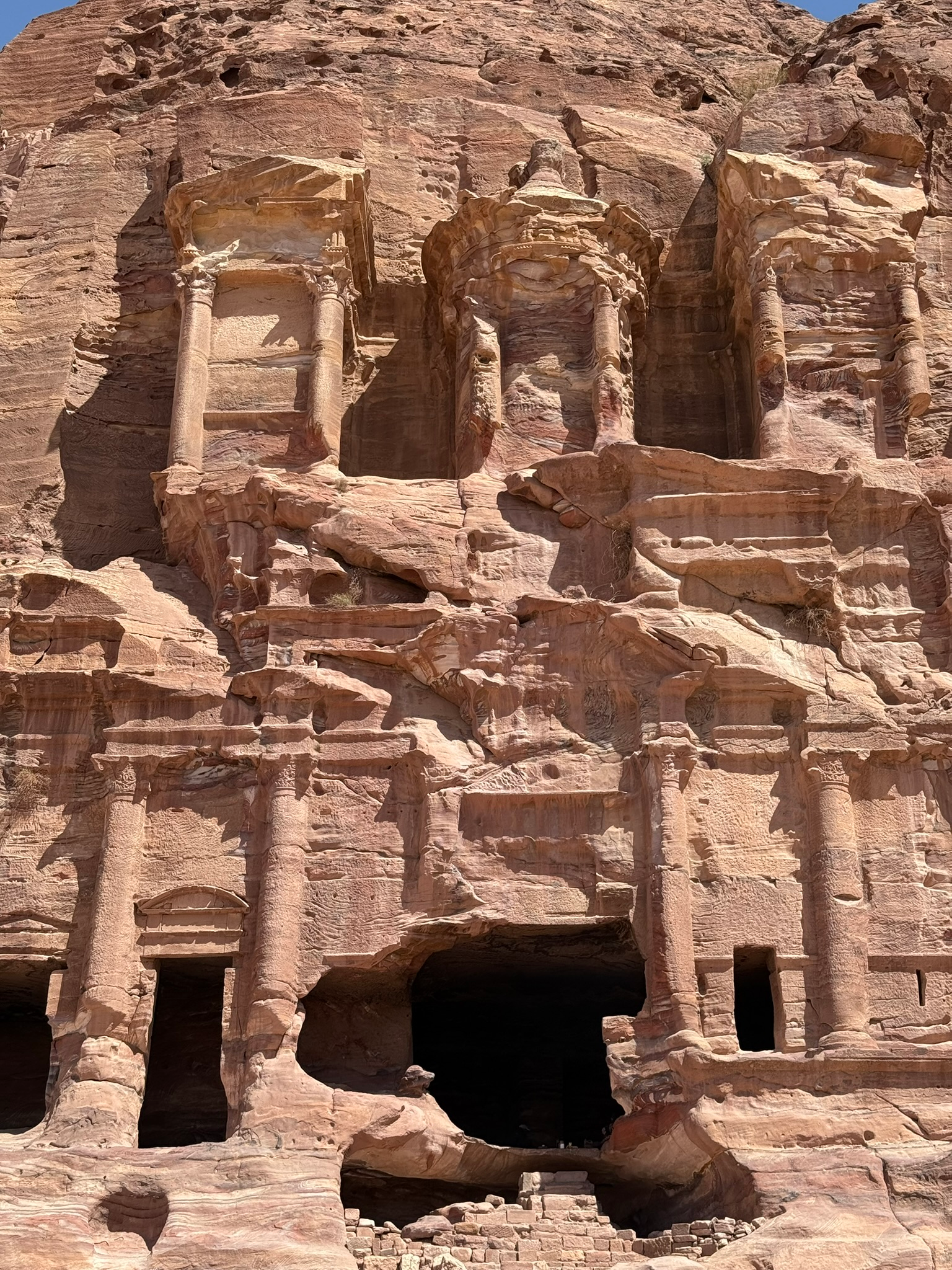
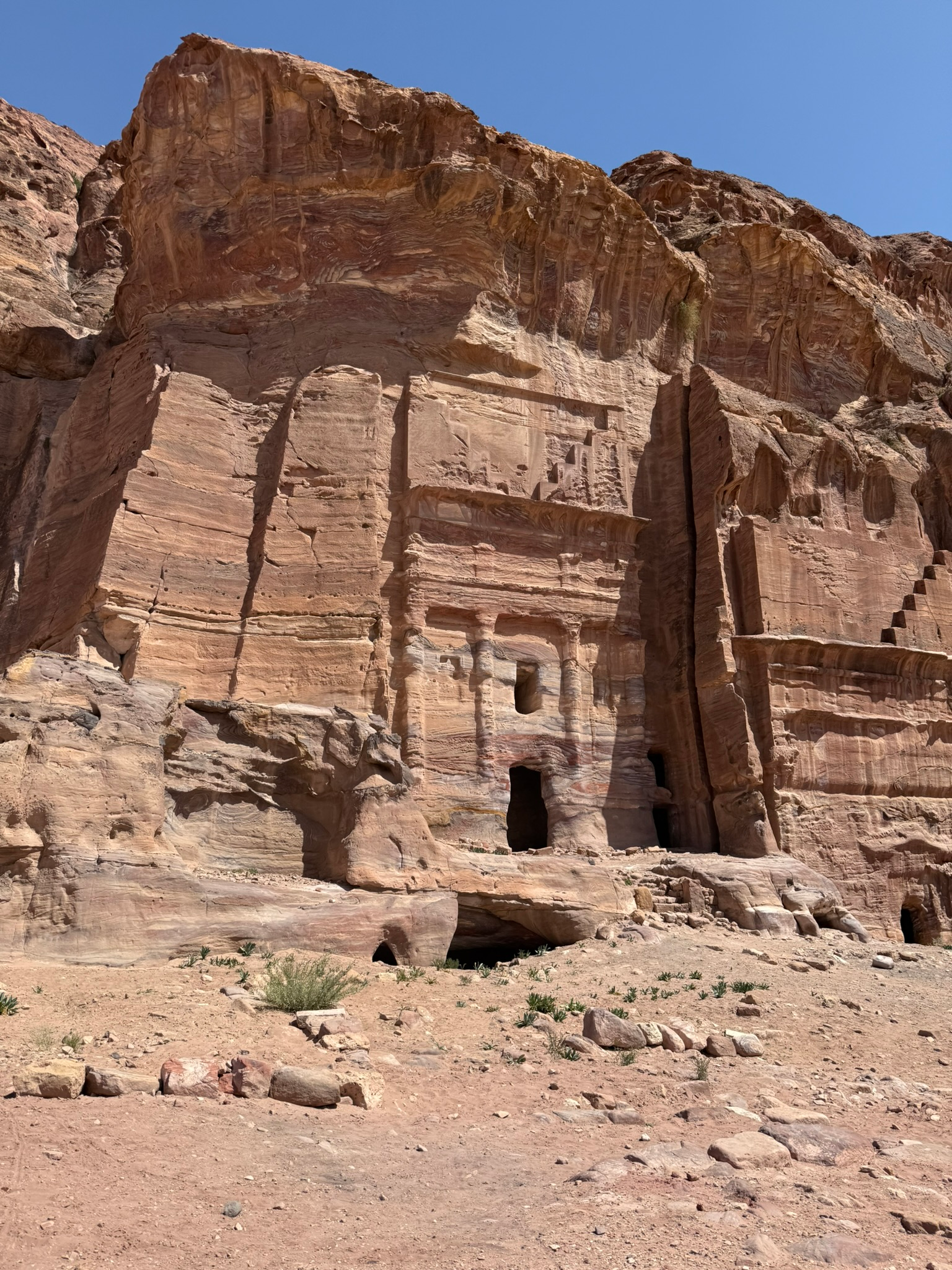
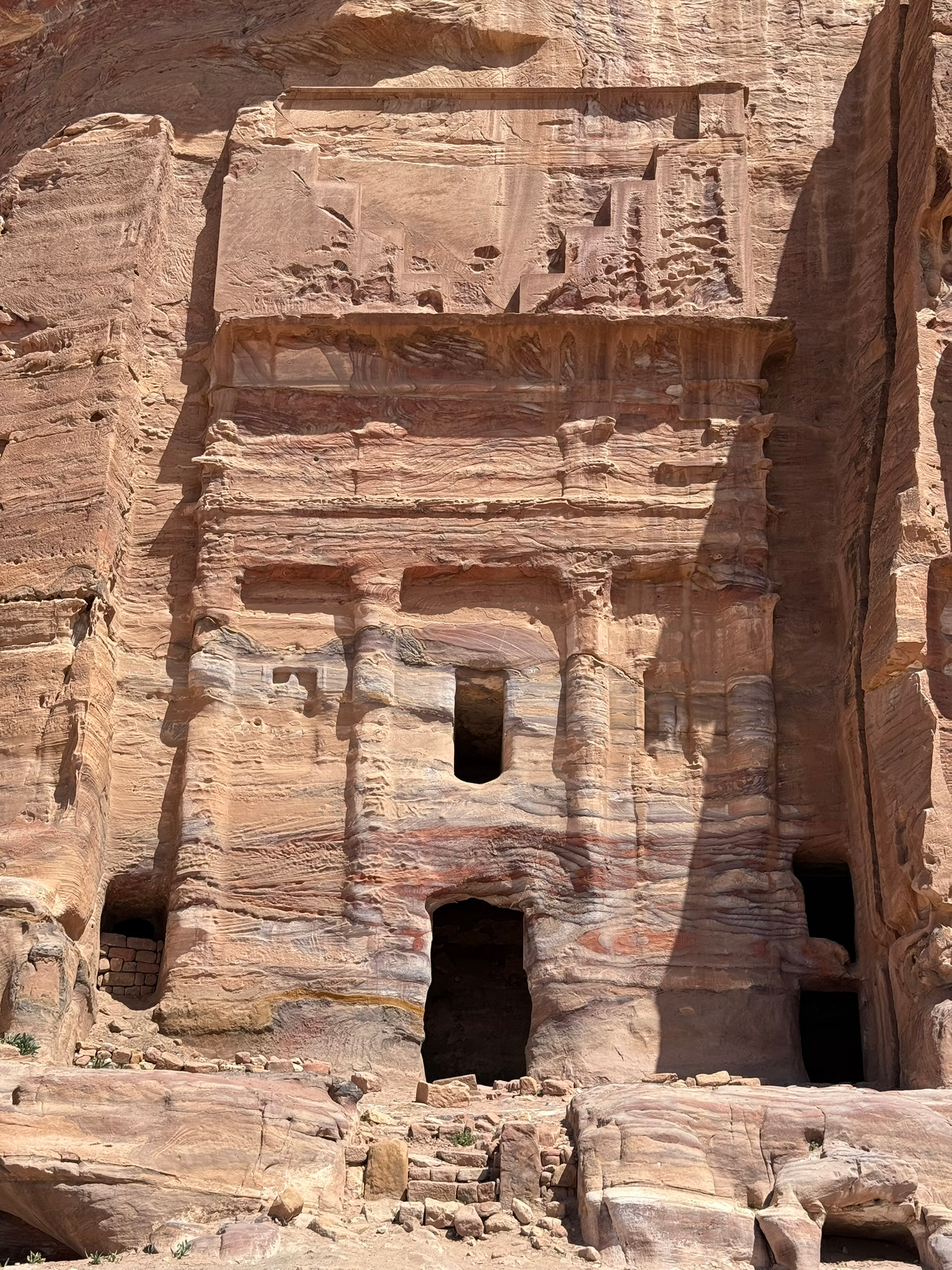
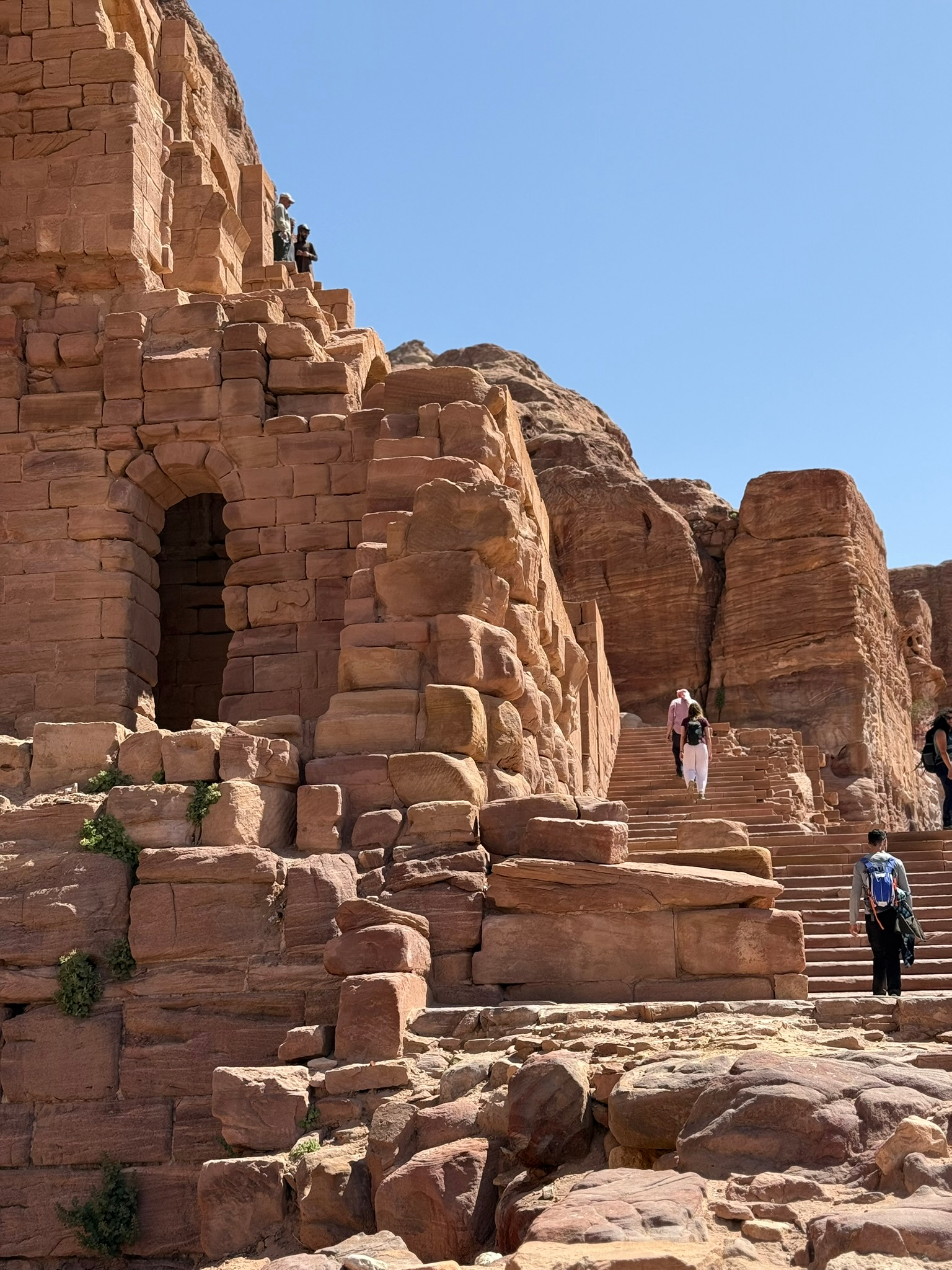
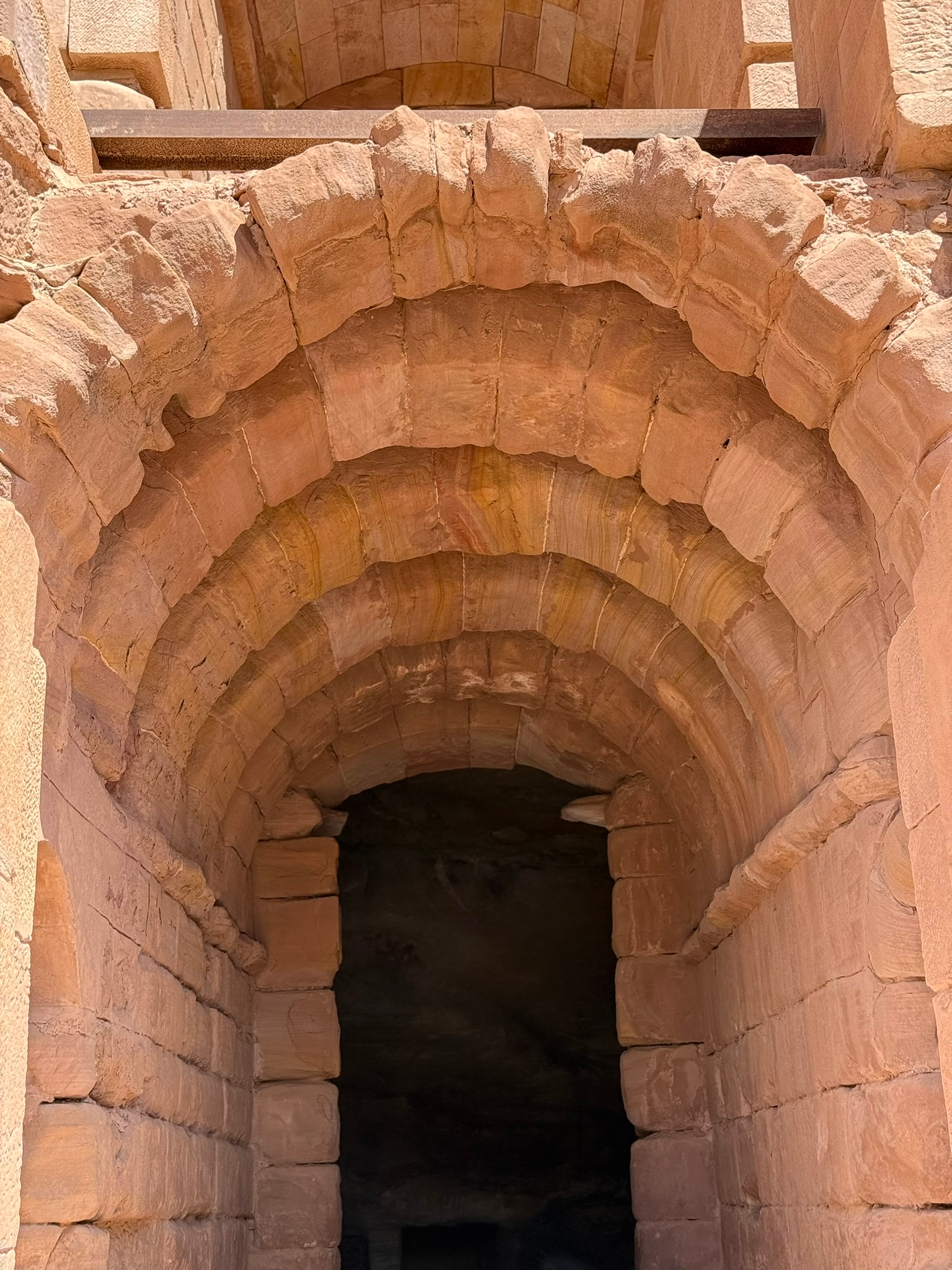
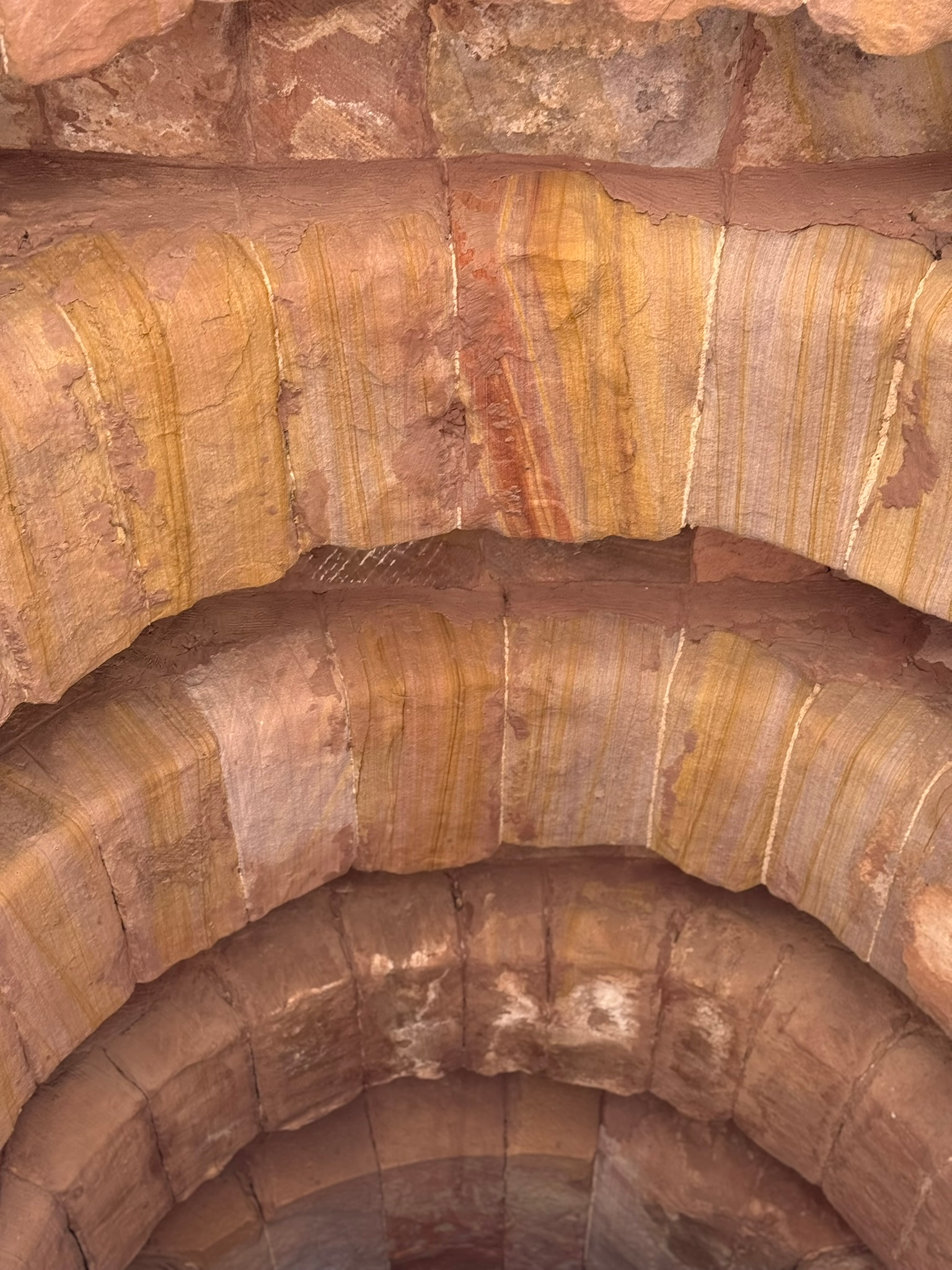
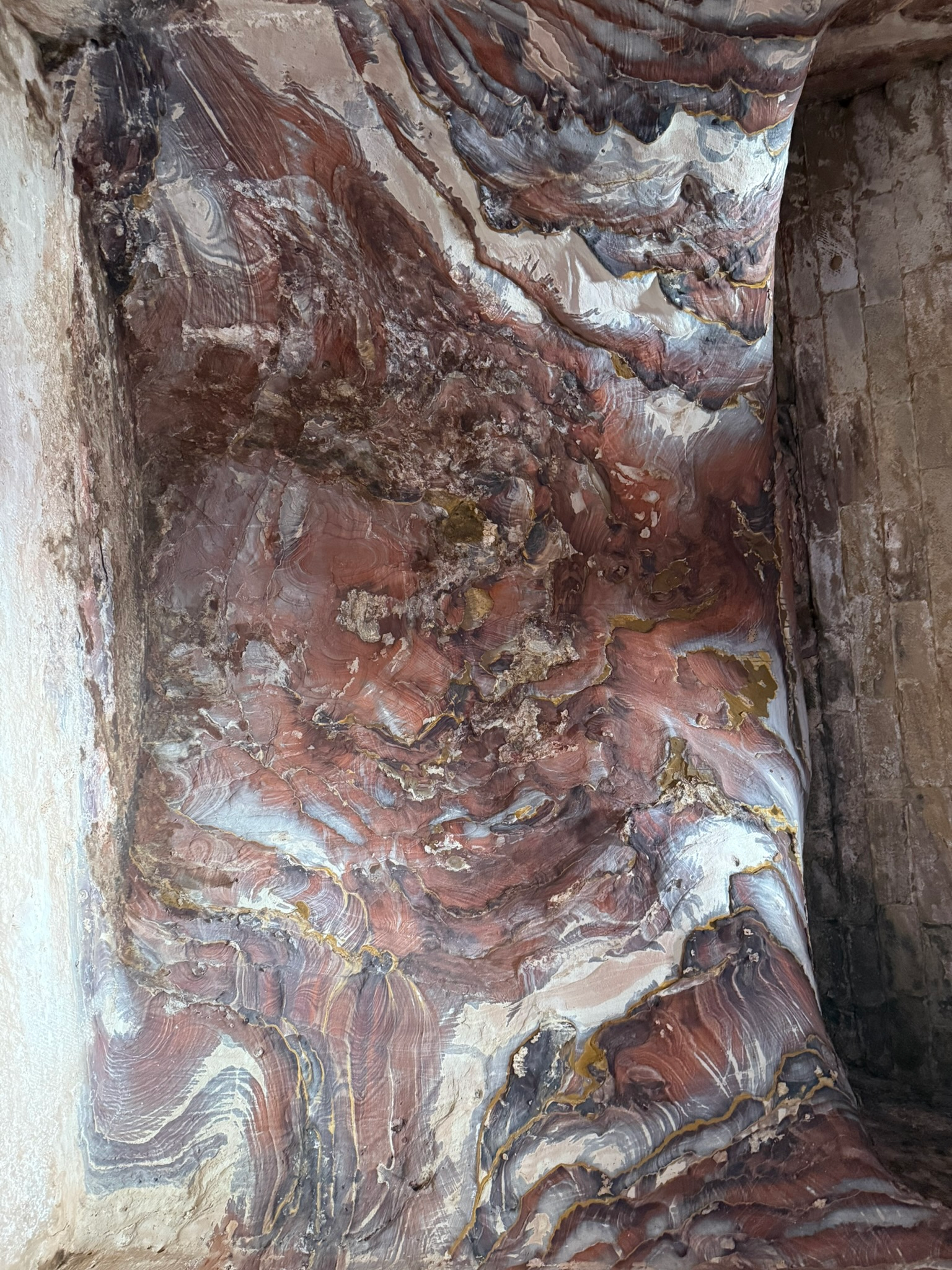
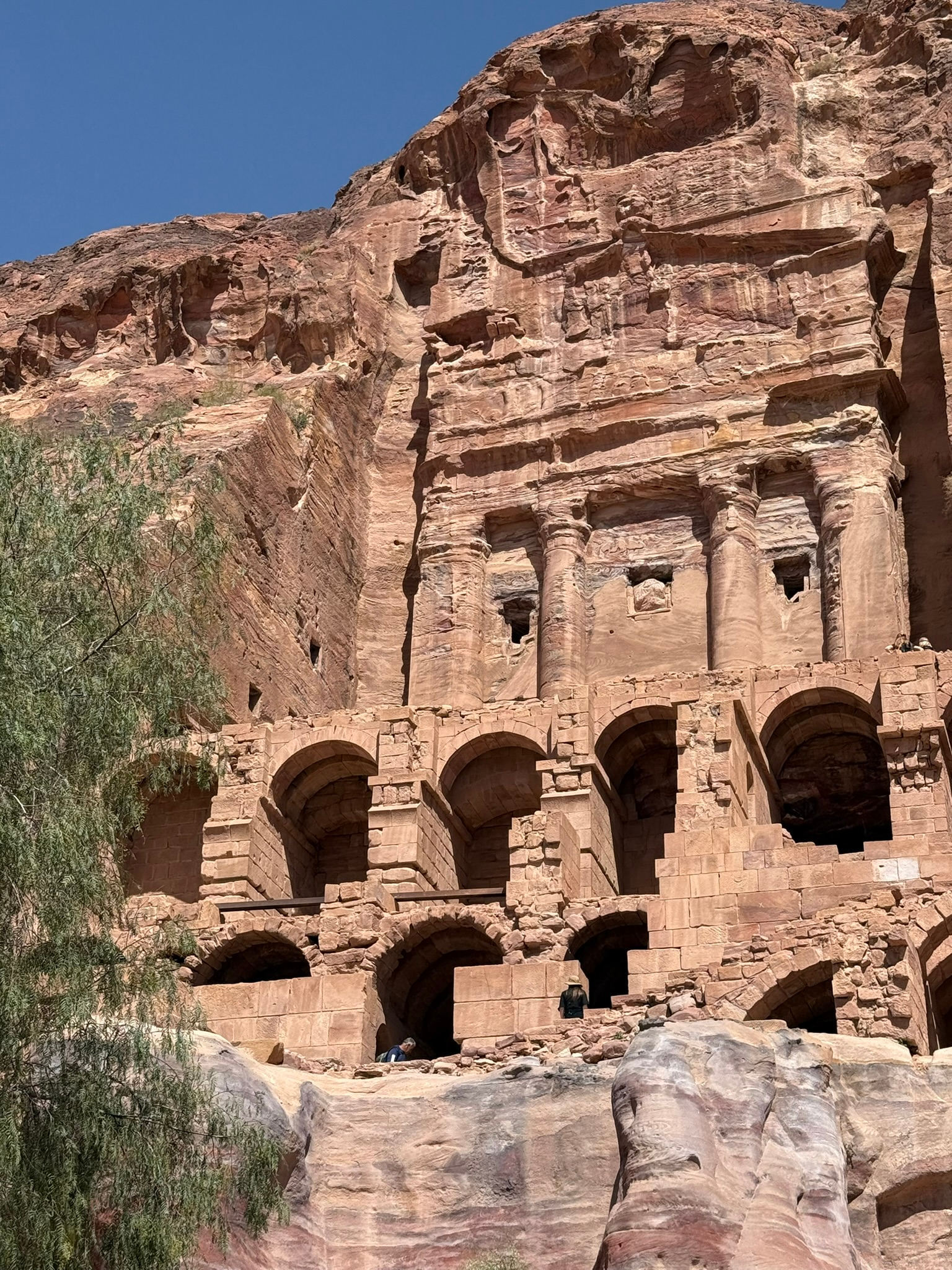
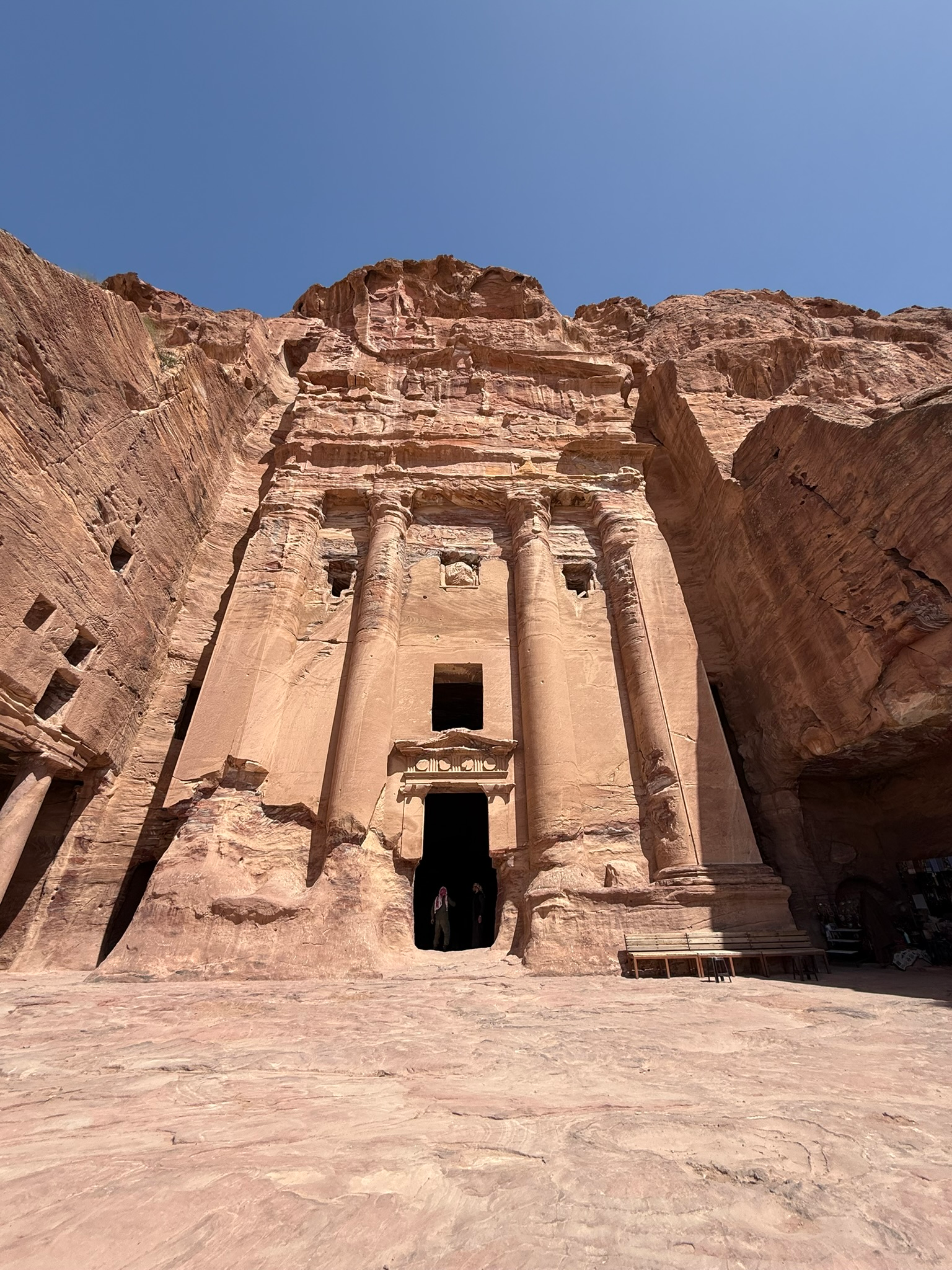
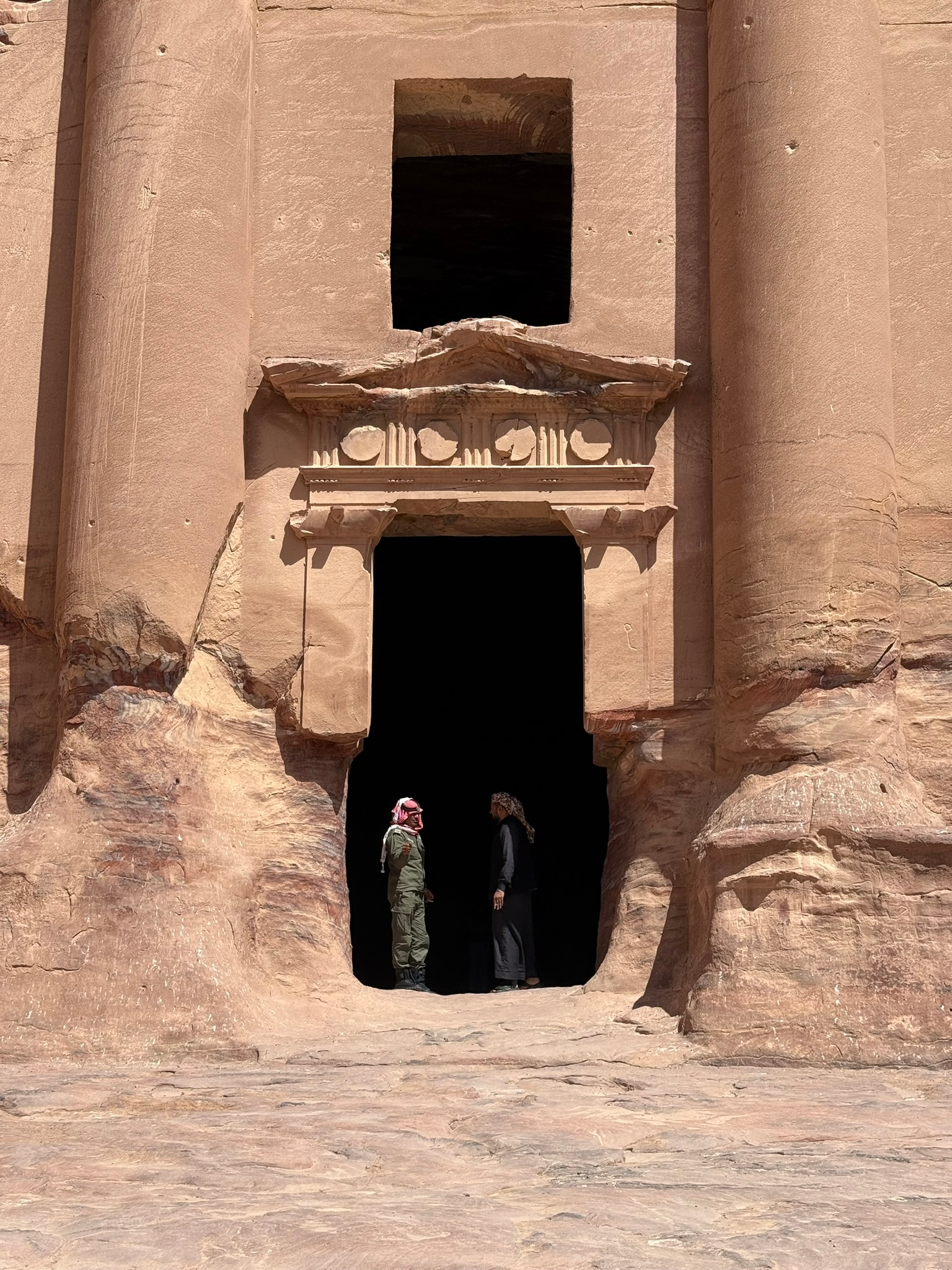
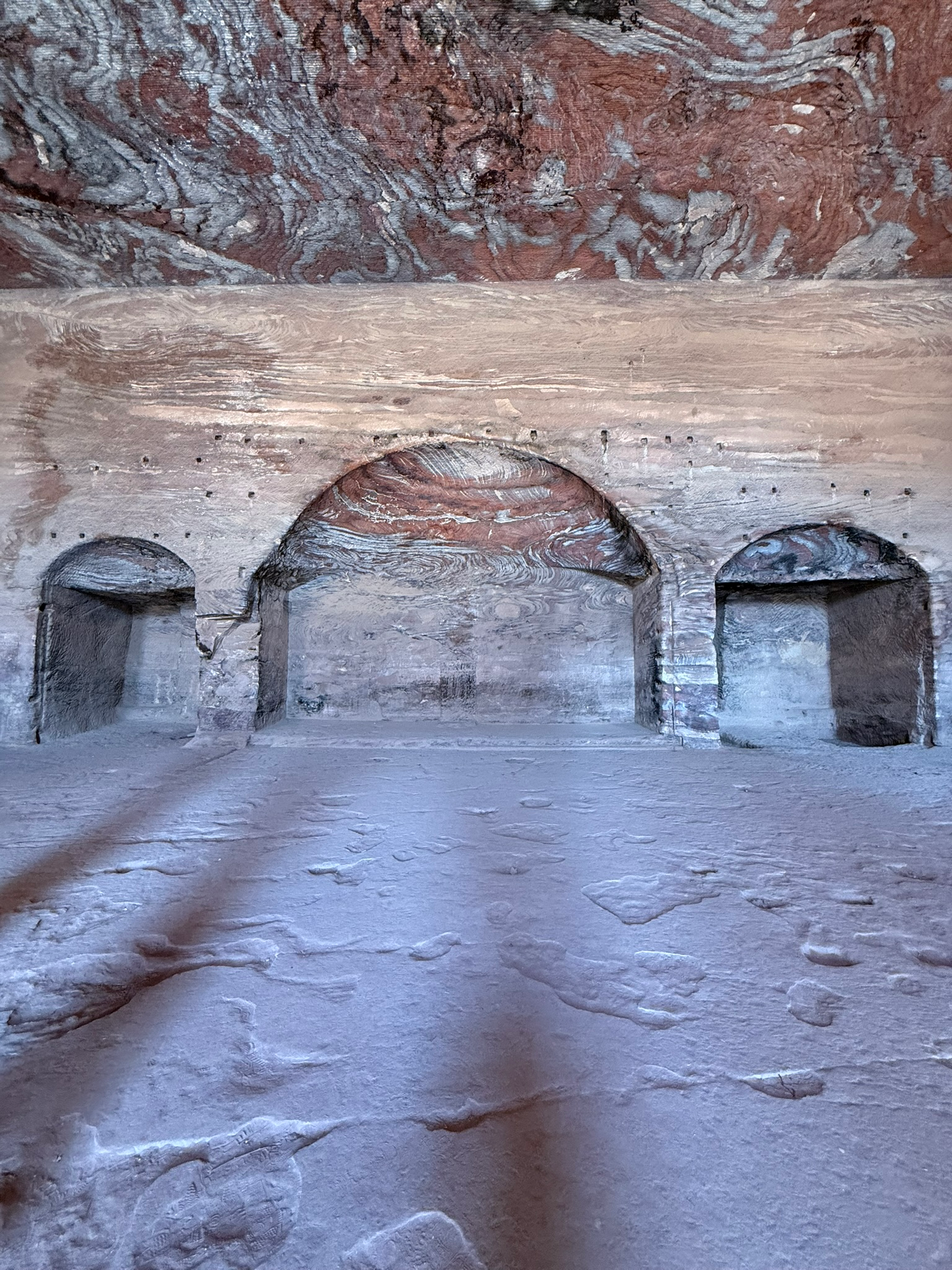
Inside the Urn Tomb, we met a spice and incense vendor who introduced himself as a member of the Bdoul community. These Bedouins, Delia had explained, had inhabited Petra’s caves for generations. During the 1980s, as plans to protect and develop Petra intensified around its designation as a UNESCO World Heritage Site, many Bdoul families were relocated to the purpose-built village of Umm Sayhoun on Petra’s outskirts.
When we asked him about the transition, the vendor explained that it was something they had been forced into and had initially accepted begrudgingly. Nowadays, he said, they also recognised some of the benefits of living in a modern settlement, including access to electricity, schools, roads and running water. At the same time, however, they felt as though they had lost a unique part of themselves and their connection to Petra. Many members of the community now earn their living through tourism, working as guides, vendors, animal handlers or owners of local businesses.

Moving on, we found a spot with a great view of the Theatre ahead of us and stopped for a short break before embarking on the final, and arguably most climactic, part of our tour. As we munched on apples and biscuits, I could still hardly believe that we were there. As always when roaming around ruins, I found myself envisioning how the city must have looked at its peak, with thousands of people going about their daily business, performances and gatherings taking place inside the Theatre, ceremonies being held upon the High Place of Sacrifice and funerals being conducted within the tombs.
There was something bittersweet about being able to explore the remains of a once-great civilisation while knowing that I would never be able to experience it in its living present.
PART III
The Wonder of the World
The short break allowed me to set everything I had already seen aside and prepare for what was still to come – the most popular attraction Petra has to offer: the Treasury.
As the valley narrowed and several hundred people funnelled through the passage ahead of us, it was easy to assume that we were getting close. A few more steps and… Wow. The friggin’ Treasury. Just… Wow. I was left speechless. For a couple of minutes, I simply stood there, unmoving and barely able to breathe, with tears welling up in my eyes. It was stunning. Magnificent. Completely unreal. The other façades we had seen were incredible, but this one was just… Wow…
Well, there’s a reason it’s the most famous part of the city. I remember feeling disenchanted while visiting some of the other New 7 Wonders of the World, such as Machu Picchu and the Colosseum, cause of the sheer number of tourists. Although the Treasury was no less crowded, I can’t say I wasn’t completely spellbound by its exterior.
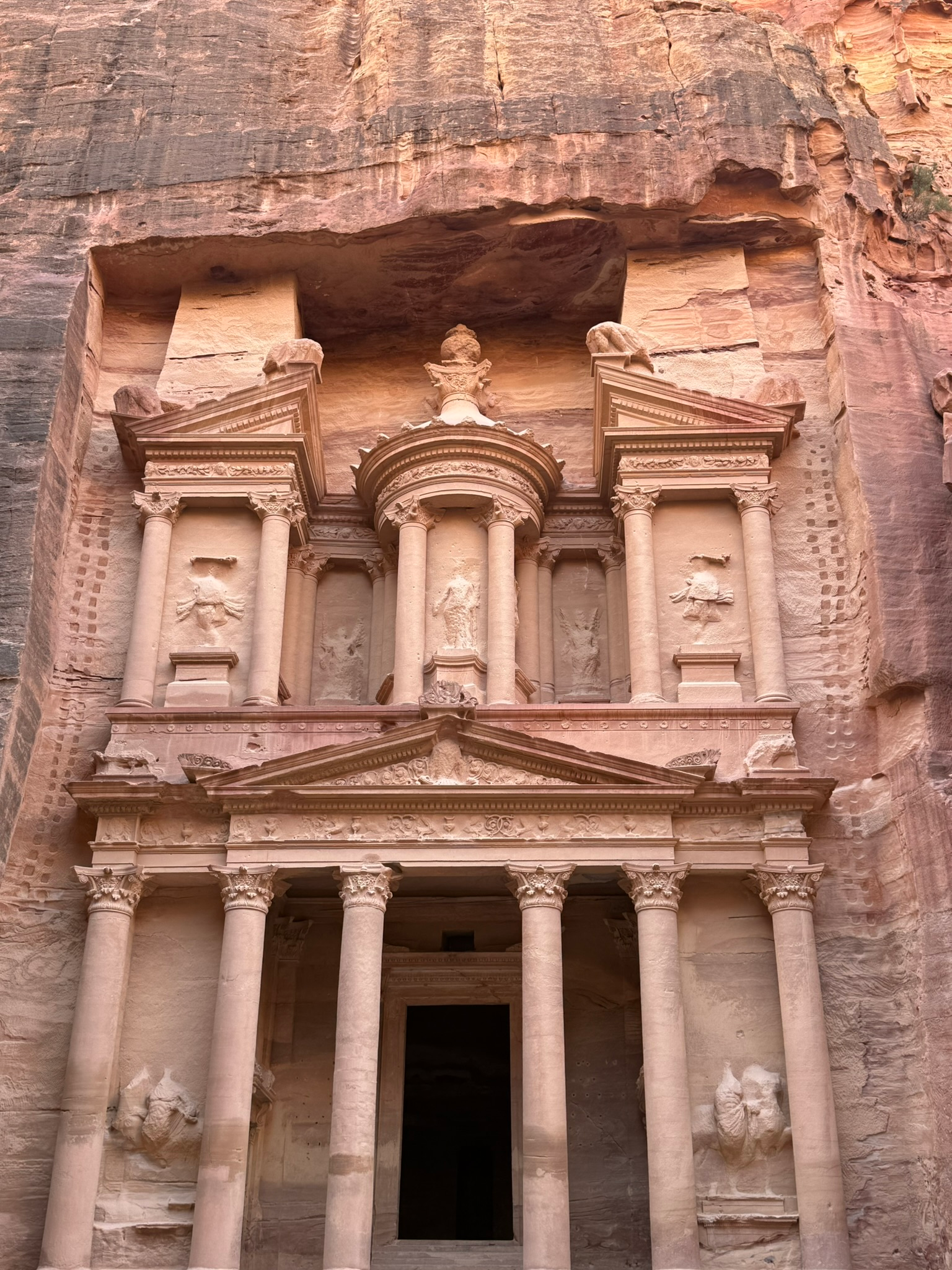
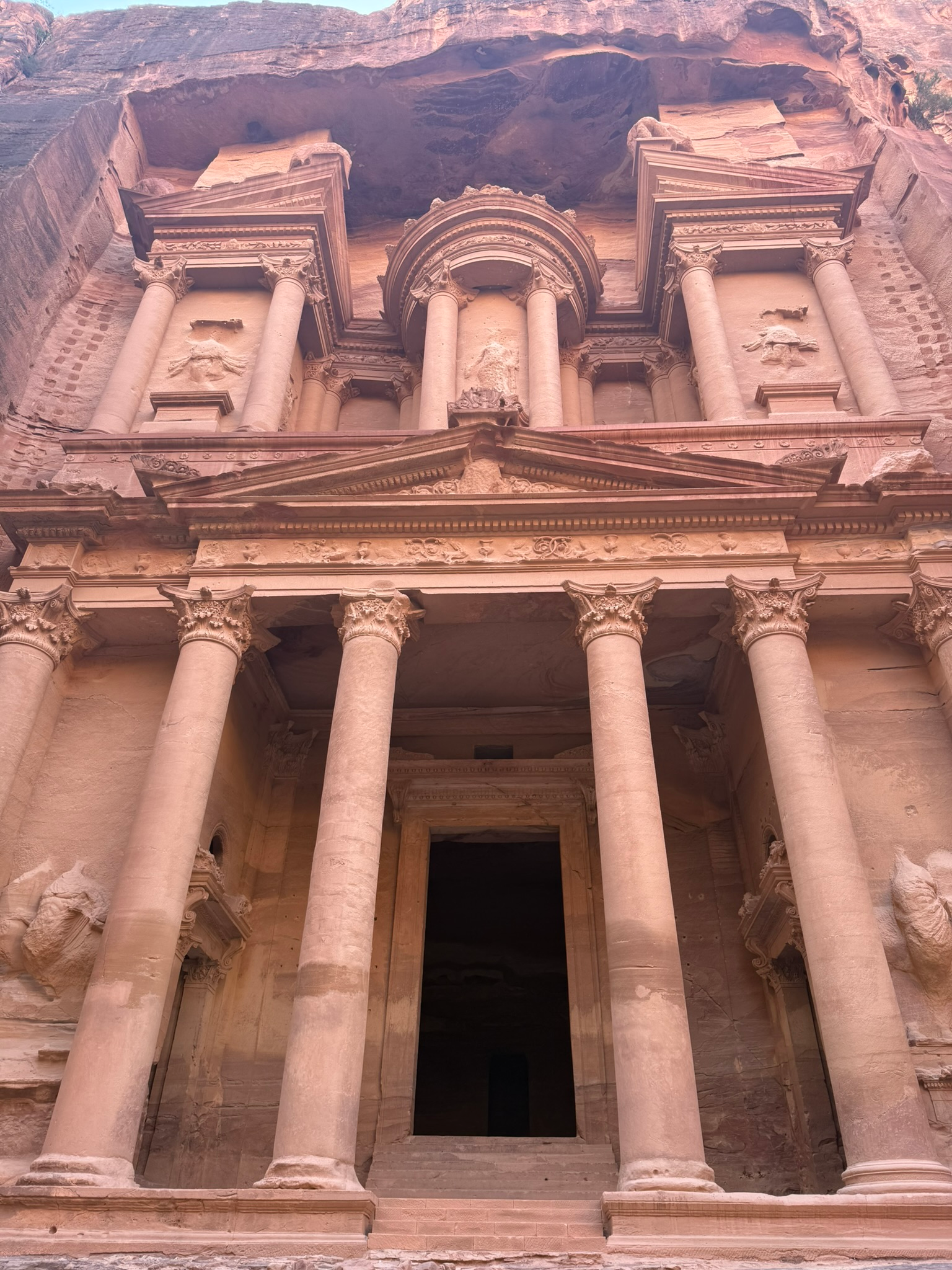
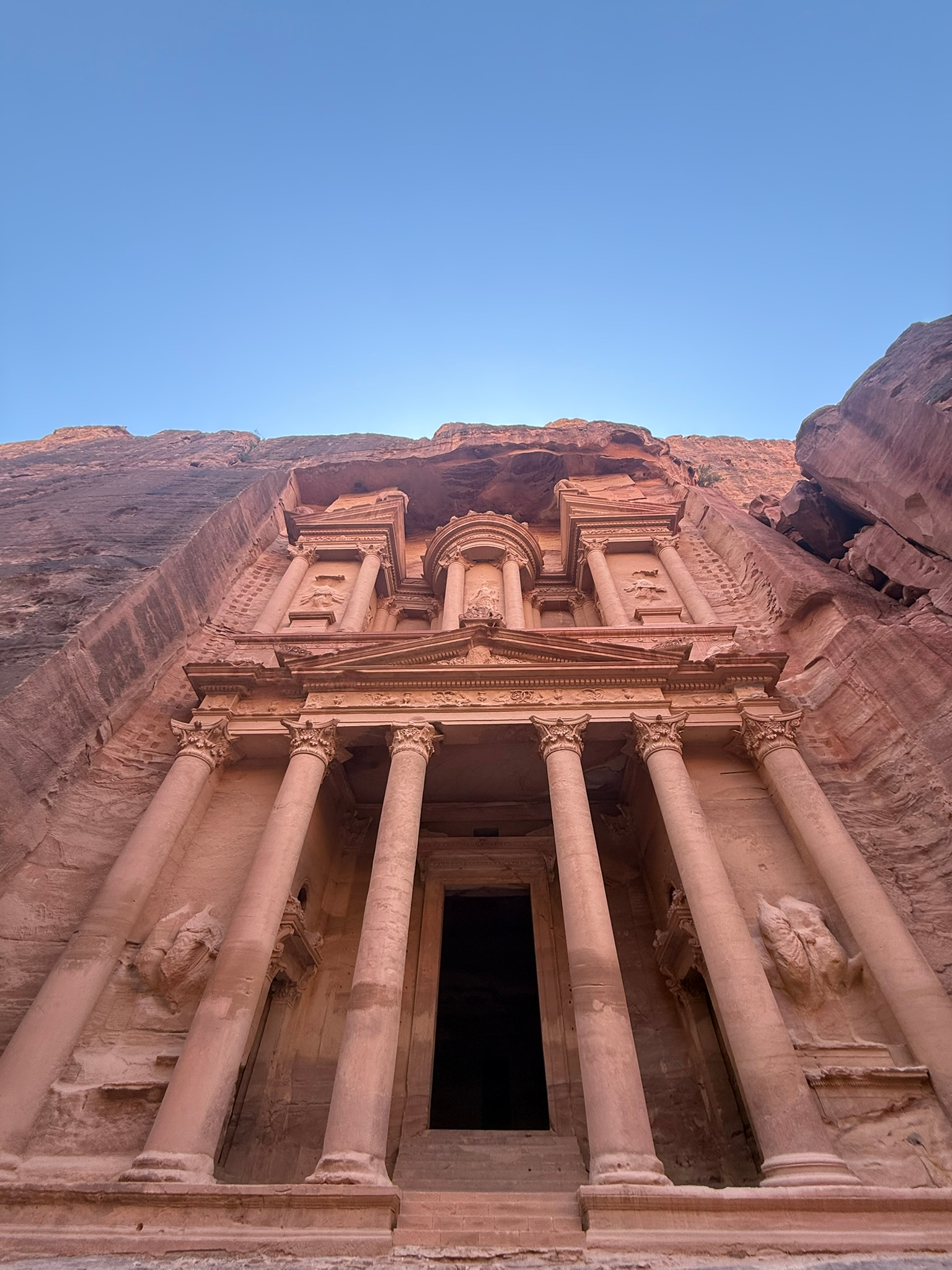
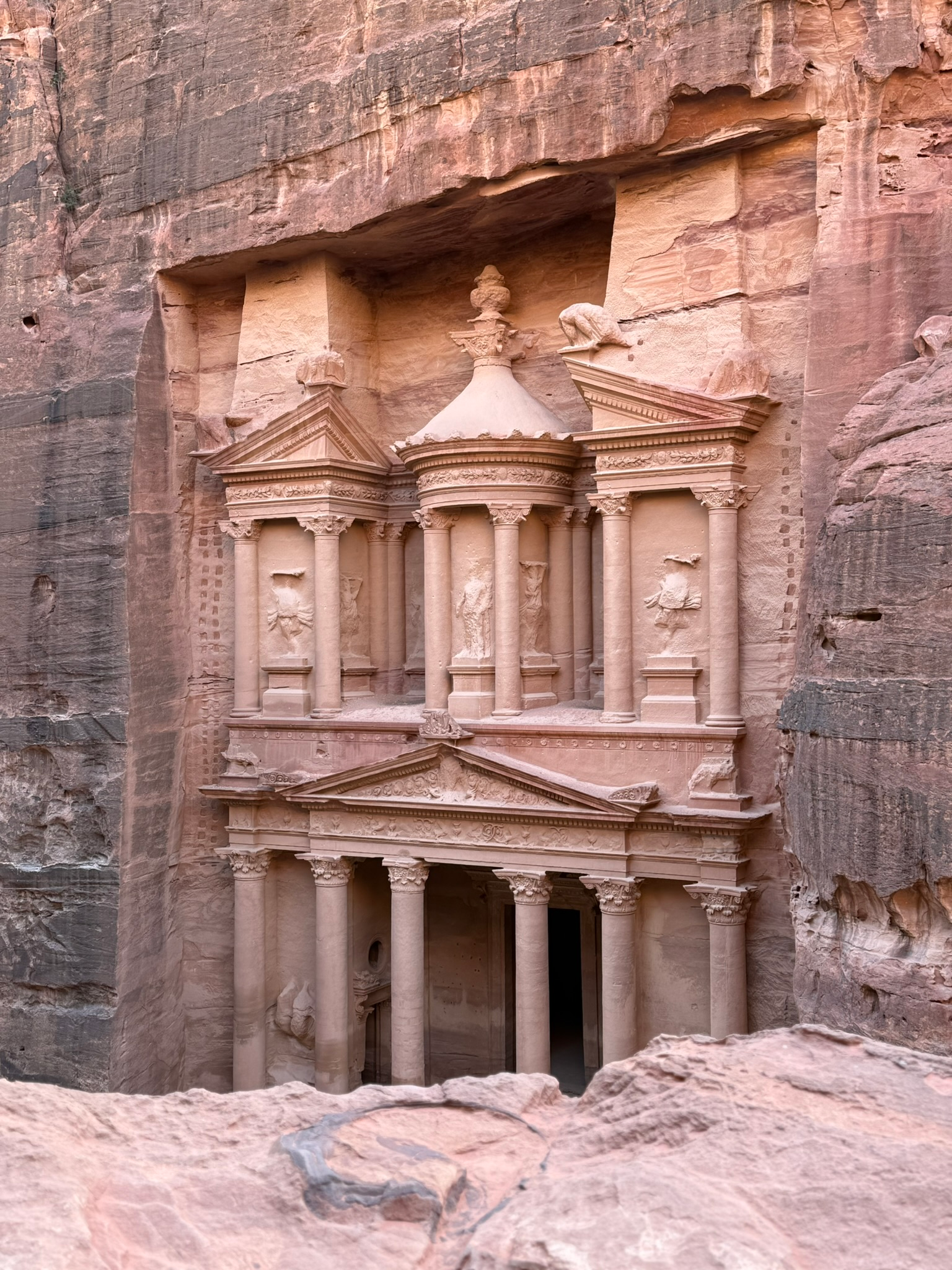
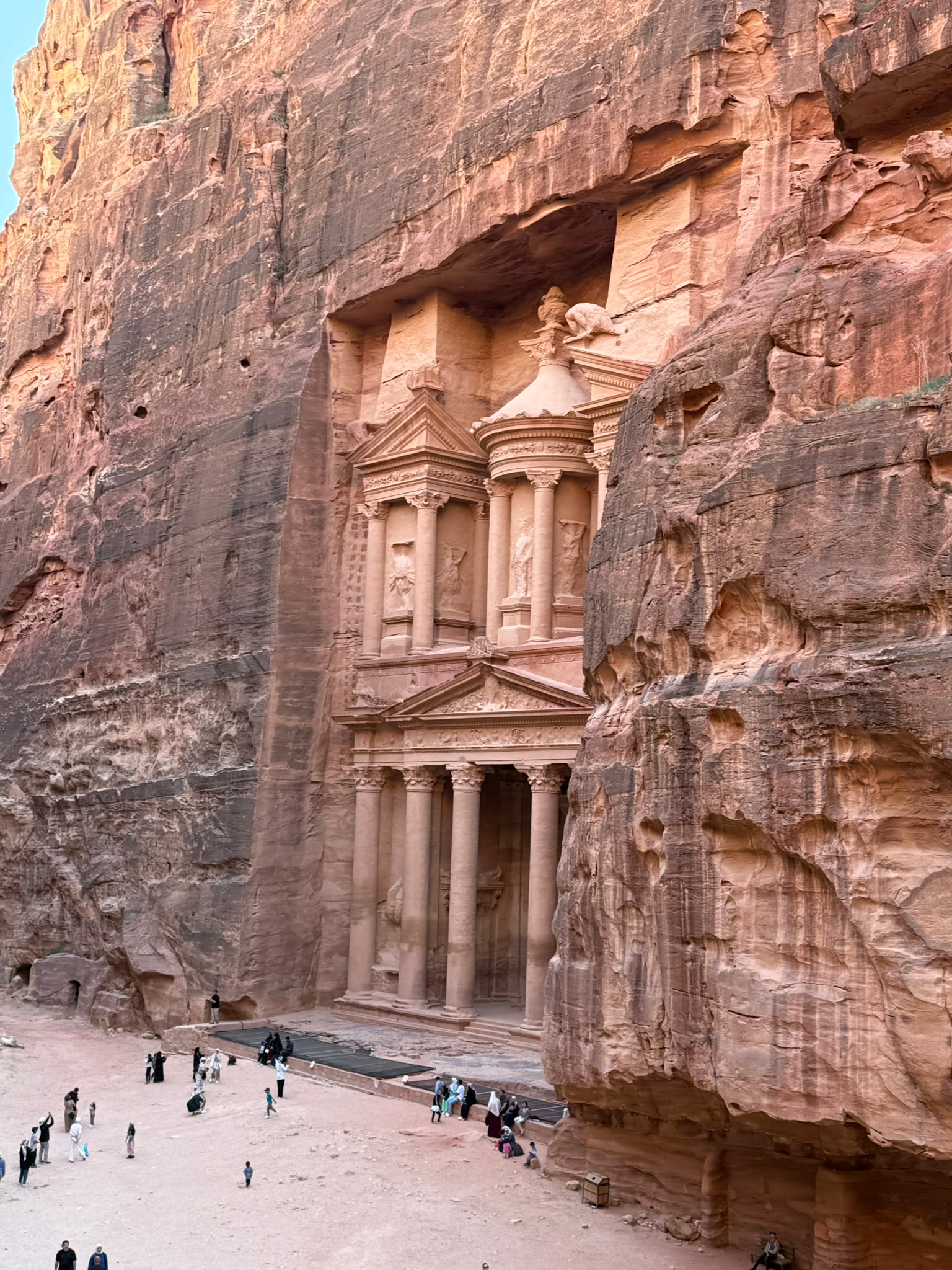
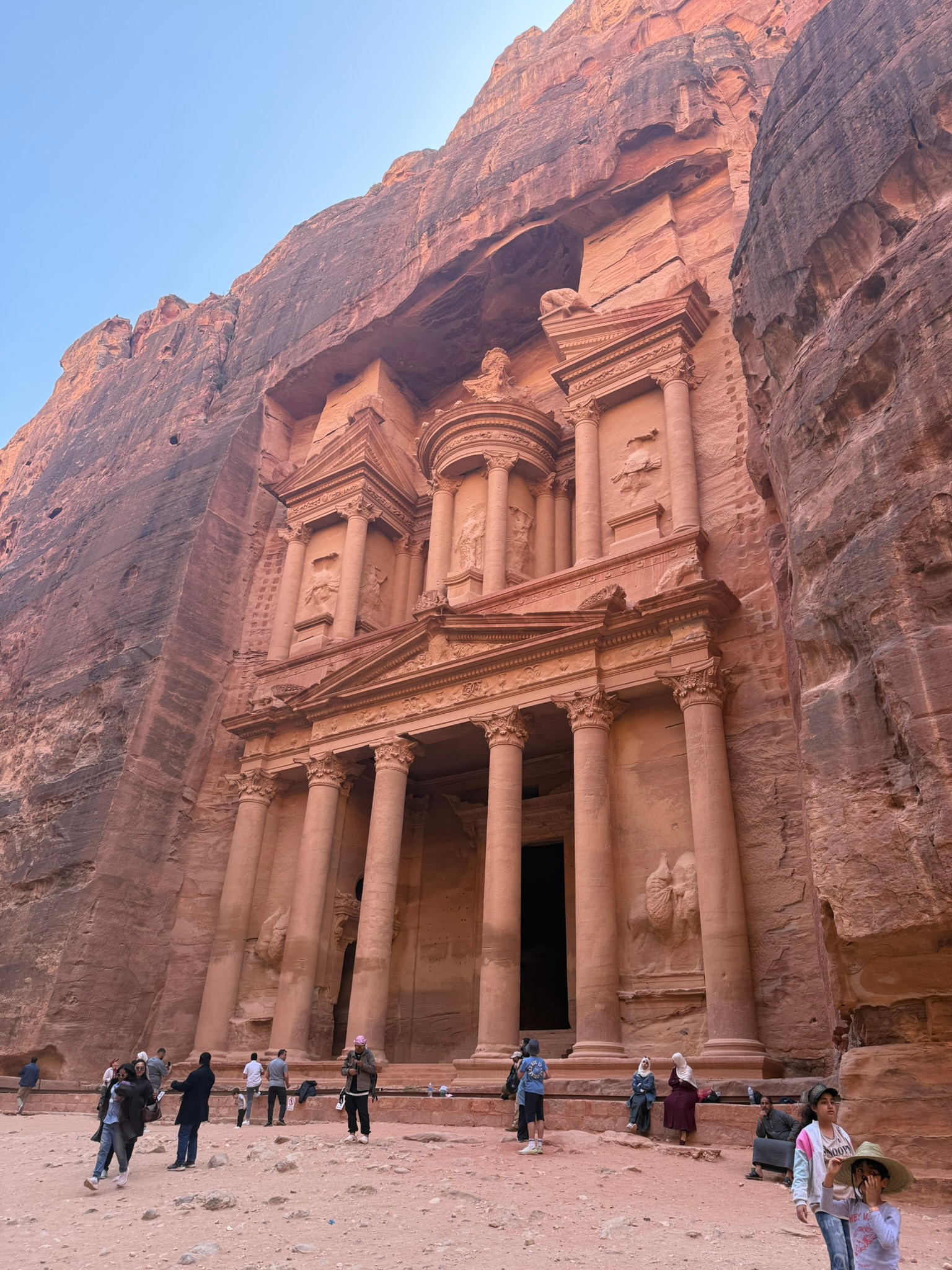
As influencers in flowy dresses gallivanted around on top of camels without so much as glancing at the ruins behind them, I did my best to approach the façade from every possible angle, trying to absorb as much detail as I could. I wanted to map the entire thing inside my head so that I could return to it whenever I wanted.
That, however, proved to be quite a complex task, given that this façade was far more intricately designed than any of the others we had seen. Or rather, it was far better preserved, largely because of its sheltered position at the end of the Siq.
Tales of the Treasury
Before being set loose and left to our own devices, Delia took us far from the crowd that had by then swarmed the site and gave us a bit of a lecture on the Treasury.
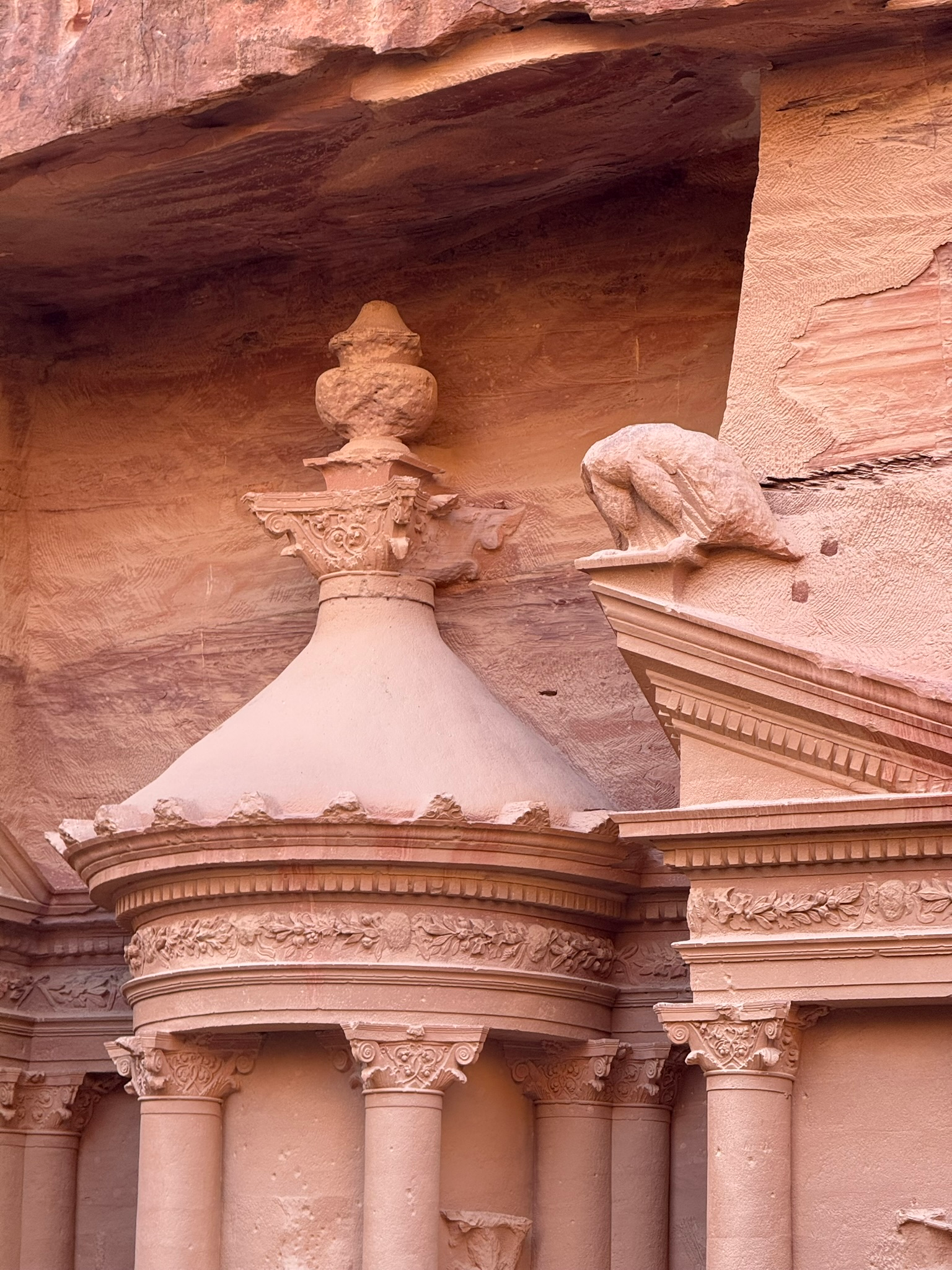
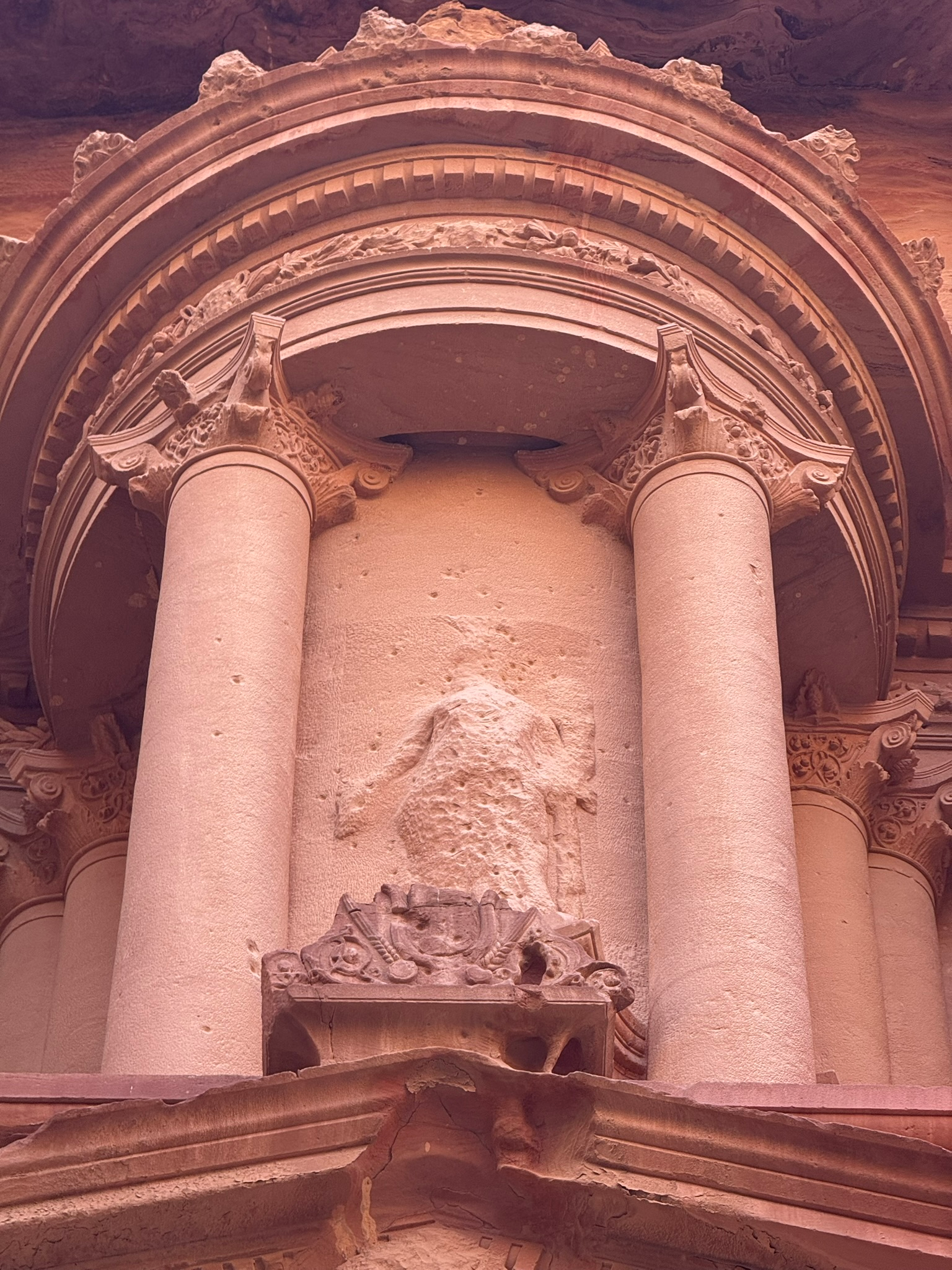
Known in Arabic as Al-Khazneh, meaning ‘the Treasury’, the monument acquired its name from a local Bedouin legend claiming that an Egyptian pharaoh had hidden his riches inside the enormous urn at the top of the façade. As one version of the story goes, the pharaoh was fleeing with his treasure when its weight began slowing him down, so he magically created the monument and hid his fortune inside it. Cause why the hell not? To this day, bullet marks remain visible around the urn, left by people who reportedly fired at it in the hope of releasing the treasure inside. Unsurprisingly, the urn is made of solid sandstone.
In reality, the Treasury was probably constructed during the first century AD as a royal funerary monument. It has often been associated with the Nabataean king Aretas IV, who ruled during Petra’s golden age, although no surviving inscription confirms precisely who commissioned it or who was buried there.
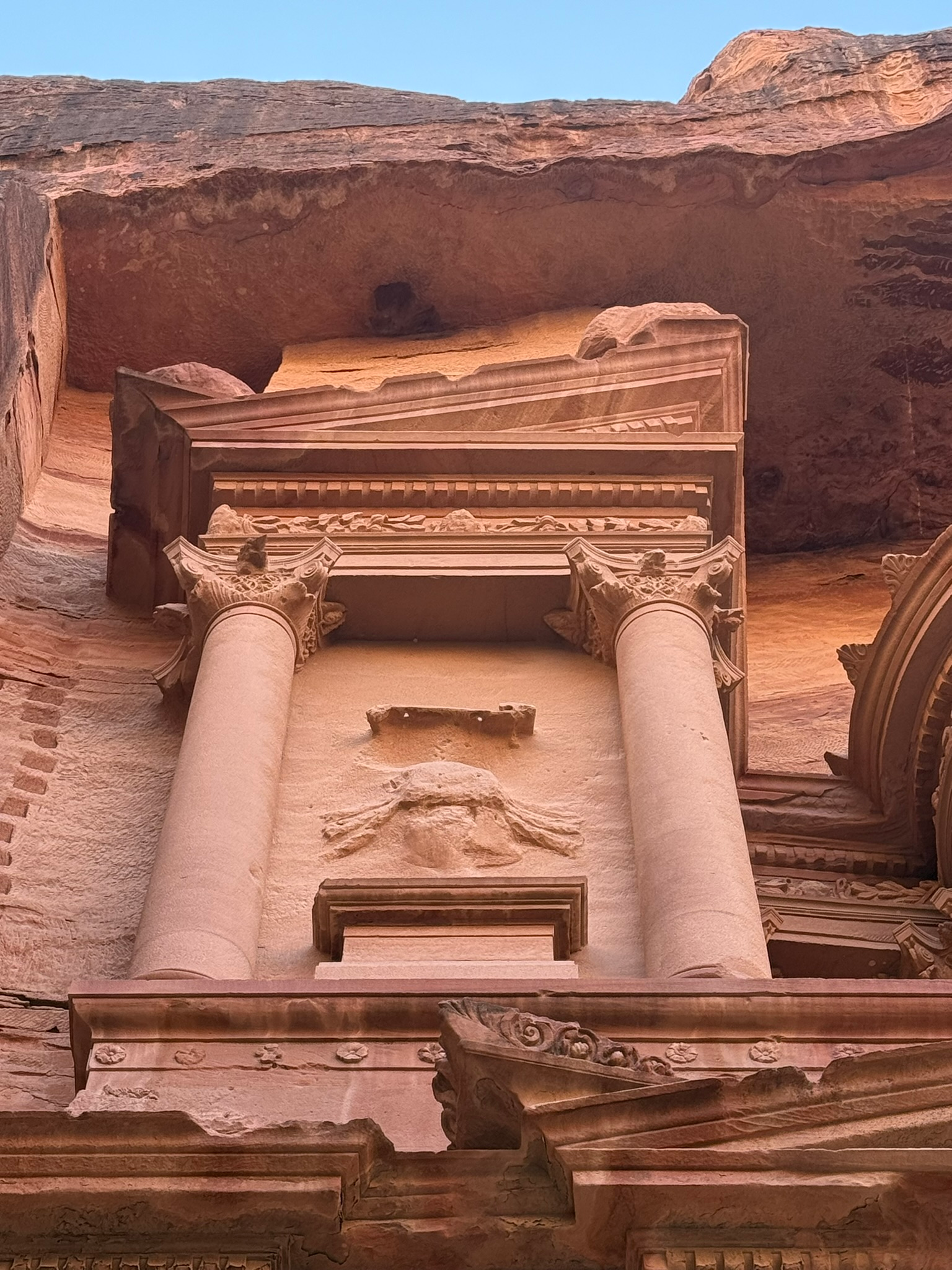
Much like Petra’s other great monuments, the Treasury is carved directly into the sandstone cliff. Its architecture is predominantly Hellenistic, with Egyptian, Greek, Roman and Nabataean imagery combined across the façade. Rather than belonging neatly to one culture, its design reflects the cosmopolitan world of Petra, where traders, pilgrims and travellers from across the ancient world regularly encountered one another. Its prominent position at the end of the Siq was surely no coincidence. For most visitors entering Petra by the traditional route, this would have been their first view of the city’s monumental architecture – one hell of an introduction.
The Grand Façade
So… A bit about the Treasury’s architecture… Similar to the Monastery, the façade consists of two levels:
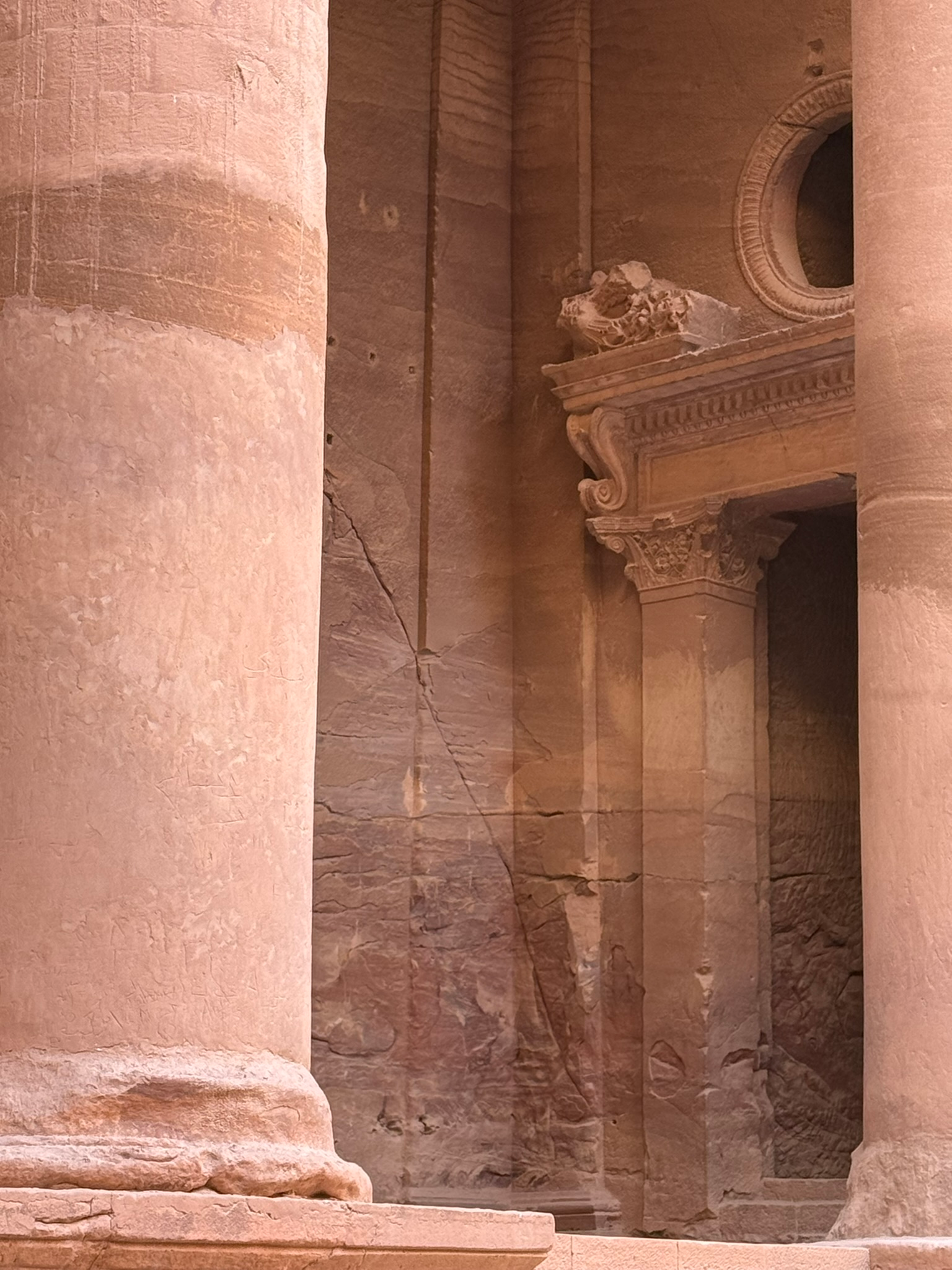
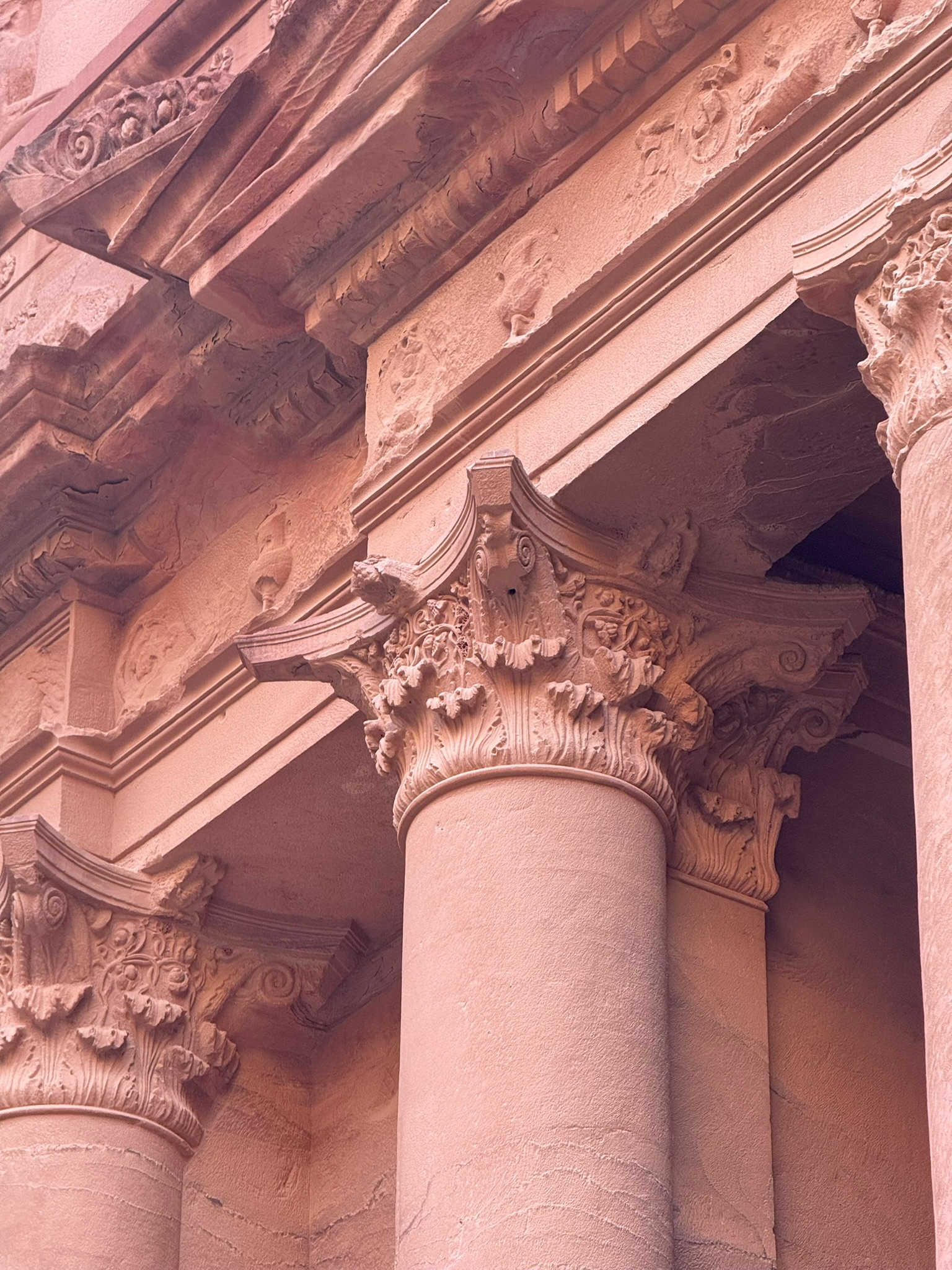
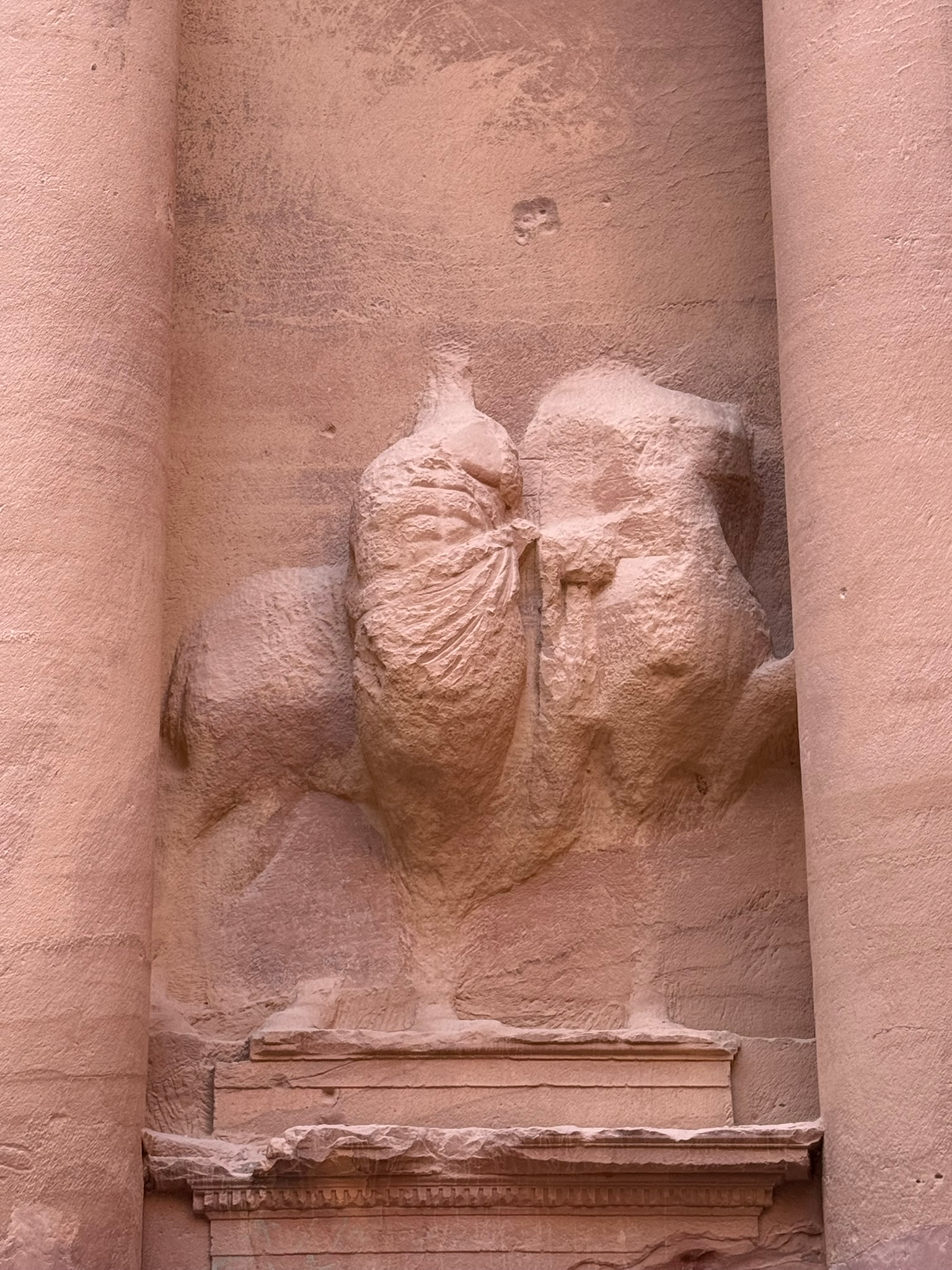
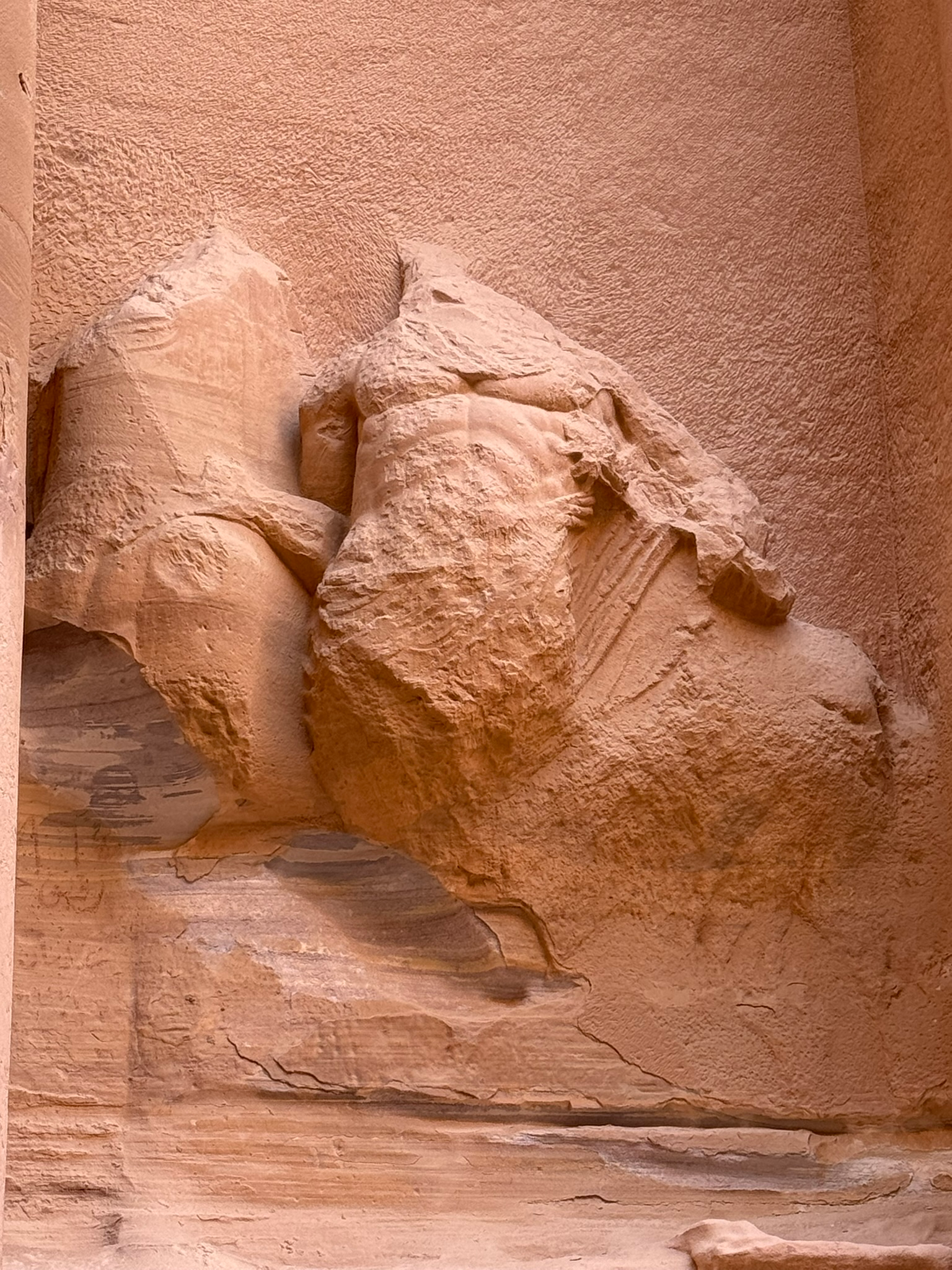
- The lower order: This is structured by six Corinthian columns supporting a richly decorated entablature and triangular pediment. On either side of the central entrance are reliefs usually identified as the Dioscuri twins, Castor and Pollux, shown on horseback. In Greek and Roman mythology, the twins were associated with protection, travel and safe passage – highly appropriate figures for a monument standing at the entrance to a major caravan city. Beyond the entrance lie a series of surprisingly plain chambers. After the splendour of the exterior, the undecorated interior feels almost underwhelming, reinforcing the idea that the façade itself was intended to communicate status, power and religious meaning.
- The upper order: This features an elaborate broken pediment surrounding a circular tholos. At its centre is a heavily weathered female figure generally interpreted as Isis-Tyche, combining elements of the Egyptian goddess Isis with Tyche, the Greek goddess of fortune. She is surrounded by figures commonly identified as Winged Victories and dancing Amazons, while eagles perch above sections of the pediment. Because the carvings are badly eroded, some of these identifications remain open to interpretation.
After Delia explained the structure’s historical importance, she gave us a couple of hours to roam around. We could have climbed to the High Place of Sacrifice, but we all opted to spend our remaining time in front of the Treasury. We were completely worn out and didn’t feel like hiking up another mountain just yet.
Instead, we explored the site to our hearts’ content. We made sure to inspect the façade from every possible angle, including from an elevated viewpoint that we had to pay to access. But hey, it was well worth both the money and the climb!
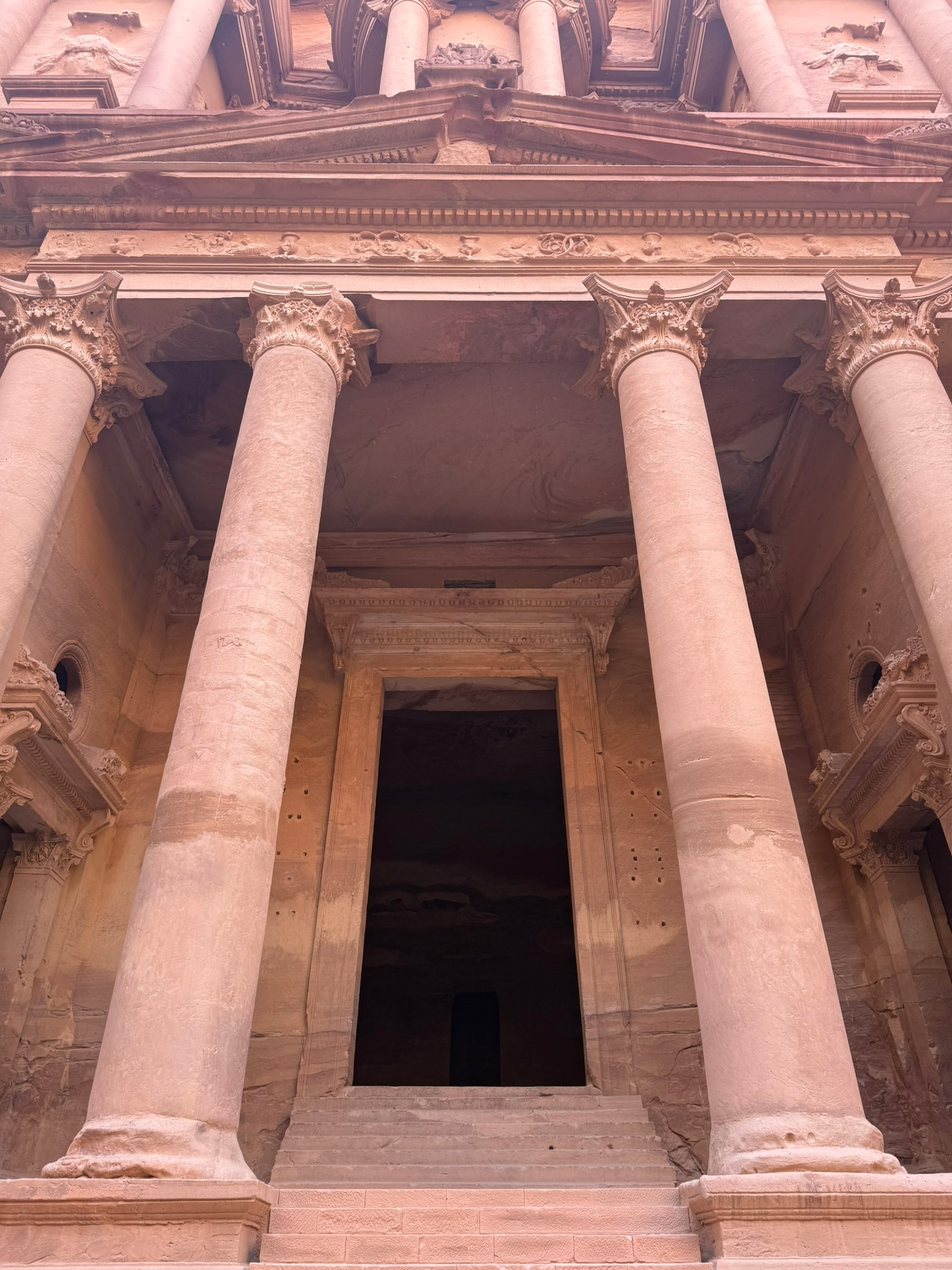
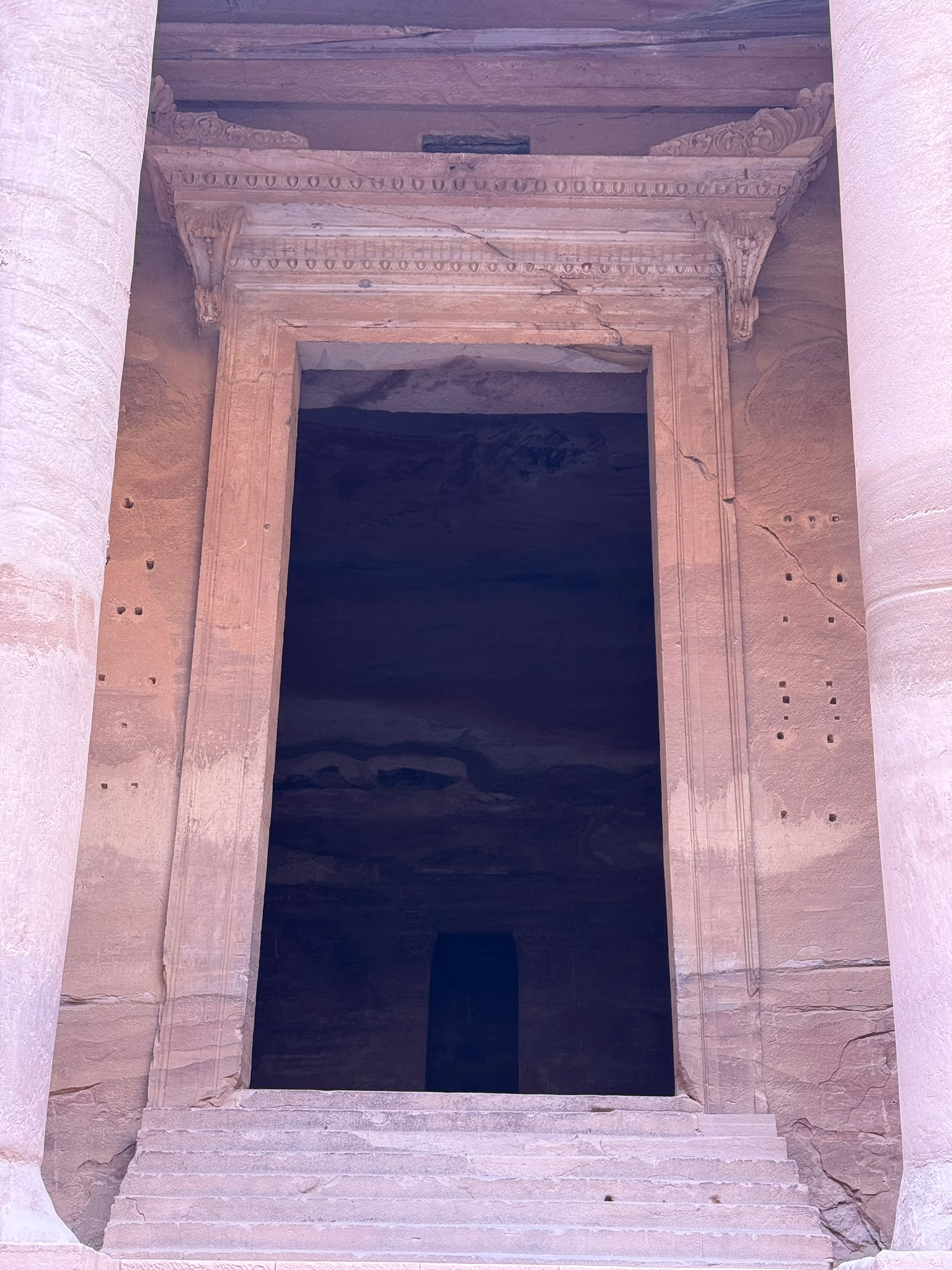
Saving the Siq for Last
With our hearts and phone storage full, we were ready to move on to the final part of our tour – and, sadly, the end of our trek.
That said, much like the rest of the trail that had brought us here, the gorge we followed towards the Visitor Centre left us in awe throughout. Known as the Siq, a name that literally means ‘the shaft’, this narrow natural gorge runs for just over a kilometre and serves as the traditional entrance to Petra. Having entered through the back door, however, we had kinda saved the best for last. Most visitors experience the route in the opposite direction, walking through the Siq before emerging dramatically in front of the Treasury.
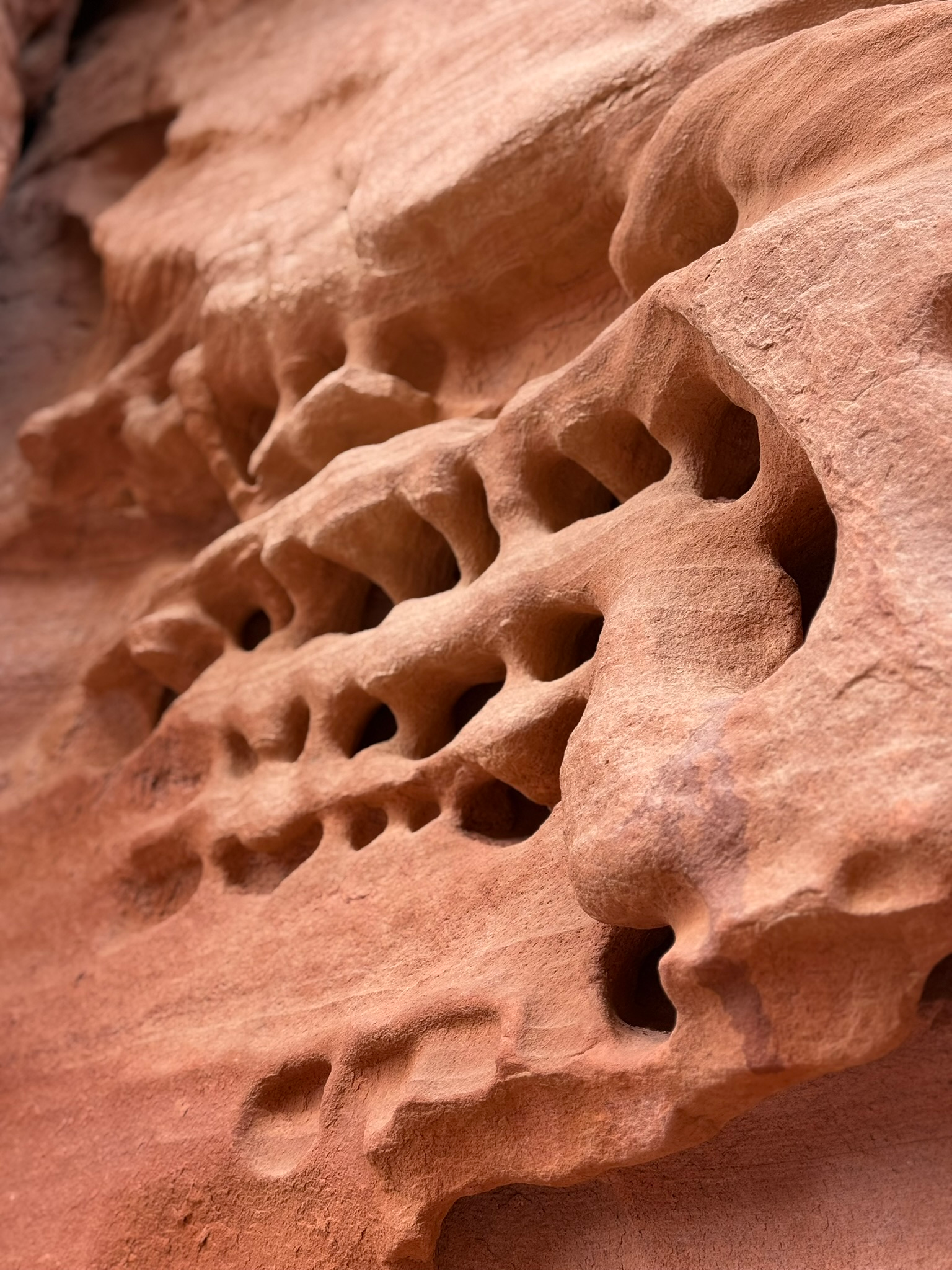
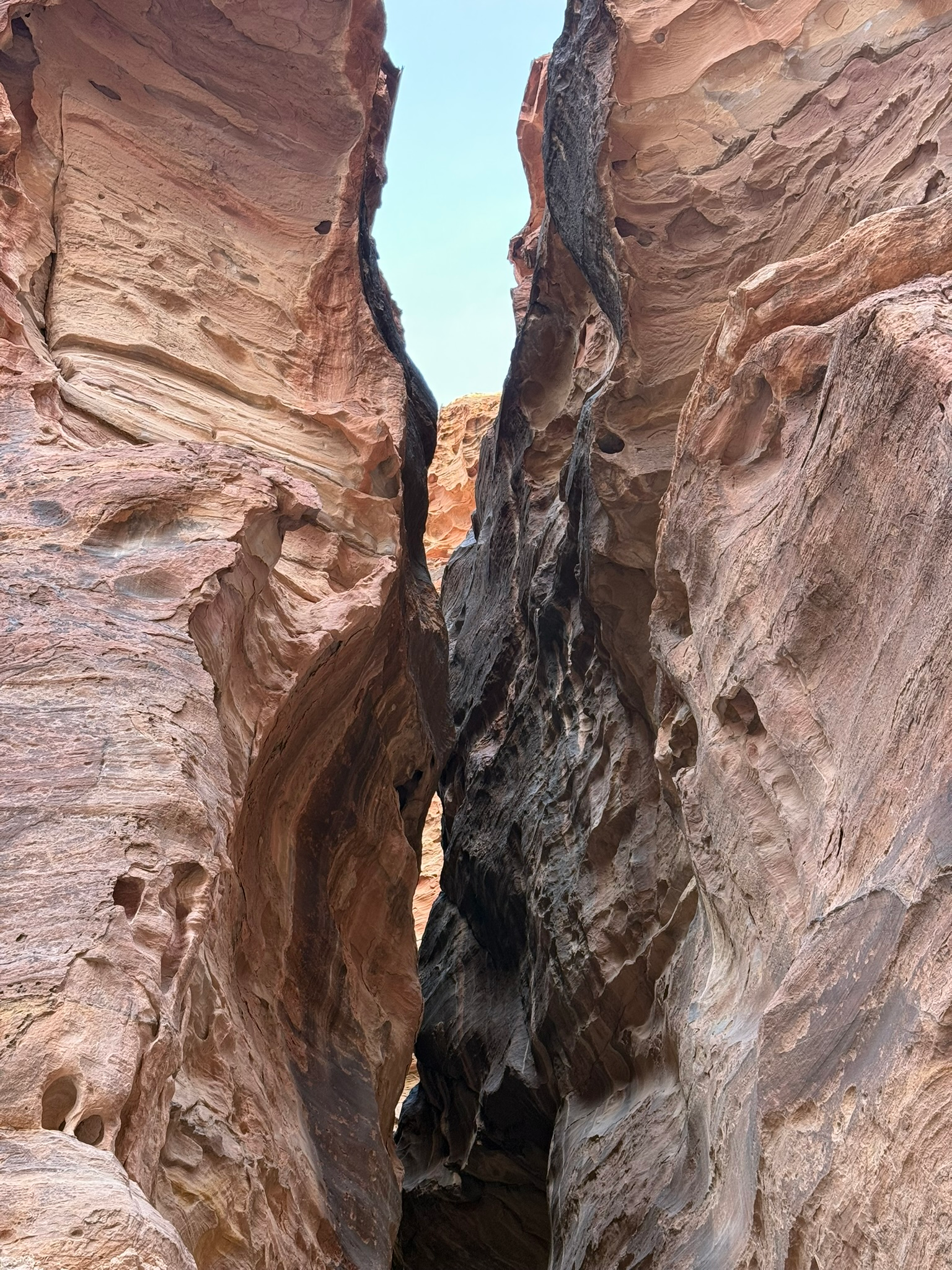
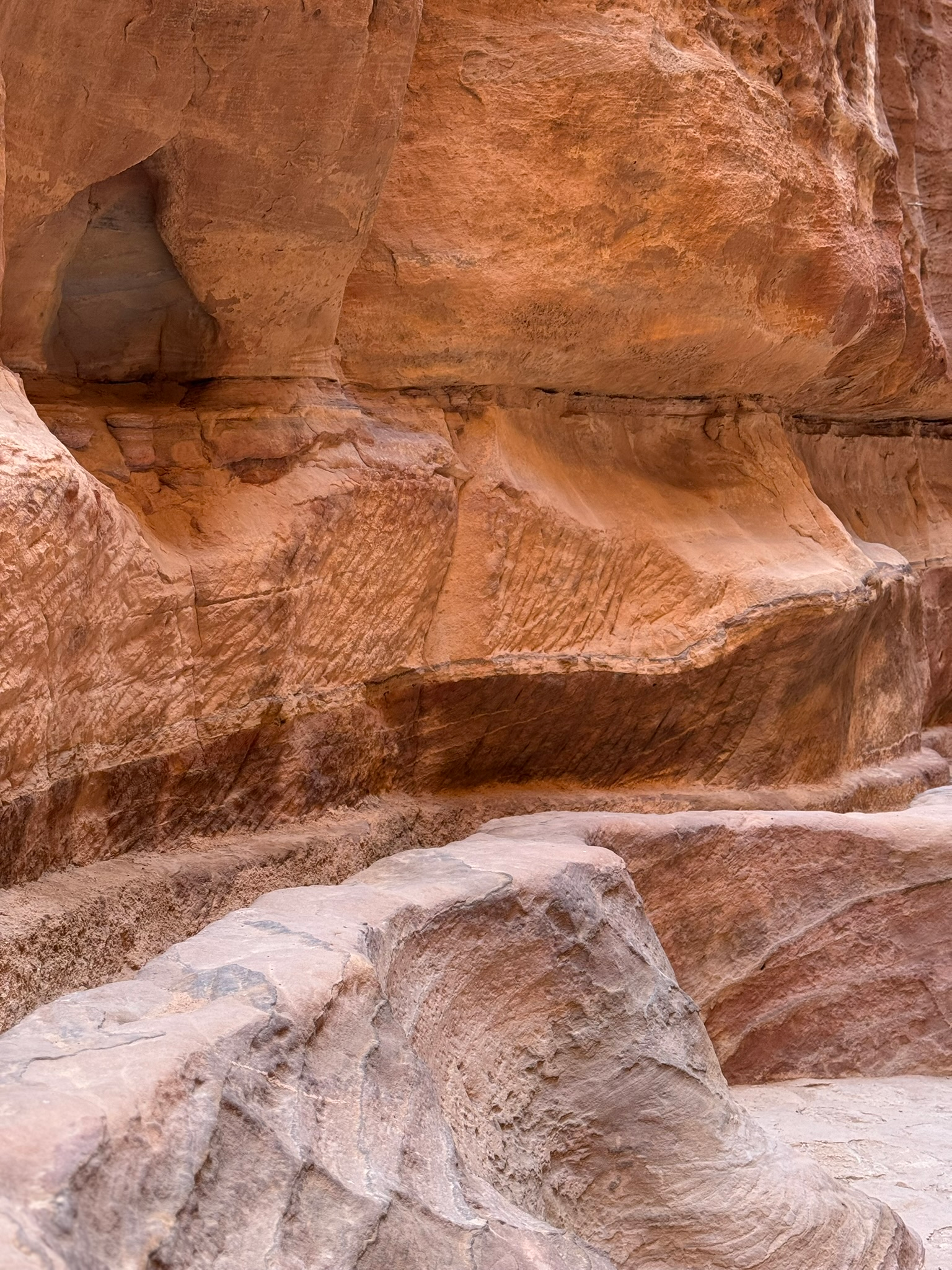
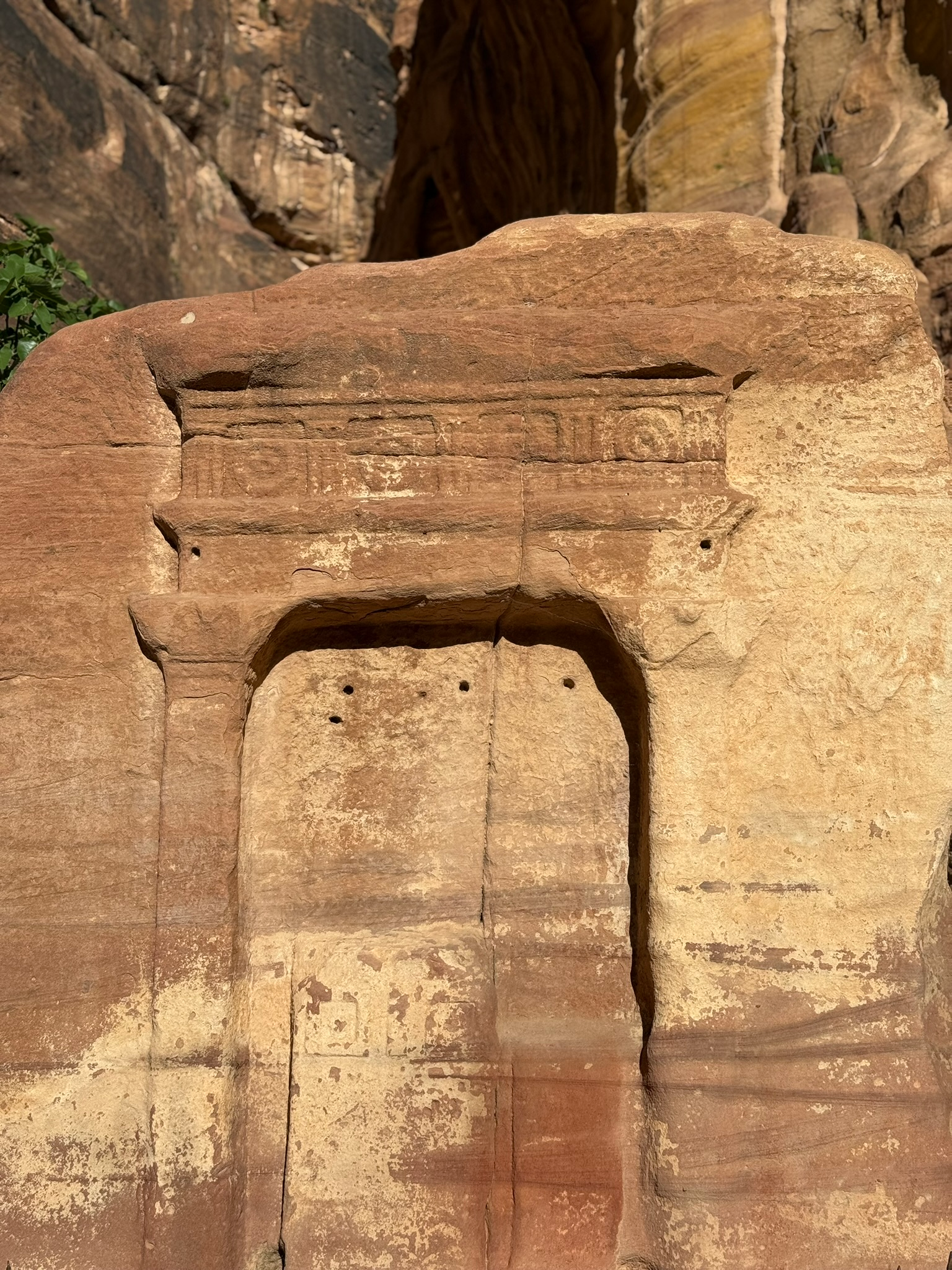
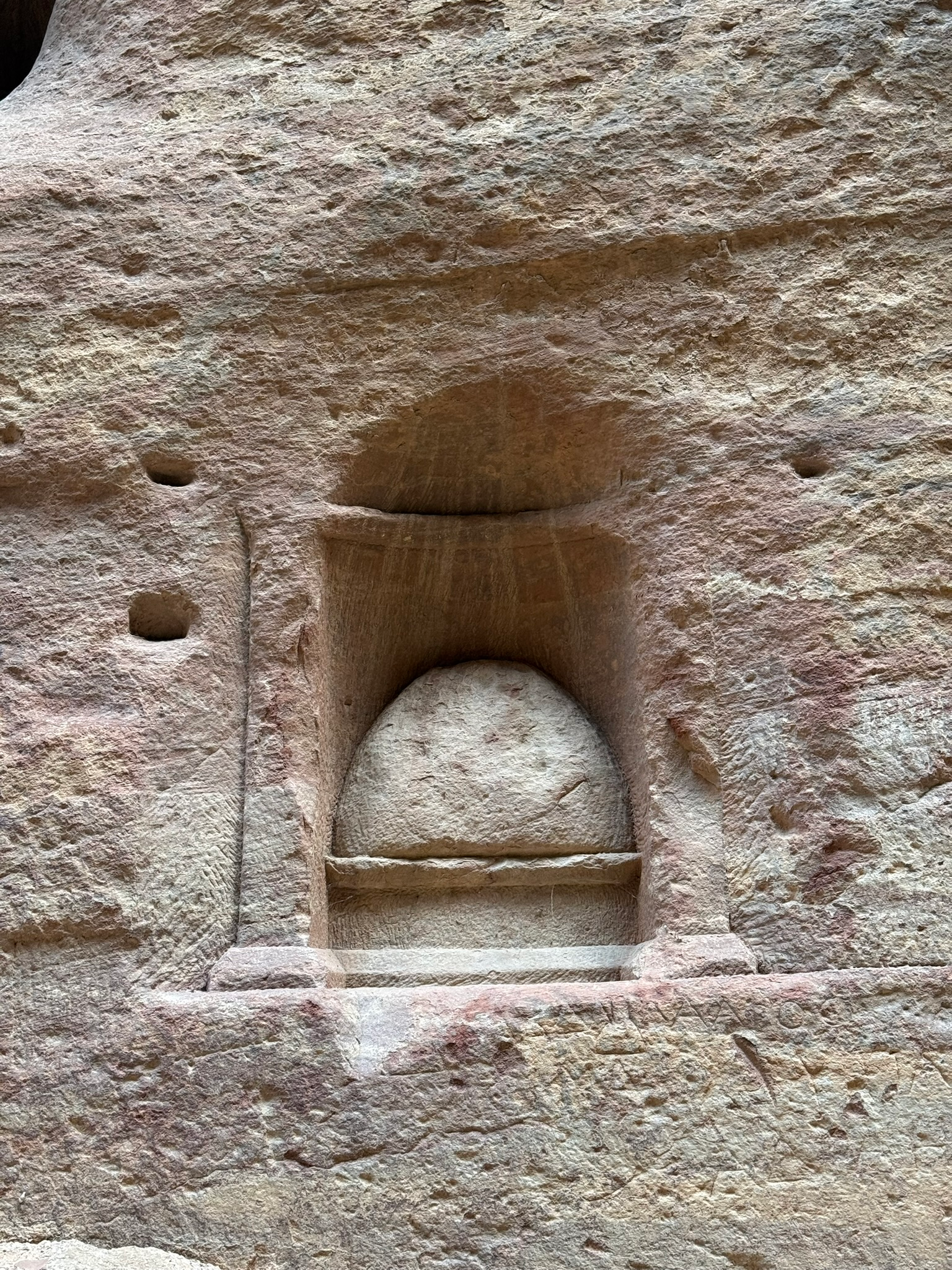
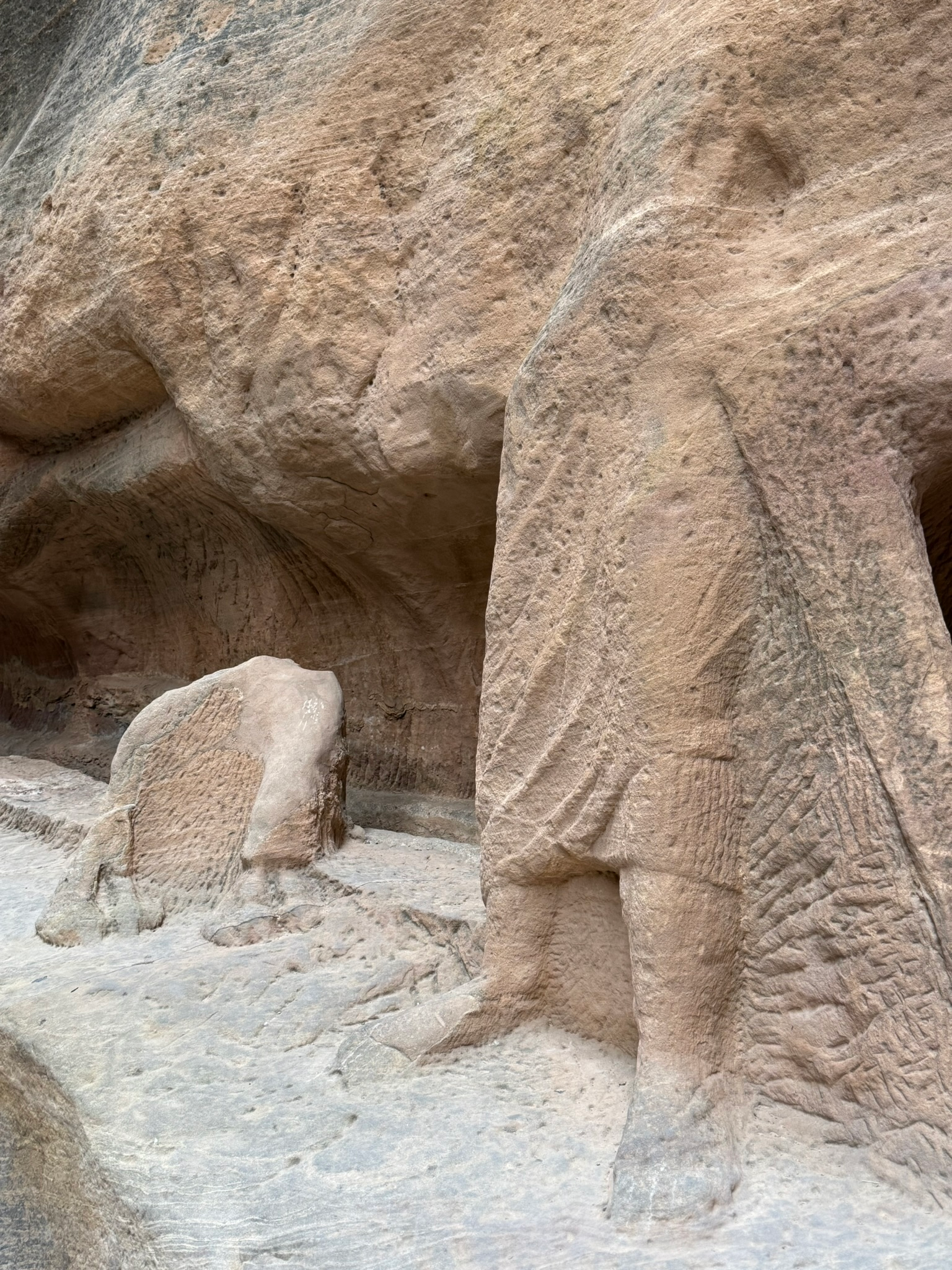
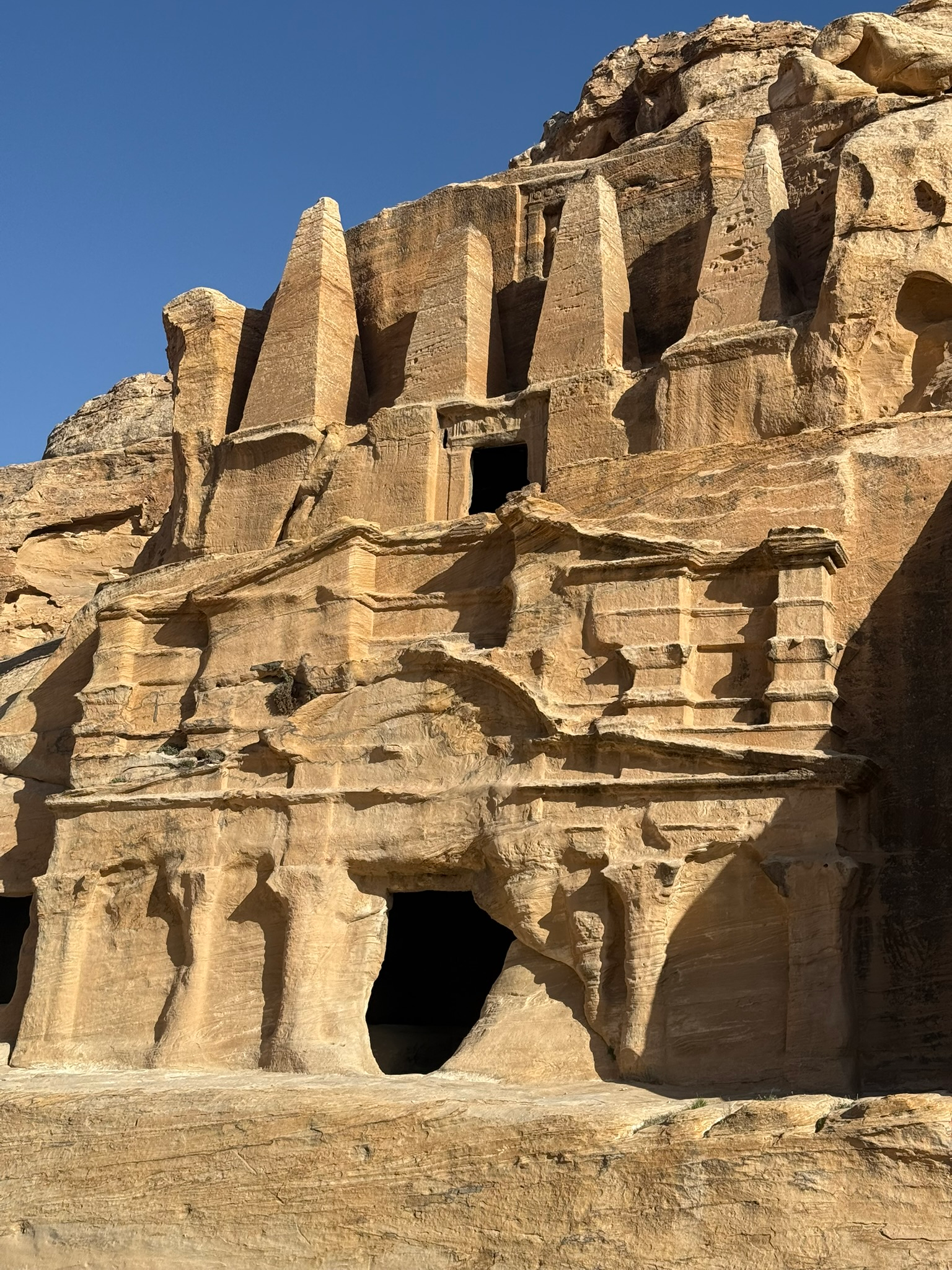
Apart from being a grandiose hallway, the Siq also played an important role in Petra’s extraordinarily sophisticated water-management system. Given southern Jordan’s dry climate and the fact that Petra supported thousands of inhabitants at its peak, securing and controlling water was essential to the city’s survival.
Ain Musa, or the Spring of Moses, was one of Petra’s major sources of fresh water. According to local and biblical tradition, the spring began flowing after Moses struck a rock with his staff. The Nabataeans channelled water from the spring and other sources towards the city using carefully graded channels and ceramic pipelines. Cisterns, reservoirs and basins were then used to store and distribute it throughout Petra. At the entrance to the Siq, the Nabataeans also constructed a dam and an 88-metre rock-cut tunnel that diverted dangerous floodwater away from the gorge and towards Wadi al-Mudhlim. This flood-control system was separate from the channels and pipes that carried fresh water into the city, although both formed part of the same wider feat of hydraulic engineering.
Although rainfall is infrequent, intense downpours can occur with little warning. With Petra situated within a network of narrow valleys and gorges, flash floods have always posed a serious danger. Though the site can be closed during periods of severe weather, the vulnerable sandstone monuments remain exposed to erosion, weathering and debris carried through the valleys. In fact, over the centuries, some areas have been damaged or buried beneath layers of rubble, sediment and sand. As we walked through the gorge, I could only imagine how it must have appeared during Petra’s glory days – with the original tombs, shrines and reliefs still in place.
Once out of the canyon, we found ourselves in the wide valley known as Bab as-Siq, meaning ‘Gateway to the Siq’. A short walk then led us to the Visitor Centre, bringing our trek to an end. As we had done at the end of every day, we high-fived one another and celebrated the fact that, finally, we had achieved our goal. And, for one last time, “Time off!”.
PART IV
Showers and Shisha
Although the Bedouin camp where we had stayed the previous night had already felt like a step back towards civilisation, we were now staying in a real hotel in the middle of a real city.
After a very restorative shower, we all met in the hotel lobby before heading out for one last dinner together before John left us. We busied ourselves writing postcards for Delia, which we presented to her after the meal. Though she flat-out refused to admit that we were her best group ever, she did concede that we were the fastest and, by far, the funniest. I, for one, can testify that she was the best guide I had ever had. Although I had taken a liking to her from the very beginning, I knew she would become far more than just our guide the second she fooled Doug with the Ramadan Stick. Throughout the rest of the trek, she only continued to confirm how awesome she really was.
After dinner, we all headed to a cave bar for some drinks and another round of shisha. I had religiously sworn off smoking and tobacco for the better part of a year, so you can imagine my reaction when I discovered that the flavoured molasses contained the nefarious substance! I genuinely had no idea. Given that I didn’t cave afterwards and experienced no cravings whatsoever, we all agreed that the previous night’s round didn’t count and that my streak was still standing. So I stuck to drinks.
Over what may genuinely have been the worst cocktail I had ever consumed, we went over some of our favourite memories from the trek. We could also finally share some of the memes we had spent the entire hike referencing – such as the runner claiming how perfect snow was for jogging before immediately tumbling down a patch of ice, the weather presenter standing in the middle of an enormous storm while warning everyone else not to go outside and, of course, practically anything involving Diane Morgan as Philomena Cunk. What a friggin’ legend!
One Emotional Farewell
And just like that, after five incredible days, we would be saying goodbye to John. He would be returning to Amman by taxi and had another two days of sightseeing planned around the city and its outskirts. It simply wouldn’t be the same without the Brit we had grown to love.
The rest of us would continue with Delia for an extra day of adventures, with Rafael and me having extended our tour while tipsy on Petra beer the previous evening. By that point, it felt as though we had been friends for years. We knew so much about one another’s quirks and had already accumulated all these tiny inside jokes, stories and references.
With the usual promises of staying in touch and meeting up again, we parted ways with John. It only took a few minutes for him to send us a heartfelt message, accompanied by a photograph and a short biography of each of us that had everyone practically in tears:
- Lara is the feeder of the group, with her Mary Poppins bag containing an endless supply of snacks. She is always good for an end-of-the-night chat beside the campfire and beneath the stars.
- Hanis an avid climber, hence the nickname Spider-Hans. At times, we would lose him, only to look up and discover that he had scaled some enormous rock to enjoy a little time alone before popping his next muscle relaxant.
- Doug is forever pondering when and where to take his next one-hour break or siesta, while simultaneously planning the best camera angles for his travel reel. Oh, is it?
- Rafael never skips leg day, which comes in handy when quietly powering past everyone on the uphill sections. He is the most laid-back person in the group and has to put up with Marius in Malta 24/7.
- Marius is the joker of the pack and a brother from another mother. There is never a dull moment in his company. He also thanked me for being myself – or at least, he seems to think that’s a good thing. Good to know!
- Delia is the hike leader with the best hair and the most relaxed, fun energy. She is always full of fascinating knowledge and is also apparently a dinosaur hunter. Comes supplied with nuts and dried fruit.
- Athallah was the reason we didn’t get completely lost on several occasions. He has an infectious smile and was the provider of our lunchtime tea every day.
- Tarrad was the sweetest companion and the group’s official apple-core disposal unit. Biggest love to our four-hoofed friend.
It was only fair that Delia came up with one for John in return:
- Super kind and caring, always happy to help put bottles away. A wearer of nipple balm and at his happiest when stroking furry friends.