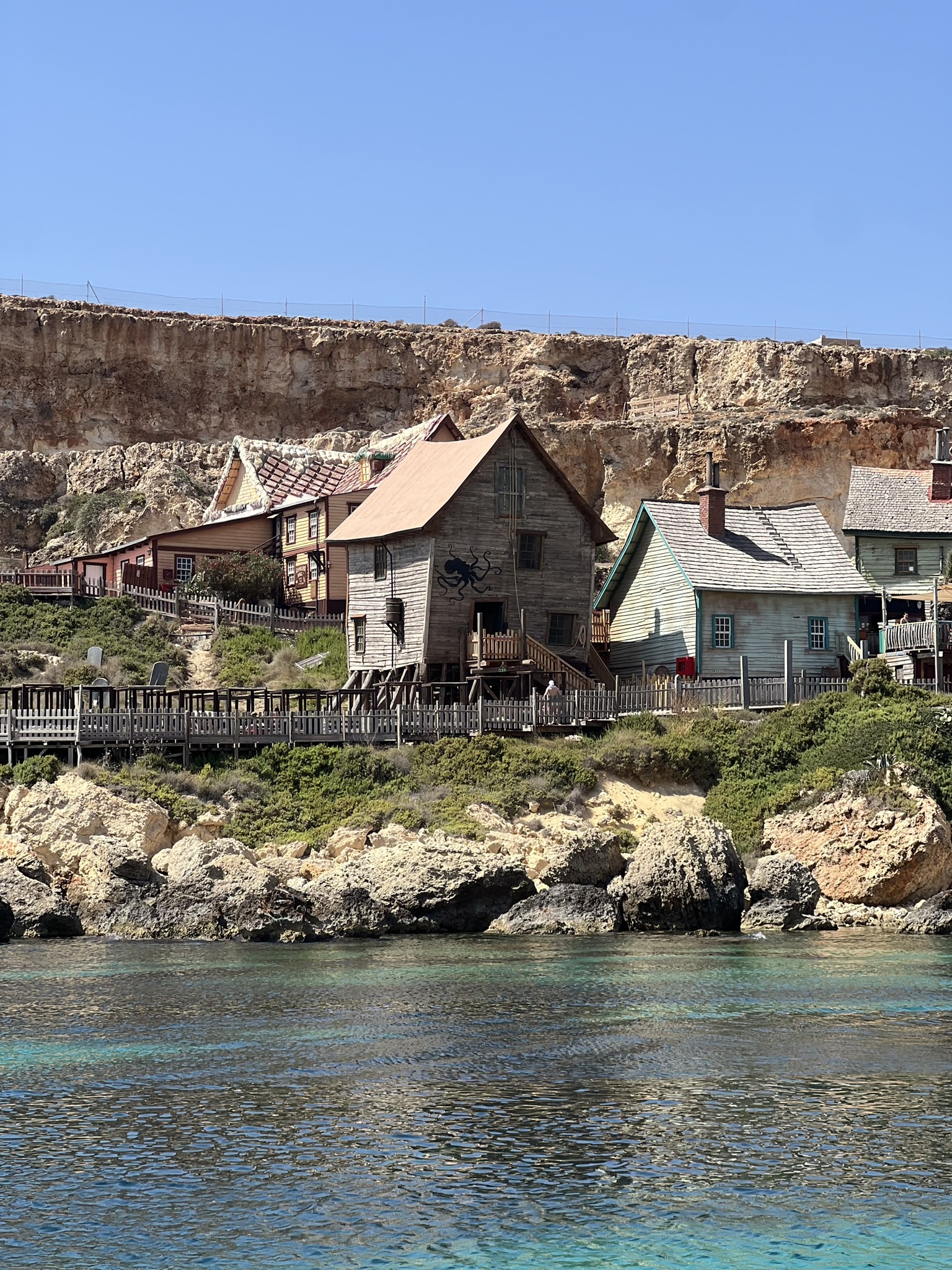
Anchor Bay & Scorpion Cave
Anchor Bay packs a film set, three-metre anchor, boulder reef and broad air-pocket cavern into one shallow shore dive.
Below Popeye Village near Mellieħa, Anchor Bay is one of Malta's more unusual shore dives. Averaging roughly 6 metres and reaching about 12 metres, it keeps the reef and anchor accessible to recreational divers while most of the dive stays comfortably shallow.
Scorpion Cave is the signature feature on the southern side of the bay. Its entrance sits around 10 metres and opens into a large cavern with a surfacing air pocket and brighter main chamber. Outside, boulders, rocky reef, sand and Posidonia seagrass make the return feel like a second dive site.
Site profile
- Coordinates
- 35.9596° N, 14.3405° E
- Dive type
- Shore · Cavern · Reef
- Experience
- Beginner-friendly bay · local cavern briefing
- Access
- Concrete jetty · south side of bay
- Cave distance
- ~150 m from the usual entry
- Depth
- ~6 m average · ~12 m max in main bay
- Scorpion Cave
- ~10 m entrance · ~8 m inside · air pocket
A dive site inside a film set.
Anchor Bay's diving story is inseparable from Sweethaven, the wooden village built here for the 1980 live-action Popeye film. Today the set remains on the northern shore while divers enter from the opposite side of the bay.
Sweethaven takes shape
Construction of the film village began in 1979. Nineteen timber buildings were assembled around Anchor Bay, transforming the limestone inlet into the fictional port of Sweethaven.
Popeye comes to Malta
The musical starring Robin Williams and Shelley Duvall was filmed here in 1980. The bay, cliffs and purpose-built village became part of the movie's visual identity.
The set stays behind
Instead of disappearing after filming, the wooden village survived and evolved into Popeye Village, preserving the original film-set character on the shoreline above the dive.
One bay, two attractions
Visitors come for the film set while divers head beneath it for the anchor, reef and Scorpion Cave. Few Maltese dive sites have such a recognisable surface backdrop.
A wide cavern, a sheltered bay and a reef built for exploring slowly.
Scorpion Cave is the centrepiece, but the character of Anchor Bay comes from the combination of overhead space, large boulders, patches of sand and seagrass, and the oversized iron anchor lying in shallow water.
Scorpion Cave
The cave mouth is partly hidden behind large boulders on the southern side of the bay. The entrance is broad, but once the roof closes overhead the dive should be treated as an overhead-environment excursion rather than ordinary open water.
The main air pocket
After the first submerged section, the cavern opens into a large chamber with an air space above. The floor becomes shallower inside, while the entrance behind creates the blue-light contrast that gives the site much of its atmosphere.
Boulders, sand and Posidonia
Outside the cave, the bay alternates between rocky reef, large boulders, swim-throughs, sandy patches and seagrass. It is easy to spend the second half of the dive searching these transitions rather than rushing back to the jetty.
The anchor and the wildlife
A roughly three-metre iron anchor rests on sand at about 8 metres, with its heavy chain continuing across the bottom. Around it and the neighbouring reef, look for the smaller Mediterranean life that suits a slow shallow dive.
Build the dive around conditions, not the checklist.
Anchor Bay is compact enough to combine several features in one dive, but the best route depends on visibility, surface traffic, the team's cavern experience and whether the bay is being used for training or tourist boats.
Approach
The standard south-side shore entry and the checks that matter before leaving the jetty.
- Enter from the concrete jetty on the southern side of Anchor Bay, opposite Popeye Village. Check the ladder and entry conditions before gearing up.
- Use the shallow water inside the bay to settle weighting, buoyancy and team positioning before heading towards the cave or crossing towards the anchor.
- Expect visibility to deteriorate after poor weather. If the water is milky or surge is moving sediment around the boulders, keep the route conservative.
- Watch for surface traffic, especially around the mouth of the bay. Keep the final ascent and any open-water crossing controlled and visible.
Anchor + Scorpion Cave
The signature Anchor Bay combination - one man-made landmark and one natural cavern.
- From the jetty, locate the large iron anchor resting on sand at roughly 8 metres and follow the chain far enough to appreciate its scale without disturbing the bottom.
- Re-group before heading towards the southern wall and the boulder field that hides the cave entrance.
- Approach Scorpion Cave around 10 metres and pause outside to confirm visibility, torch function, spacing and the team's comfort with an overhead environment.
- Enter only as far as the team's training and the natural-light zone allow. The main chamber becomes shallower and includes an air pocket above.
- Exit back into open water and return through the reef and seagrass rather than retracing every metre over bare sand.
Scorpion Cave focus
A slower cavern-oriented dive that gives the chamber and its smaller recesses more attention.
- Follow the southern side of the bay towards the entrance, approximately 150 metres from the usual jetty entry.
- Carry a reliable torch even when the main entrance is bright. Light falls away quickly around the recesses and side chambers.
- Maintain close buddy spacing and controlled finning so sediment is not lifted from the bottom and the exit remains visually obvious.
- Treat the air pocket as part of the cavern, not as permission to push farther into an overhead environment. Stay within training, gas and equipment limits.
- On the way out, turn back towards the entrance before exiting and take in the contrast between the darker chamber and the blue Mediterranean outside.
Reef & seagrass
The quieter option when the cave is busy, visibility is marginal or the team simply wants a relaxed shallow dive.
- Stay on the rocky margins of the bay where boulders, ledges and small swim-throughs create more structure than the open sandy centre.
- Slow down over Posidonia edges and sand patches for cuttlefish, octopus and bottom-dwelling species rather than treating the vegetation as empty space.
- Use the anchor as a navigation landmark if it fits naturally into the route rather than crossing the bay solely to tick it off.
- Keep an eye above as well as below: the shallow profile means surface traffic and swimmers can matter more than depth.
- Finish in the protected water by the jetty with enough gas and time to handle a busy exit without rushing.
Anchor Bay, from Sweethaven to Scorpion Cave.
From the surface view and Popeye Village to the anchor, Scorpion Cave and the wildlife around the bay.
Photo story
Seven photos