Part Two
ANTARCTICA – CLIMATE
During this presentation, we got to see why and how the weather in Antarctica was so crazy. With the continent being a polar desert with very little precipitation, the frozen tundra is the coldest, driest, and windiest place on Earth.
We started off the lecture with Keith explaining that the climate here is highly variable, with a few commonalities arising from the natural boundaries between Antarctica and Australia and South America, and with much of this variability being driven by the ocean. In fact, Robert Falcon Scott, one of the most intrepid explorers to ever set foot on the icy continent, met his untimely demise partly because of these climatic extremes. Roald Amundsen, who arrived earlier and under very different conditions, succeeded where Scott did not, highlighting just how fickle and unforgiving Antarctic weather can be.
From there, he went on to explain some of the main factors that influence Antarctica’s climate, which include:
Latitude: Below 66.4 degrees south, there are periods during which the sun neither sets nor rises, resulting in 24 hours of continuous daylight or complete darkness, respectively.
Elevation: Because colder air is found at higher elevations, East Antarctica is by far colder and drier than the rest of the continent. Weather fronts rarely penetrate the continent’s interior, leaving it persistently cold and dry.
Continentality: The variation in climate between coastal regions and inland areas that are far removed from the ocean and other bodies of water.
Surface type: Snow- and ice-covered surfaces can reflect up to 90% of incoming solar radiation due to their high albedo, meaning the surface absorbs very little heat despite prolonged sunlight.
As true as this is for the Southern Ocean, Antarctica’s climate is further shaped by two other major factors: the Antarctic Circumpolar Current (ACC) and the polar front, both of which help isolate the continent from the rest of the world. The polar front, a persistent, clockwise-moving belt of low atmospheric pressure that generates strong winds and controls the nature of surface ocean swells, works in tandem with the circumpolar current to effectively contain Antarctica’s weather systems. A perfect example of this interaction can be seen in the notoriously rough conditions of the Drake Passage.
Weather here isn’t just about cold – it’s about pressure. Invisible systems of rising and sinking air dictate where winds go, where clouds form, and why Antarctica behaves nothing like the rest of the planet.
At the equator and up to around 60 degrees of latitude, low-pressure systems draw winds towards them. These air masses collide, rise, and cool, forming clouds as they ascend. In contrast, high-pressure systems force dense air downward, where it diverges at the surface and warms. While the Antarctic Peninsula is generally influenced by low-pressure systems bringing warmer, moister air and strong winds, the rest of the continent is dominated by high-pressure systems that distribute cold, dry air and relatively light winds. As a result, Antarctica experiences a persistent outward flow of air from the centre of the continent towards the coast.

This outward flow gives rise to one of Antarctica’s defining features: katabatic winds. These are gravity-driven winds formed when extremely cold, dense air drains downslope from the high interior of the ice sheet towards the coast. Katabatic winds can reach speeds of over 200 kilometres per hour and are a major reason Antarctica holds the title of the windiest continent on Earth. They sculpt the snow surface, drive sublimation of ice directly into vapour, and can bring life and logistics to a complete standstill within minutes.
Although this circulation pattern is present year-round, there is still seasonal variation. During winter, expanding sea ice pushes low-pressure systems further offshore, reducing precipitation at the South Pole. In summer, this pattern reverses as ice along the continent’s margins begins to melt. Despite this, Antarctica has very little “weather memory”. With no soil, vegetation, or liquid water to retain heat, conditions can change brutally fast, making forecasting especially difficult.
Most of this information is gathered from satellites, but automatic weather stations scattered across the continent record all meteorological variables and integrate the data every five minutes, often operating without maintenance for up to two years. These stations give us a clear picture of temperature variation across Antarctica:
Winter:
Inland: -40 to -70 degrees Celsius
Coastal: -15 to -35 degrees Celsius
Coldest recorded temperature: -89.2 degrees Celsius
Summer:
Inland: around -25 degrees Celsius
Coastal: around 0 degrees Celsius
Peninsula: up to 15 degrees Celsius
That said, the actual experience of cold here is often far worse than the numbers suggest. Wind chill can drop perceived temperatures by tens of degrees, meaning conditions that appear manageable on paper can become life-threatening in reality. In Antarctica, it’s often the wind, not the thermometer, that kills.
As Keith explained, the regional variability between Vostok Station, located deep within the continent, and South Georgia, found much closer to South America, is dramatic. Vostok exhibits extreme seasonal temperature differences due to strong continental effects, including a slight temperature rise during the coldest months caused by the collapse of the troposphere and stratosphere by several kilometres as dense cold air accumulates. South Georgia, on the other hand, experiences relatively stable temperatures and precipitation throughout the year due to its maritime climate.
To wrap up the lecture, we covered some of the meteorological phenomena unique to Antarctica.
One of these is temperature inversion, a process that occurs frequently here. While air temperature normally decreases with altitude, there are times when a layer of warmer air sits above colder air near the surface. In Antarctica, this is often caused by katabatic winds and freezing rain, supercooled raindrops that freeze upon contact with surfaces. As a result, warmer air becomes trapped between the intensely cold surface and the colder atmosphere above.
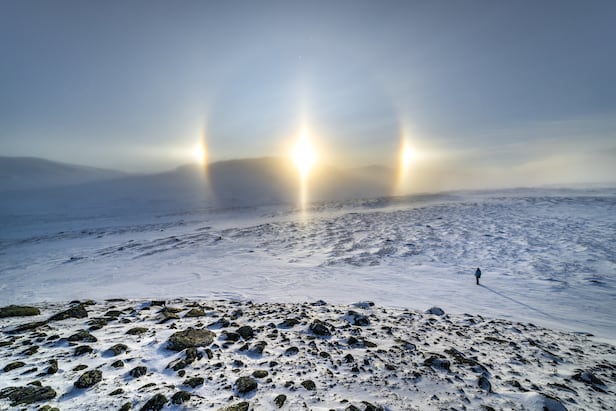
Under these conditions, atmospheric convection is suppressed, allowing distinct cloud types to form, such as cirrus clouds, which are commonly observed over Siple Station. These clouds are composed of ice crystals measuring one to two centimetres across and form through sublimation. Under the right conditions, they can give rise to parhelia, bright spots appearing on either side of the sun due to refraction, or even fog bows, pale, whitish rainbows produced by a high concentration of moisture in the air.

Another phenomenon Keith touched on was whiteout conditions. In these moments, the boundary between sky and ground disappears entirely, shadows vanish, and depth perception is lost. Even in calm weather, whiteouts can render navigation impossible, leaving people disoriented and dangerously exposed. In a place like Antarctica, where landmarks are scarce and distances deceptive, this can be fatal. Friggin’ cool. And absolutely terrifying.