Luxor – Day 1: Chasing Pharaohs
LUXOR
Day 1: Chasing Pharaohs
November 15, 2023
PART I
You know what I love more than having a splinter hammered beneath my fingernail? Early morning flights. Love ’em! And guess what we had in store for us? You got that right!
That’s how we got to the next stop on our trip, Luxor. I’d say we got there uneventfully, though that would probably be a lie, given that Akash forgot his luggage in front of the airport. It was quite the hassle and expense for him to have the driver go back to retrieve it the moment we arrived at our apartment. Luckily, the airport staff had kept it in storage, and everything worked out well in the end. In fact, we could now proceed with the day’s plans – a full-day tour around Luxor’s main historical sites.
We were picked up by our tour guide, Ahmed, who would be showing us around all day long. Before the historical tour, we made a quick stop at an artisanal shop for breakfast. Whilst their handiwork was impressive, to say the least, I had kinda outgrown the need to buy souvenirs during my gap year. That said, seeing all kinds of statuettes, pottery, and jewellery made out of different precious stones and materials did kinda have me wanting to go all out on a shopping spree.
While some of the staff were busy chiselling and sculpting away, others were rushing to the restaurant in front of the shop to get our food – no doubt earning some commission in the process. Why else would we have our breakfast at an artisanal shop?
First Encounter with Ancient Egypt
Finally, we were ready to start the actual tour. It would be my first glimpse into Ancient Egypt – a dream come true. Not to mention, it was also somewhere that had been on my bucket list since I was a kid: the Valley of the Kings.
Once at the site, we were met by our guide, Ali, a scholar and archaeologist working there. He began by explaining that the history of Ancient Egypt can be summarised as the Old, Middle, and New Kingdoms, with intermediate periods in between. Whilst most Egyptian pyramids were built during the Old and Middle Kingdoms, the power and prosperity of Egyptian civilisation peaked during the New Kingdom (1550-1070 BC), which spanned the Eighteenth to the Twentieth Dynasties. Our journey through Egypt’s history would begin with the New Kingdom in Luxor and take us backwards in time towards the Old Kingdom as we approached the capital, Cairo.
Constructed during the New Kingdom, the Valley of the Kings is arguably one of the most important archaeological sites in the world. Here, Ali introduced us to some Ancient Egyptian mythology basics and funerary customs:
- Creation myth: In the beginning, there was nothing but Nun, the endless dark waters of chaos. From these waters rose Atum (sometimes identified with Ra), the first god, who created himself and settled on a mound called Benben. He then gave rise to Shu, the god of air, and Tefnut, the goddess of moisture. These in turn gave rise to Geb (earth) and Nut (sky), who gave birth to Osiris, Isis, Set, and Nephthys. Thus, the world and the nine gods (the Ennead) were born, and balance (Ma’at) was established.
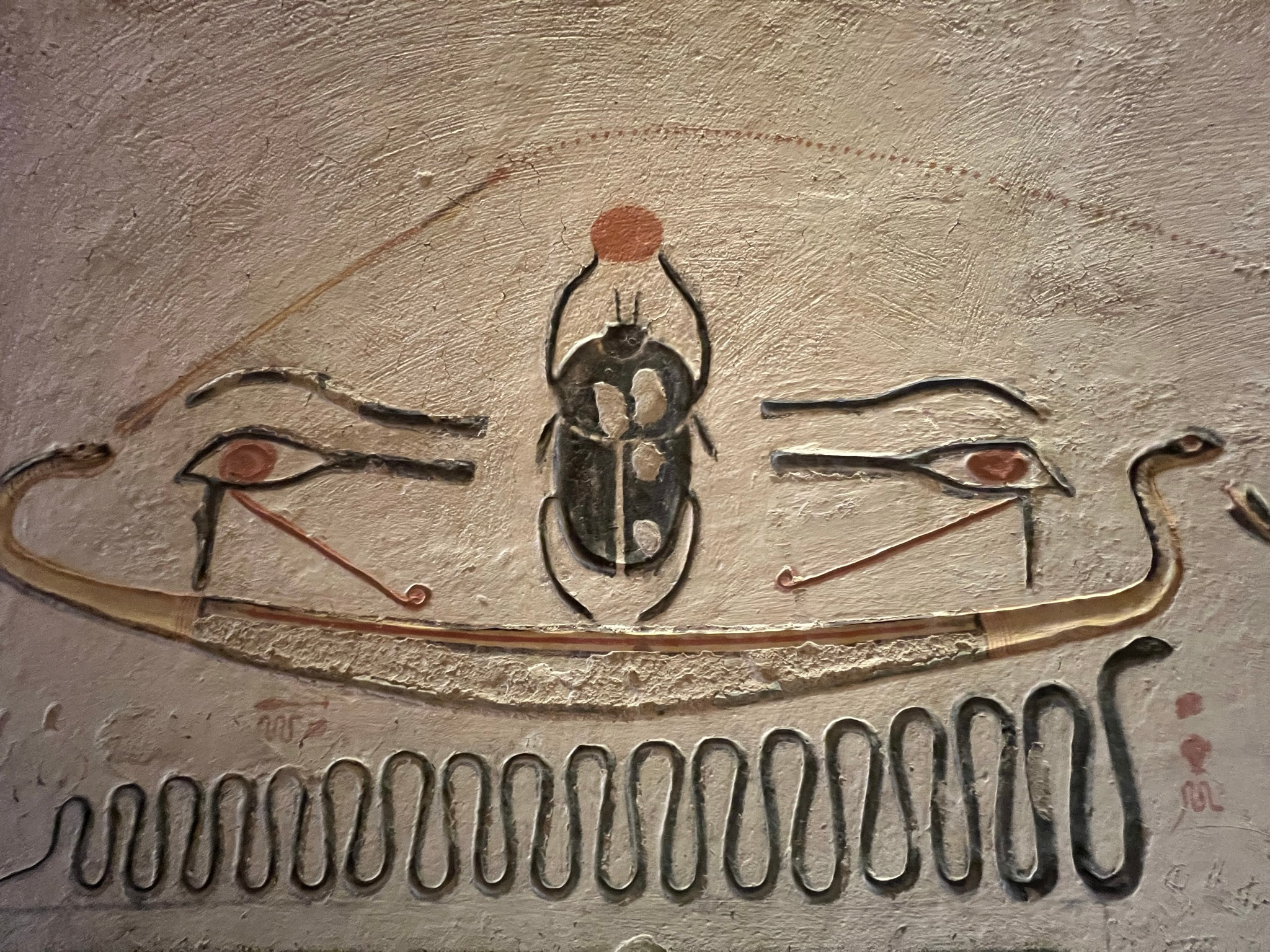
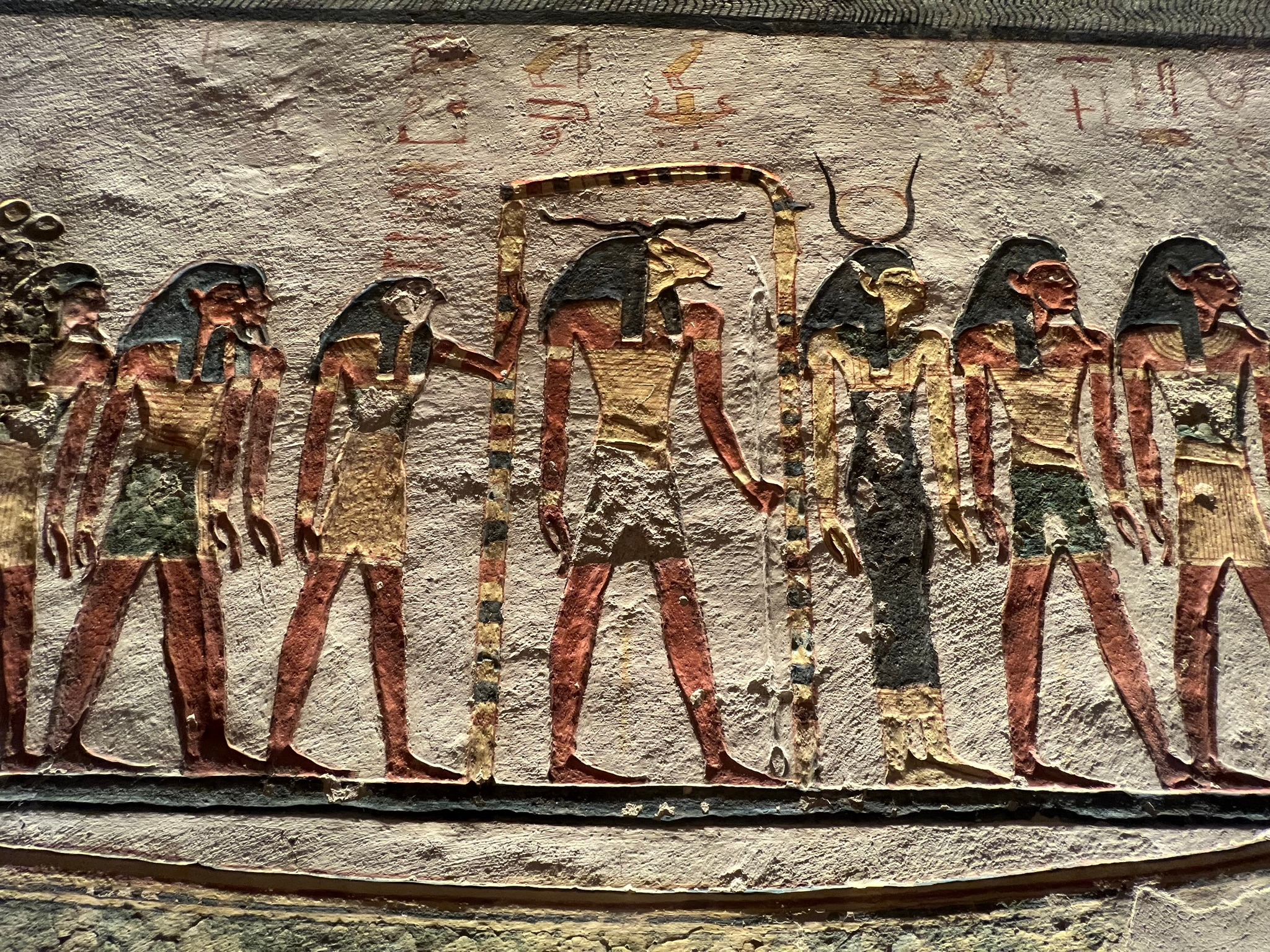
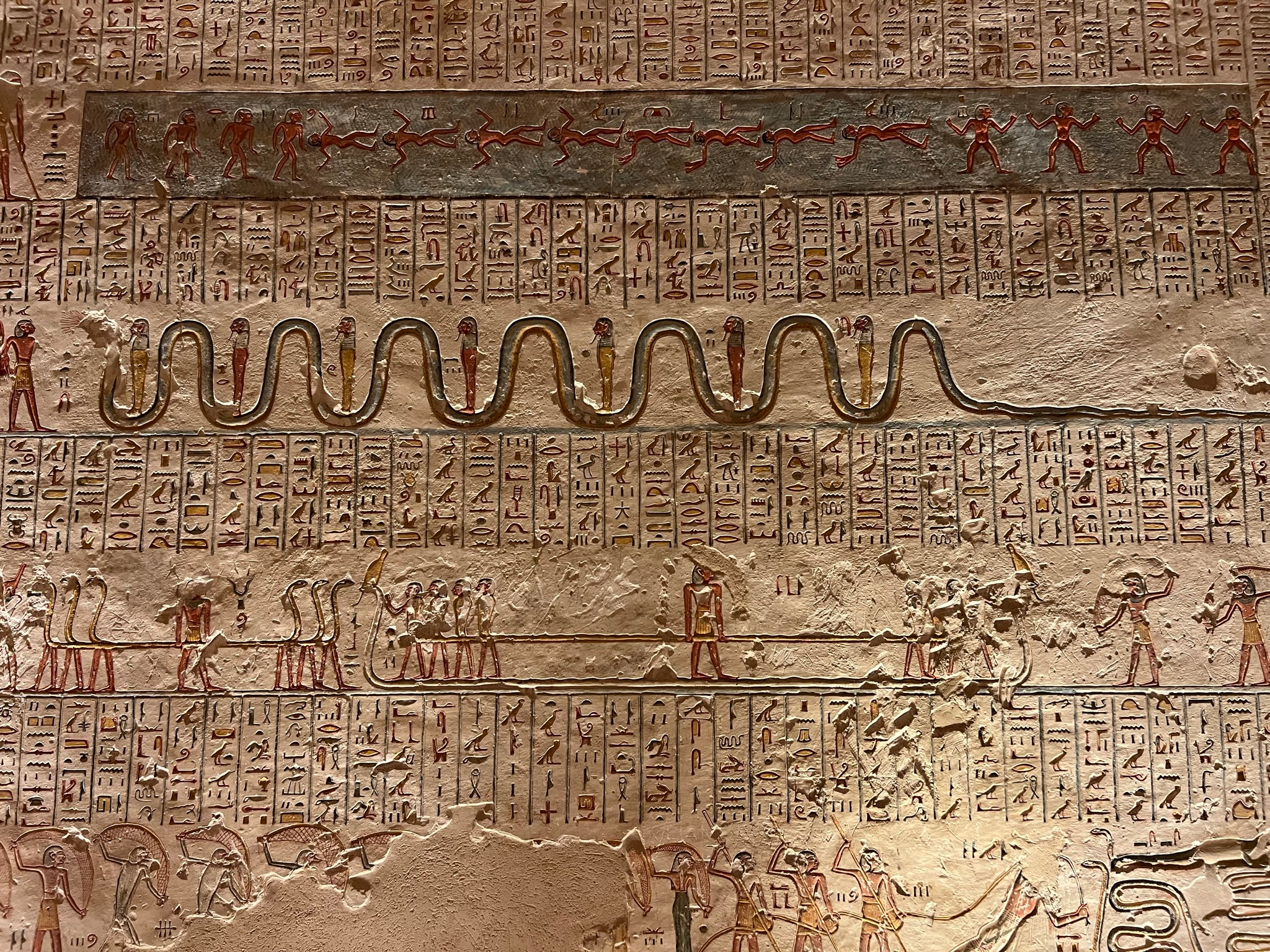
- Journey of the sun myth: Each day, the sun god Ra sails across the sky in his solar barque, bringing light and life to the world. At night, he journeys through the underworld, battling dangers before being reborn at dawn. During this nightly voyage, Ra faces the giant serpent Apep, who attempts to stop the sun from rising. With the help of gods such as Set, Thoth and Ma’at, Ra defeats chaos and continues his passage. Every sunrise symbolises his victory over darkness and the eternal cycle of renewal.
- Osiris myth: Osiris was a wise and just ruler who governed Egypt alongside his wife Isis. However, his jealous brother Set murdered him and scattered the pieces of his body throughout Egypt. Isis searched for and reassembled his remains, though one crucial body part could not be recovered: his penis. With the help of Anubis, she restored him through what later became associated with the first mummification. Osiris thereafter became Lord of the Dead, while Isis conceived Horus, who would later defeat Set and restore order.
The last myth, he explained, symbolises the cycle of death and rebirth, the legitimacy of kingship, and the eternal struggle between order and chaos.
Preparing for Eternity
With earthly life being just an introduction to the next, more important stage of everlasting joy, the journey to the afterlife was central to ancient Egyptian funerary mythology and rites.
The first step, as with most religions, was to lead a good life free of sin and dedicated to the gods. In addition, individuals were expected to undertake extensive preparation during their lifetime and learn the instructions for their future journey.
The second step is mummification. Once dead, bodies would undergo a method of embalming called mummification. Much like tombs, the quality of mummification depended on the social status of the individual and the amount of money paid, with the best treatment reserved for pharaohs. This funerary rite is highly connected to the cult of Osiris, and, after what had happened to him in myth, it’s no wonder that ancient Egyptians believed the body had to be entirely preserved after death for the deceased to enter the afterlife, especially since they believed identity and name were tied to physical form.
The mummification process, he went on, took around 70 days. This was usually carried out by a special class of priests, one of whom wore a mask of Anubis, a deity with the head of a jackal who was regarded as the guardian and guide of souls in the afterlife. Mummification involved a number of steps:
Purifying: The body is washed with palm wine and water from the Nile River.
Brain removal: The brain is removed through the nose using a hooked instrument (and not a straw as the urban legend claims).
Internal organ removal: The innards are removed and placed in canopic jars.
Drying: The remains are then covered with natron (a type of salt) for 40 days to dry them out.
Filling the body: The dried body is washed again with water and filled with sawdust and linen cloth.
Wrapping: Then, it is wrapped in linen bandages previously soaked in resin.
Decoration: Amulets are added between the wrappings, and the linen is decorated with protective symbols.
Mask and coffin: A funerary mask is placed over the head. The mask would accurately portray the pharaoh’s features so that the soul could find the body when it leaves it to wander around. It would also have a wider base to allow the stiff neck to pass after rigor mortis would set in. The mummy is then enclosed within a decorated coffin.
The final ritual, which is arguably the most ostentatious, is placing the coffin inside a tomb. In the Old and Middle Kingdoms, elites were buried inside pyramids, which served as monumental tombs. Though heavily guarded at the time, having such large structures marking treasure-filled burials made them easy targets for tomb raiders in periods of instability. For this reason, most pyramids were eventually raided, with treasures looted and mummies desecrated. in an effort to prevent further robberies, Egyptians of the New Kingdom adopted a new strategy – hiding tombs in remote desert valleys. Though harder to locate, this did not fully deter thieves, with many tombs in the Valley of the Kings still being looted.
The Perilous Journey Through Duat
Living a good life? Check. Preparing the body for the journey? Check. Next up is the journey itself. Duat, the Egyptian underworld, is where souls would travel after death. This journey was full of trials and tribulations, and only the truthful could pass through its gates, which were guarded by more than 10,000 beings.
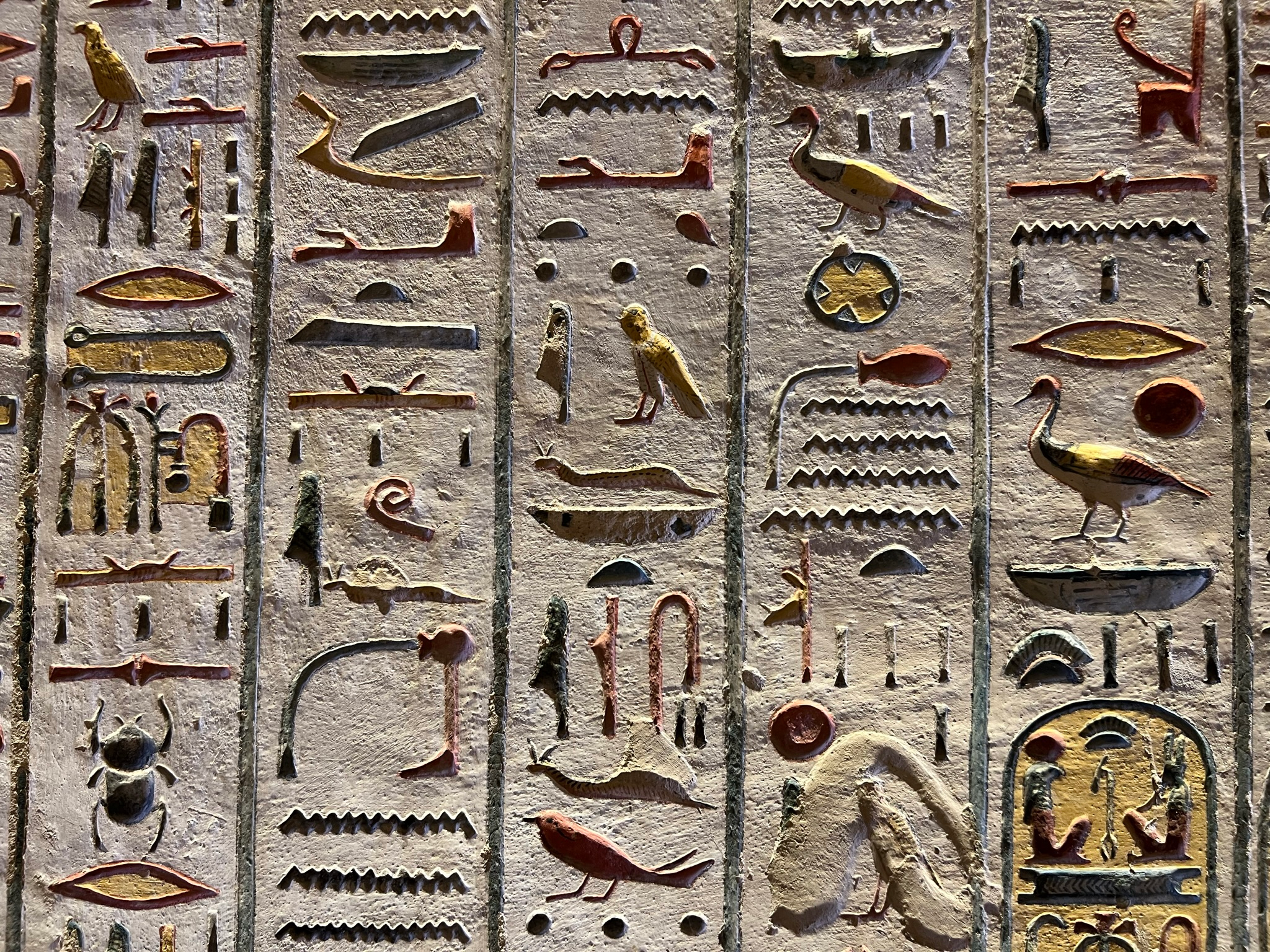
Luckily, the Book of the Dead, a collection of funerary texts containing spells and rituals, was designed to guide and assist the deceased. These texts were often written on tomb walls and sarcophagi so the soul could follow the instructions. Burial chambers also contained items the deceased might need during the journey, hence the treasures found in many tombs.
Even so, the journey was not easy and the trials were believed to be gruelling. One such trial was the “Declaration of Innocence”, during which the dead had to deny a list of 42 sins. The final judgement, known as the “Weighing of the Heart”, was carried out by Osiris and the Assessors of Ma’at, whereby the deeds of the deceased (symbolised by the heart) were weighed against the feather of Ma’at, representing truth and justice. If judged worthy, the soul would enter Osiris’s realm – a lush and perfect land similar to the modern concept of heaven.
PART II
The Theban Necropolis Awaits
After the fascinating lesson, Ali brought us back to the present and our current location, giving us a brief description of the site we were about to explore and going over the layout of the area.
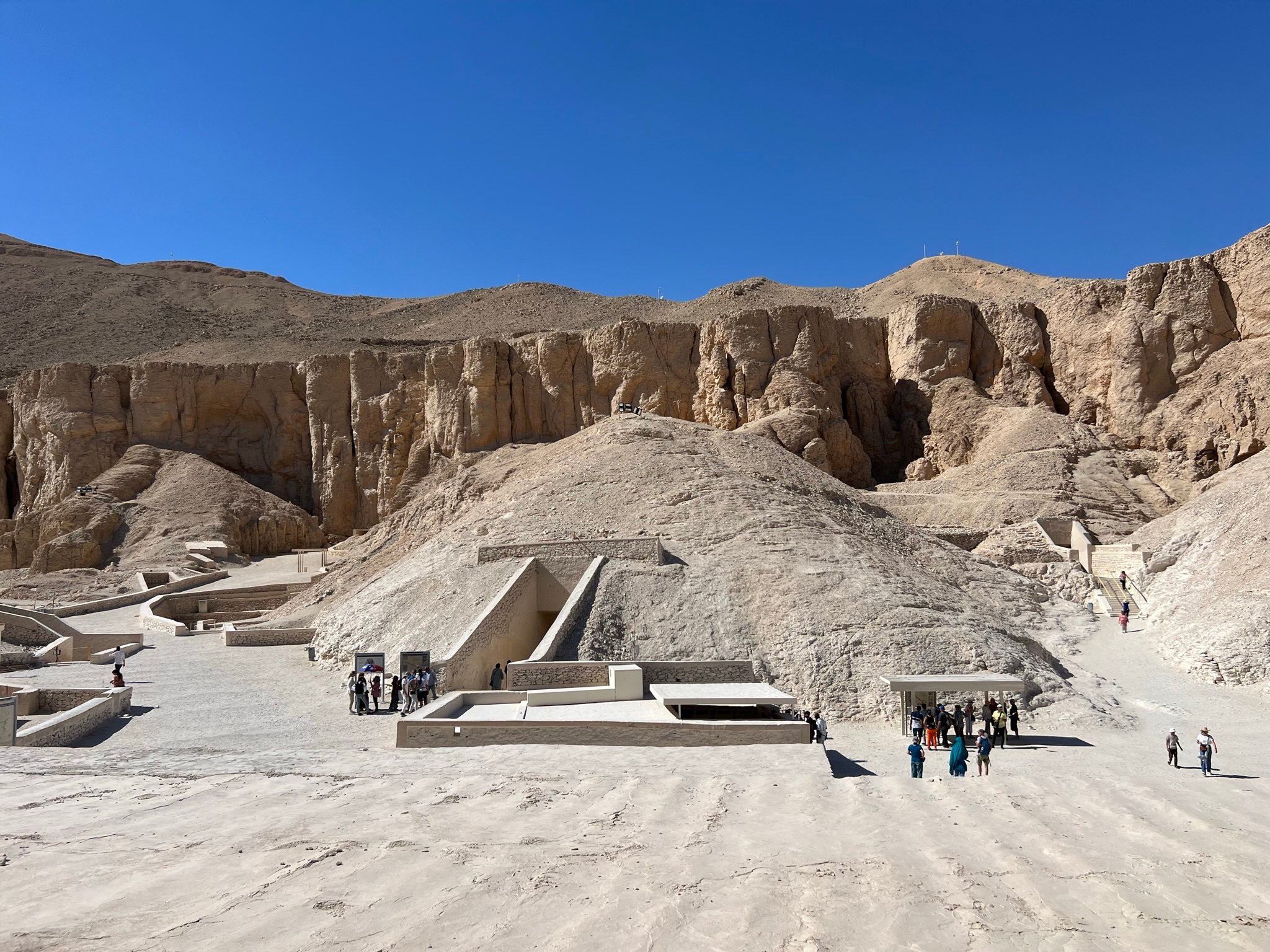
The Valley of the Kings, he told us, is part of the Theban Necropolis and is located on the west bank of the Nile River. This, he added, was in reference to Amun-Ra, who was associated with the setting sun in the west. Built in a valley cradled between desert mountains, the site was intended as a hidden resting place for the tombs of royal figures and nobles, away from tomb raiders. That said, most tombs here were eventually robbed, and although sarcophagi were often larger than the entrances to tombs, this did not stop thieves from looting treasures – including mummies. In fact, some mummies were later discovered in different locations, likely moved by priests for safekeeping, while others were never found at all.
The Valley of the Kings, he went on, was considered the main royal burial site of the New Kingdom and contains around 65 tombs, all varying in size and decoration. While each tomb has historical value, some stand out due to their grandeur, artwork, or the fame of the individuals buried there. Of note, it was here that Tutankhamun’s tomb was discovered in 1922 by Howard Carter, bringing global attention to the site from archaeologists and tourists alike.
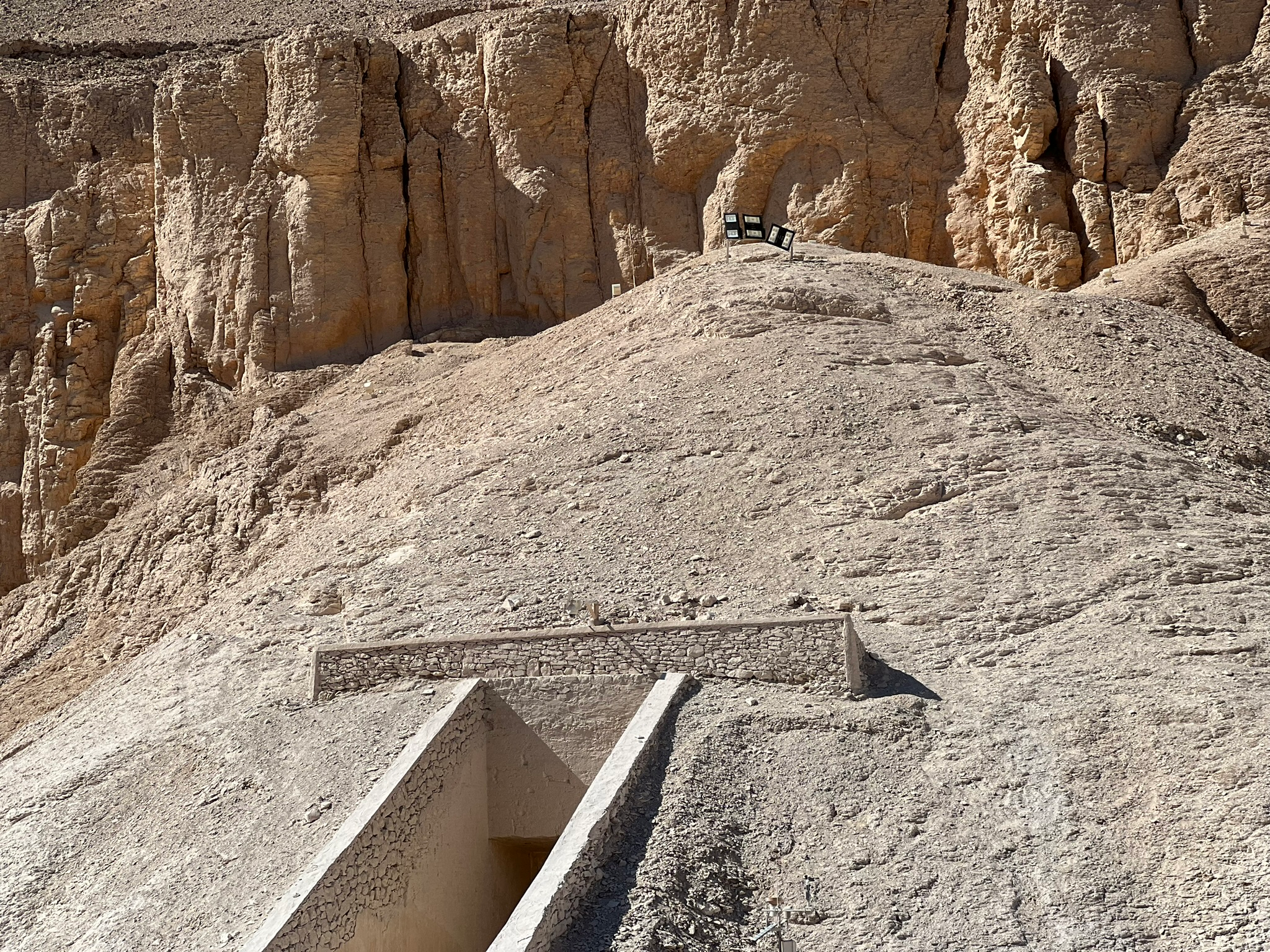
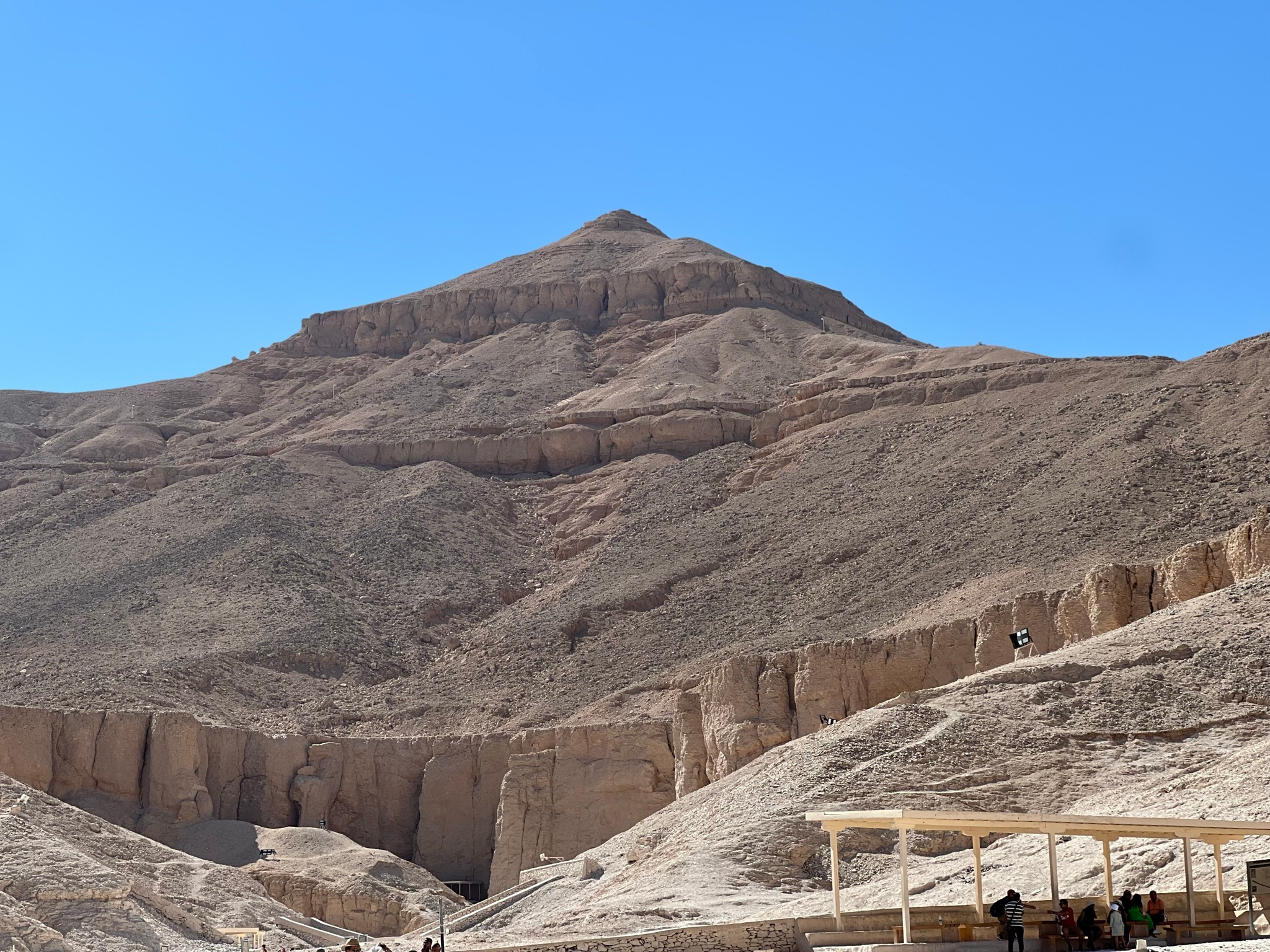
Inside the Boy King’s Burial Chamber
After a full twenty-minute explanation, Ali requested a grotesquely expensive fee and told us he would not be able to accompany us inside the tombs, urging us to let him go pick up his son from school. Wonderful.
We then set off, trying to explore as many tombs as possible, with Akash and me doing our best to cover as much ground in as little time as possible while trying to capture every detail. That, of course, was no easy task, and given that we were on a schedule, I felt rushed to say the least, which was a friggin’ shame considering how long I had wanted to go there. I could’ve easily spent an entire day there, let alone a couple of hours. I have to admit that I felt kinda cheated and that I’d definitely need to revisit another time, if only to visit every single tomb and properly take it all in. In the meantime, this would be nothing more than a taster. And lemme just say, it didn’t disappoint.
The first tomb we explored was the most famous, that of Tutankhamun. Tutankhamun, though a minor pharaoh in life, became the most famous in death. He is believed to have ascended to the throne at around eight years old and ruled for about 10 years, spending much of his reign trying to reverse Atenism, a monotheistic religion promoted by his father, and restore Egypt’s traditional polytheistic beliefs.
His death remains a mystery, though several hypotheses have been proposed. After his burial, his tomb is thought to have been raided a couple of times before debris from later tomb construction buried it for millennia. As if its discovery was not enough, the “curse of the pharaohs” added further intrigue, with several members of Howard Carter’s excavation team dying within a decade of the tomb’s opening.
While the chamber itself is one of the smallest in the Valley of the Kings, it is the most famous for its near-intact condition and the treasures it contained, including chariots, jewellery, chalices, and, the pièce de résistance, King Tut’s mummy wearing a golden funerary mask inside a solid gold sarcophagus.
Weighing around 10 kilograms, the mask is made of two layers of high-karat gold and is inlaid with coloured glass and gemstones. On the back, it bears a hieroglyphic inscription intended as a protective spell to guide the pharaoh in the afterlife. Today, most of the treasures have been moved to the Egyptian Museum in Cairo. However, inside the tomb, Tutankhamun’s mummy can still be seen in a glass case, along with the external stone shrine that once enclosed a series of wooden shrines and the nested coffins. The burial chamber walls are also decorated with well-preserved scenes depicting the pharaoh’s journey into the afterlife.
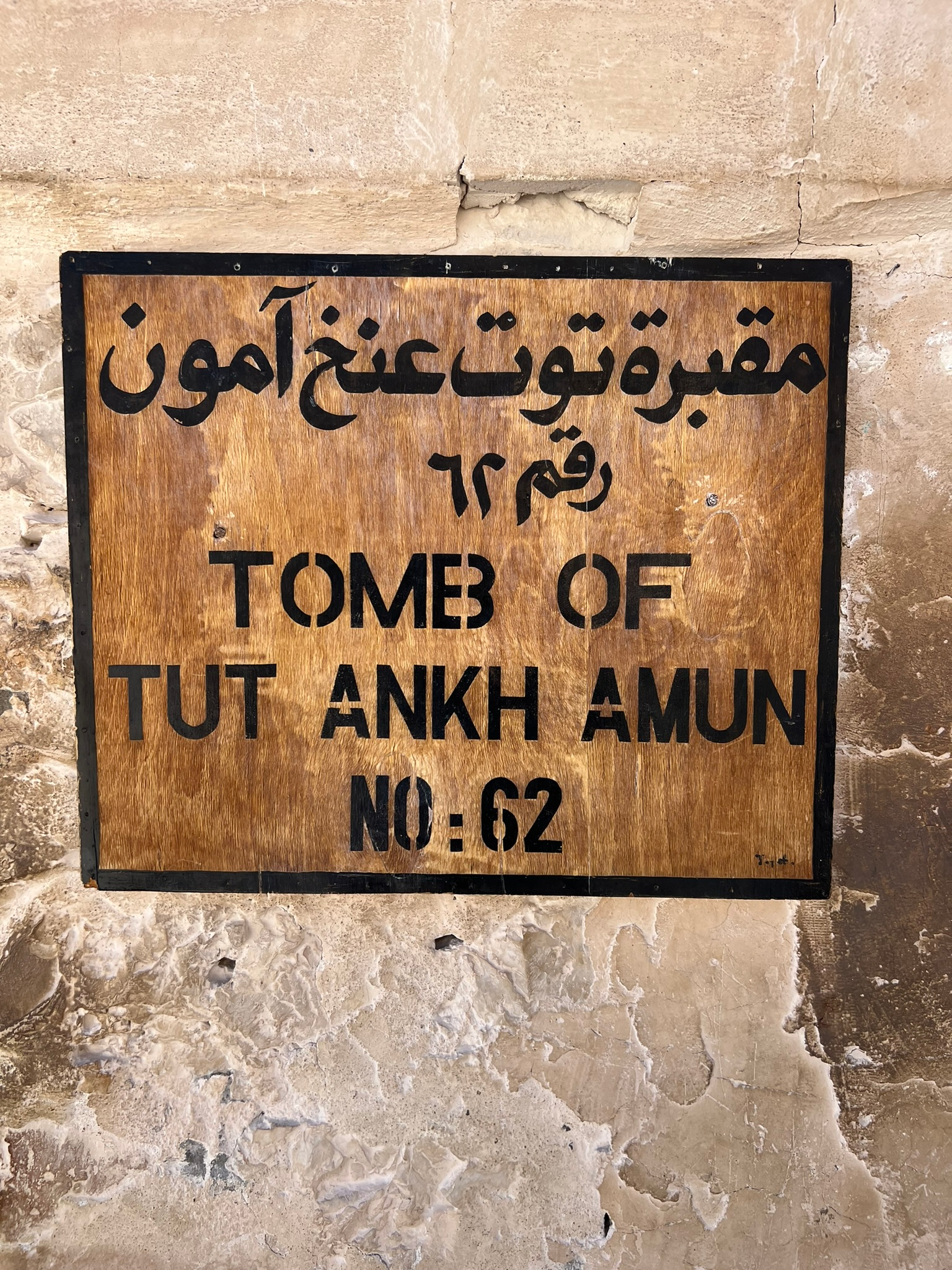
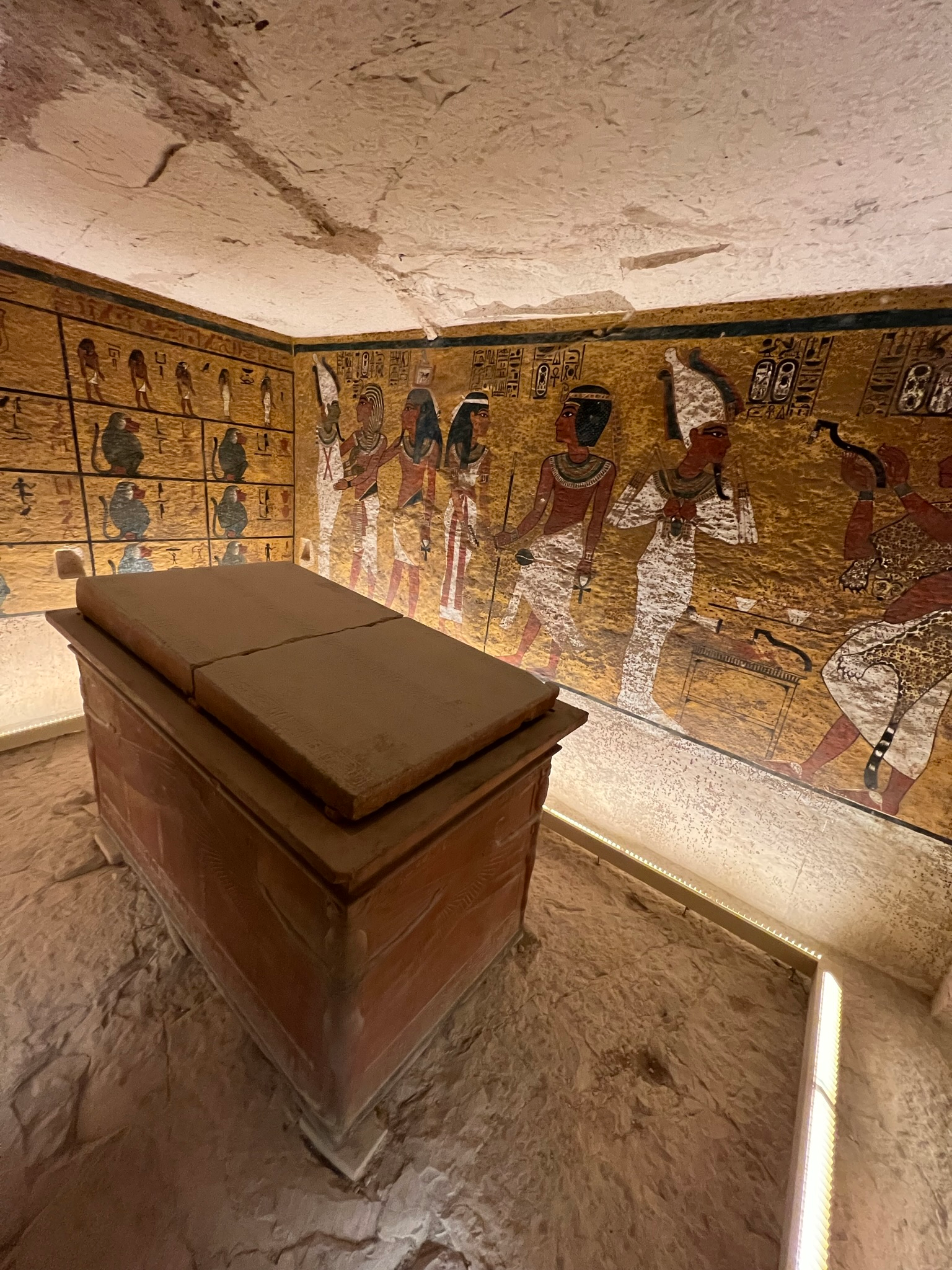
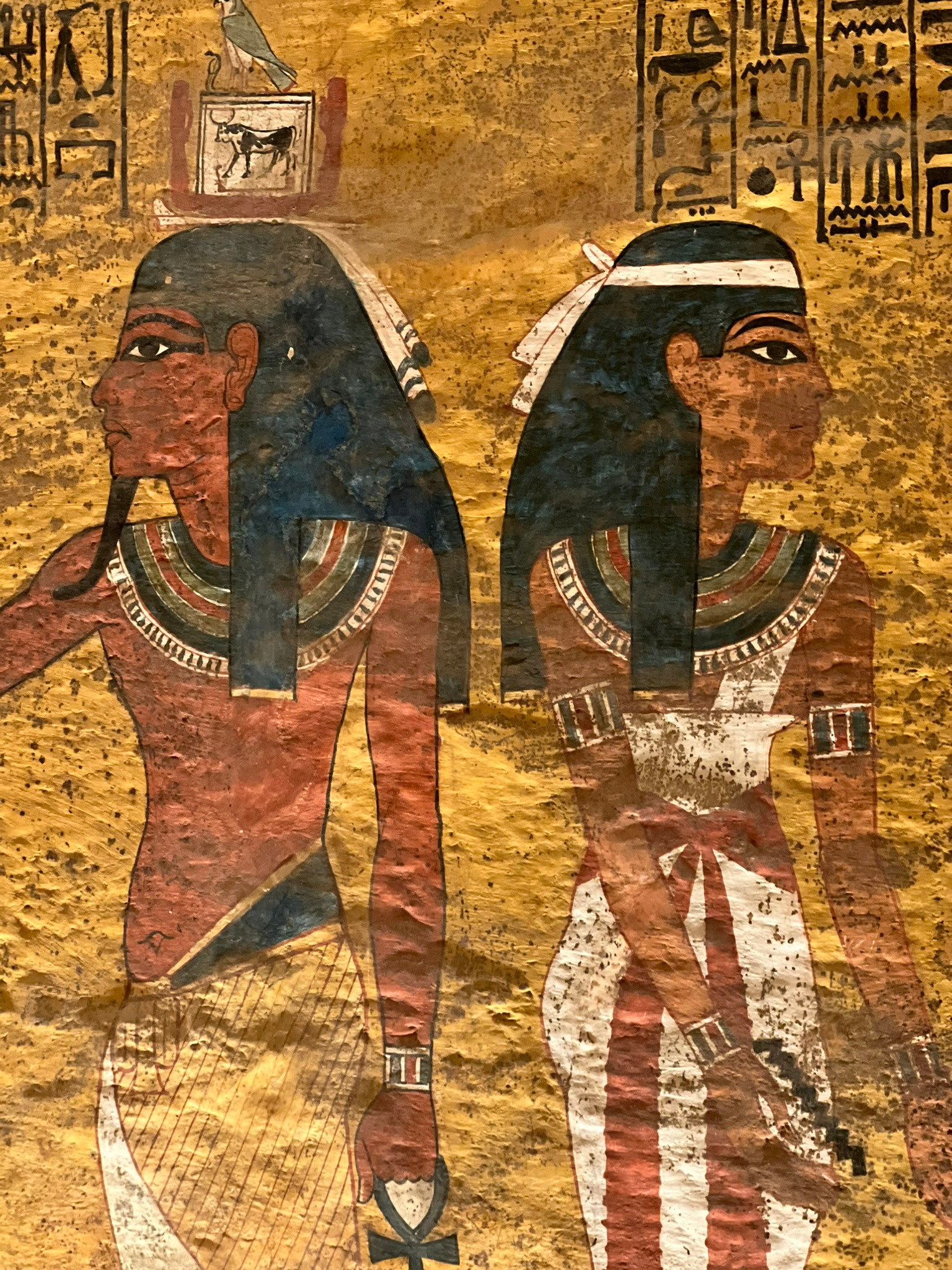
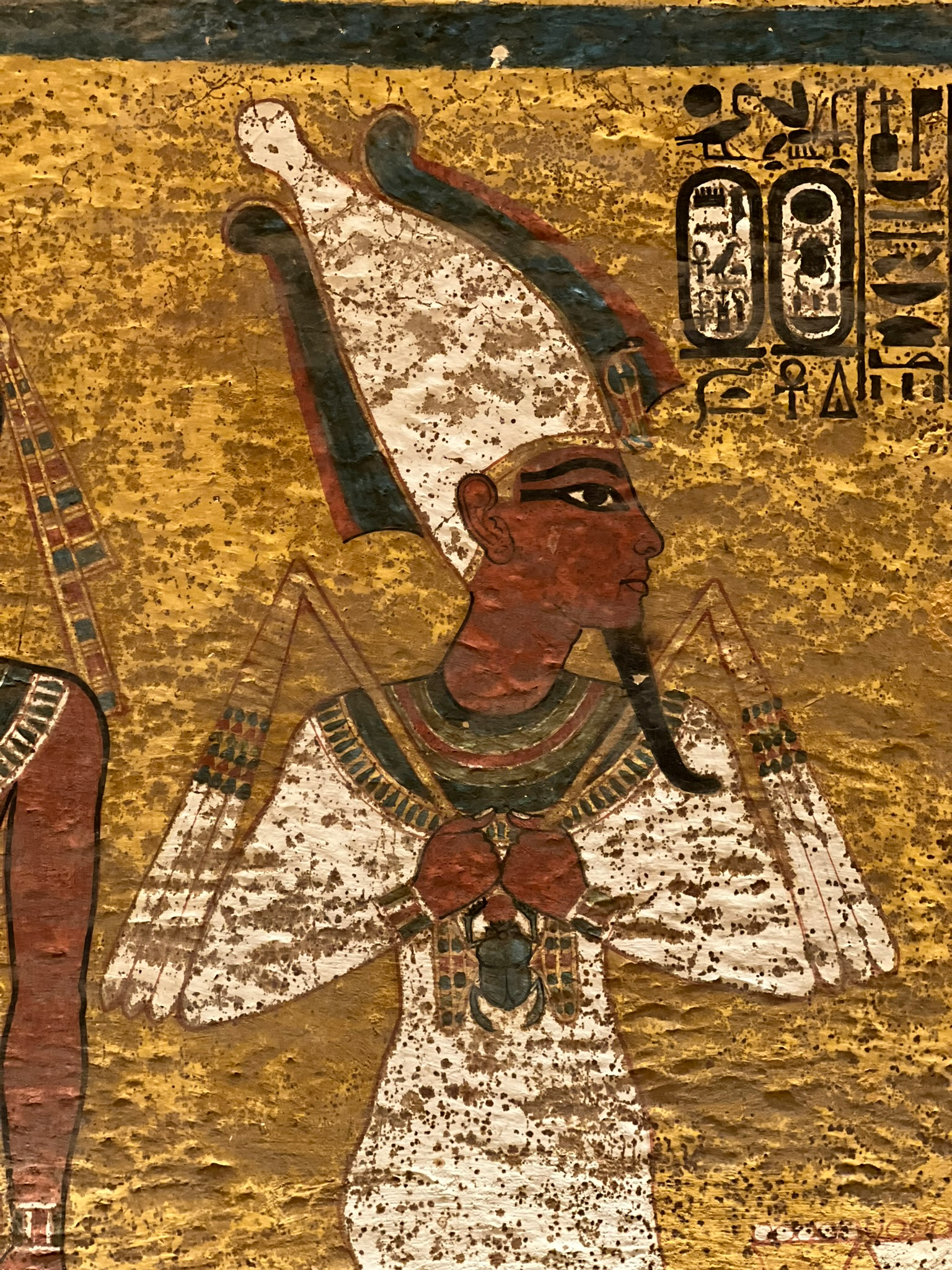
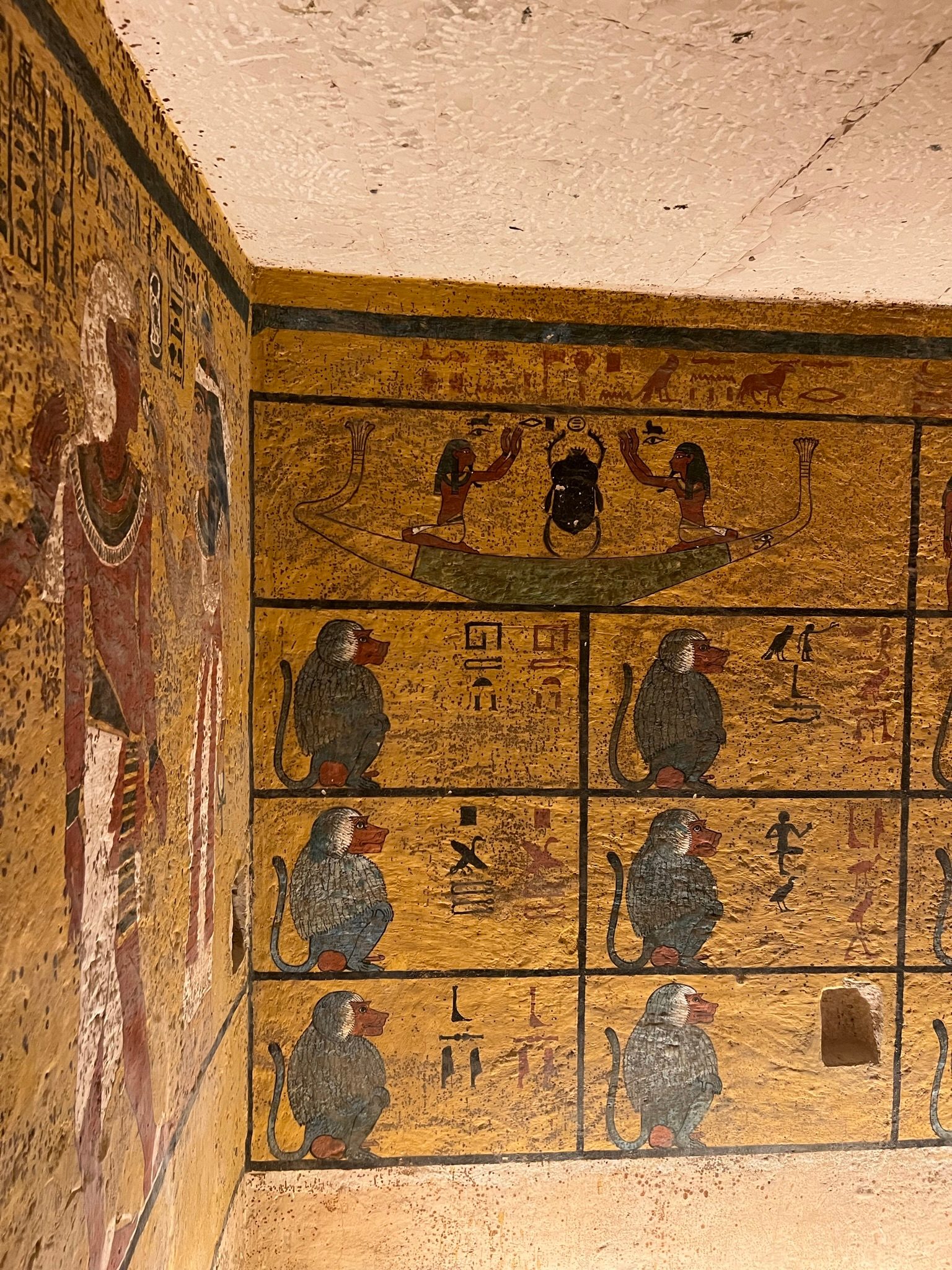
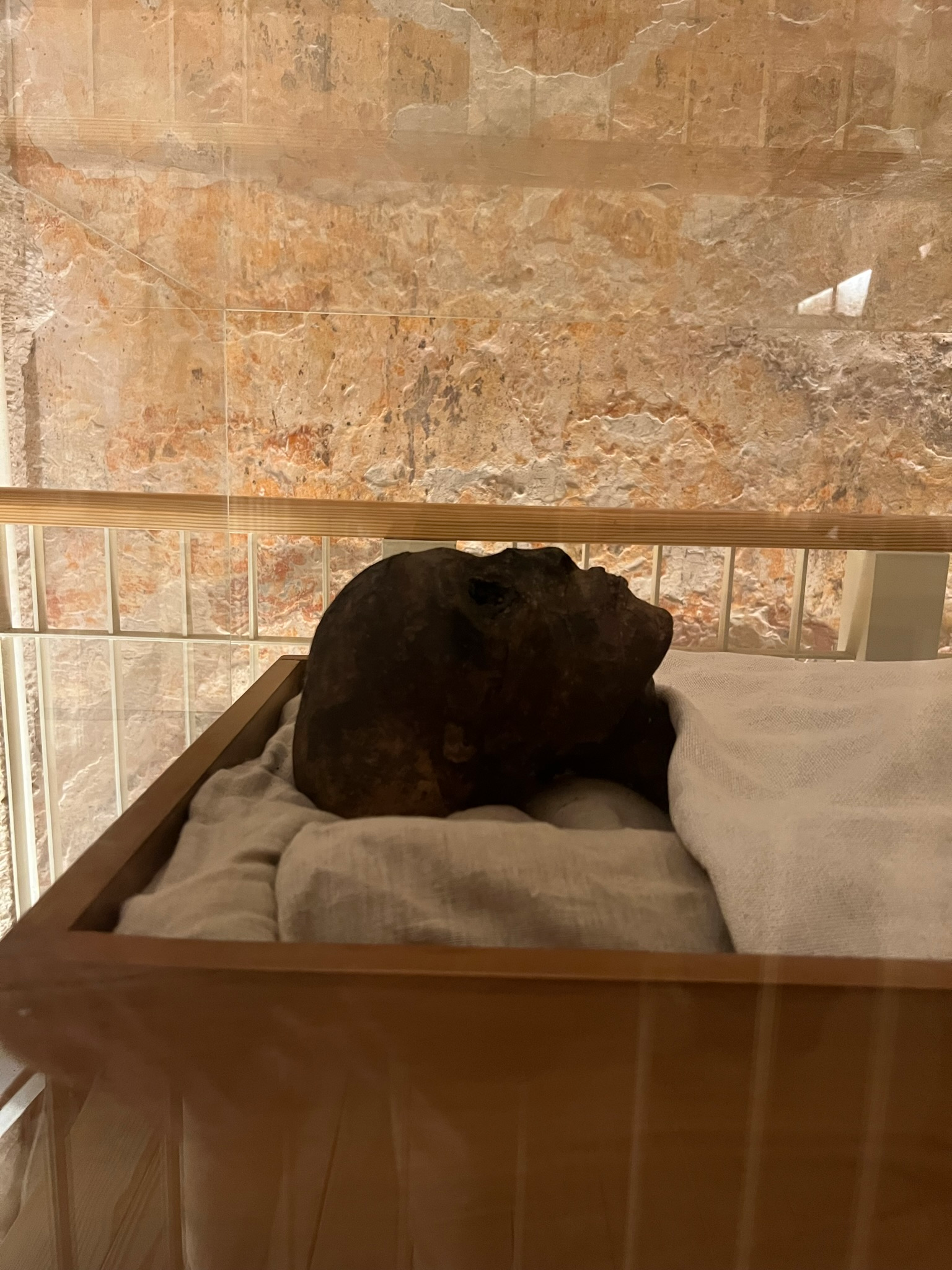
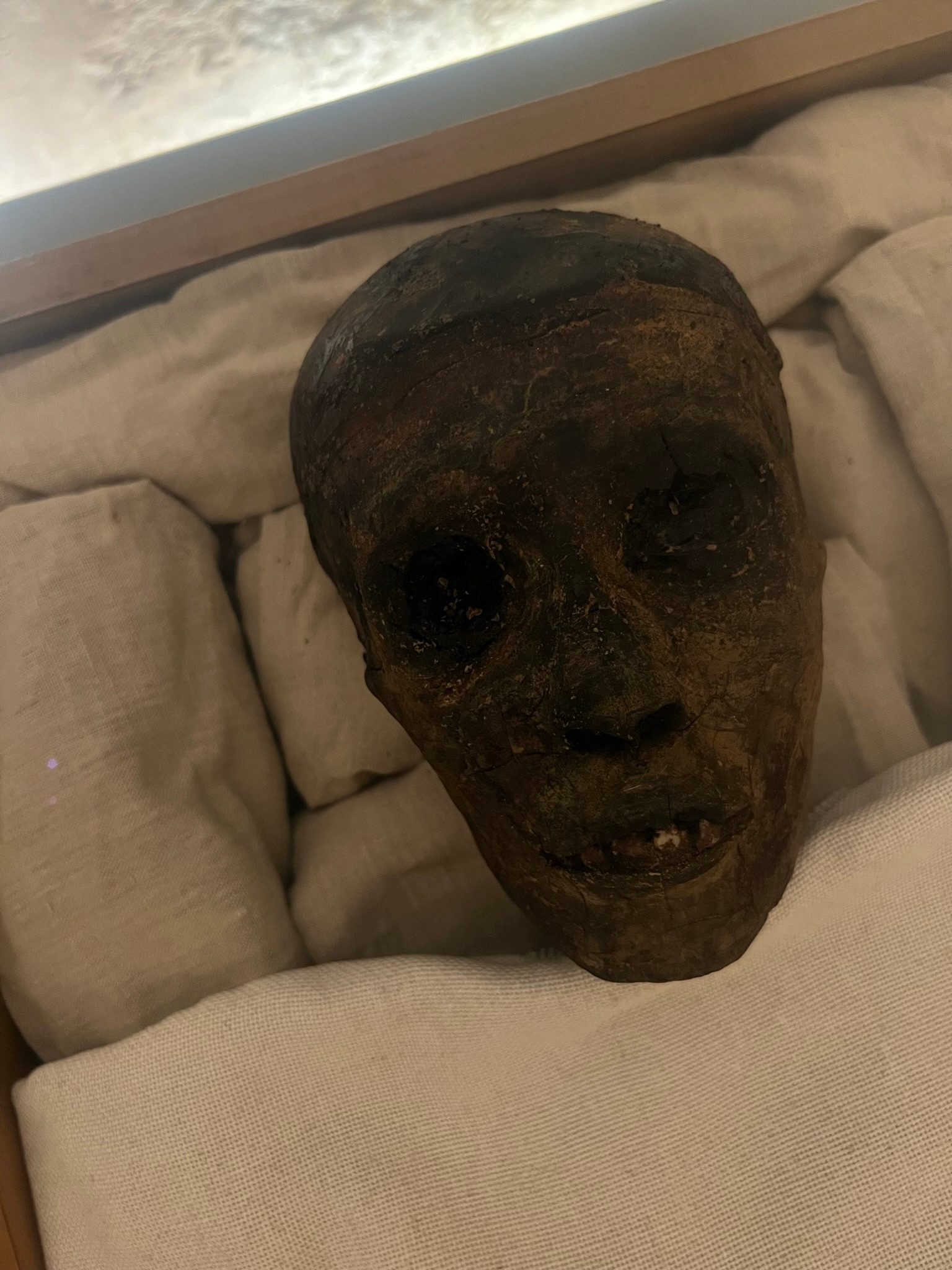
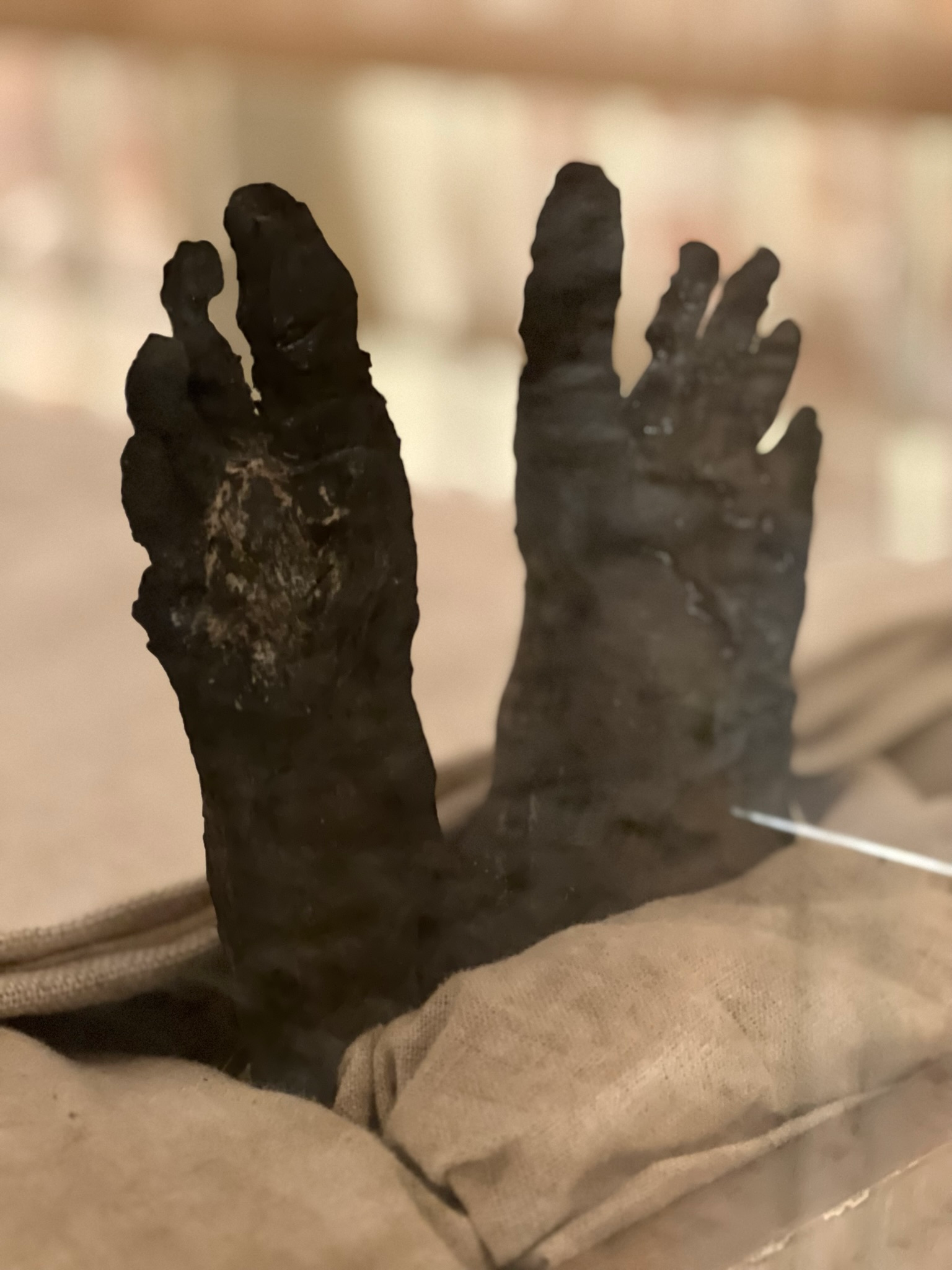
While exploring the tomb, I was in silent awe, trying to imagine Howard Carter’s reaction when it was first discovered. I couldn’t quite believe I was there, in the presence of a friggin’ pharaoh. The same one I had been fascinated by since I was a kid. The same one I had seen in documentaries. The same one I never thought I’d see in real life. Pure awe. And privilege. To experience history like that felt unreal.
Exploring the Royal Tombs
After being practically dragged out of Tutankhamun’s chamber to allow others in, we explored a few more tombs:
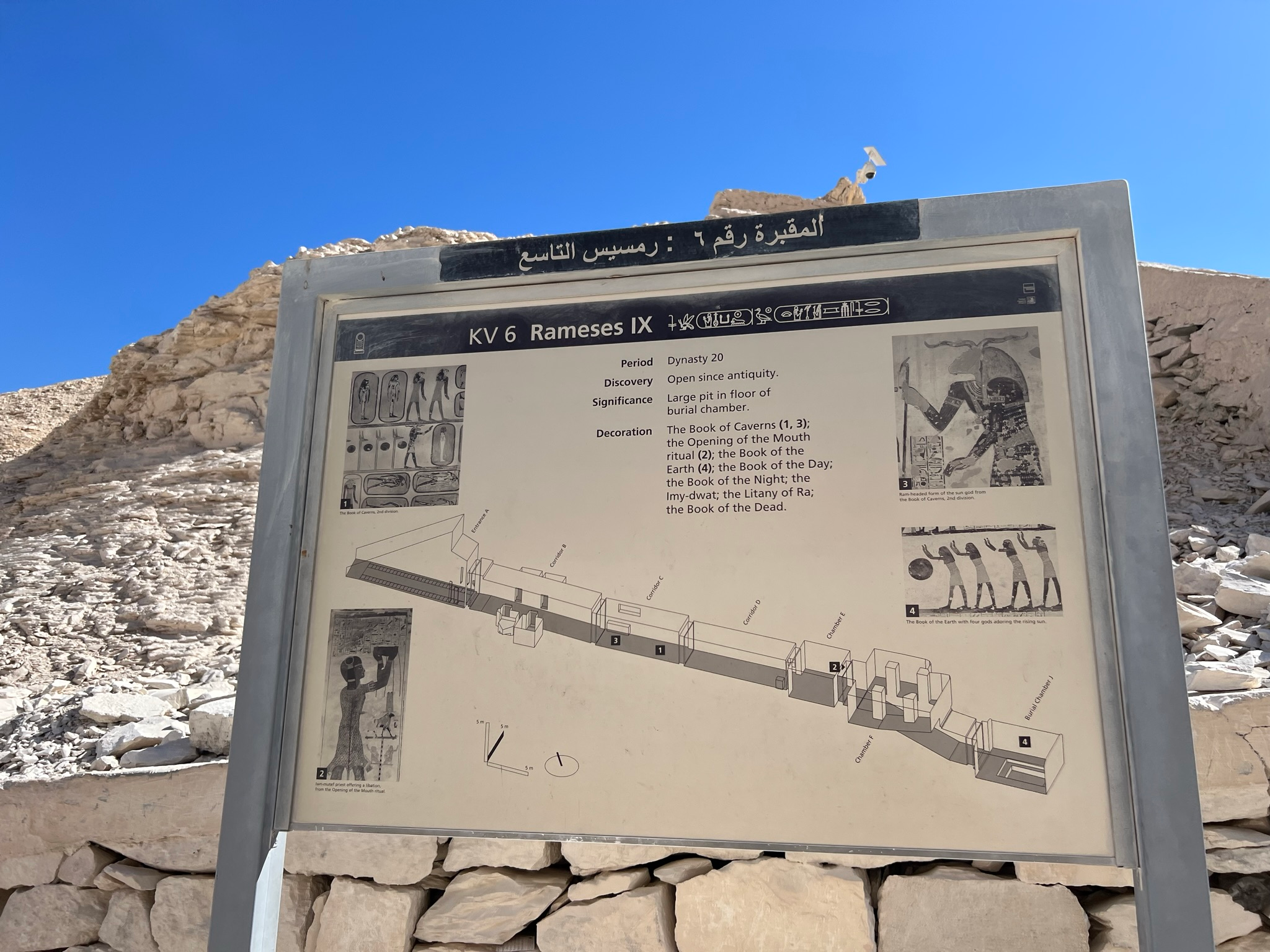
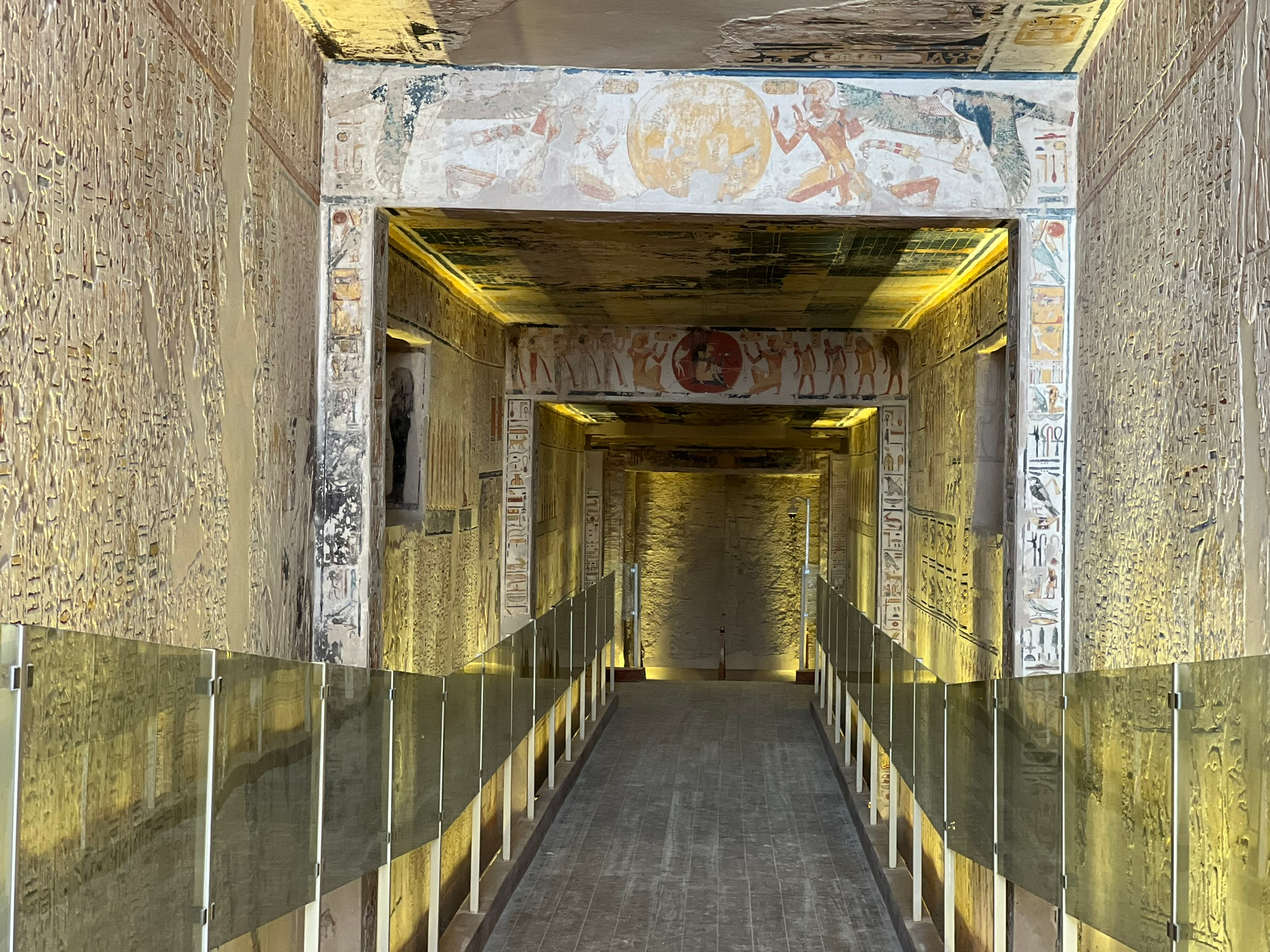
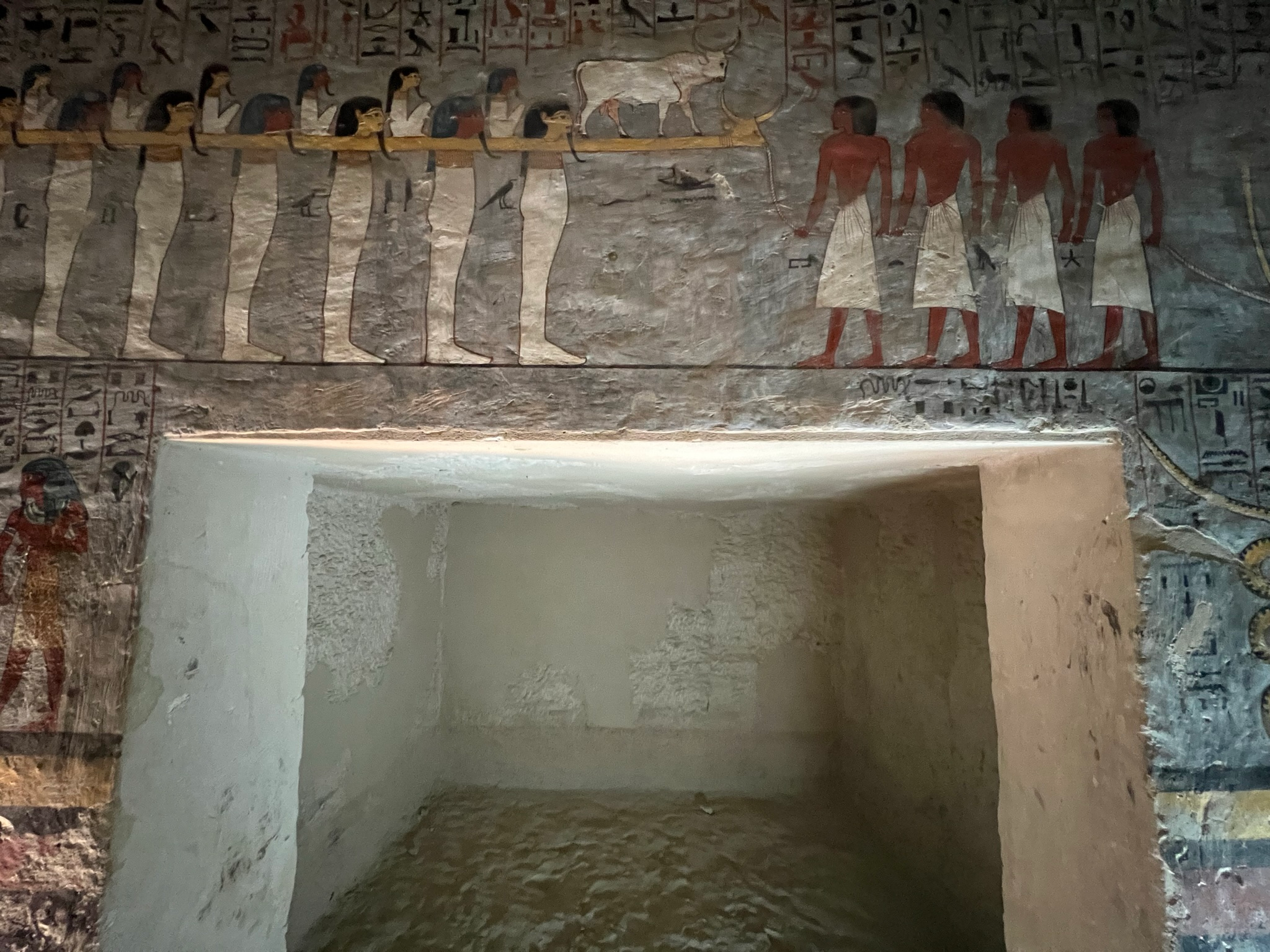
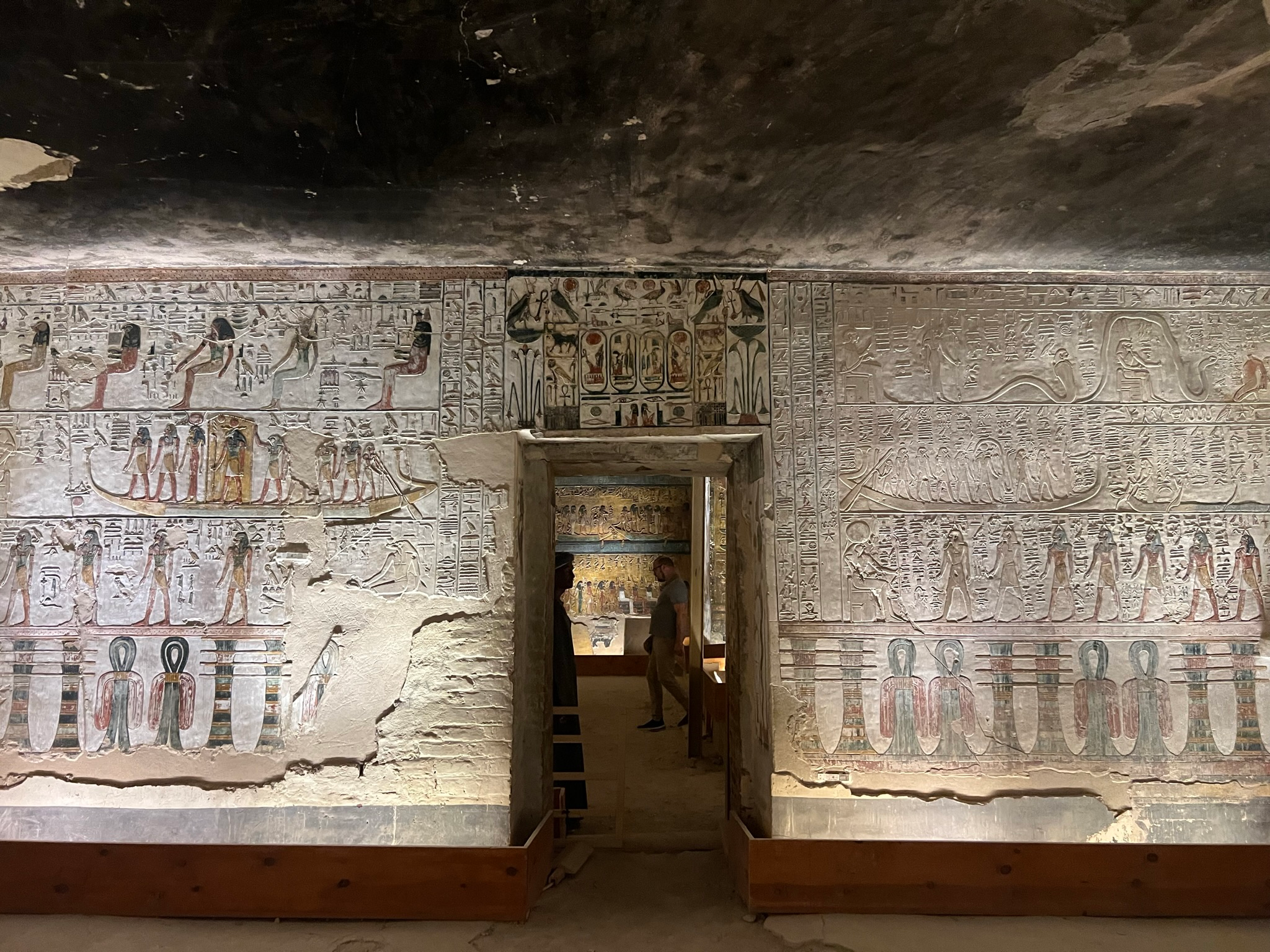
- Tomb of Ramses IX: Ramses IX ruled during a particularly turbulent time characterised by political and religious instability. His tomb consists of a 105-metre-long corridor with several side chambers leading to the burial chamber, where an empty two-tiered pit once held the sarcophagus. The walls are richly decorated with hieroglyphs and scenes from the Book of Gates and the Book of the Dead.
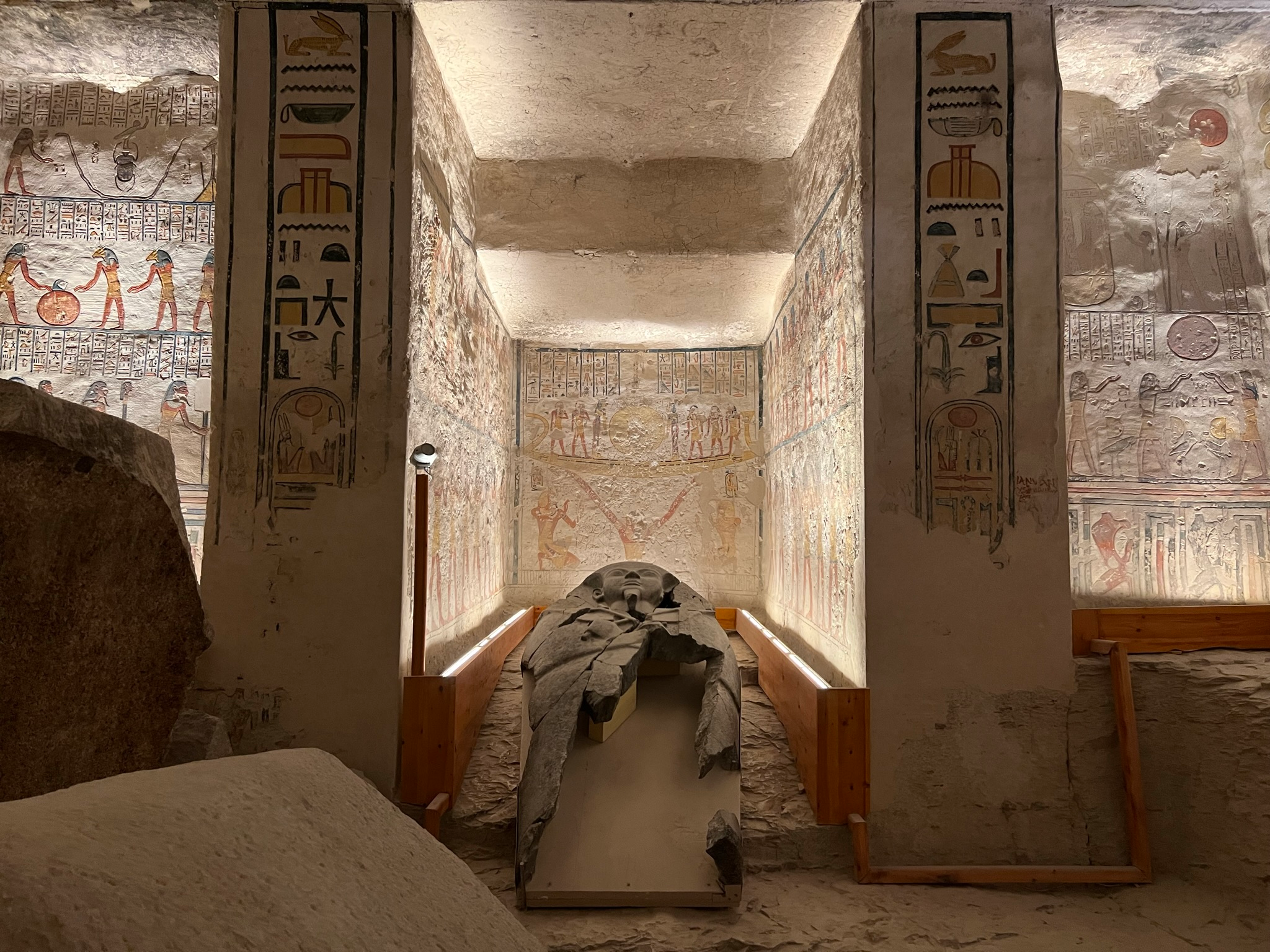
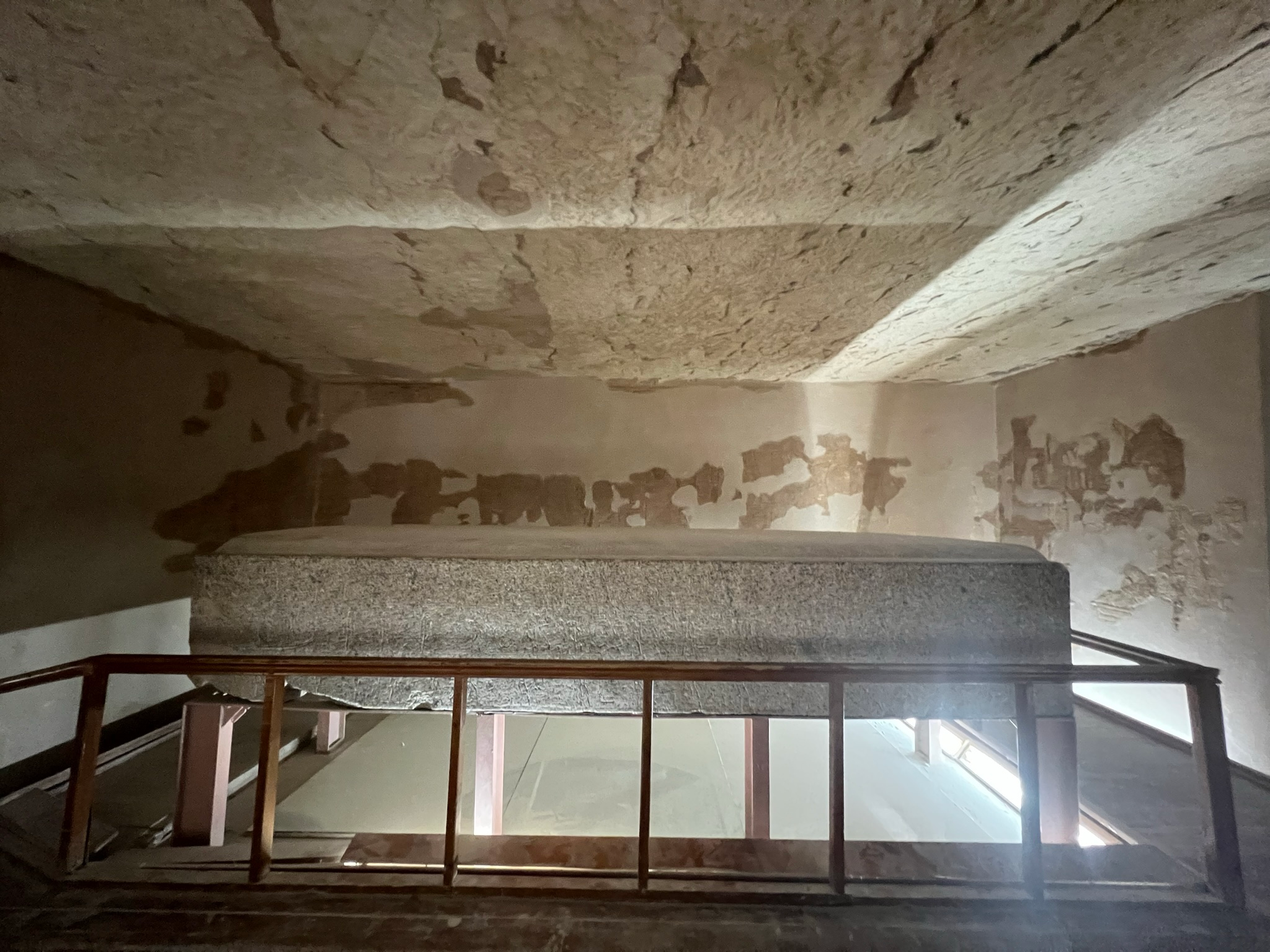
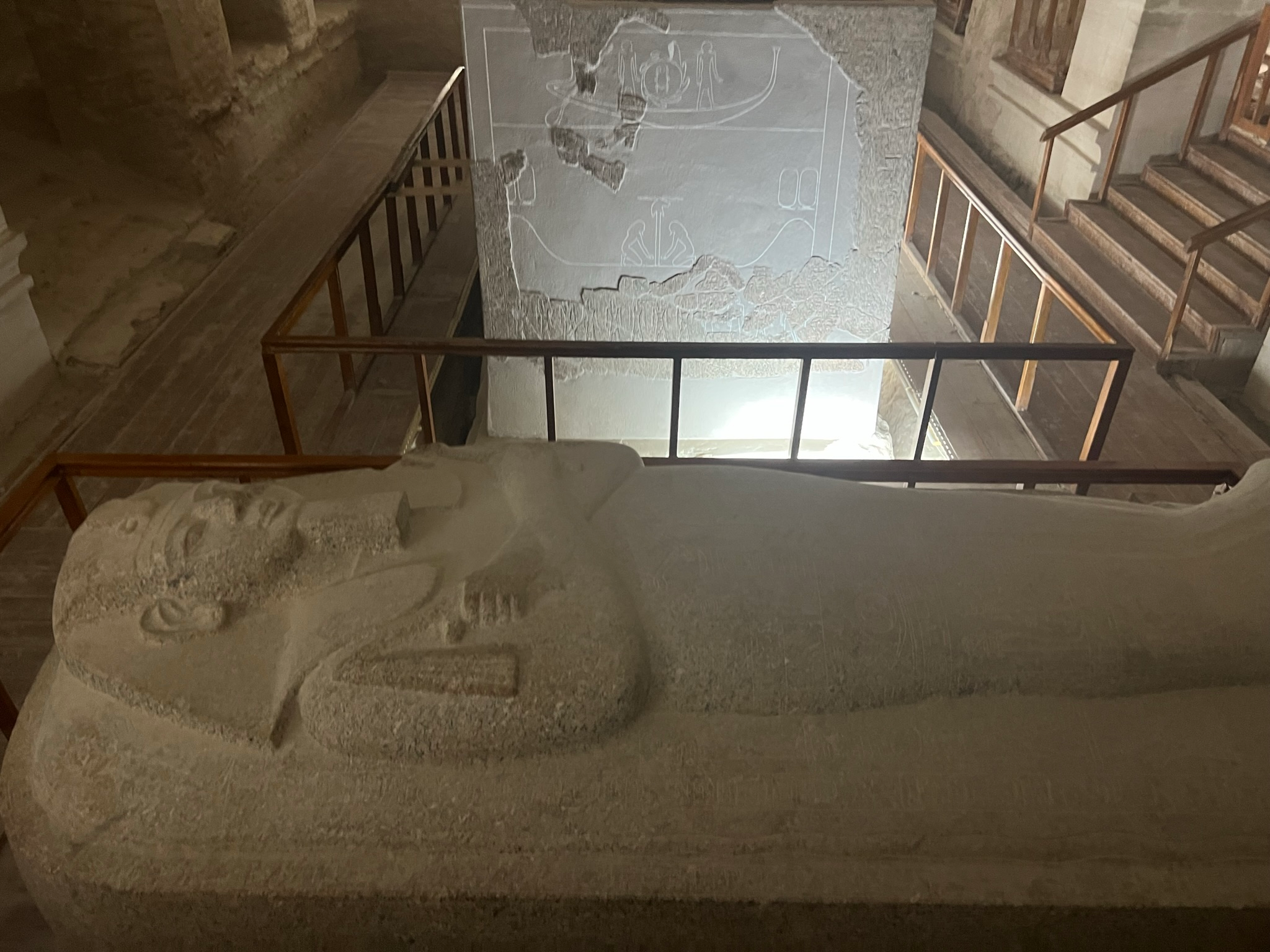
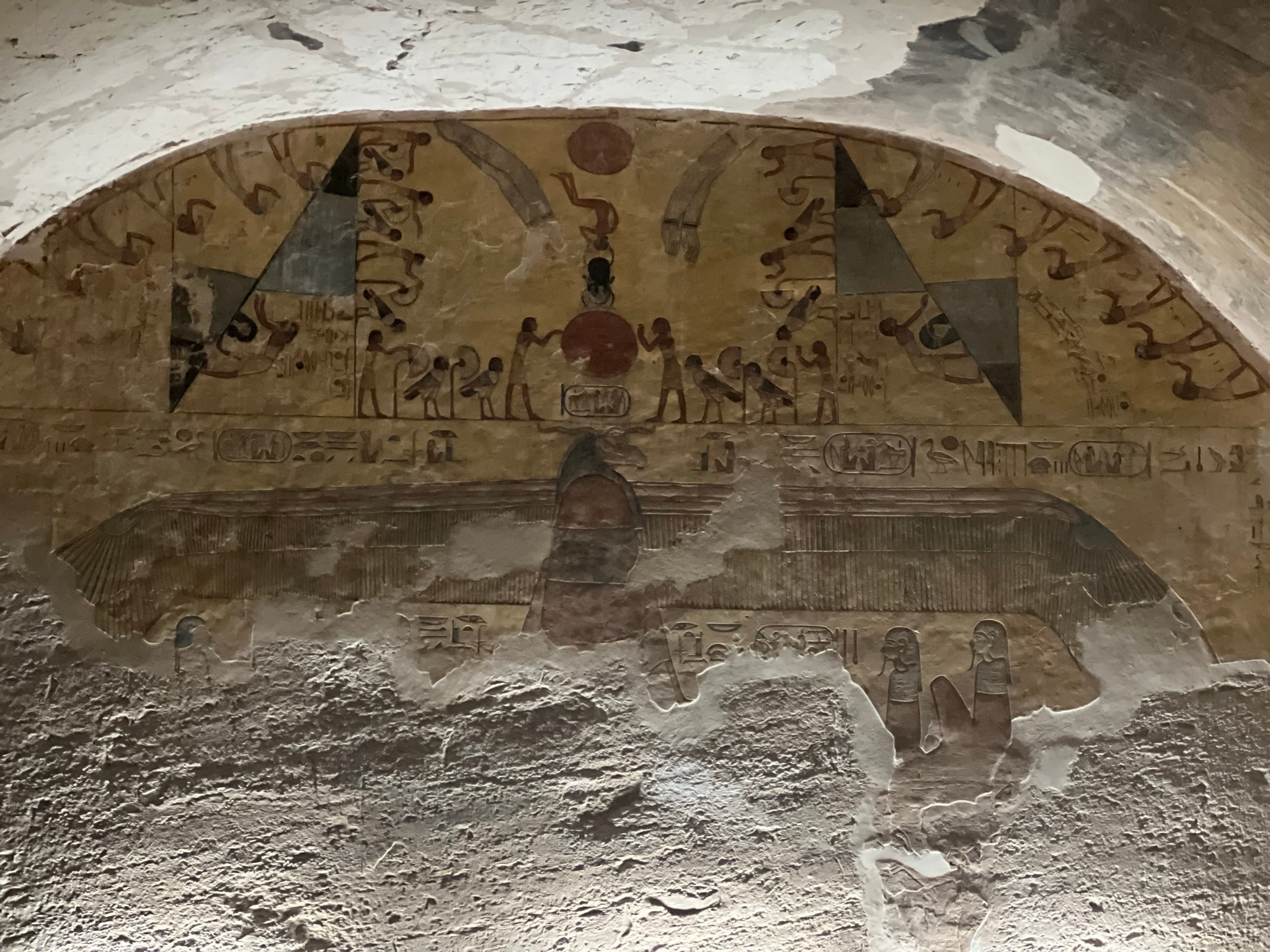
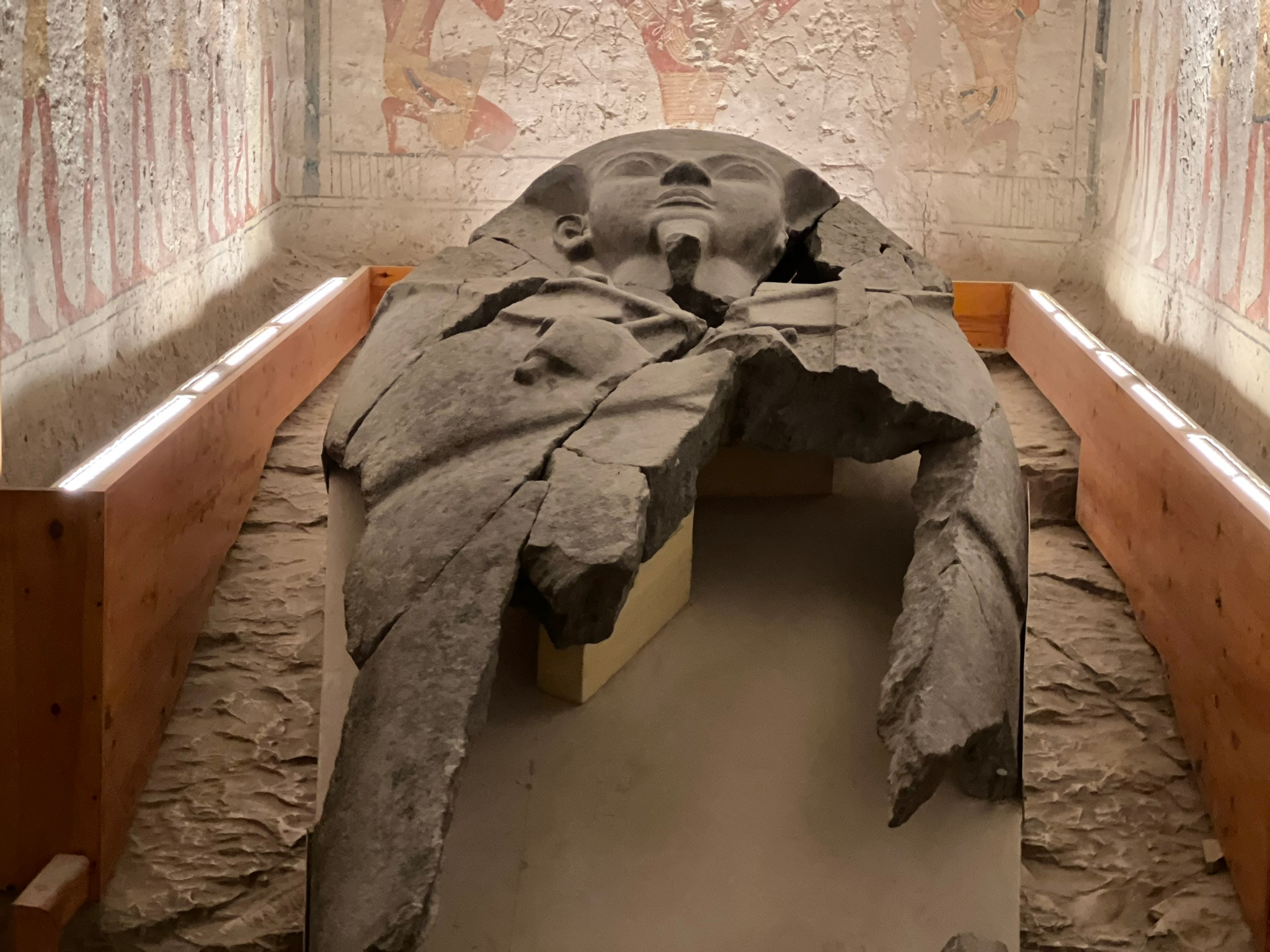
- Tomb of Merenptah: Overshadowed by his father Ramses II, Merenptah was a powerful pharaoh known for repelling foreign invasions. His tomb follows a similar layout to Ramses IX’s but features a longer corridor and a vast burial hall with a large granite sarcophagus. Scenes throughout depict the sun god’s nightly journey, with the goddess Nut shown on the ceiling swallowing the sun at dusk and giving birth to it at dawn, symbolising death and rebirth.
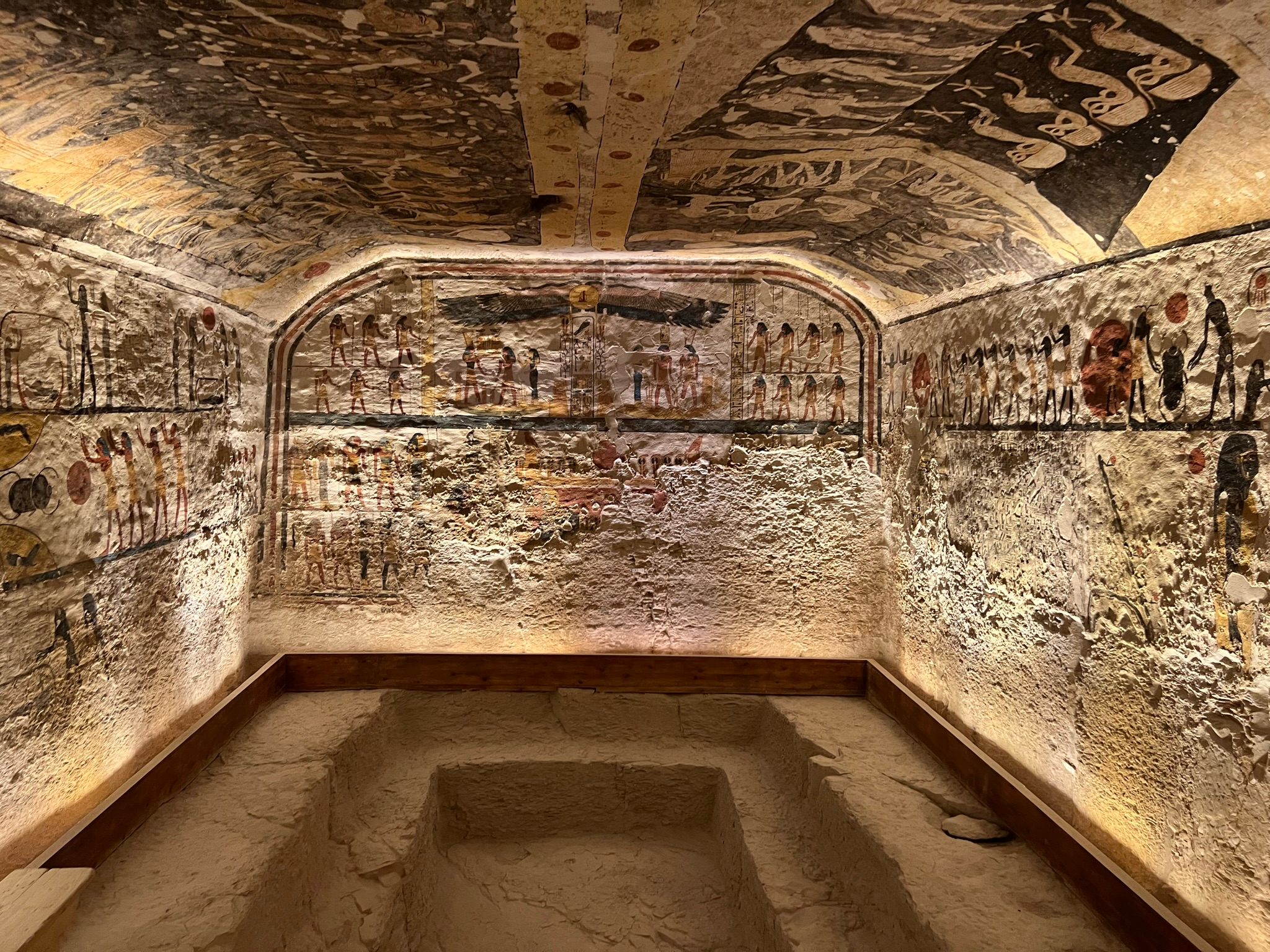
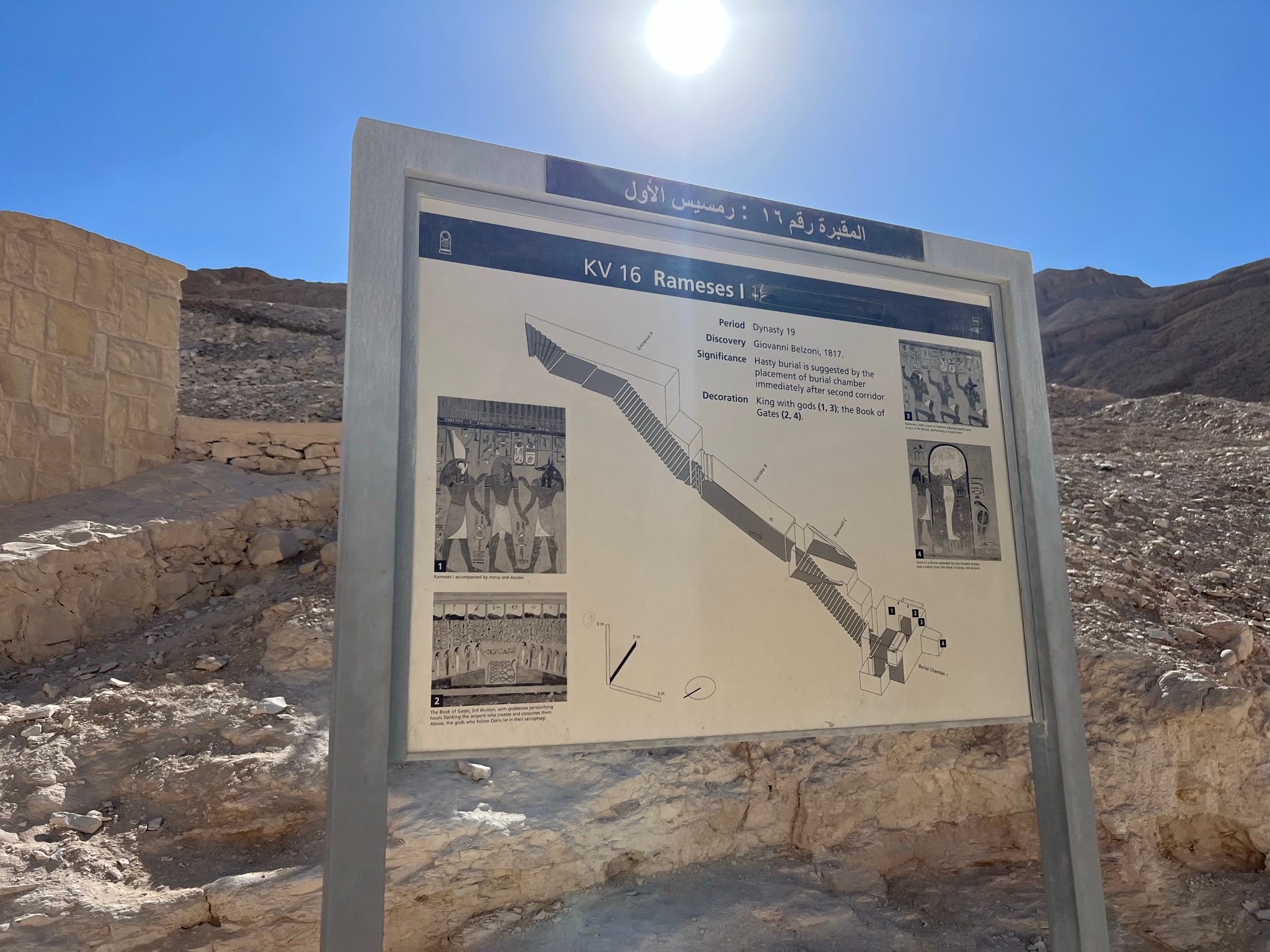
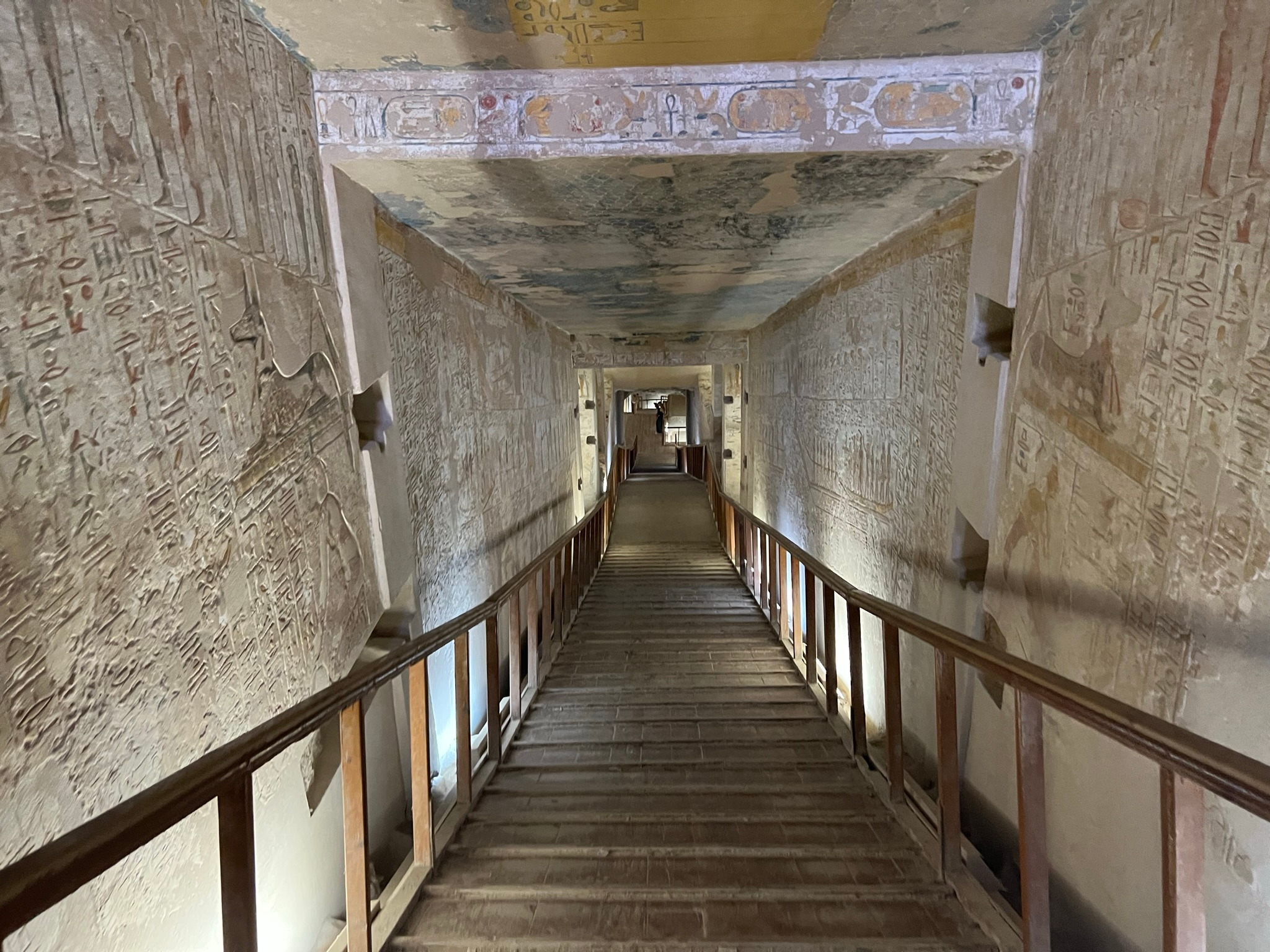
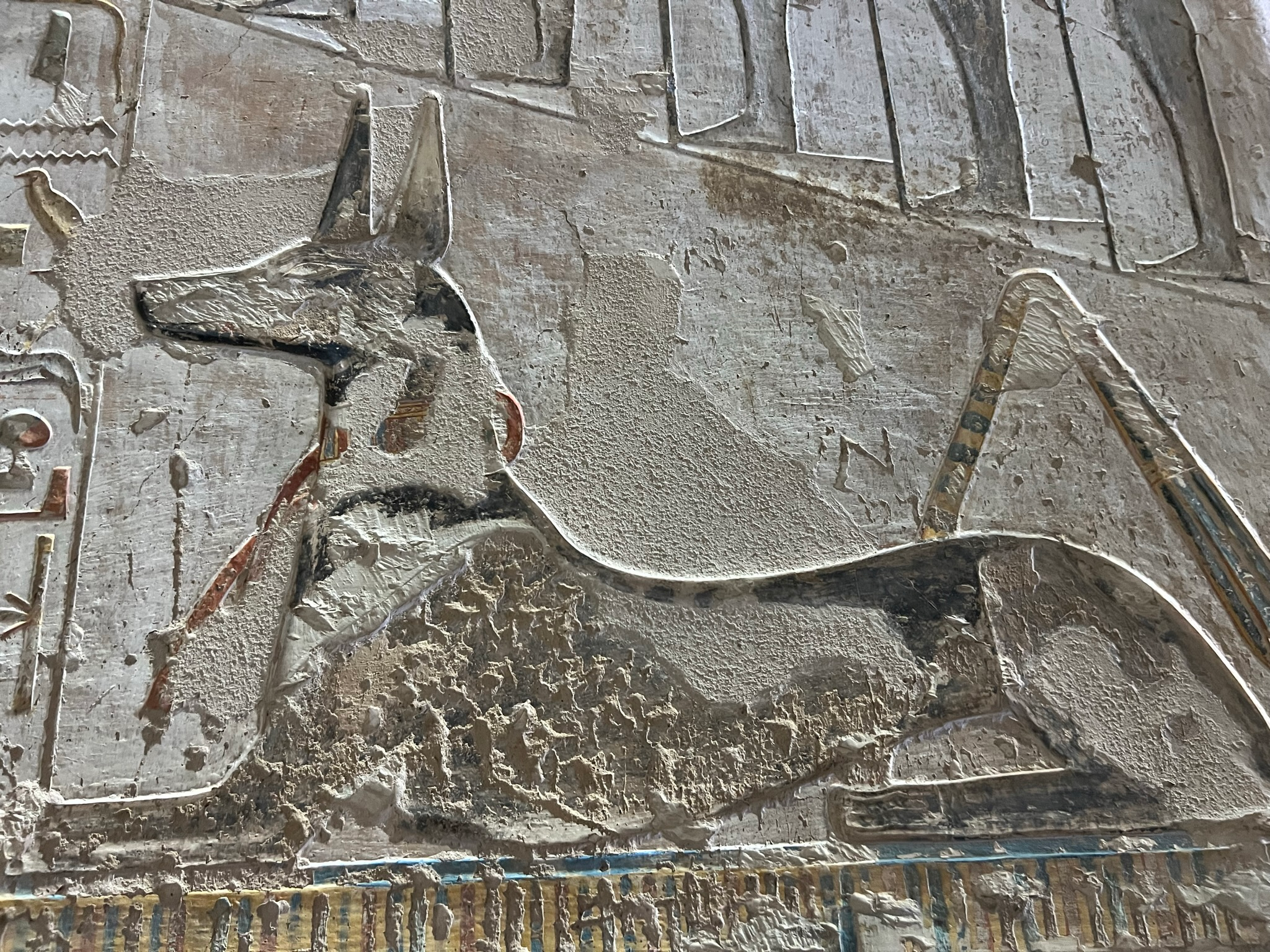
- Tomb of Ramesses I: Though he ruled briefly, Ramesses I founded the Ramesside dynasty, which included pharaohs such as Ramses II and Seti I. His tomb has one of the shortest corridors, likely due to his sudden death and rushed construction. Despite its simplicity, it still contains a red granite sarcophagus.
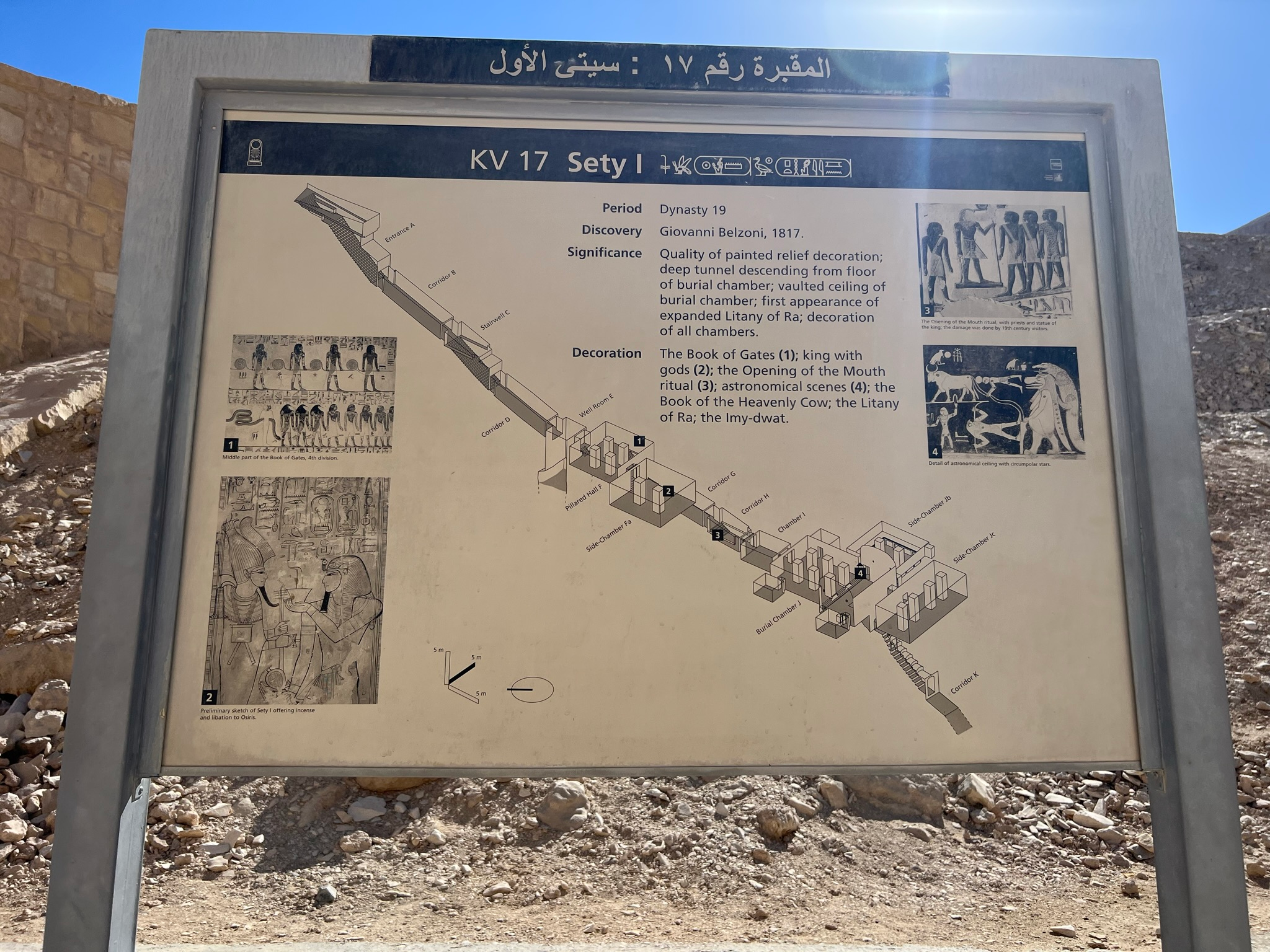
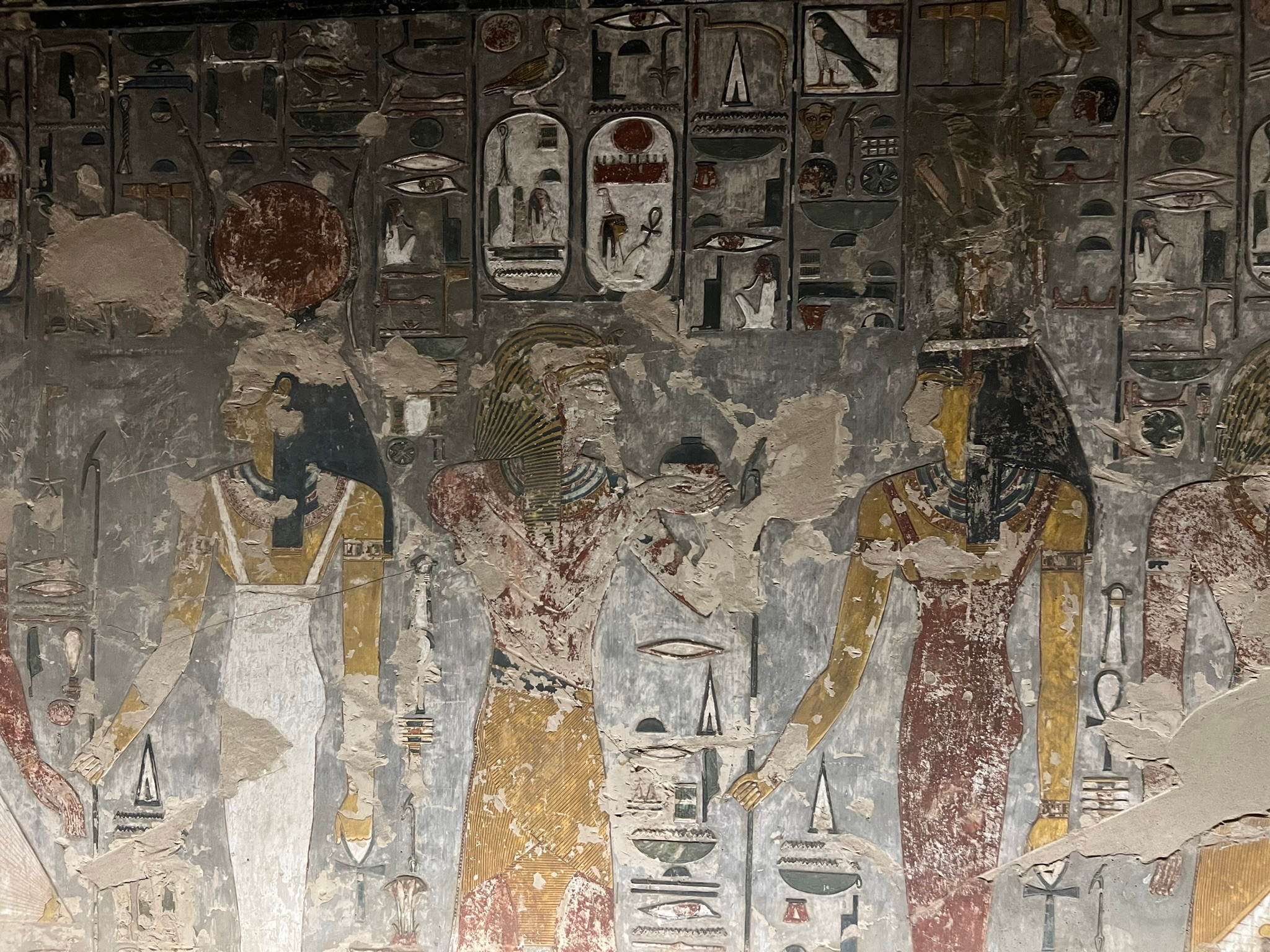
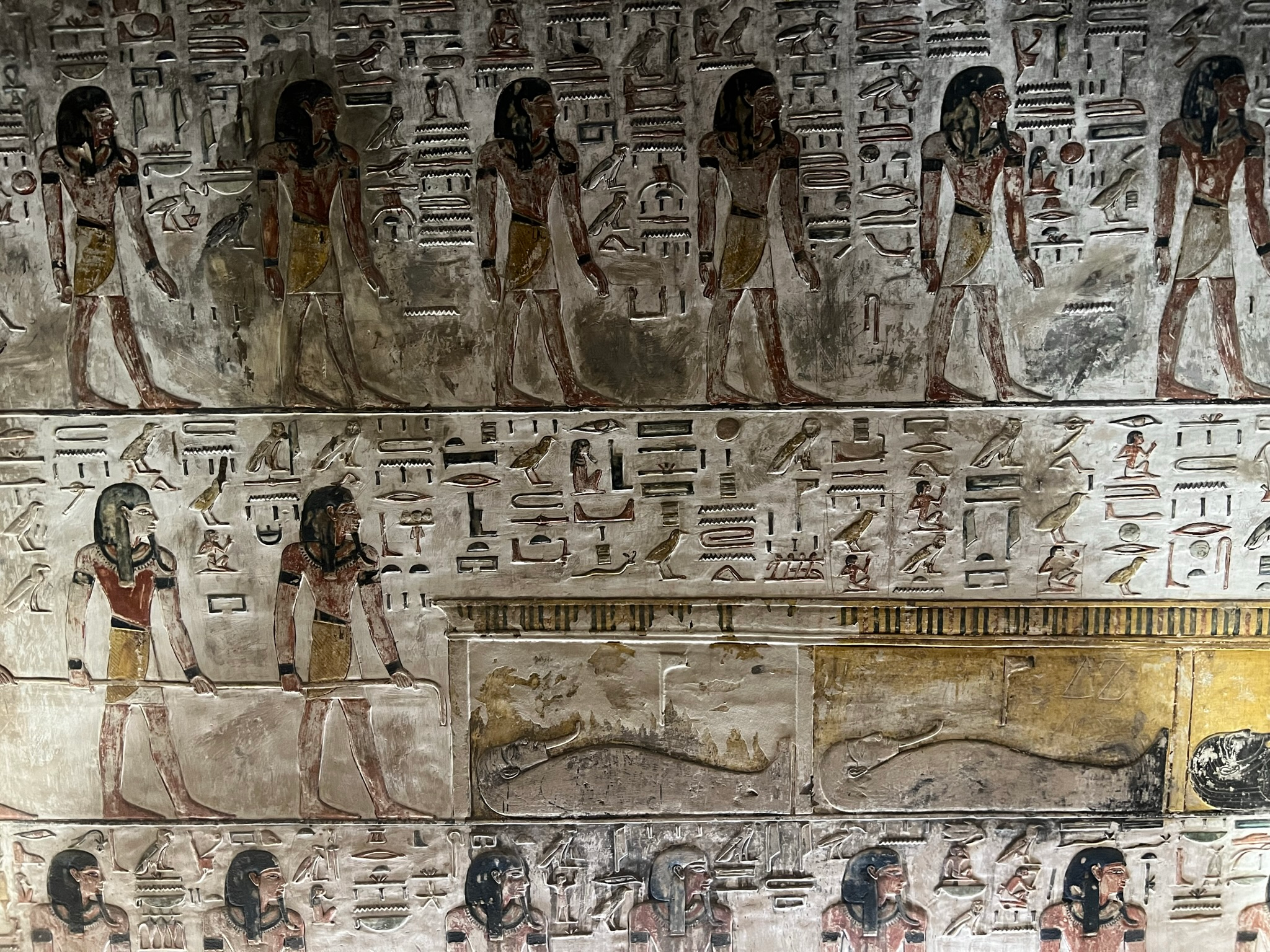
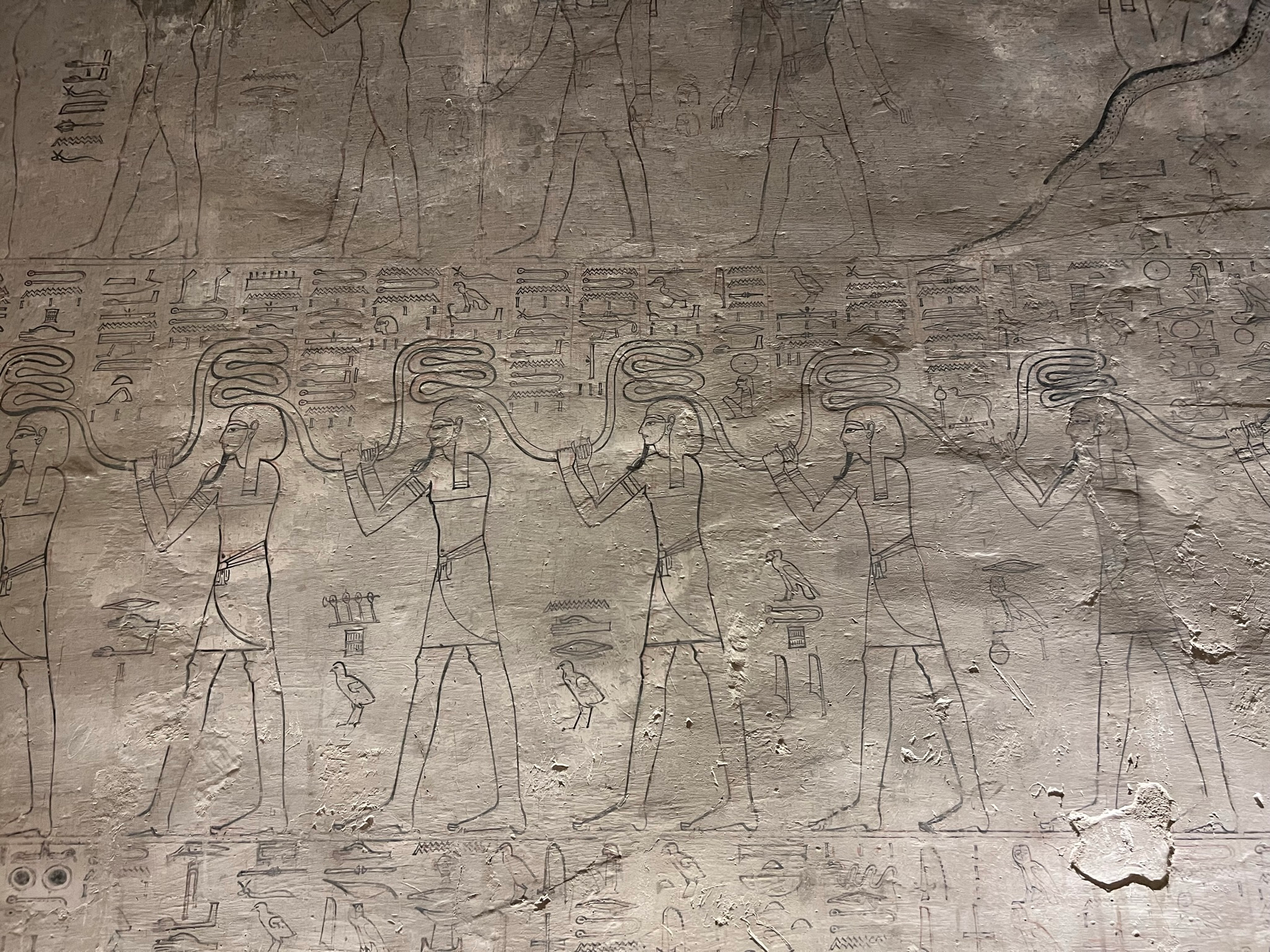
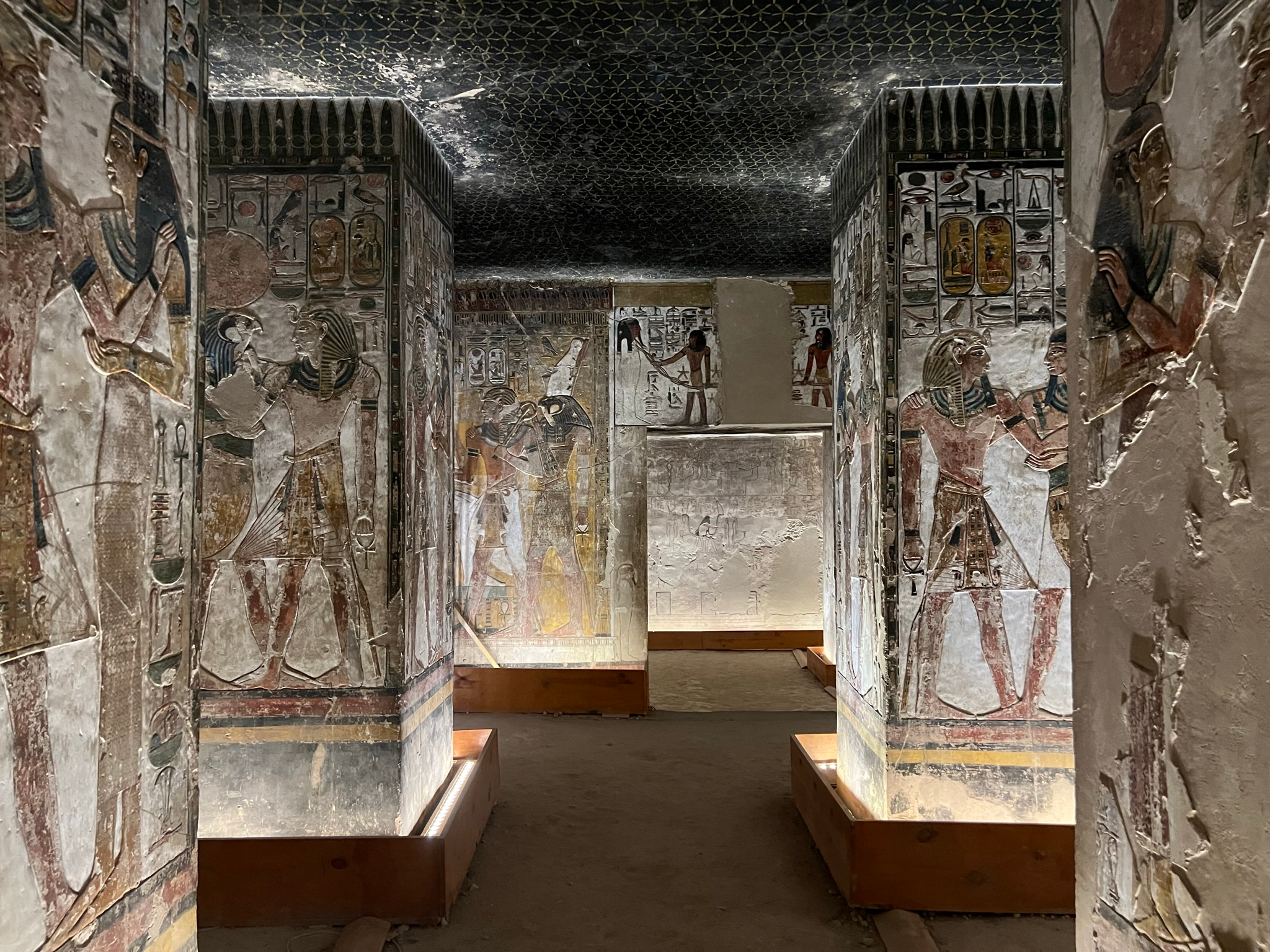
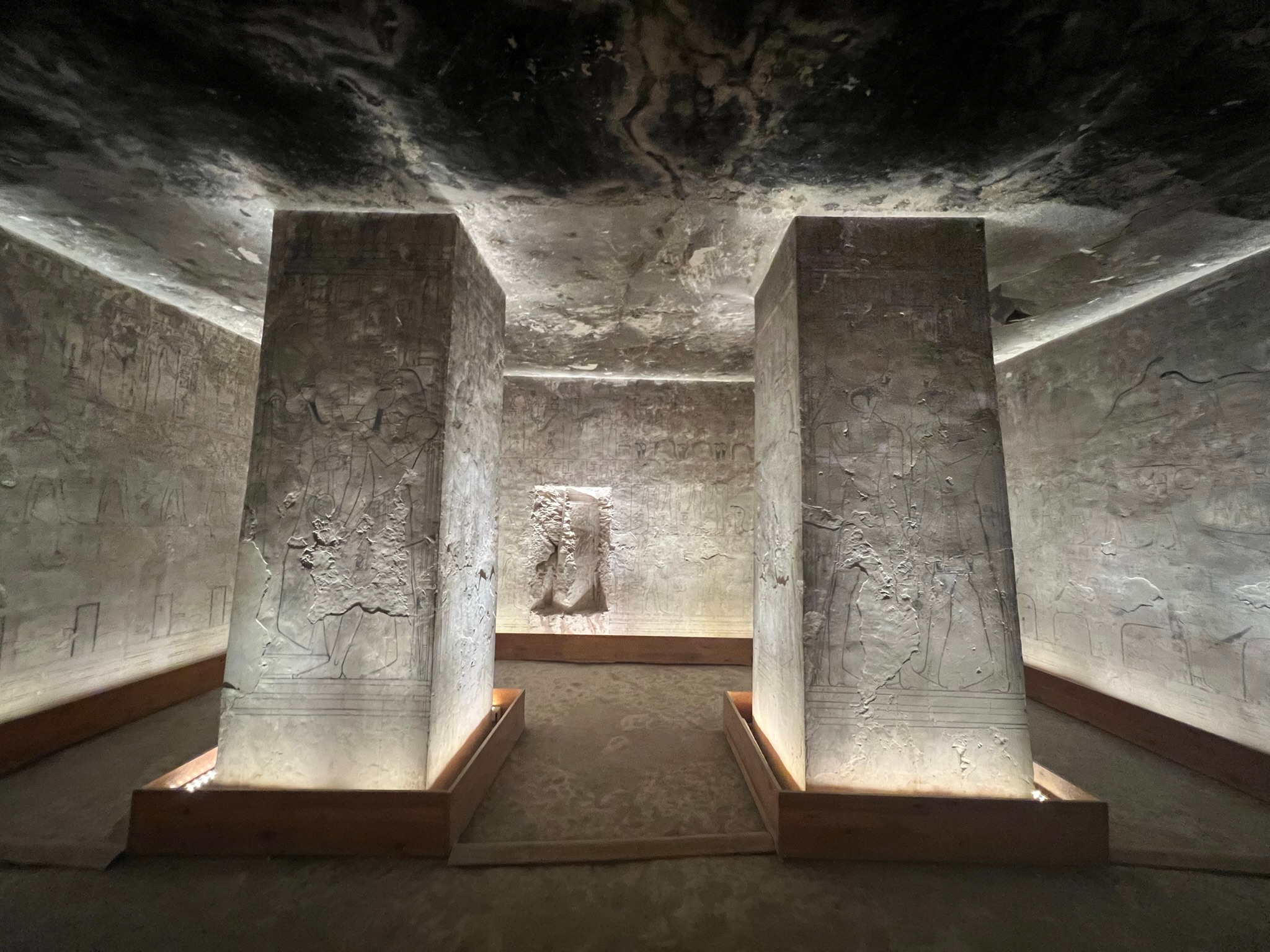
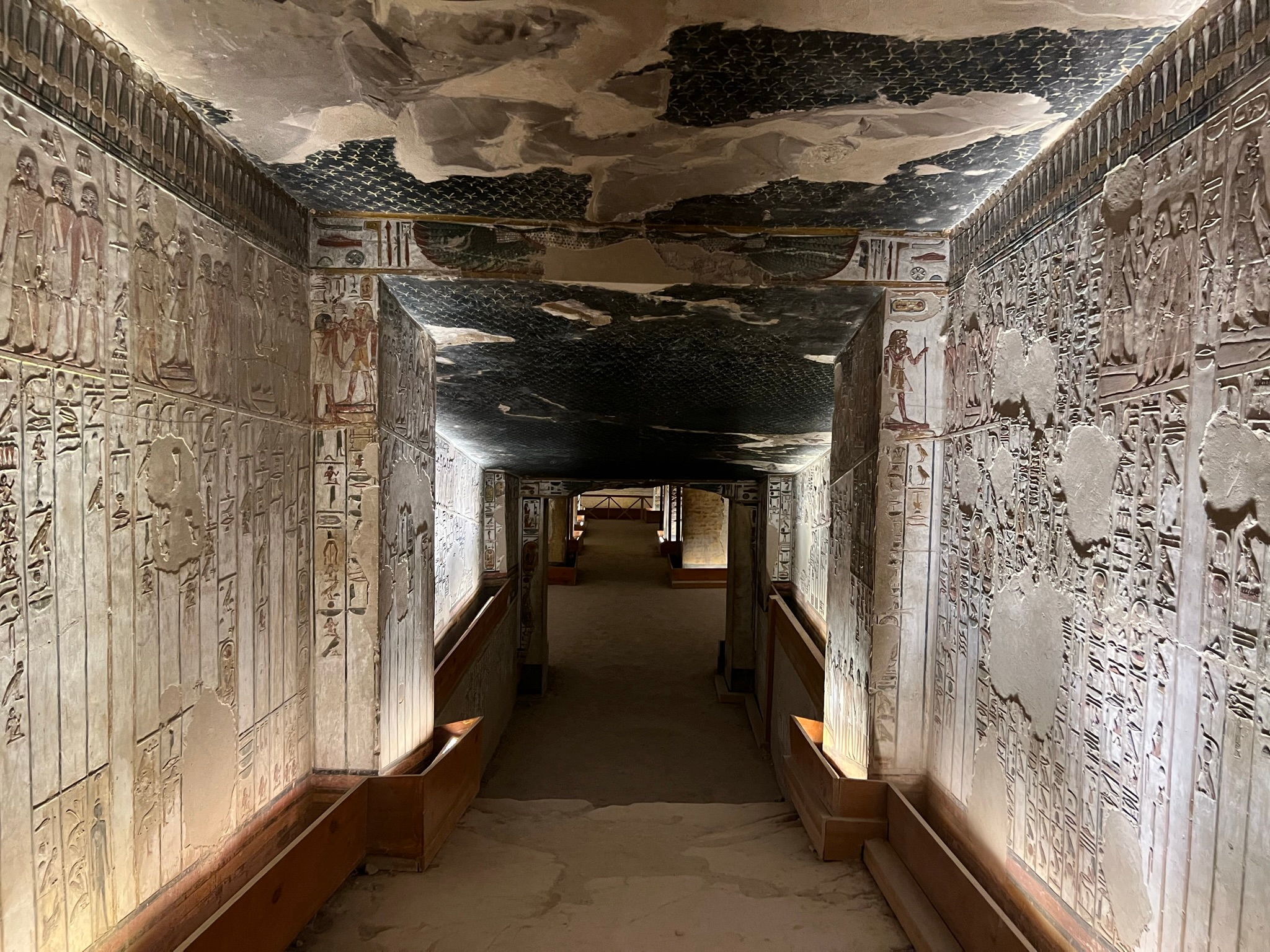
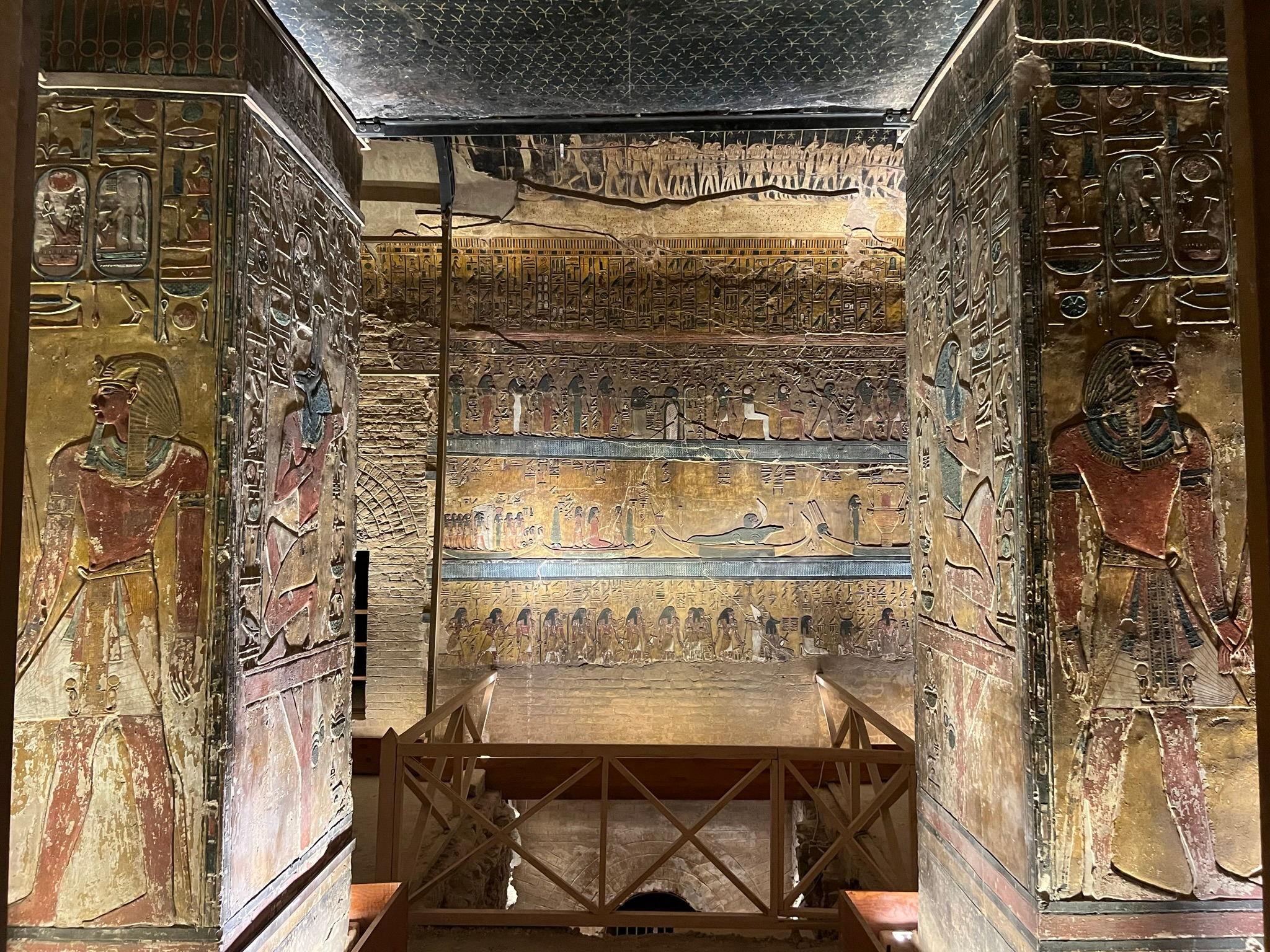
- Tomb of Seti I: A powerful and influential pharaoh, Seti I led military campaigns and major construction projects, including at Karnak. His tomb, accessed for an extra fee (definitely worth it), is one of the most elaborate in the Valley of the Kings. The 137-metre corridor includes multiple levels, side chambers, and pillared halls, leading to a richly decorated burial chamber with a sunken sarcophagus pit and celestial ceiling. A local guide (whom we tipped) showed us additional areas usually closed to the public, which made it feel slightly sacrilegious in the best way.
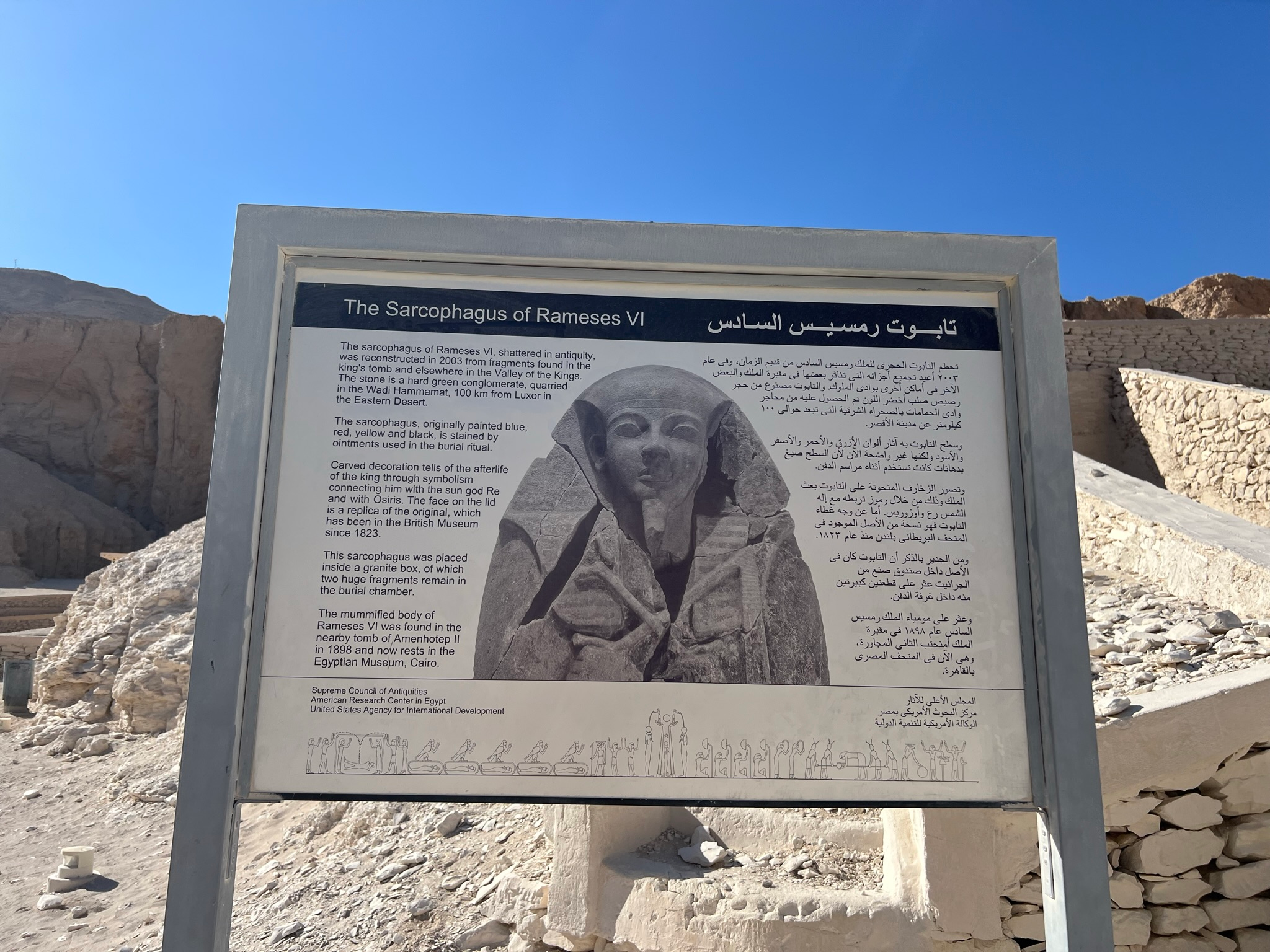
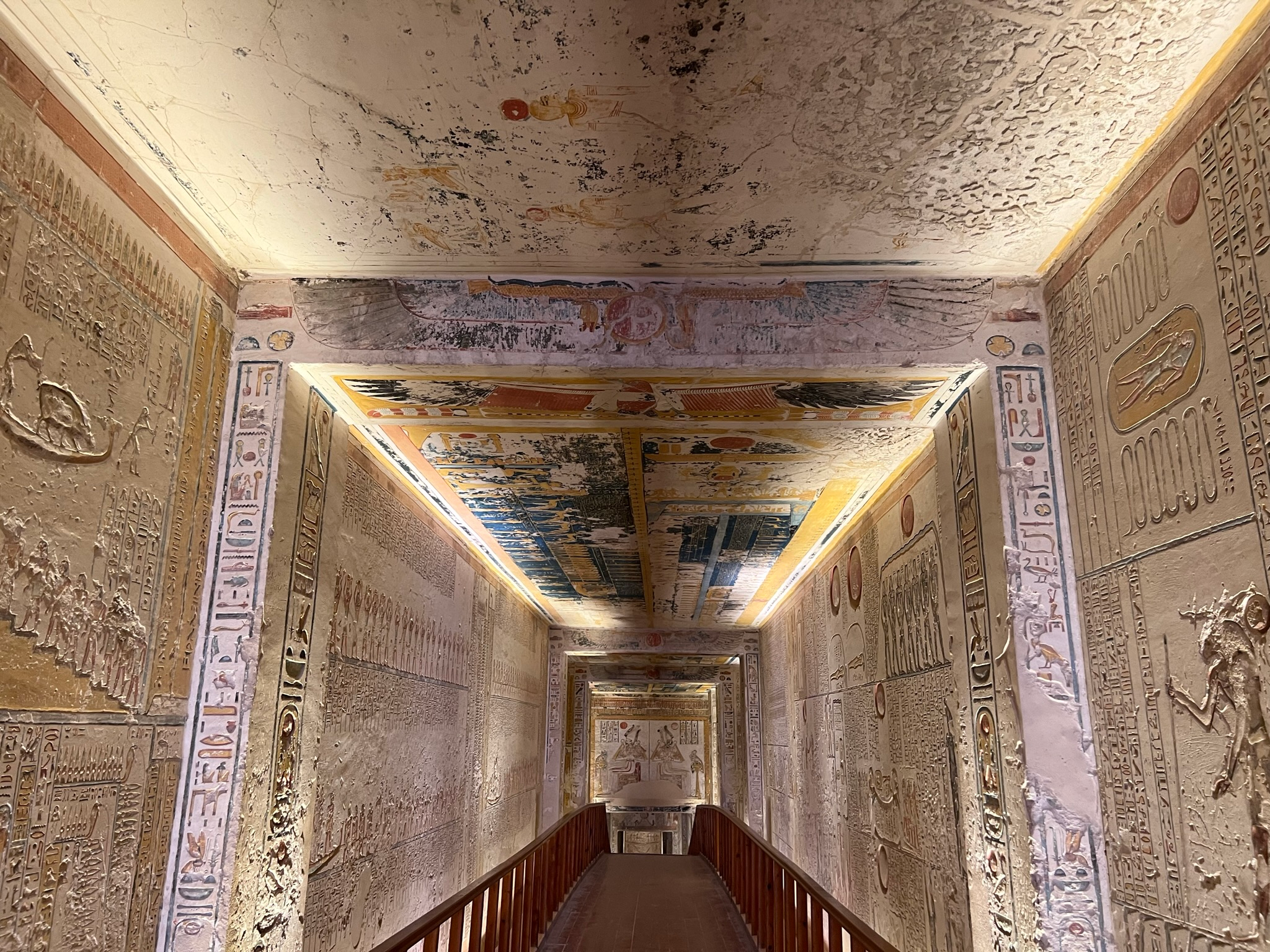
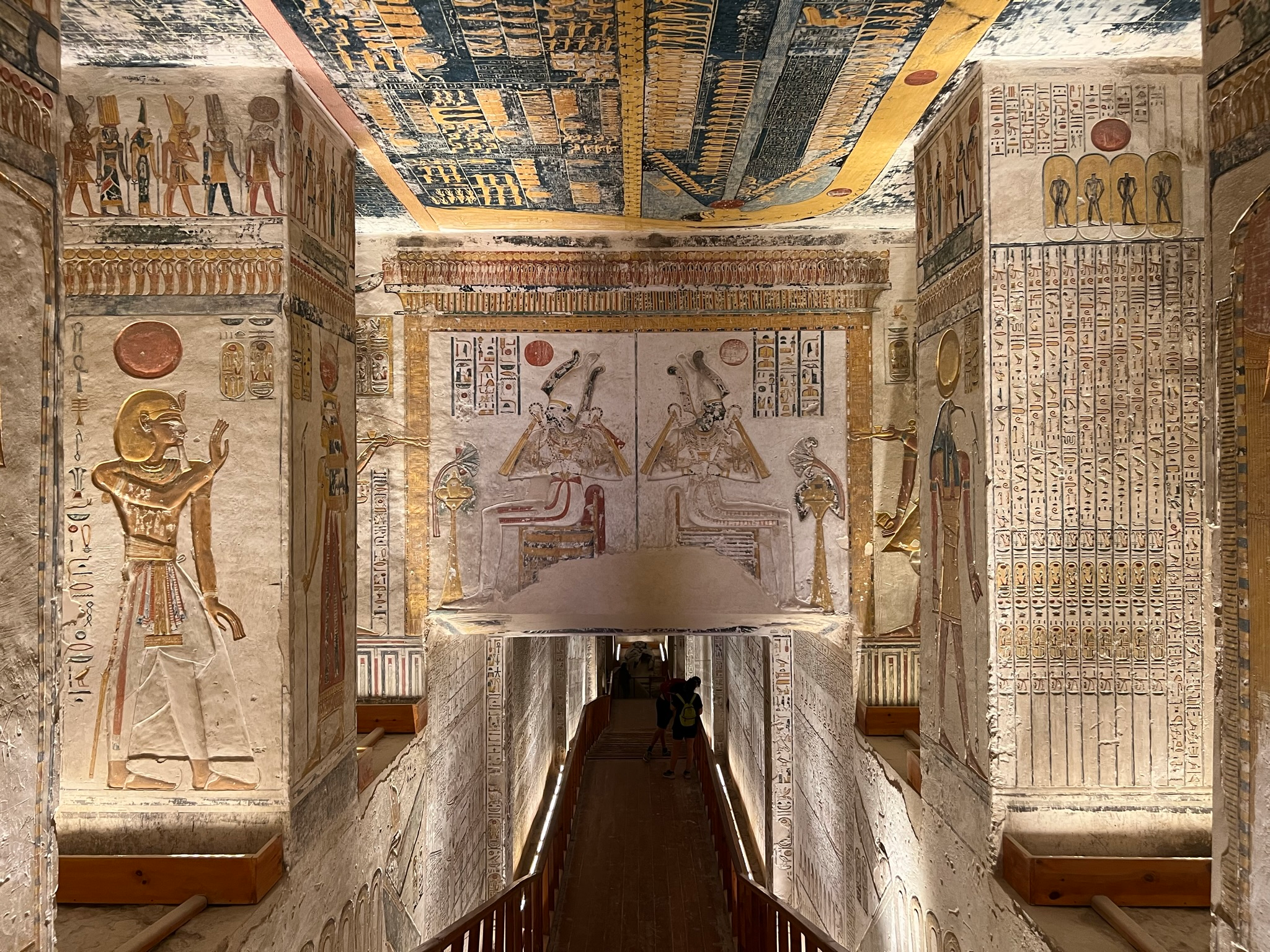
- Tomb of Ramesses VI: Though politically less significant, Ramesses VI’s tomb is one of the most visually stunning in the Valley of the Kings. Its corridor features some of the most intricate wall art, leading to a richly decorated burial chamber with a broken granite sarcophagus and a vivid depiction of the goddess Nut on the ceiling, showing the sun’s cosmic cycle of death and rebirth.
PART III
A Felucca Ride on the Nile
After spending a couple of hours roaming the ruins, we headed for lunch. While we were excited to try some local food at a typical restaurant, we were once again taken to the same damn artisanal shop we had visited earlier that morning. Of course, we only realised when we got there, and when we complained, Ahmed said we wouldn’t have enough time to go elsewhere if we wanted to do everything we had planned.
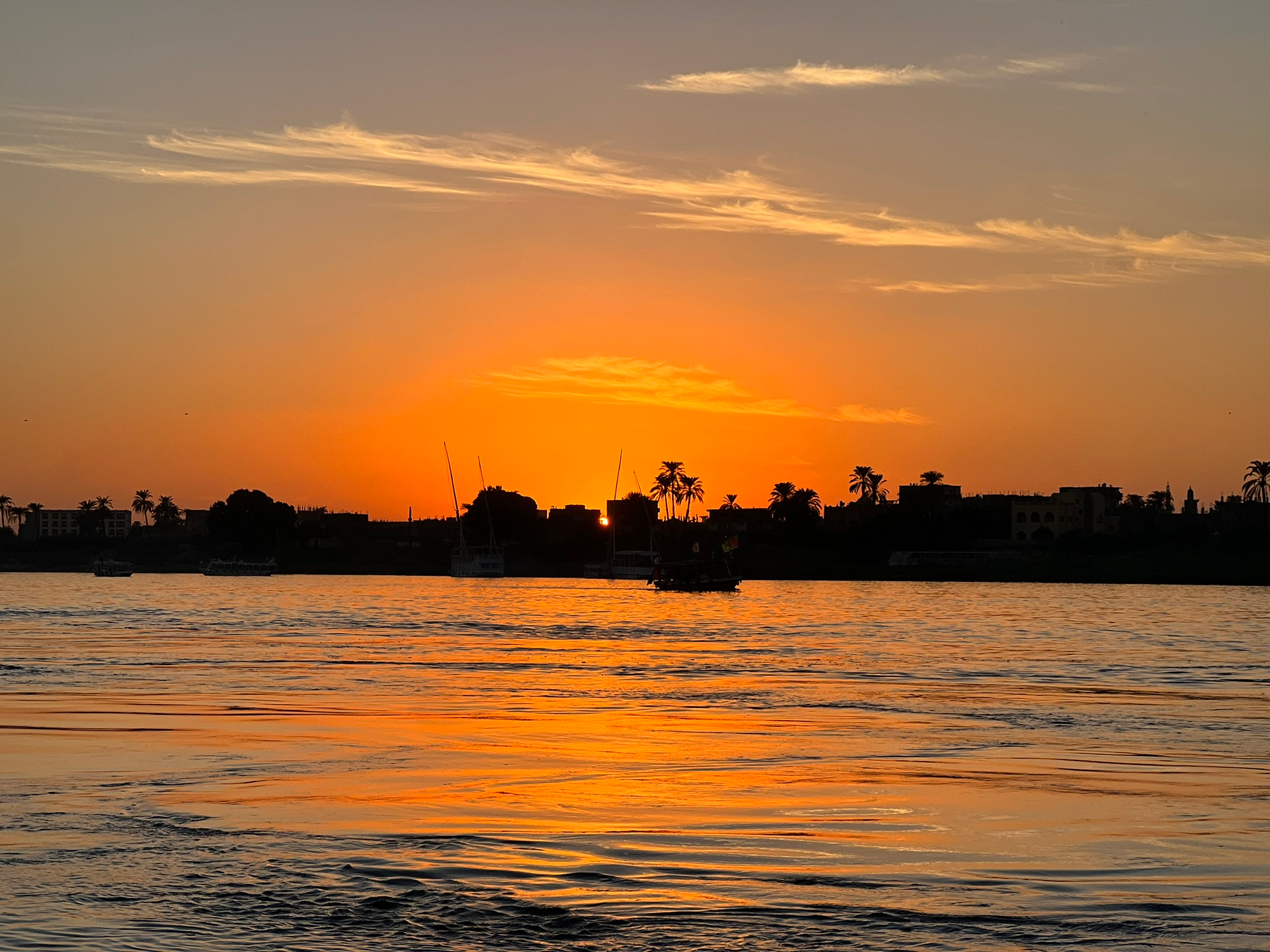
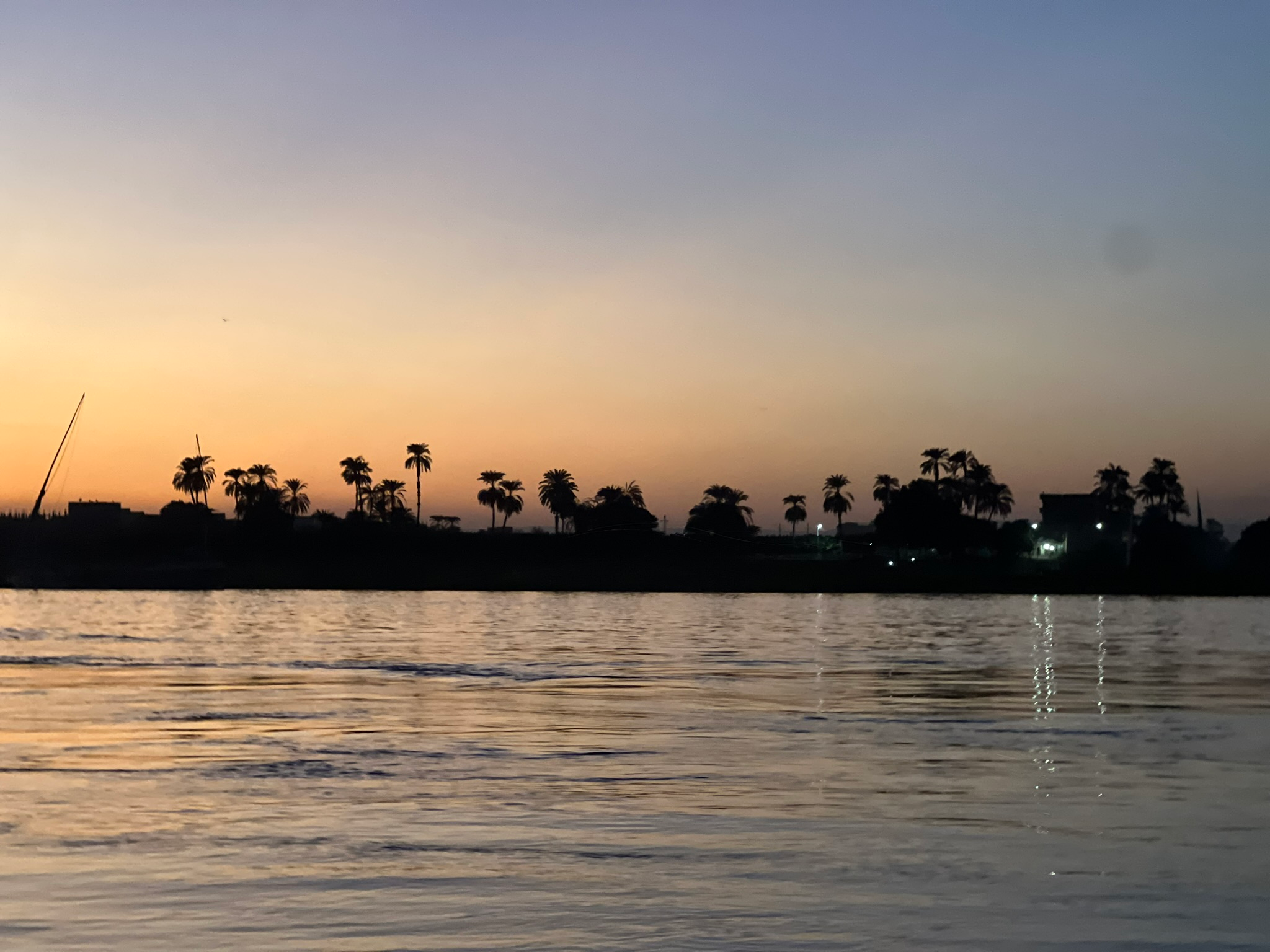
And so, after begrudgingly eating our lunch, we crossed between the west and east banks of the Nile to enjoy a felucca ride on the river itself. I’d usually go on about describing the boat and how the captain manoeuvred it. I’d also mention the gorgeous pink sunset draping over the green river, as the night sky offered the first glimpse of the stars. I’d probably also go on about it being the perfect end to a beautiful day exploring ancient ruins.
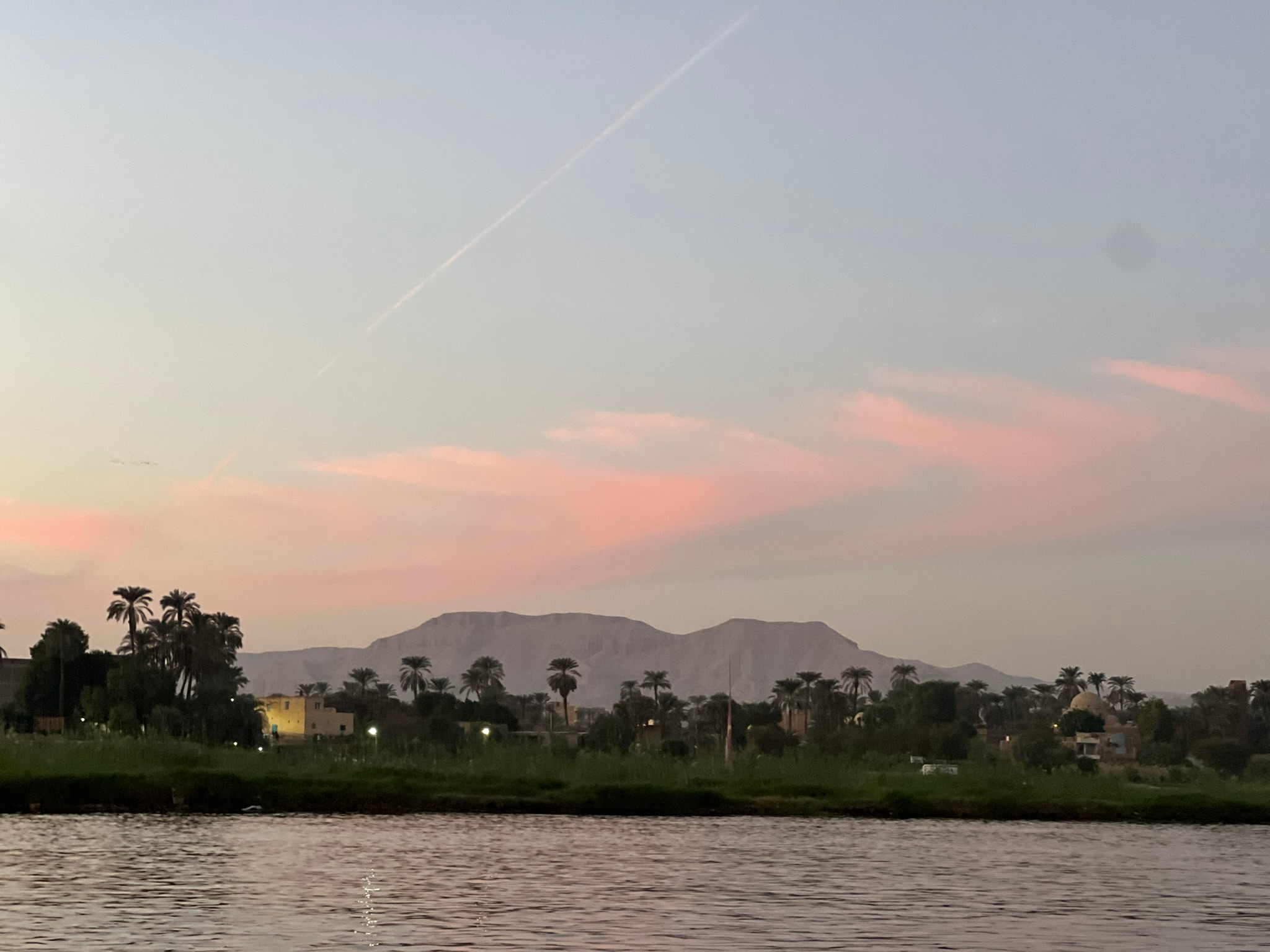

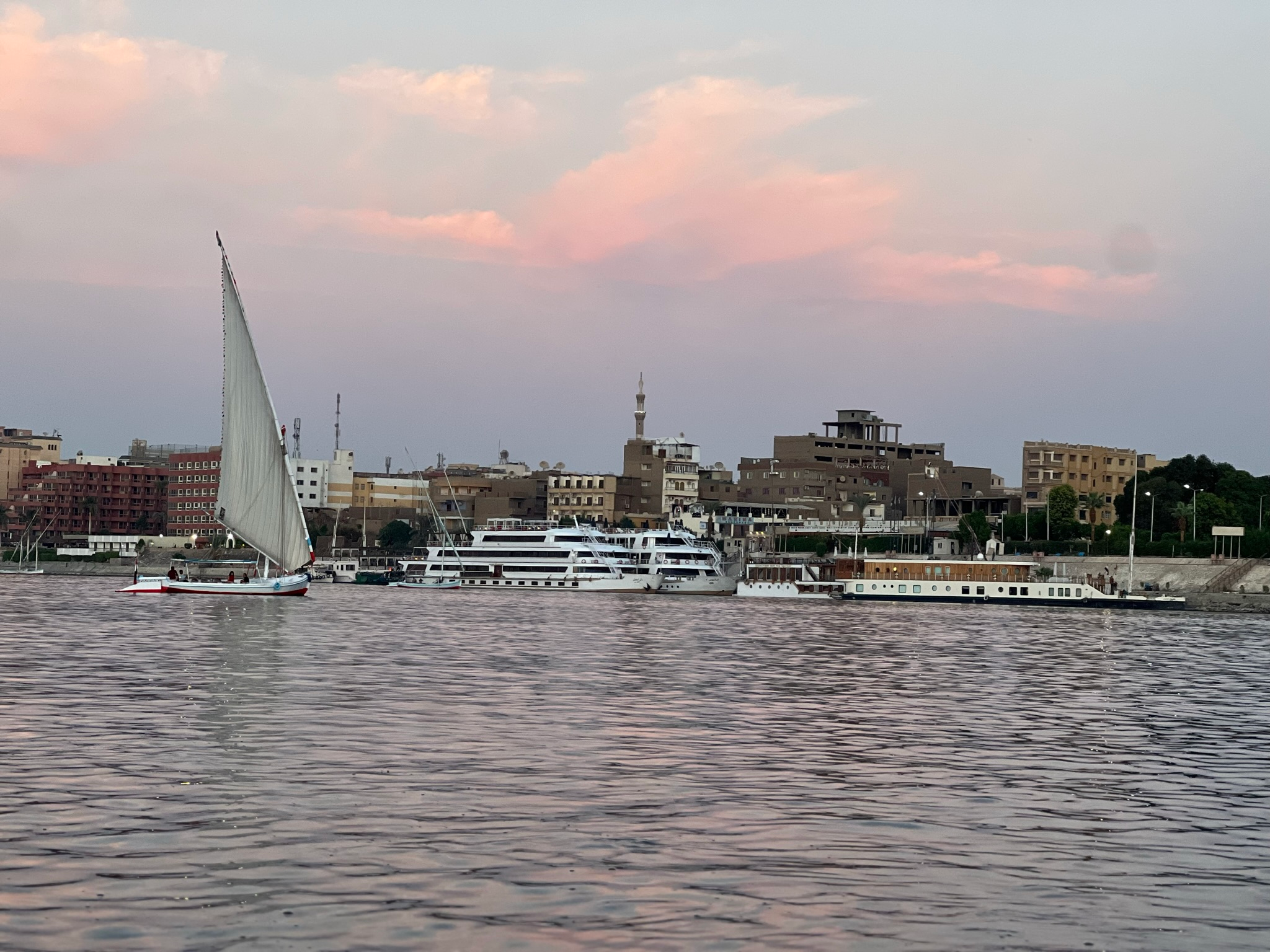
I probably would’ve done that – only it didn’t quite fit our mood at all. We had spent the day being rushed from one place to another, being harassed to buy all kinds of things, pestered to tip for the slightest service we hadn’t even asked for, and guided by people who seemed more focused on money than meaning. We had heard Egypt was supposed to be super cheap – so far, it had cost us an arm and a leg just because of these gratuities.
I know it might sound like white privilege, and although I wouldn’t consider myself financially struggling, I am nowhere rich and I work very hard for my money. It sucks knowing that my money, and hence my time, is treated as expendable. There was little sense that the effort it took to earn it mattered on the other side. They didn’t seem to care that we worked hard for every cent we earned. Not to mention that time off is a luxury, and we were trying to see as much as we could in such a limited time.
It was mentally and physically exhausting. In all my years of travelling, I don’t think I’ve ever said I wanted to leave a country I was visiting – except here. I could have happily gone home. So could the others.
Luxor Temple: Gateway to the Divine
By the time we reached Lour next stop, night had fully settled over the city and our moods were at rock bottom to say the least. That didn’t last long though, with Luxor Temple being yet another highlight.
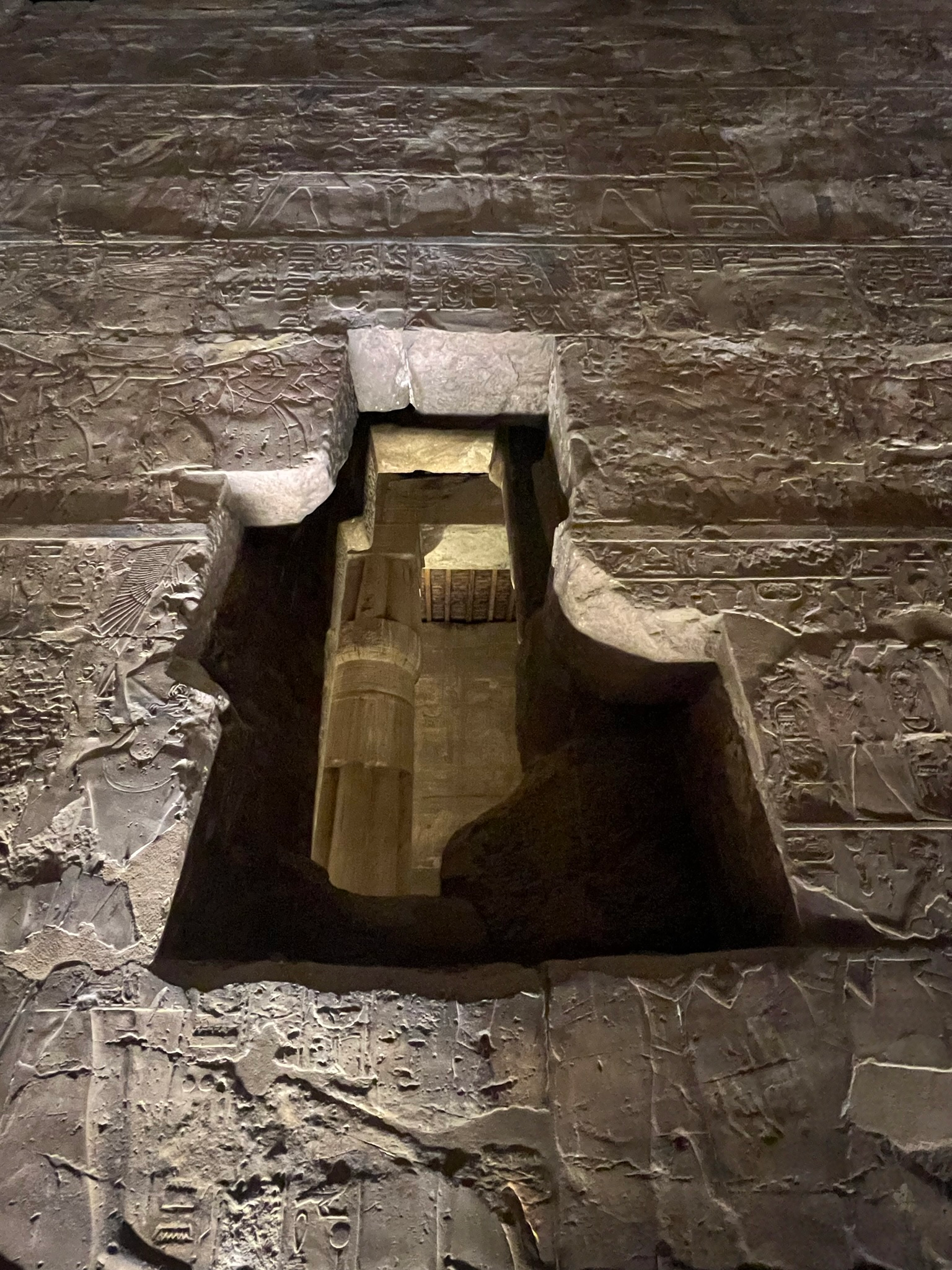
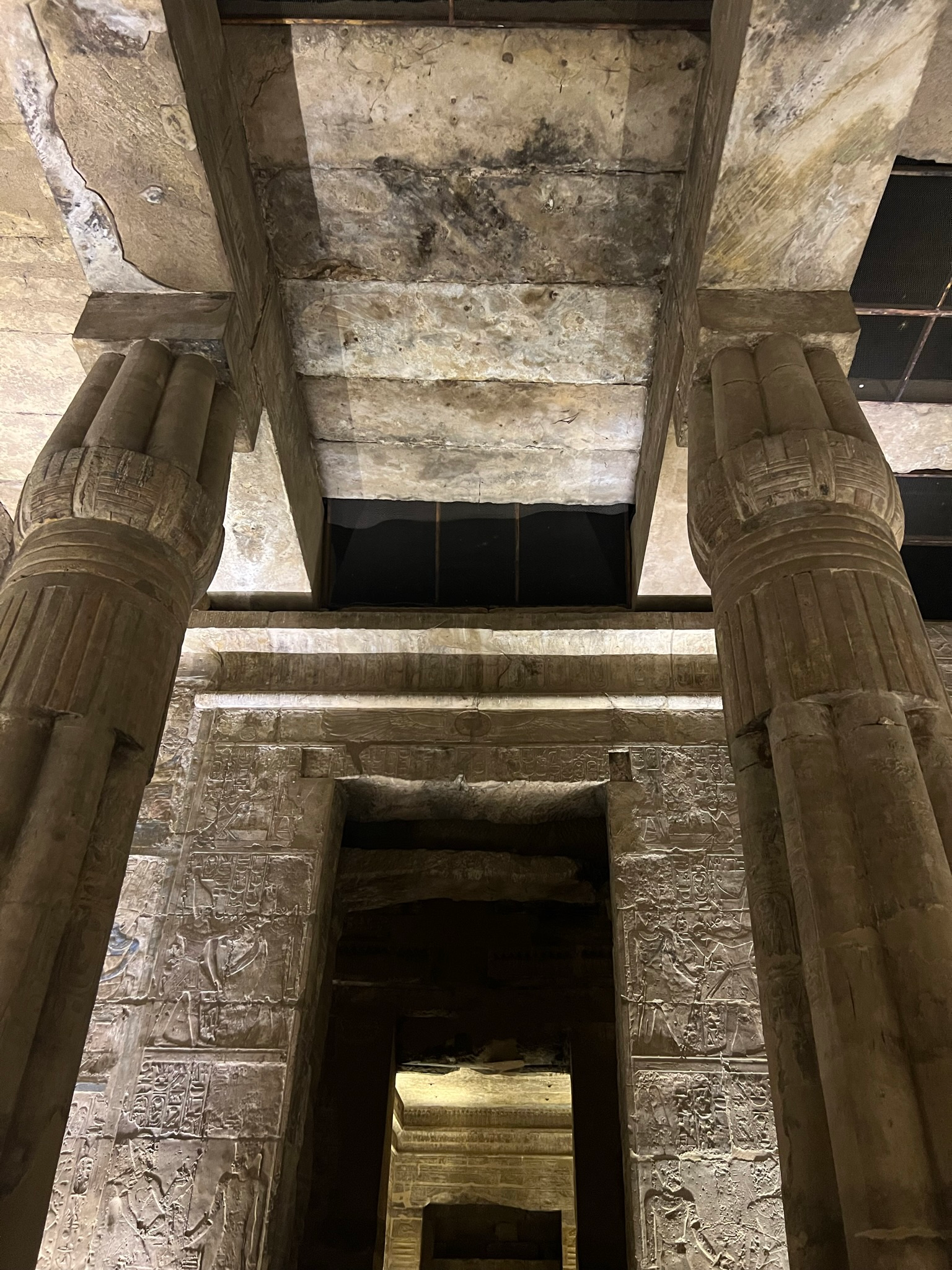
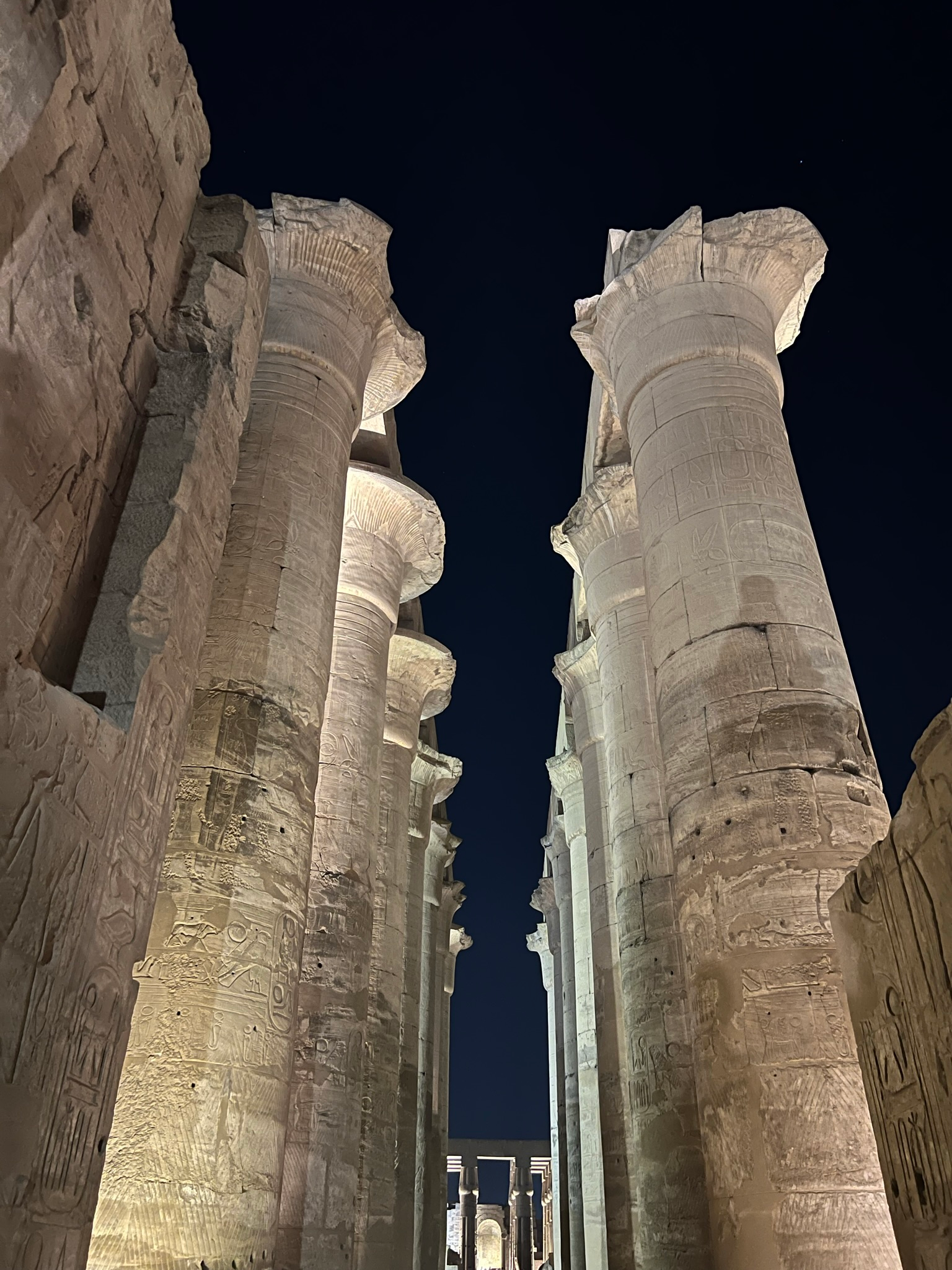
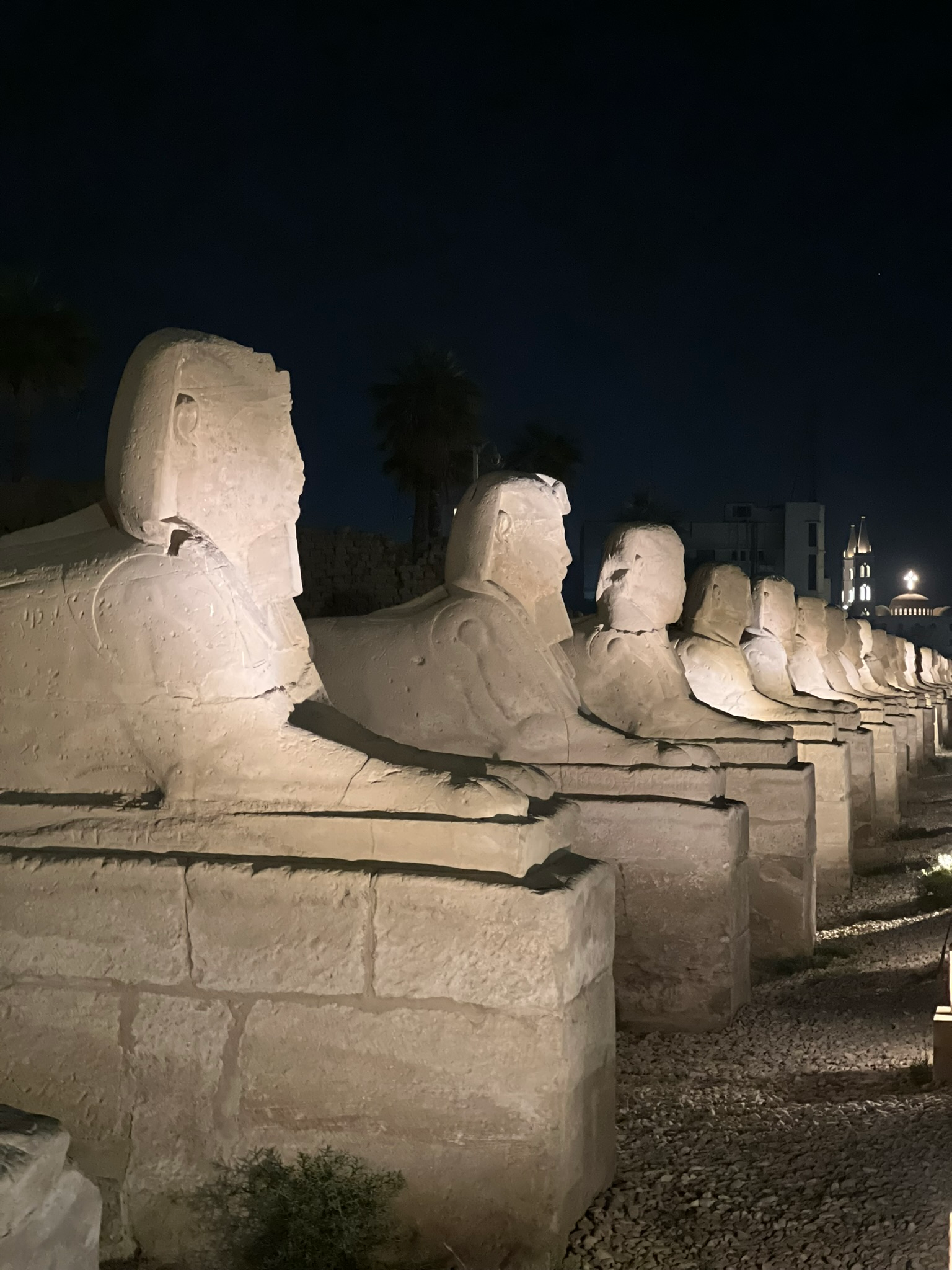
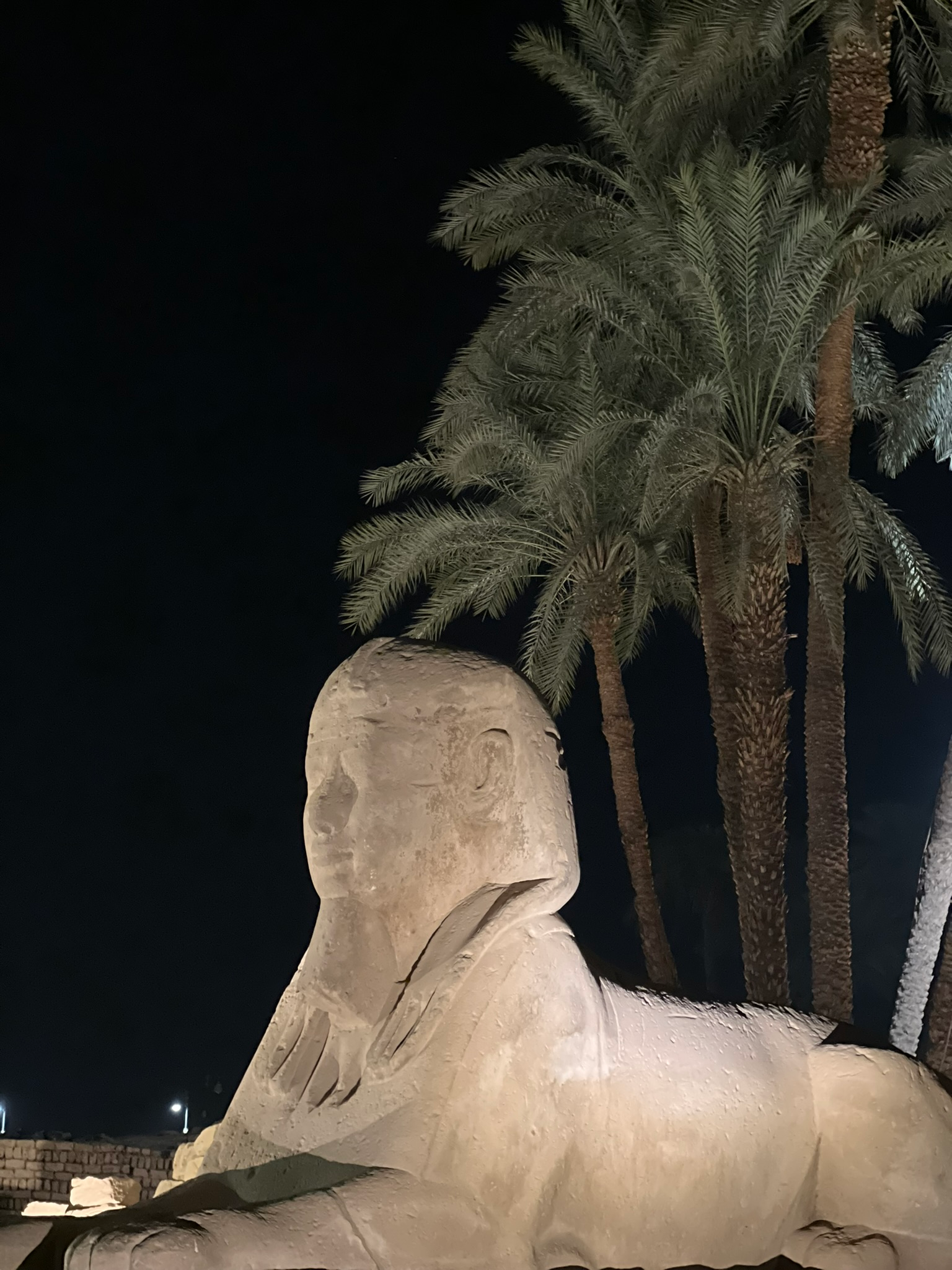
Located on the east bank of the Nile River, Luxor Temple was largely built around 1400 BC by Amenhotep III during the 18th Dynasty of the New Kingdom, with later additions by Tutankhamun and Ramesses II. The temple is connected to the Karnak Temple Complex, another major site on the east bank, by the Avenue of Sphinxes, a 2.7-kilometre processional road lined with sphinxes and ram-headed statues. Unlike most temples dedicated to a specific deity, Luxor Temple is primarily associated with the divine aspect of kingship, especially the renewal of pharaonic authority. It is even believed that pharaohs were crowned here.
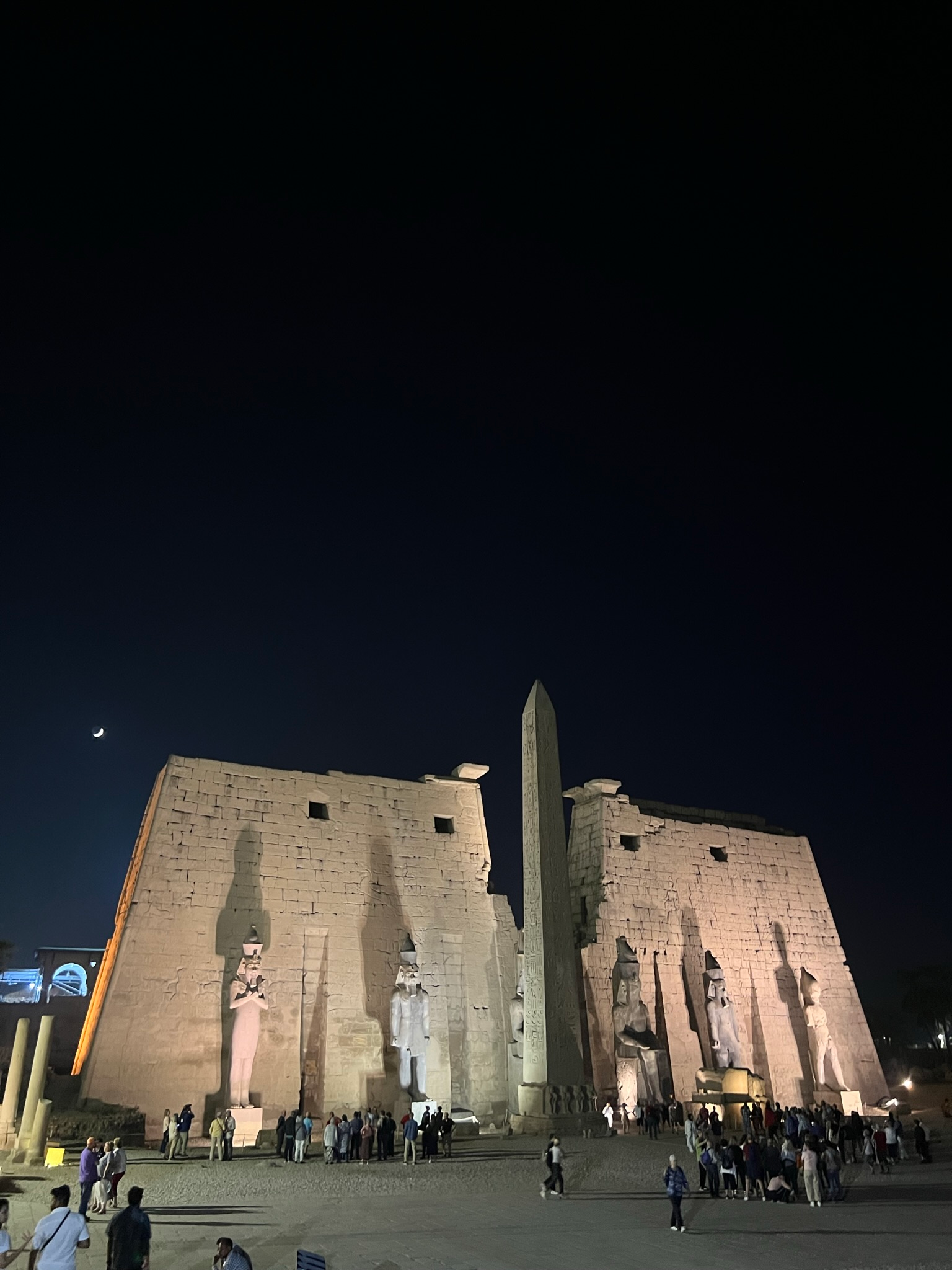
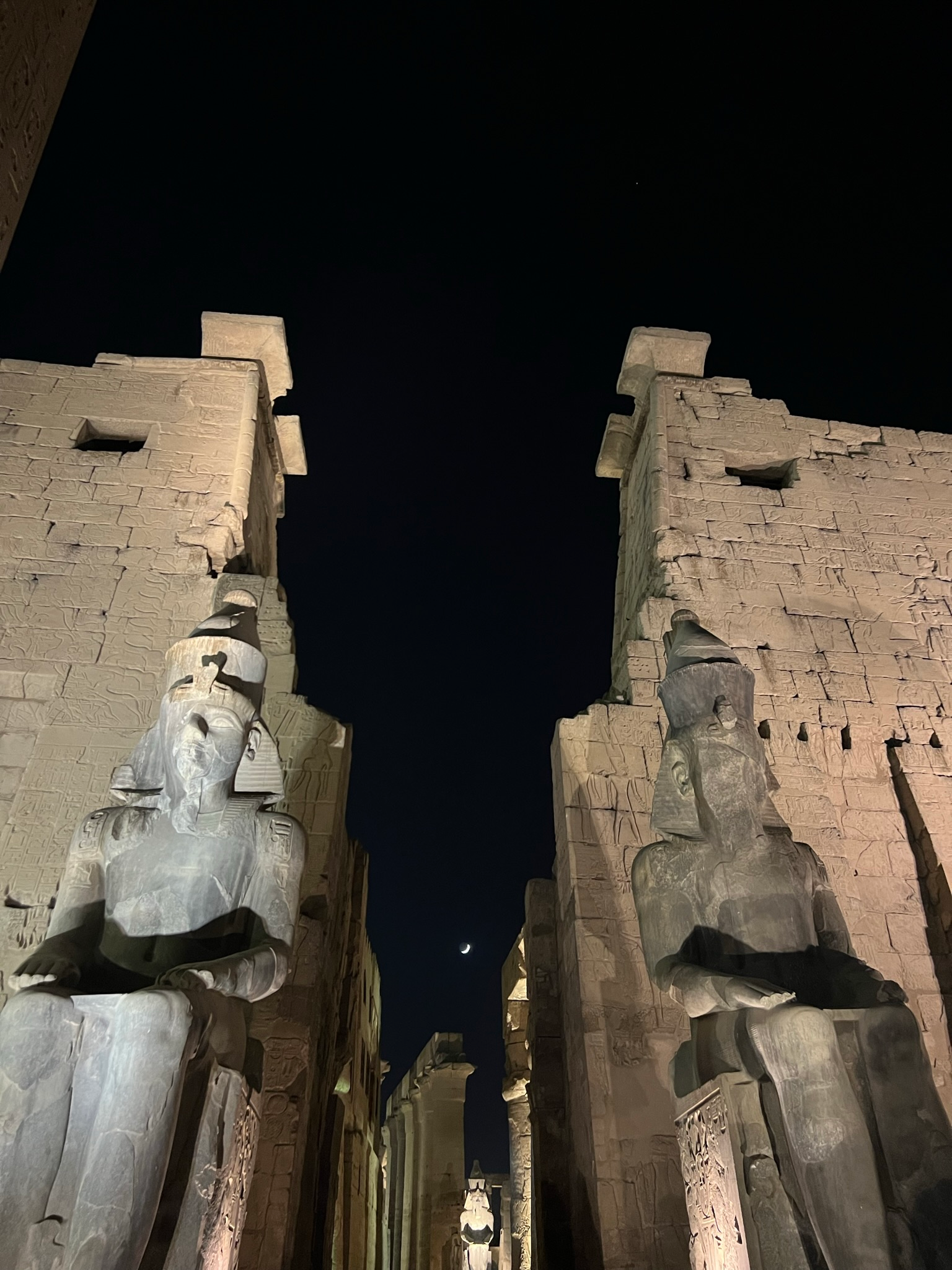
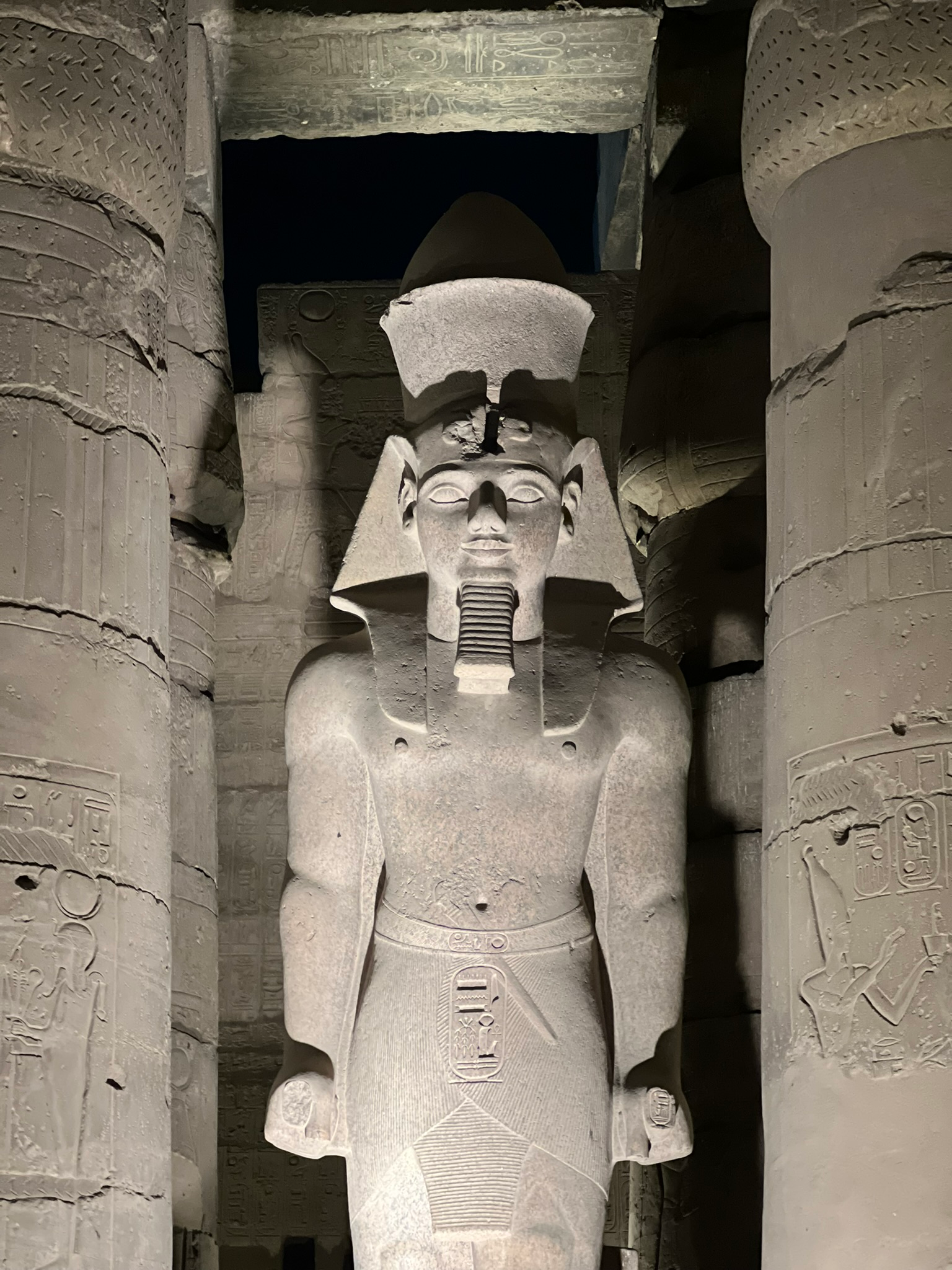
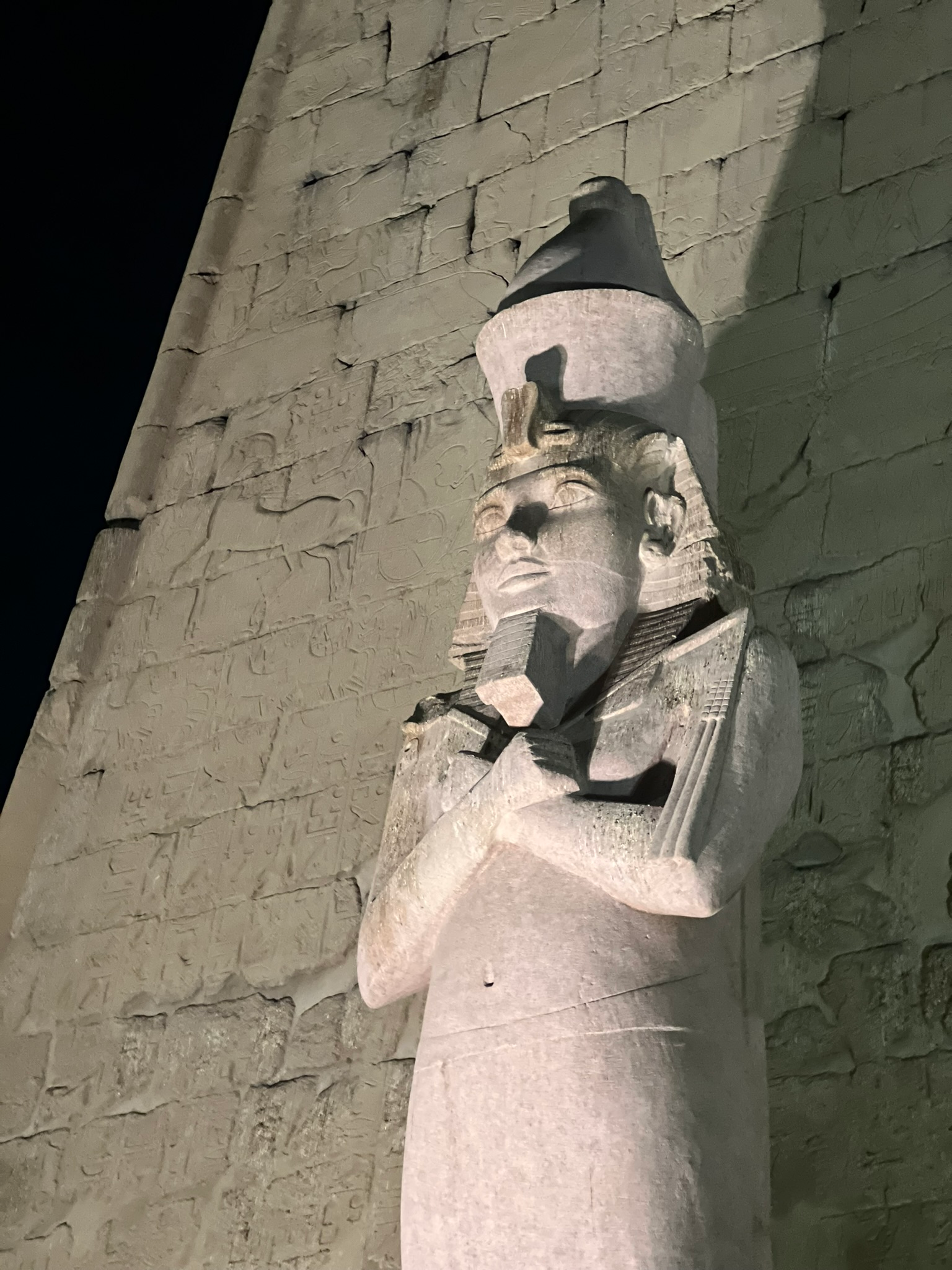
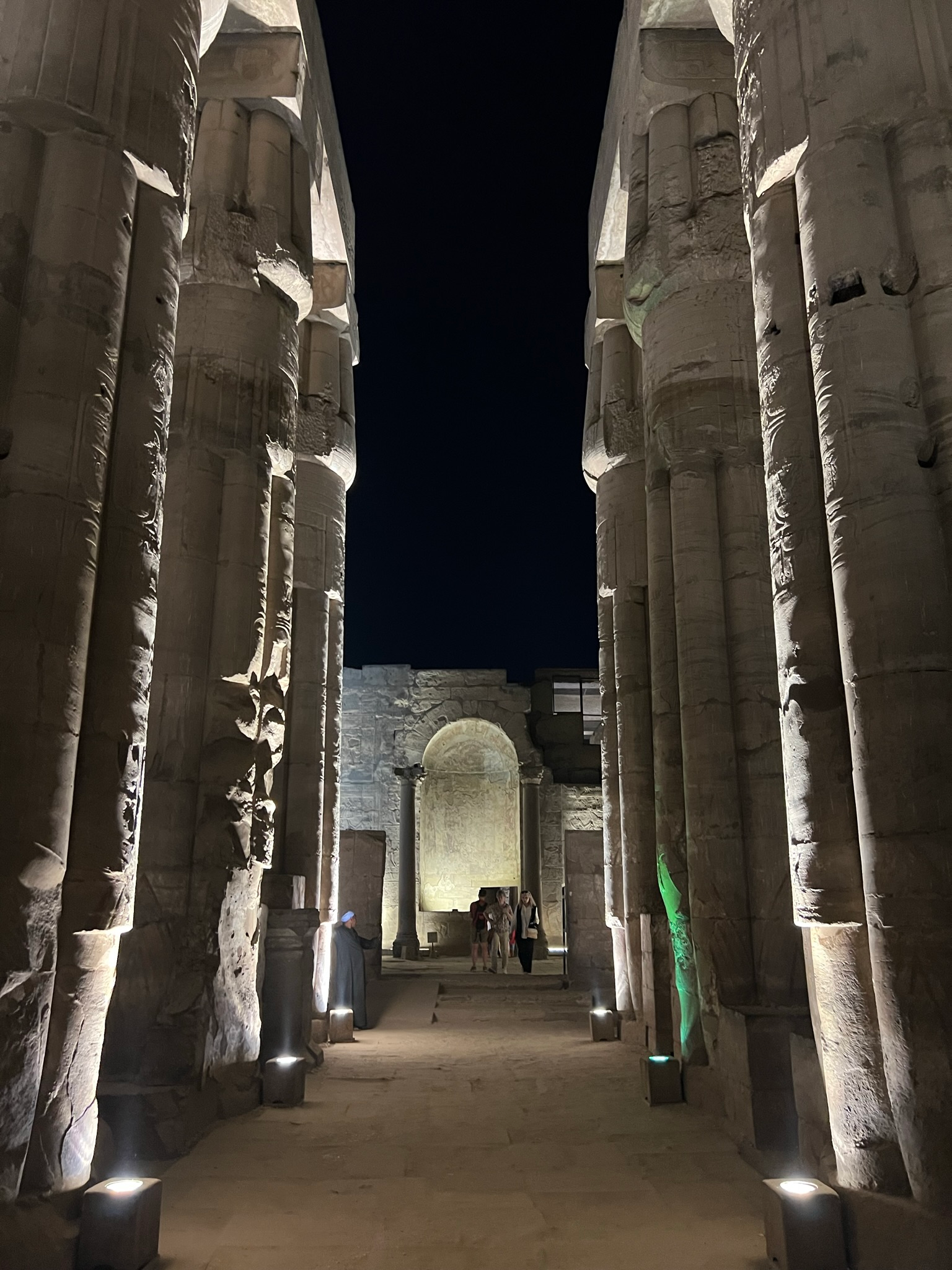
The temple is glorious, to say the least. Entering from the Avenue of Sphinxes, you are met with a monumental pylon featuring colossal statues of Ramesses II and twin obelisks, one of which now stands in the Place de la Concorde in Paris. Much like pyramids, obelisks symbolised the sun god Ra and were believed to represent petrified rays of sunlight.
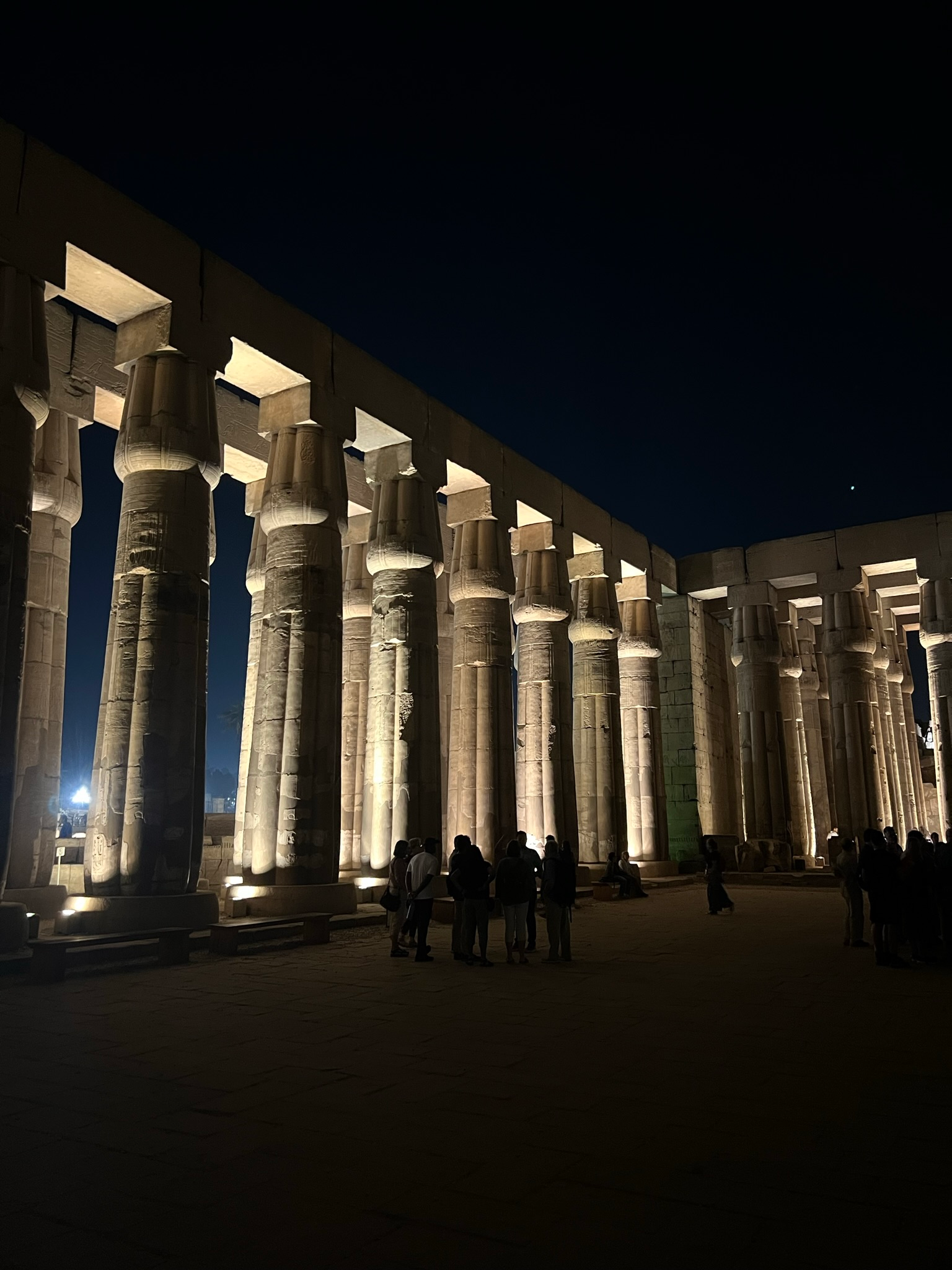
Beyond the entrance lies the Court of Ramesses II, lined with columns and colossal statues of the pharaoh. From here, a colonnade built by Amenhotep III leads into a section decorated with reliefs depicting the Opet Festival, an annual celebration during which statues of the Theban Triad – Amun, Mut, and Khonsu – were carried in procession from Karnak to Luxor along the Avenue of Sphinxes. Next is the Courtyard of Amenhotep III, a vast peristyle space surrounded by columns that once served as a gathering place for religious ceremonies. A hypostyle hall then leads deeper into the temple, marking a symbolic transition from the earthly realm into the divine. The innermost sanctuary housed the cult statue of Amun and was accessible only to high priests and the pharaoh.