Raja Ampat – Day 5: Marine Gods
RAJA AMPAT
Day 5: Marine Gods
May 11, 2023
PART I
I woke up to a beautiful sunrise and great news. Well, not great-great, but relatively great. I was contacted by the department of surgery telling me they could move the interview by ten days.
Meaning I’d have to cancel my plans for Bali and change my flights. An easy compromise to make. This was meant to be a dive trip in the first place, so I wasn’t too bummed out about missing out on sightseeing – I still wanted to visit Indonesia again one day after all. And, changing the flights would be nothing more than a financial setback – one I’d easily get over if I secured this new job position. And just like that, it felt as if this massive weight had been lifted off my shoulders, as if all my worries had dissolved into nothingness.
After all the drama and turmoil had passed and I had once again settled into holiday mode, I have to admit that I was a bit disappointed in myself. The relaxed, easy-going Marius I had managed to become after months on the Caribbean side of life seemed to have disappeared for a while there. I guess it’s understandable, given that everything I had worked so hard for was all up in the air. In a way, I could already see myself devolving into the stressed-out, uptight jackass I had become over the years. And this was my biggest fear. I’d have to actively do something about it. I couldn’t let it happen. I couldn’t let myself get alienated once again. I couldn’t focus on ‘matters of consequence’ only. How to do that exactly, I still had no idea. But knowing I’d have to do something about it was already a step in the right direction, for whatever that’s worth.
Manta Sandy
To continue with the streak of good luck, Johnny announced our next dive site – Manta Sandy. And just in case you’re wondering – yep, you guessed it. At this dive site, we’d most likely be able to witness manta rays as they visit cleaning stations in order to rid themselves of parasites whilst providing sustenance to the cleaners (usually wrasses and shrimps) – something they indulge in for up to eight hours a day!
Manta rays – friggin’ manta rays! Having barely done any research on Raja Ampat prior to visiting, I literally had no idea we’d be able to spot them here. I’d never seen one and they were definitely at the top of my to-see list, especially with Amelia going on and on about them back in Utila. And finally I’d get the chance to see one – if the conditions would allow us, that is. But, according to Johnny, he had received a call from the mantas and they’d likely show up. I for one knew better than to get my hopes up. Likely doesn’t mean definitely, as life has taught me on so many occasions (including the previous night!).

And so, cautiously optimistic, I found myself on the Zodiac on my way to yet another adventure. After a short ride to the dive site, we geared up and started our descent down to the featureless sandy bottom. I gotta say it was a bit weird not seeing tons of fish or any coral at all considering we were still in the same paradise that is Raja Ampat. But hey, if there’d be mantas I guess they’d make up for the lack of décor.
A brief swim later and we got to the cleaning station – a sandy patch with some five big rocks spread throughout the area. At the front was a line made of rocks that had been placed there by the park rangers, demarcating the no-go zone for divers in order not to molest the rays throughout the cleaning process. As we had been instructed, the second we got there we all lined up behind the rocks, deflated our BCDs, and lay on the sand, waiting watchfully for a manta to show up – or not. I have to admit that watching a bunch of wrasses circling around the rocks wasn’t as engaging as one might think. Plus, lying on the seafloor with nothing to do is not the best form of entertainment. It did give me a chance to practice my bubble rings at least.
The Marine Gods: In the Flesh!
I think it must’ve taken only some two minutes before the first manta showed up! Far away in the big blue, the dark shadow slowly materialised into this huge, majestic being as it flapped its wings effortlessly, gliding right above me to get to one of the rocks.
I was stunned, shocked, paralysed. I was completely wonderstruck. I assumed I’d feel that way if I were to ever see one of them, but honestly, I could have never expected that. It felt as if I was in the presence of a marine god. It was the perfect mixture of wonder, reverence, and respect. I felt so tiny and insignificant compared to the magnificent being in front of me that I could hardly believe it.
The ray’s wingspan must’ve been some five to six metres, making it the second biggest marine creature I had ever seen after the whale sharks in Utila. And, much like those times, I felt nothing but privilege being so close to such regal, gentle beasts. As much as Johnny had insisted for us not to approach and let them do so out of curiosity, I’d be lying if I said I didn’t want to. I had this perfect image of us eyeing each other from a distance, and then, driven by this unspoken link and an inexplicable affinity, we’d touch. Of course, the second we’d do that, the manta would take note of my innocence and purity, offering its back for a ride. We’d go out for a swim and then, we’d breach out of the water and fly away together into the sunset. That’s my brain for you – imagine it on psychedelics! I think it’s years of watching Scrubs that have led to such vivid daydreams…
As the creature circled around one of the big rocks, the wrasses started busying themselves, nipping the wretched parasites off the manta. I have to say that despite how much time I spent admiring it, I couldn’t get used to the idea that I was in its presence. With its black dorsum and white underbody, two huge pectoral fins, a long and pointy, stingless tail, an enormous whale shark-like mouth and two impressive horn-shaped cephalic fins folded onto themselves, the manta had me in awe to say the least.
Manta Mayhem
These fantastic beasts, Johnny had told us, have the largest brain-to-body ratio of all fish, and a complex reproductive cycle which might be triggered by the full moon, at which point the male chases the female until he manages to bite down on her wingtip before turning upside-down in order to mate.
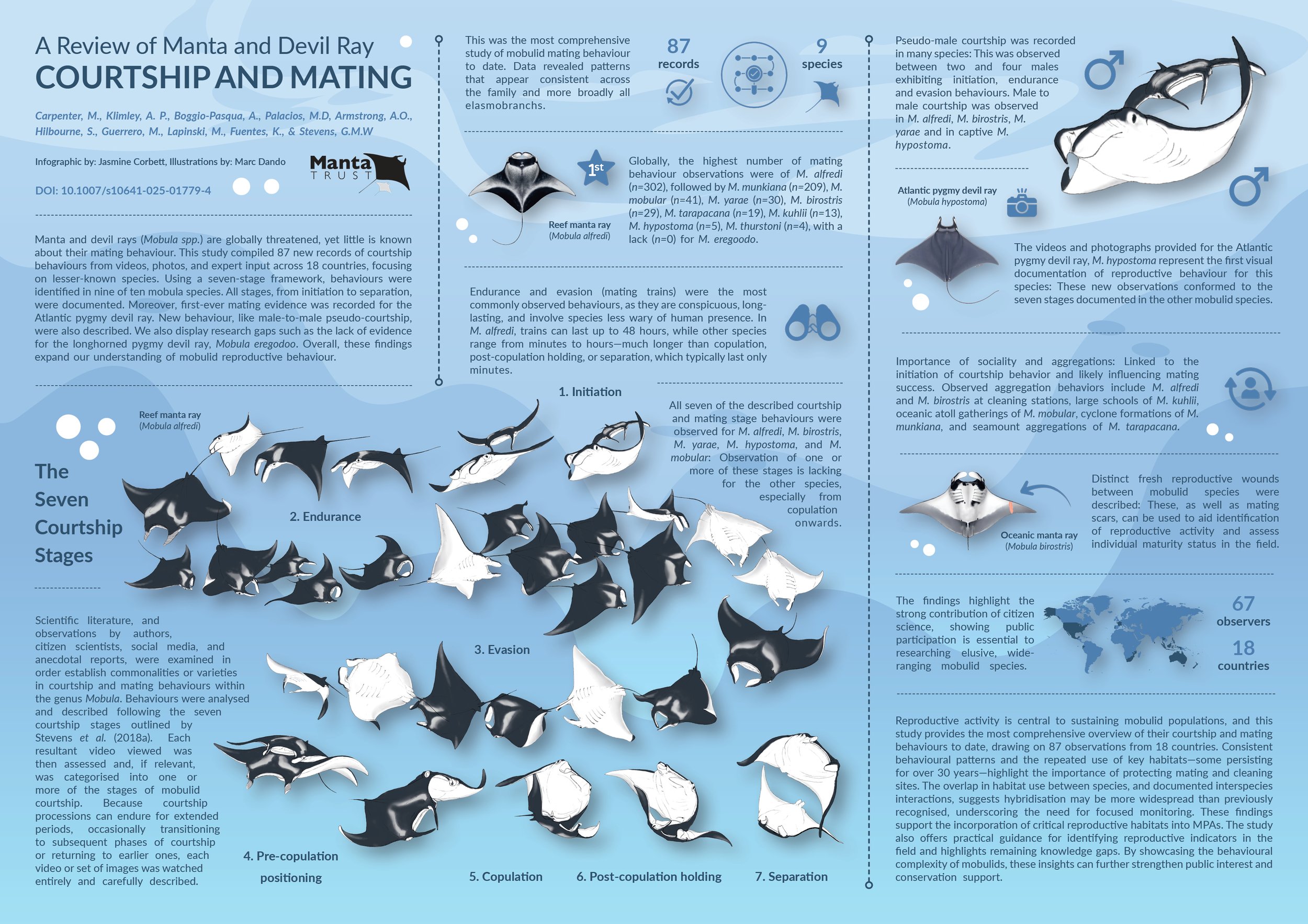
After a long gestation period of around a year, one or two pups are born, after which they are fully independent and go on to continue the cycle. He went on to tell us that the filter feeders flatten their cephalic fins in order to channel plankton, shrimp, and krill into their mouths, with certain group feeding techniques being employed to facilitate this process – such as vortex feeding which is quite reminiscent of bubble-netting in whales! And one last thing… The spots and colour variations on their ventral surface, much like the white spots on whale sharks or markings on whale flukes, can be used to identify individual reef mantas. They’re so friggin’ awesome…
As if that weren’t enough, a second manta – this one all black – joined in the fun, circling around the first one in perfect unison and harmony. They’d dance around the rock until one of them would break off and glide away to a different one, the other soon following suit, as we’d all watch them, mesmerised and in pure disbelief. It felt just like being in the cinema as we lay there on the sand with such a spectacular show unfolding right in front of our eyes. And, being on the side, I was lucky enough to have them swim right by me every single time they’d dart off from the cleaning station, reappearing after a few minutes for another round. By the end, we had seen a total of five mantas, one being as large as seven metres in size and another a couple of metres.
You can imagine our elation once we were all back on the boat. I seriously couldn’t shut up about it, yelling “I can’t friggin’ believe what just happened!” over and over. I felt just like a kid waking up to a bunch of incredible gifts on Christmas morning! This was privilege. Thank you oh mantas, for gracing us with your presence and company!
PART II
Sawandarek Jetty
Still on a high from the previous dive, I couldn’t wait for more. This time round, we’d be going to Sawandarek Jetty. The second we back-rolled, Keith noticed his mask was gone. A horrid flashback of my dropping days had me plunge down for it after a quick signal to Dom, thereby closing that chapter of my life once and for all. Or so I hoped, that is.
The main highlights of this dive, apart from the gorgeous coral garden, were a huge hawksbill turtle and a metre-long giant clam. Over a large area dominated by cabbage corals, we also got to observe a school of sweetlips and one of trevallies, with thousands of them swarming the seas. As amusing as that was, I guess Dom kinda stole the show the second he took out some bread from his BCD. In no time, he was swarmed by all kinds of fish, with this one huge batfish being friendlier than most. I’m not kidding – it followed us for the rest of the dive and would even allow us to pat it!
At the end, once we got to the jetty, we had the opportunity to go under it – reminding me of that one time I explored Underwater Vision’s pier with Aviv much to Catherine’s annoyance and reprieve. It was a somewhat ethereal experience, with the intense clarity and brightness of the water illuminating the underside of the jetty in a light blue colour, the fish swimming in between the planks and debris at the bottom. Oh, and there was a big juvenile batfish. That was cool too!
Cape Kri
Needless to say, all throughout, we had kept up the same routine of diving, eating, and sleeping. As Johnny put it – if your hair is dry it’s time to dive and if your hair is wet it’s time to eat. A hard and fast rule that proved to be an easy one to stick to. As exhausted and fatigued as I was, I’d always be ready for the upcoming dive. And, as full and bloated as I felt, I’d always have my fair share – the food being so delicious.
After the surface interval, we headed to the next dive site – Cape Kri. Here, the thing to look out for, according to the briefing, would be a school of sweetlips. That’s it. But, according to Siti, this was the dive site that put Raja Ampat on the map, with a record of 374 different species of fish being found in this one dive site alone. Whilst we did get to see the infamous school of sweetlips and a huge variety of other fish, I can’t quite say these were the highlights of the dive. No way. For me, the highlight was descending down to 34 metres whilst following a black-tip reef shark and getting narc’d as hell. Man, I had missed that feeling! The state of euphoria and feeling flushed all over – kinda like a full-body orgasm really. As I twirled and giggled mindlessly – this time round, I did remember to check on my deco time, something I’d always forego back in Utila whenever I’d get narc’d. So yeah, responsible fun, heh.
As we swam on the shallower end and I started to sober up, I was once again focused on the sealife rather than my hedonistic tendencies. I managed to spot the trippy juvenile emperor angelfish amongst the multitude of fish that characterised each and every dive here.
Smashed Hearts and Missing Birds
After the dive, I tried to ignore a dull ache in my left ear. I knew it’d probably be the start of yet another ear infection. It couldn’t have come at a worse time, given that I still had three more dives in Raja Ampat and a whole other diving trip coming up.
As much as I hated it, I decided to be an adult and skip the night dive. At this particular dive site, the likelihood of spotting blue-ringed octopi was minimal at best – softening the blow somewhat. Most of the others decided to skip the dive too, with Siti and Ebe being the only ones going out. I can’t say I didn’t feel any FOMO when they came back bragging about the epaulette shark they had managed to find. Watching the videos they had shot of the weird yet gorgeous creature did make feel a bit better though – which is very strange since I don’t really take any pleasure from digital sightings.
To add to the list of disappointments, we had been warned that if it were to rain from the afternoon onwards, we wouldn’t go trekking the following day. You see, Raja Ampat and West Papua are home to a particular animal I had been dreaming of seeing since I was a kid – the legendary bird of paradise. Turns out, these extraordinarily beautiful creatures only come out during dawn and only rarely after it rains. As much as this trip had been all about diving for me, I have to say my heart shattered into tiny irreparable bits the second it started to rain and we were told the trek would be off.
Admittedly, skipping out on the dive was also the perfect excuse to get some rest and chill on the boat a bit. I got to witness a glorious sunset and do some stargazing, finally getting to take it all in – something we didn’t have much time for during the cruise!
