San Blas Islands – Day 3: The Guna Yala Way
SAN BLAS ISLANDS
Day 3: The Guna Yala Way
February 19, 2023
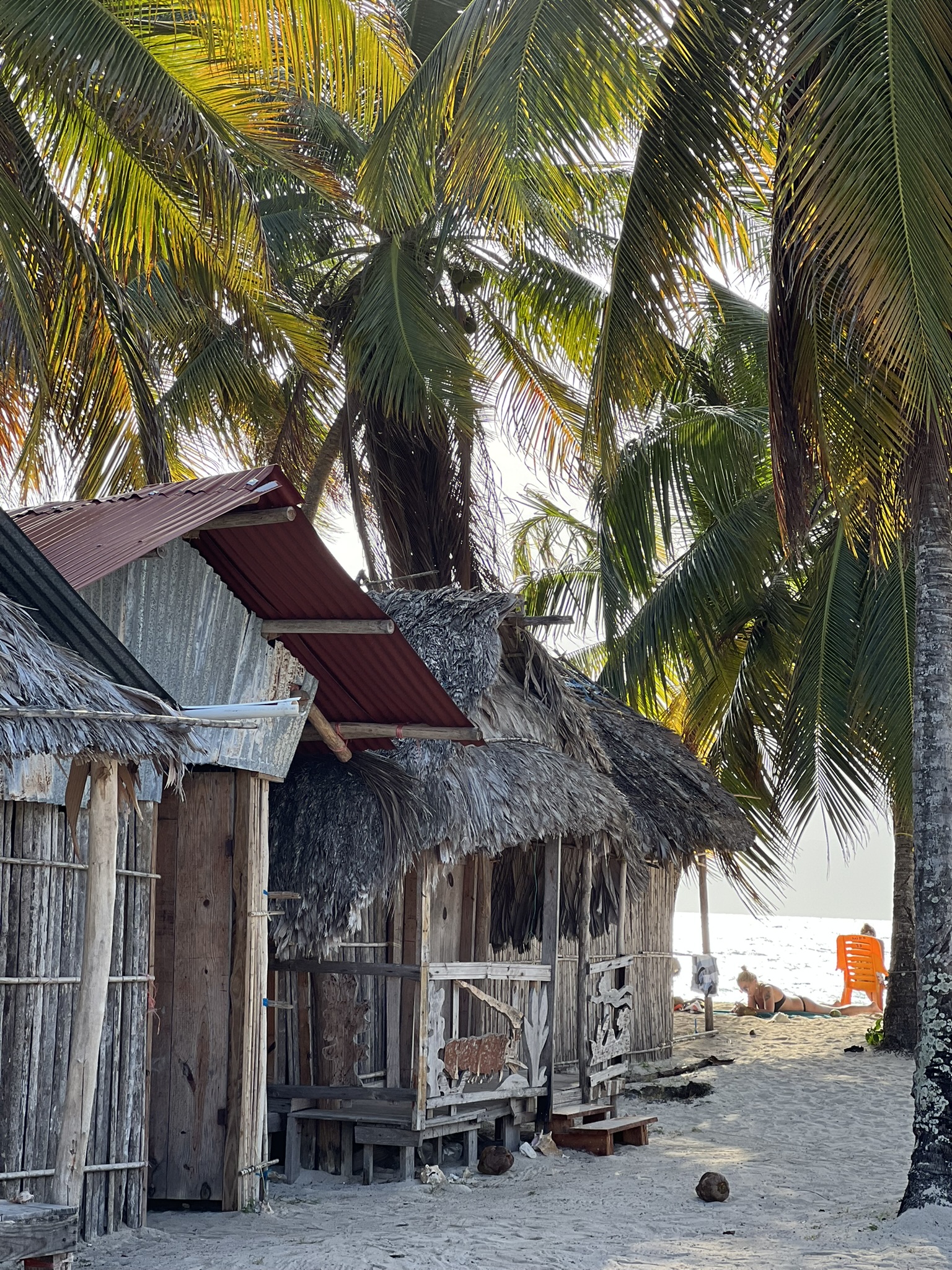
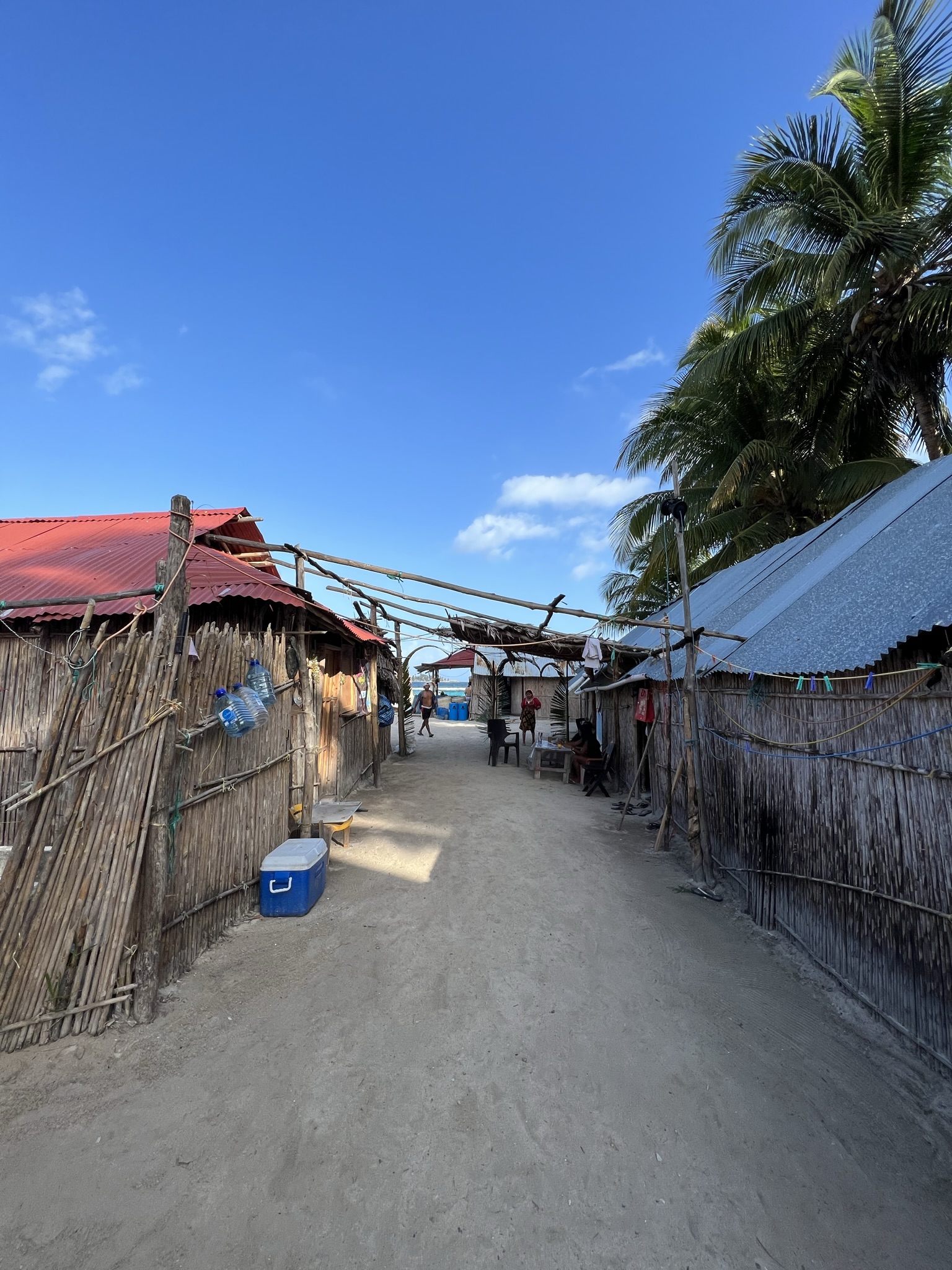
The third day would take us to Isla Ina, one that differs from the rest mostly on the basis of its inhabitants. As soon as we stepped off the docks, we were met with dozens of thatched huts – the Guna’s residential area.
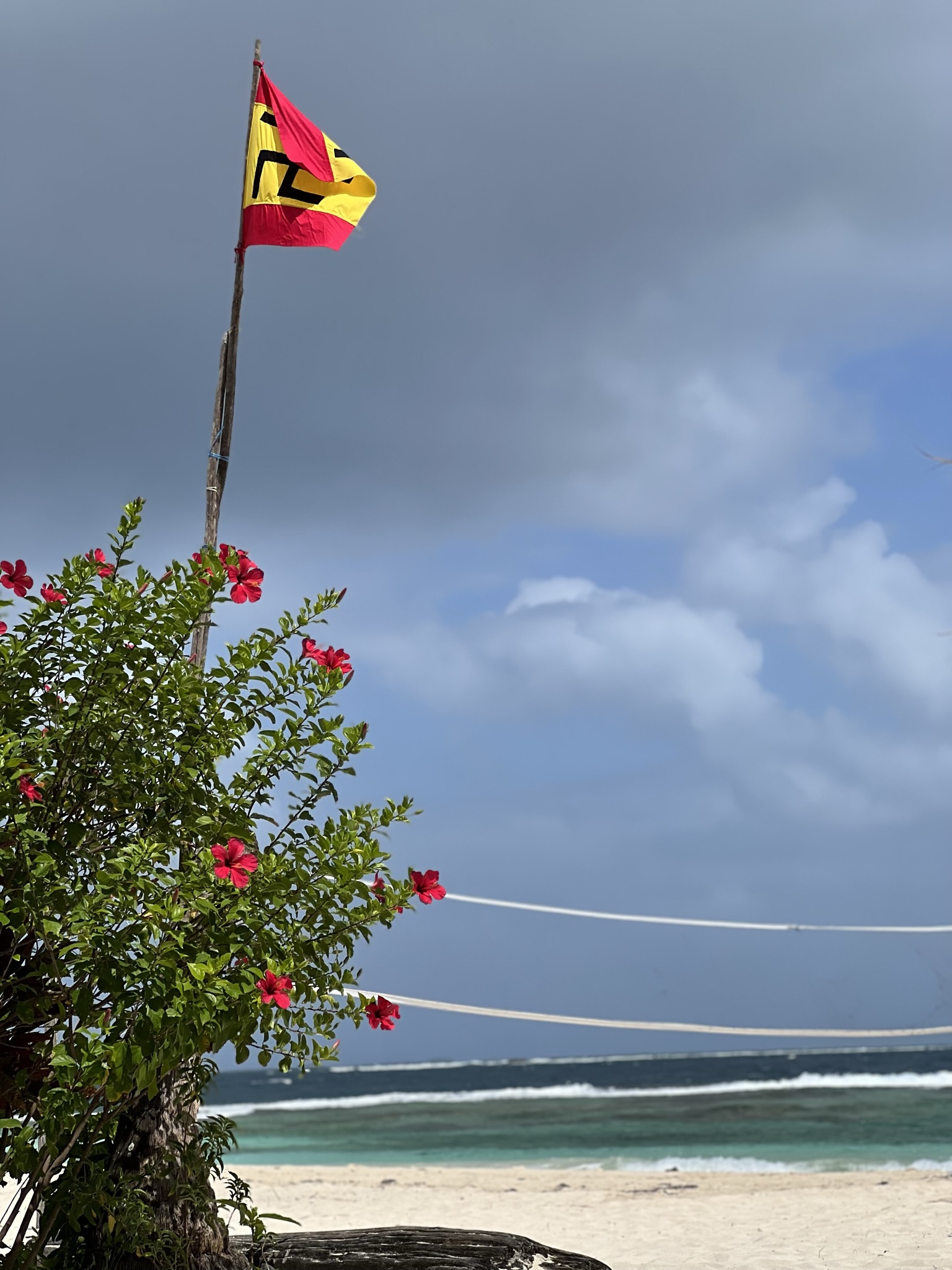
Up until this point, I hadn’t bothered much to learn about the Guna, knowing they’d explain more on the third day. I mean sure, I passed the kids their balls, admired the ladies’ molas, and admonished tourists’ misplaced apprehension towards the Guna’s reverse Nazi emblem, but apart from that, I was genuinely at a loss.
I cherished my hammock, my books, my snorkelling, my sunbathing, and my infinite supply of coffee, and waited patiently for the talk that would eventually shed some light on their culture. For the time being, I was happy just savouring all the Caribbean had to offer.
Entering Guna Yala
From a dip in the Caribbean, I found myself plunging deep into Guna culture. Iniklipi, our host, would be our guide into this new world.
The Guna Yala territory, he explained, consists of a narrow strip of land in the north-east of Panama, including the San Blas Islands, of which around fifty are inhabited by the Guna out of roughly 400 islands and cays. There are some 51 Guna communities in total, 49 of which are island-based. Guna Yala is divided into four districts – Narganá, Ailigandi, Dubwala and Puerto Obaldía – each with its own sahila, a political and spiritual leader. These sahilas, Iniklipi explained, meet at least twice a year at the General Congress of the Guna, with elected representatives liaising with the Panamanian government to communicate the community’s needs. Their economy relies mainly on fishing, agriculture, tourism and the sale of handicrafts.
The Guna originally occupied parts of northern Colombia and the Darién region prior to the Spanish conquest. Following sustained conflict with the Spanish, other indigenous groups and even disease-bearing mosquitoes, they gradually migrated towards the Caribbean coast and offshore islands. Political unrest followed Panama’s independence from Colombia in 1903, with the new government imposing assimilationist policies and banning several Guna customs. This culminated in the Guna Revolution of 1925, symbolised by a yellow flag with orange stripes and a black left-facing swastika at its centre.

Backed by Richard Marsh, an American explorer who sympathised with their cause, Guna leaders drafted a declaration of independence and launched coordinated attacks on police and government officials. The United States intervened diplomatically, sending a warship to the San Blas Islands where negotiations between Guna leaders and Panamanian authorities eventually led to peace. The resulting agreement recognised Guna Yala as part of Panama while guaranteeing cultural autonomy and self-governance in most internal affairs.
Today, the Guna face new challenges – chiefly climate change, which threatens to submerge low-lying islands, and Westernisation. Some leaders have proposed relocating communities back to the mainland forests of Darién in order to reconnect with ancestral land.
Scissor Maidens and the Molas
Among the traditions central to Guna culture, Iniklipi mentioned ceremonies such as the Ico-inna, marking a girl’s first menstruation; lullabies used by women to transmit knowledge and values; and distinctive female attires, which include gold nose rings, arm and leg beads, patterned wrap skirts and mola blouses.
Molas – intricately hand-stitched textiles layered with vibrant geometric designs – are said to originate from the mythical underworld of Galu Dugbis, inhabited by the Scissor Maidens. Beautiful and dangerous in equal measure, they guard ancestral knowledge and shifting patterns of reality, granting insight only to those who can resist being claimed by them – including the Guna spiritual leaders. According to legend, one woman managed to reach Galu Dugbis herself, where she witnessed patterns that changed like clouds in the sky. There, she learned the art of mola-making and acquired female ancestral knowledge, which she later passed on to other Guna women.

Geometric designs found on molas include labyrinths, independent modules, diagonal curves and arrows, each representing abstractions of natural forms. Their vibrant colours generate three-dimensional and vibrational effects that seek to fuse reality with the supernatural, helping express respect for the environment and connection with the universe. A Guna woman showed us the process and explained the steps:
A coloured layer of fabric is stitched onto another layer of a different colour around the edges.
A drawing or pattern is made on the top layer, which is then cut along the drawn lines.
The cut edges of the upper layer are folded inward to reveal the colour of the layer beneath.
The folded edges are sewn down, joining all the layers that make up the mola.
Gold Worlds and Dragon Moons
After this, he went on to tell us that the Guna have a distinct worldview, believing that the round universe is divided into three levels – the Upper, Middle and Lower Worlds. Humans, according to Guna belief, live in the Middle World, surrounded by the sun, stars and planets, while the other two worlds mirror ours, albeit everything there is made of pure gold. Spiritual leaders can access all three worlds through their dreams.
The Great Father and Great Mother, who created the universe and now watch over everyone, are said to have created spirits as well. These can be benevolent or malevolent and live in abodes called Gulus, located near the coast. Gulus are described as resembling a mix of fortified houses, churches and ships, and can only be seen by spiritual leaders. Wooden carvings known as nussus, believed to embody protective spirits, are used by spiritual leaders to cure ailments, ward off evil spirits and resolve everyday problems.

To finish, he added that the Guna people are known for two other things. First, they are known to have low average blood pressure, which does not increase significantly with age as it does in most populations. And second, perhaps more intriguingly, they have a high prevalence of albinism within their communities. These so-called White Indians played important roles during the Guna Revolution, often acting as spies. During lunar eclipses, they are traditionally the only people allowed outside, tasked with shooting arrows to drive away the dragon believed to be devouring the moon. Cool, cool.
One Last Sunset
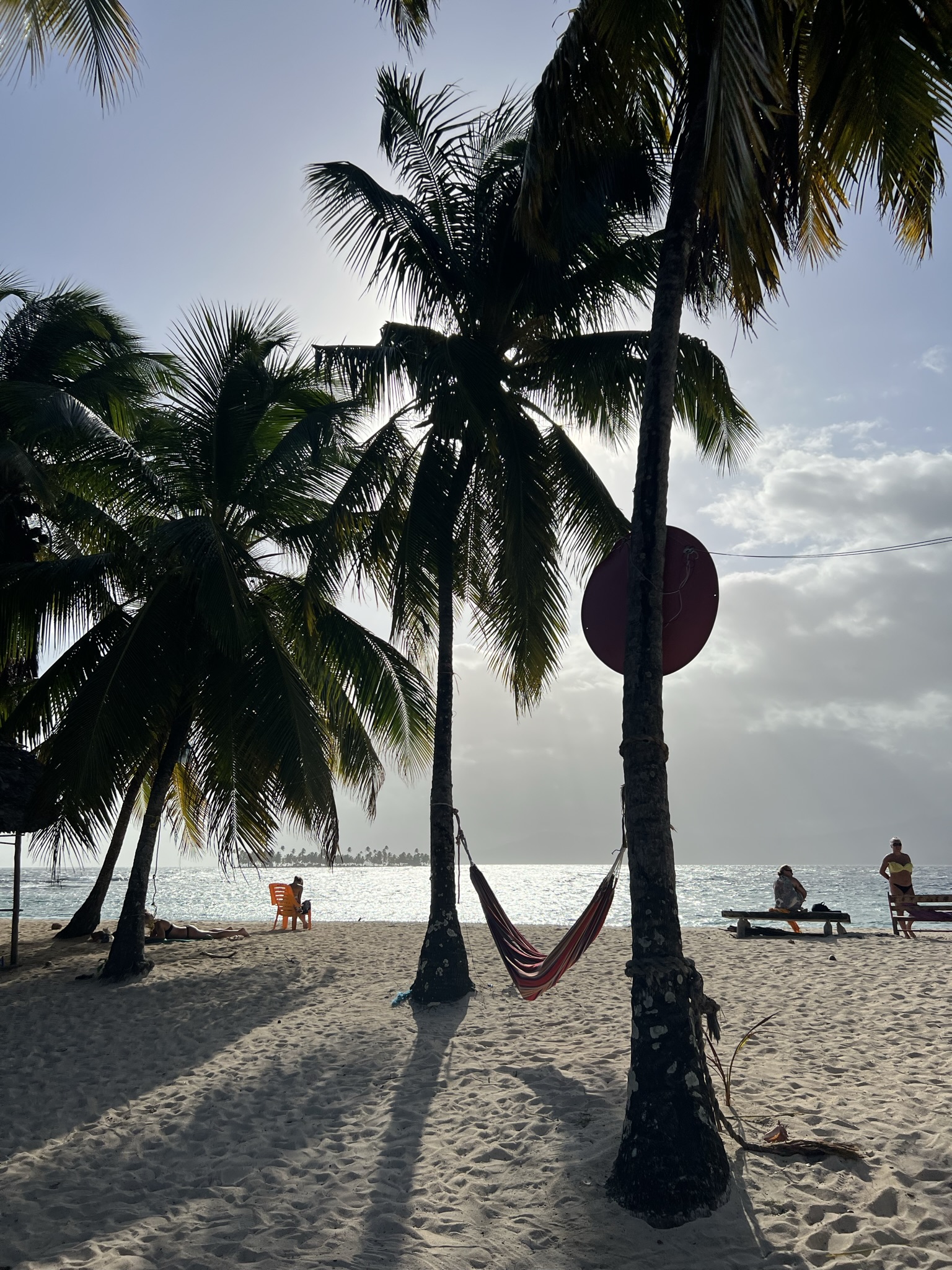
With that, we were left to our own devices. Once again, I spent the remainder of my day swinging gently on a hammock, the Caribbean stretched out in front of me, endless and indifferent, the water shifting from turquoise to deep blue as the light began to soften.
It struck me, almost cruelly, that this would be the last day I’d spend in its company – at least for the foreseeable future. The Caribbean had threaded itself through this entire journey, showing up again and again like a familiar lover I kept running into in different countries. From snorkelling in Mexico to learning to dive in Belize, from Utila’s reef-studded routines to Bocas’ rain-soaked islands and now these impossibly pristine islands, it had shaped not only my days, but my sense of freedom. To imagine life without waking up to salt air and sea horizons felt somewhat wrong . Wrong and heart-wrenching. Man, was I gonna miss it. We’d had a hell of a run, but now, like all affairs, it was time to let it go.
That final sunset felt heavier than the rest. The sky burned through shades of orange, pink and purple, reflected perfectly on the glassy water, as if the sea itself was holding on – unwilling to darken just yet. I sat there in silence, watching the light drain from the world, listening to the waves crash softly against the shore, trying to memorise the moment. One last Caribbean sunset. One last breath of salt. One last goodbye.
