San Pedro de Atacama – Day 1 & 2: The Desert Inferno and the Lunar Sea
SAN PEDRO DE ATACAMA
Day 1 & 2: The Desert Inferno & The Lunar Sea
April 07 & 08, 2023
PART I
My trip to San Pedro de Atacama was going to be a long albeit uncomplicated one. I was meant to take a flight from Puerto Natales to Santiago with a technical stop at Puerto Montt, after which I’d take another flight to Calama. Then, a one-hour transfer to the town and that would be it.
Instead? Well… my flight to Santiago was delayed – by six hours. Meaning I had to reschedule my flight to Calama to the next day. Meaning I’d only have a day and a half in a town that’s full of things to see and do. At that point, I was considering skipping it altogether, given that I was still exhausted from the W trek and that I had barely slept. What could I possibly do in a day and a half? Having booked all my flights a few weeks before, the idea of wasting a couple of hundred euros didn’t quite appeal to me either, so by the end, I decided to suck it up and go through with it.
As Enzo and I waited out the six hours, we practically had nothing to do given that we had no data and there was no Wi-Fi. After getting tired of writing and reading, I found myself AirDropping the photo of the elephant seal I had taken in Antarctica to complete strangers once again. I don’t know why, but I found the very idea of people accepting a random photo of such an ugly animal so hilarious.

After the agonising time spent doing nothing, we were finally on the plane to Santiago. Here, we said our goodbyes and then, after a thirteen-hour layover in the airport – trying to get some shut-eye as I sprawled myself all over the floor all the while – I found myself on the next flight. Then the shuttle to San Pedro. Then a walk to my hostel.
Zombie Boy
By the time I got there, I felt pretty much like a fully decomposed zombie. I had been awake for more than thirty-two hours and to add to my list of woes and sorrows, the sweltering heat of the desert town was practically unbearable.
Oh, and the host kindly let me know that I had lost my booking and that there were no more beds available given that I had failed to show up the day before. At that point I felt like collapsing on the ground and giving it all up after having travelled for way longer than I’d be staying. Instead, I got my crap together and begged the host to come up with some other arrangement. Turns out, offering to pay for the previous night’s accommodation did the trick and a bed magically reappeared out of thin air. With that settled, I proceeded to enquire about my options regarding all the activities I was meant to do in the town with such little time on my hands.
With the universe on my side, she managed to hook me up with a tour agency and suddenly, I found my timetable chock-full with things to do. I could sleep some other time, right? One final push! Much like I do when I try to quit smoking by smoking like a chimney the day before in order to make me feel like I don’t ever wanna smoke again the following day, I decided I’d pack my schedule with activities so when the time eventually came for me to go back home, I’d perhaps be too tired to even notice that the lifestyle I had gotten used to over here would be gone.
A Bitter Adobe Inferno
The walk to the office was a bittersweet one. On one hand, the rust-brown coloured town with its charming adobe houses was unlike anything else I had seen before, with the closest thing being the city of Cappadocia in Turkey.
On the other hand, the scorching sun and the dust-laden air made it seem like an infernal hellhole – my skin caked in sweat and earth and my mucosa as dry and arid as the friggin desert. Imagine the contrast between the cold, frigid Patagonian weather that I adored and the hot, burning climes of the Atacama Desert. In my sleepy haze, this place was nothing but an inferno I wanted to get out of as soon as it was humanly possible. Knowing my time was almost up and that I’d have to go back home soon, I felt like I could have easily skipped this part and dedicated the last few days to getting some well-earned rest.
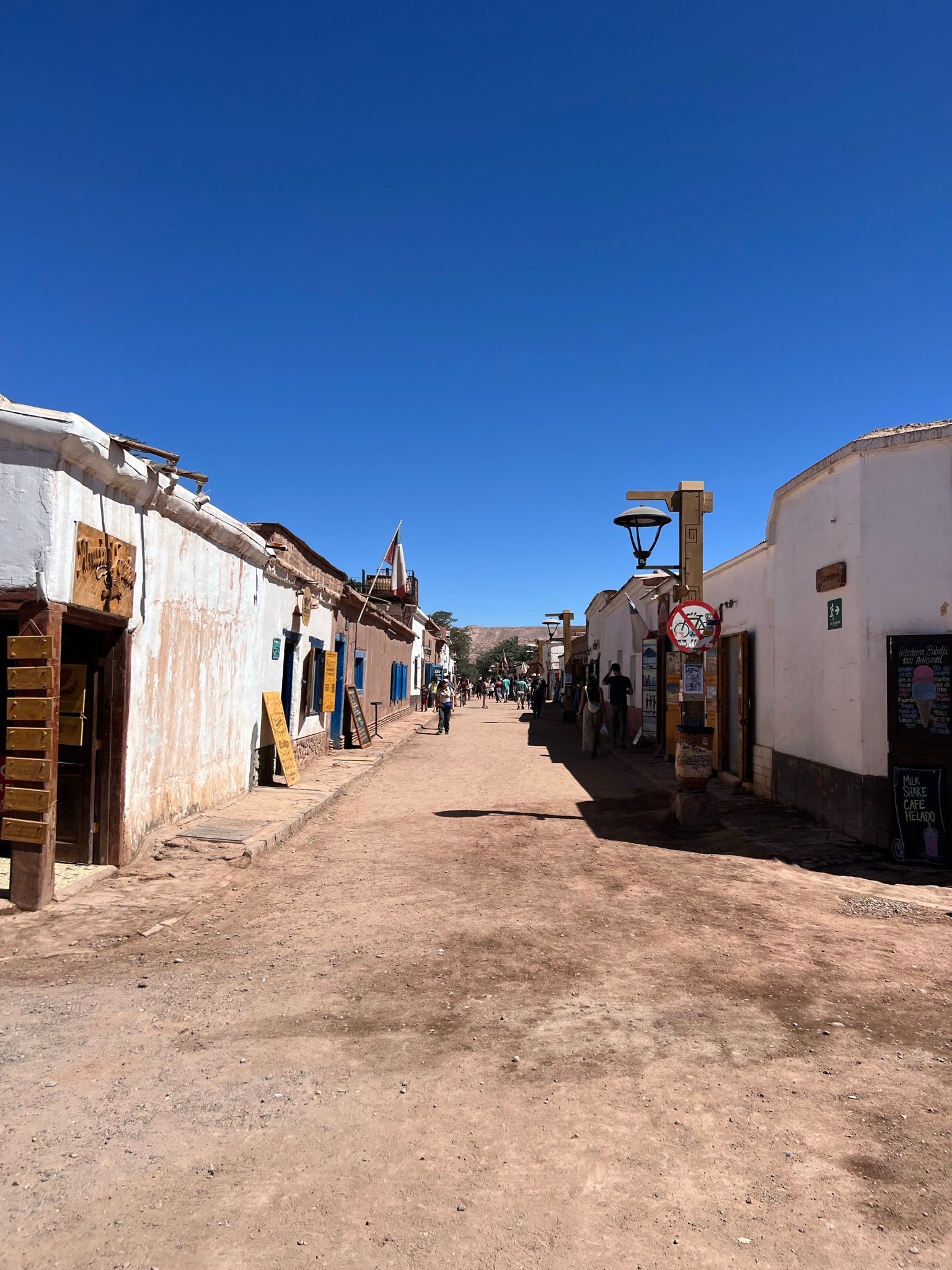
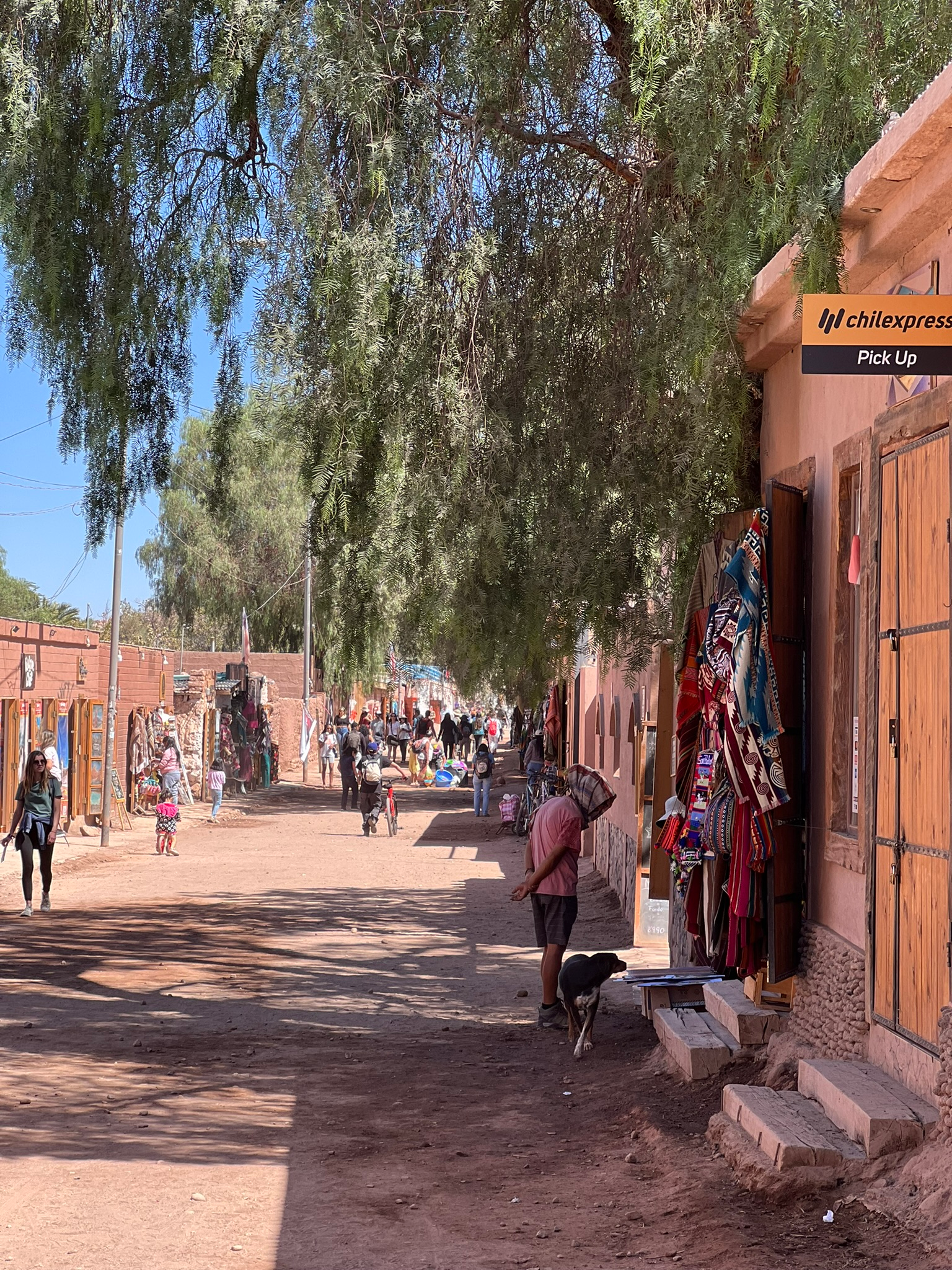
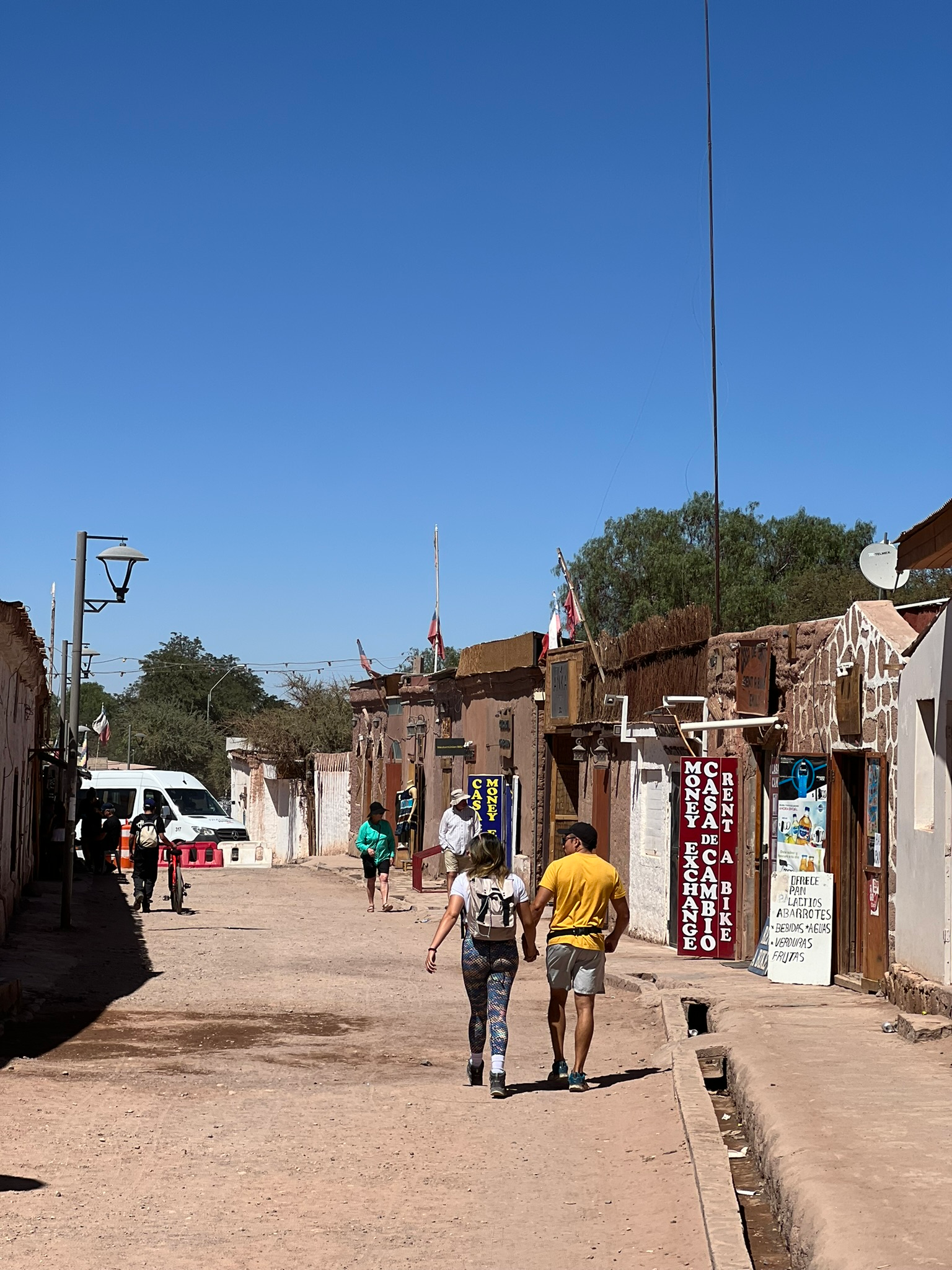
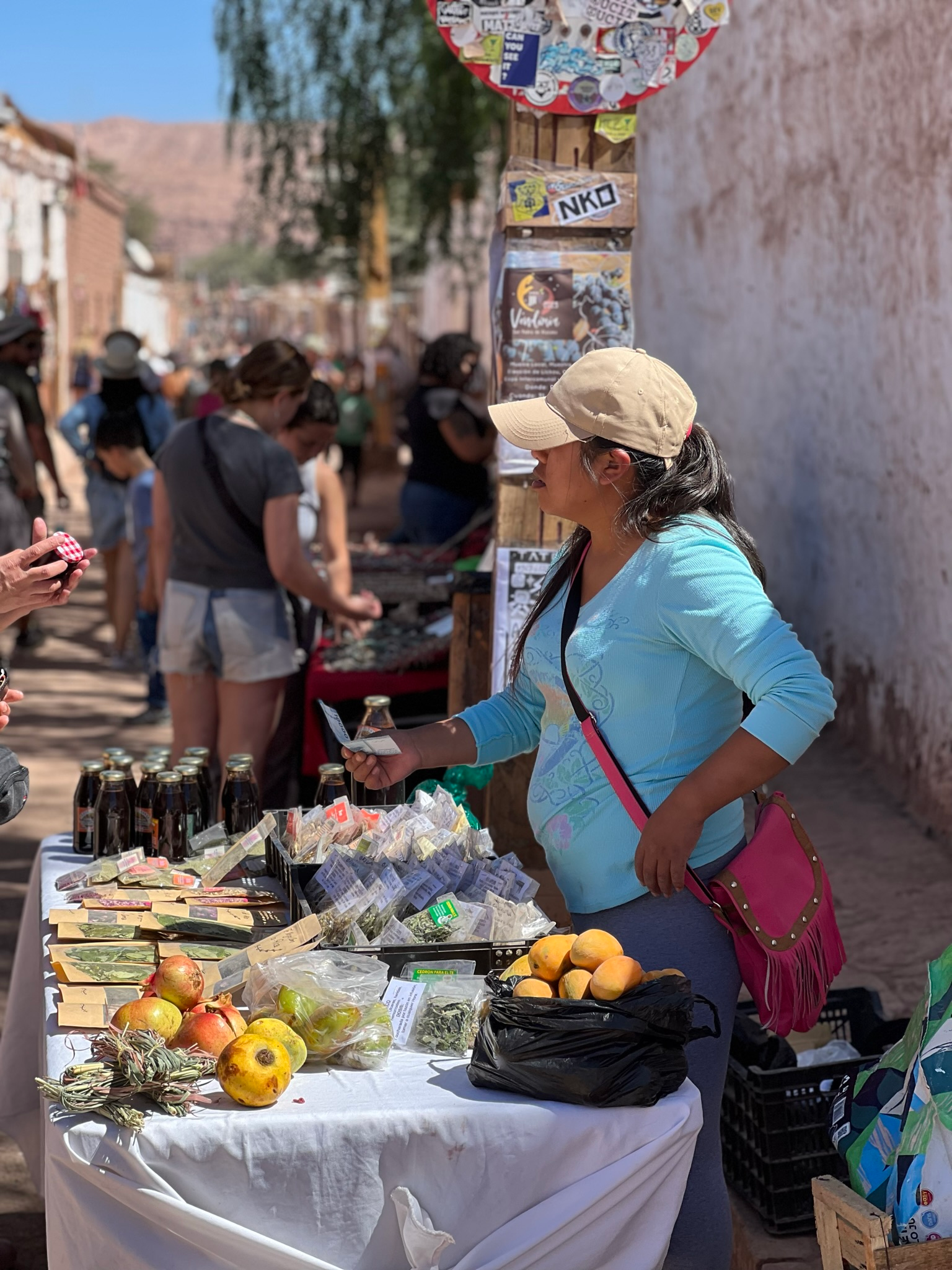
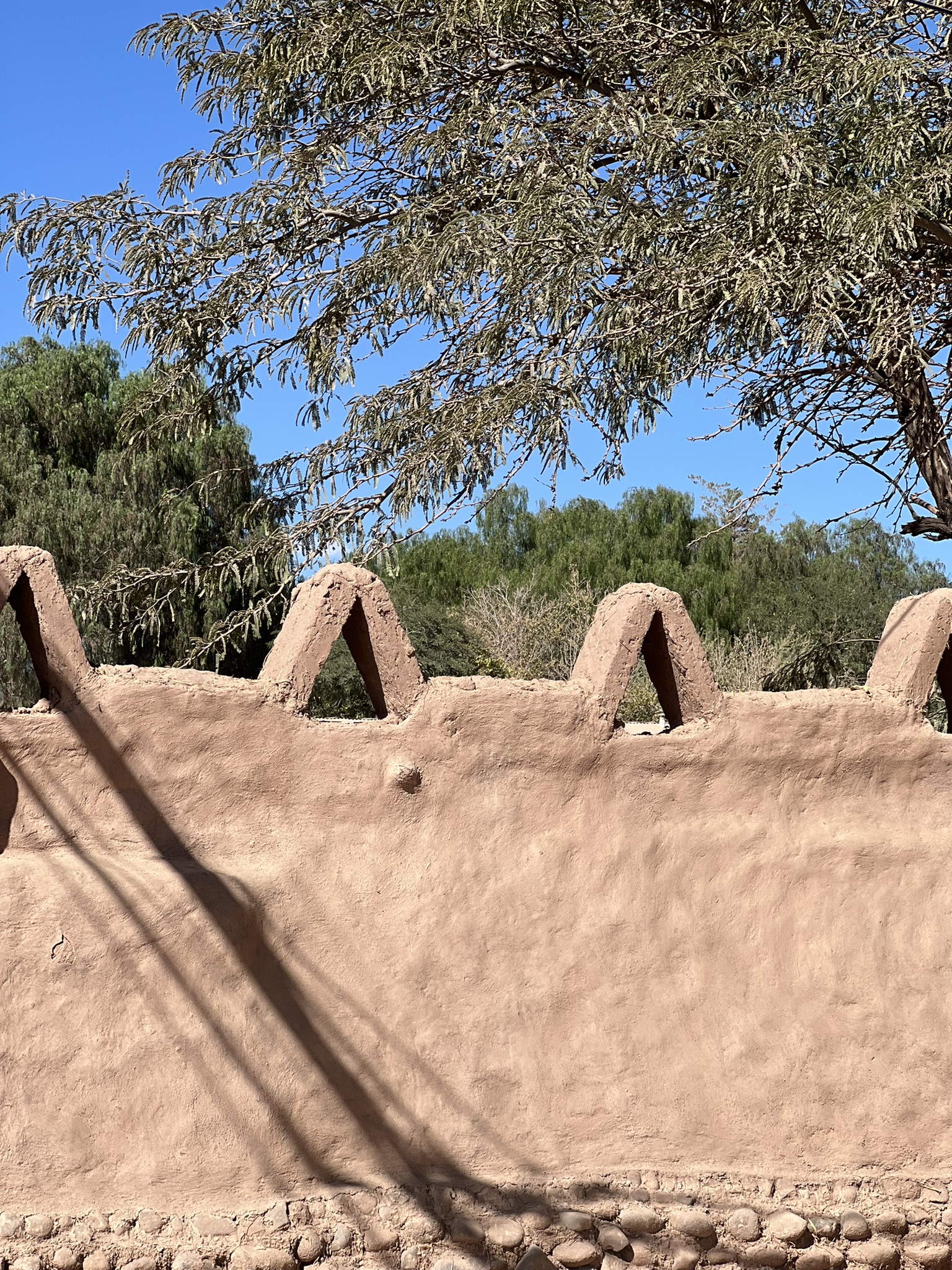
Of course, this all changed once I got around to exploring everything the region has to offer. Whilst I didn’t have much time to learn about the town’s history, other than the fact that it was primarily inhabited by the Atacameño tribe prior to the Incas and the Spaniards following the Conquest, much was to be said about the geography of the place. Like the fact that it’s situated in the Atacama Desert – the driest non-polar desert in the world with certain areas receiving a maximum of one millimetre of precipitation annually. Crazy, right? The desert, being found west of the Andes mountain range, boasts an area of around 105,000 square kilometres. Being rich in natural minerals and other valuable deposits, many mining towns are found throughout the vast expanse of the dry, desolate land – most of which having been abandoned over the years.
The town of San Pedro, being found at an altitude of 2,400 metres, has temperatures varying from around 25 degrees Celsius in the morning to 0 degrees Celsius at night, making it one of the most hospitable areas in the region. In contrast, further south next to the region of Yungay, the otherworldly baked, dusty, rocky landscapes are so arid and dry that they are often compared to Mars – with NASA using the area to test instruments and equipment to be used in future expeditions there. Another cool thing? With the desert being found so high up and having practically no cloud cover or light pollution, it is one of the best places on the entire planet to carry out astronomical observations and studies.
PART II
Valley of the Moon
Despite so many things to do and see, I only had a day and half here. Having mysteriously overcome my need to sleep and hydrate, I was finally ready to embark on the first of many adventures. My first stop would be the Valle de la Luna in the Cordillera de la Sal of the Atacama Desert. Together with Camila, our local guide, and Emiliano, a Colombian guy, I found myself on a minibus, lulling myself to sleep on the way to the Valley of the Moon.
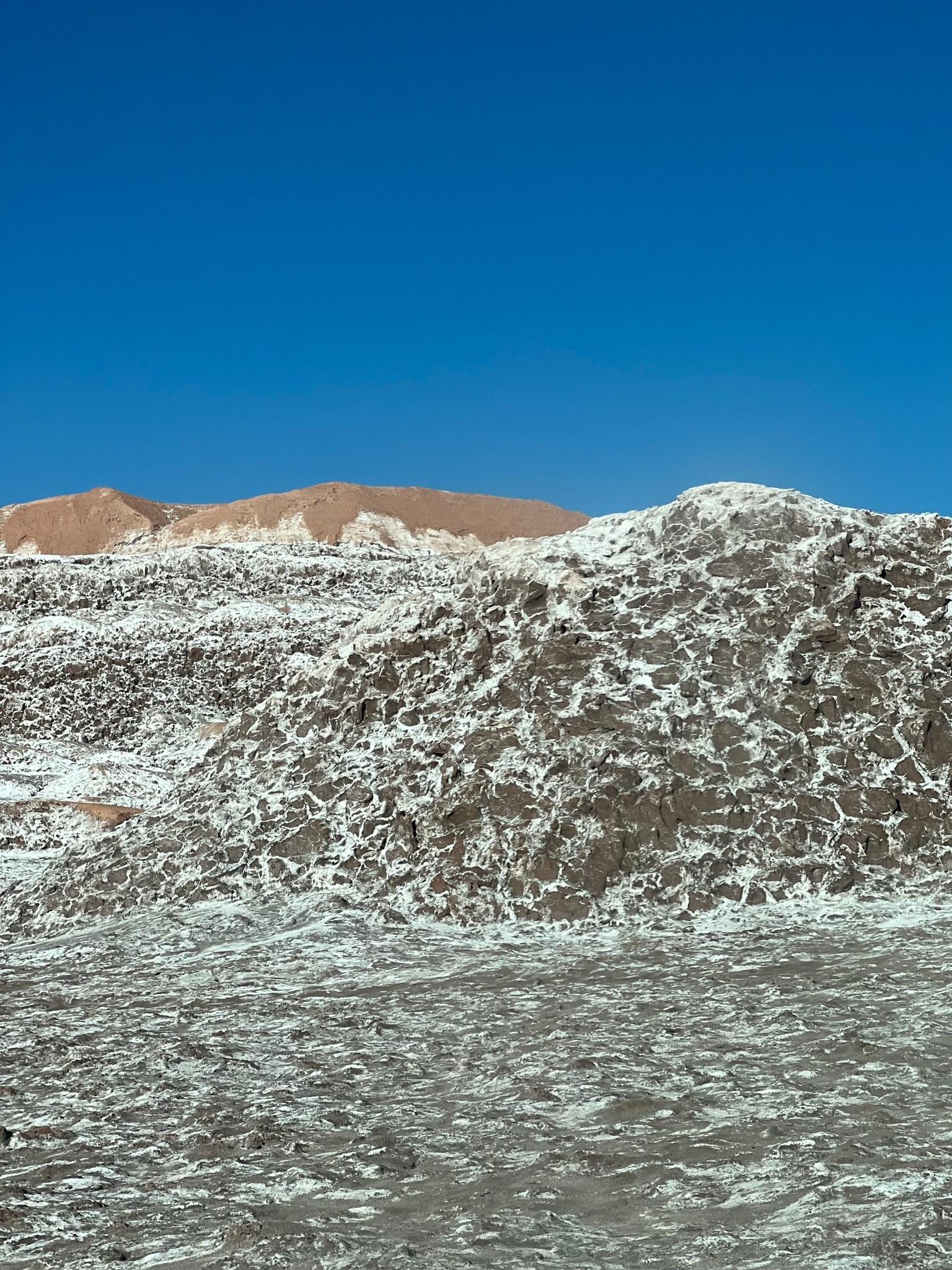
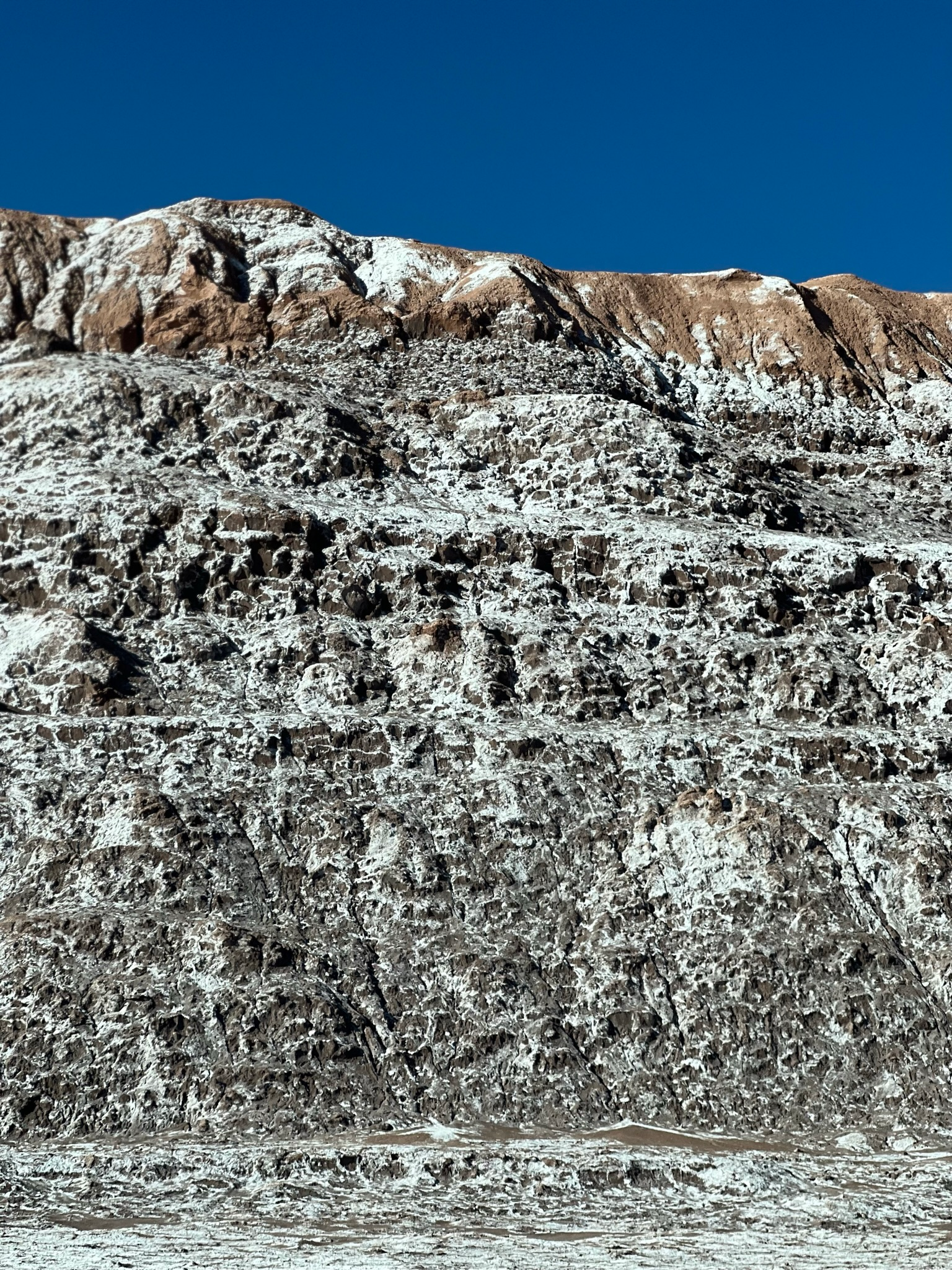
So called after its resemblance to the lunar surface, this thirteen-kilometre stretch of arid land is known for its spectacular sand and stone formations that have been carved by wind and water over the millennia. We parked next to the Great Dune – so-called… well, I’m sure you can imagine where it takes its name from. The 26-metre wave of tan, brown sand reminded me of those surrounding the oasis of Huacachina back in Peru – its sand smooth and soft as it slopes delicately to form a crescent shape. To the other side is a rocky hill – a 25-million-year-old mass of tawny brown stone peppered with white. This, Camila explained, would be a mixture of gypsum and salt derived from the nearby Andes mountains via wind and rain.
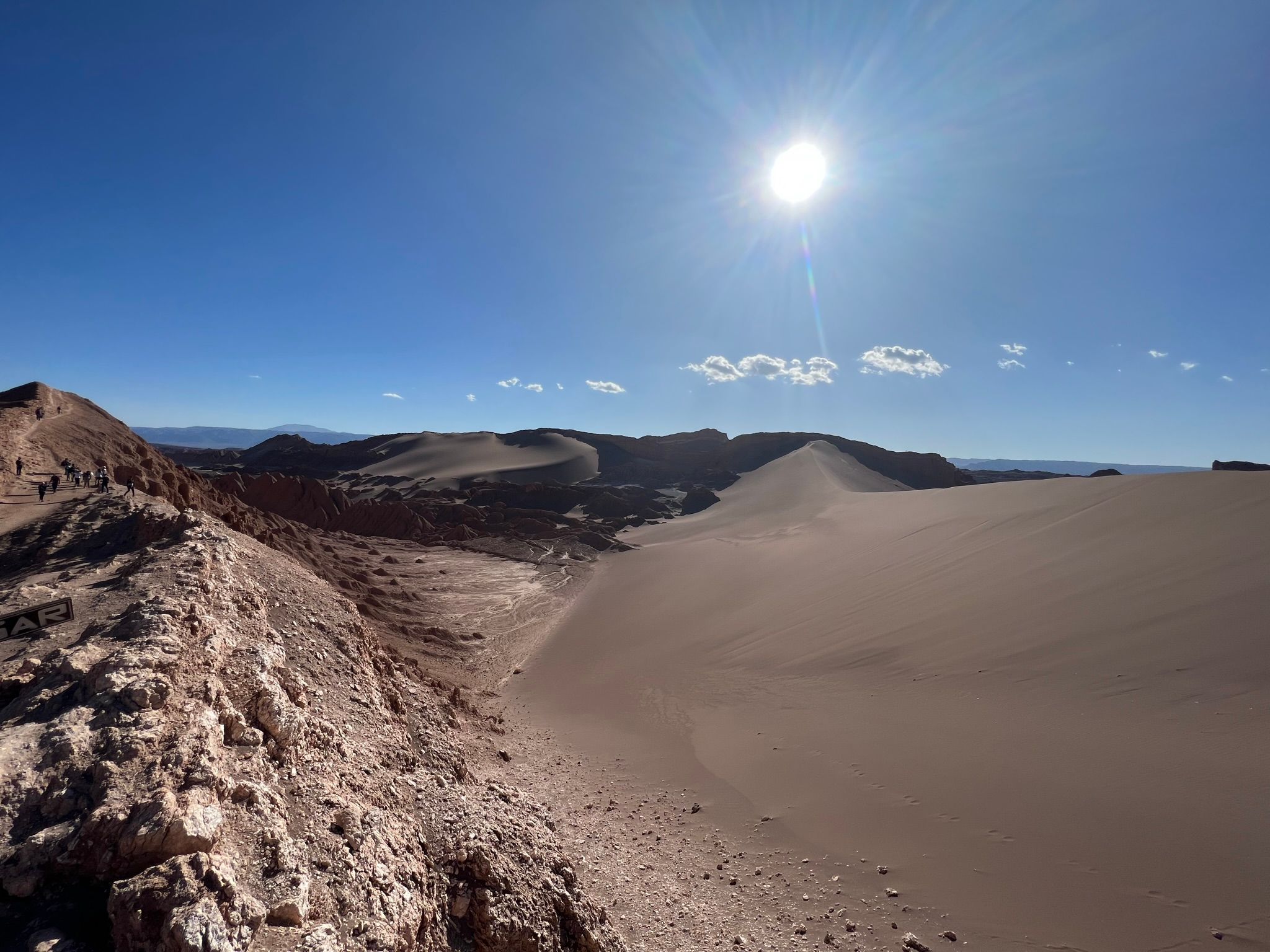
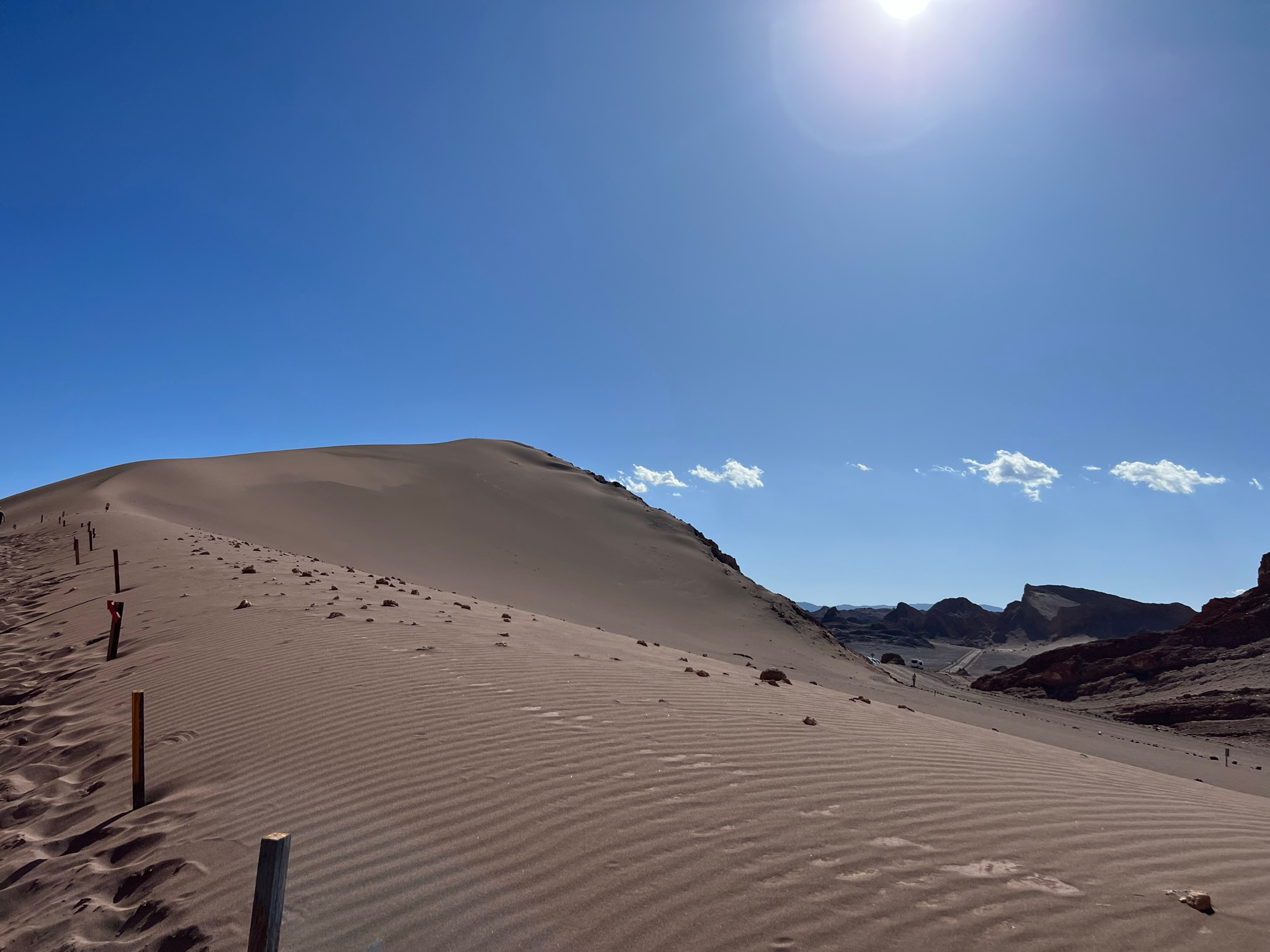
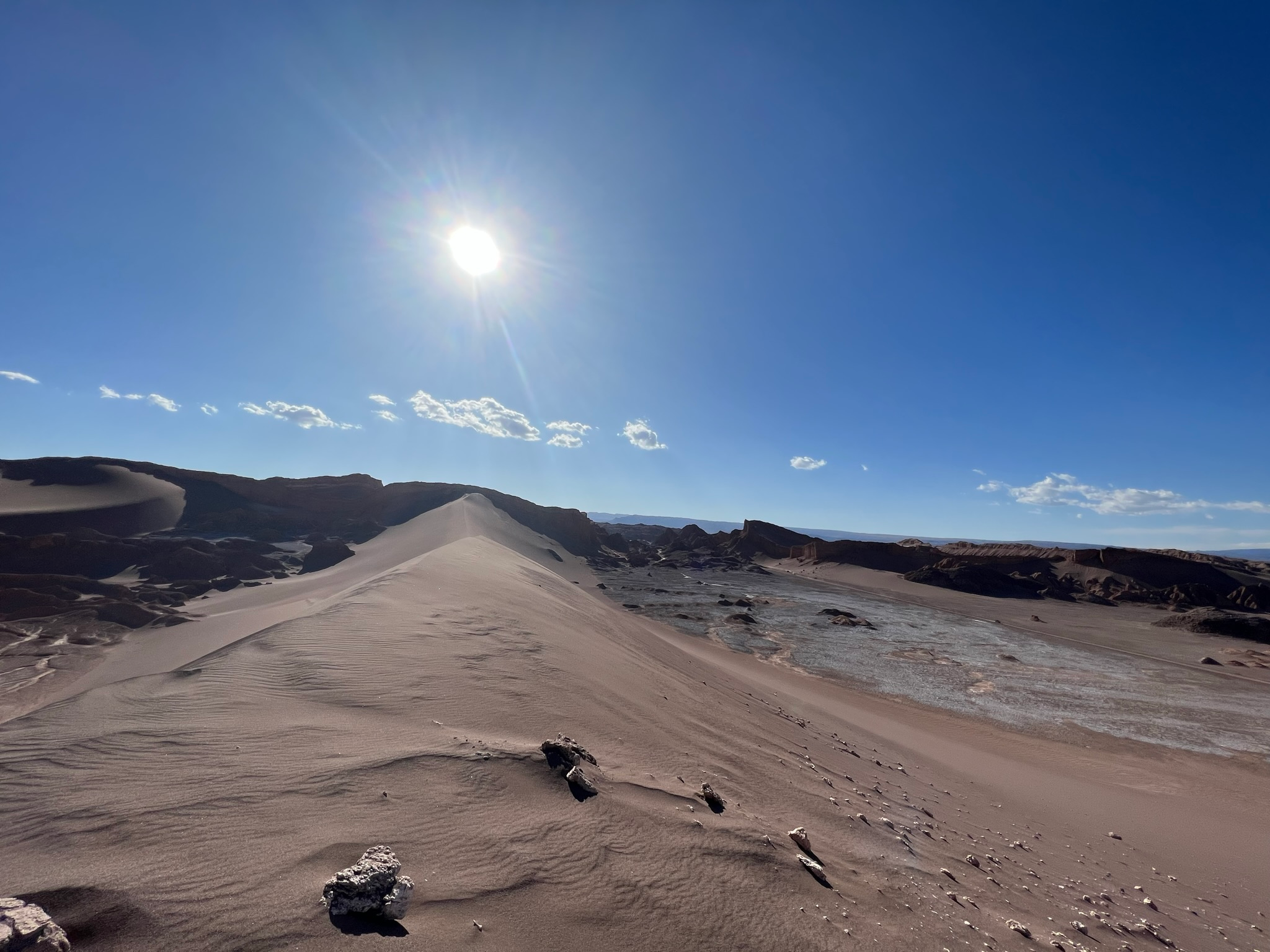
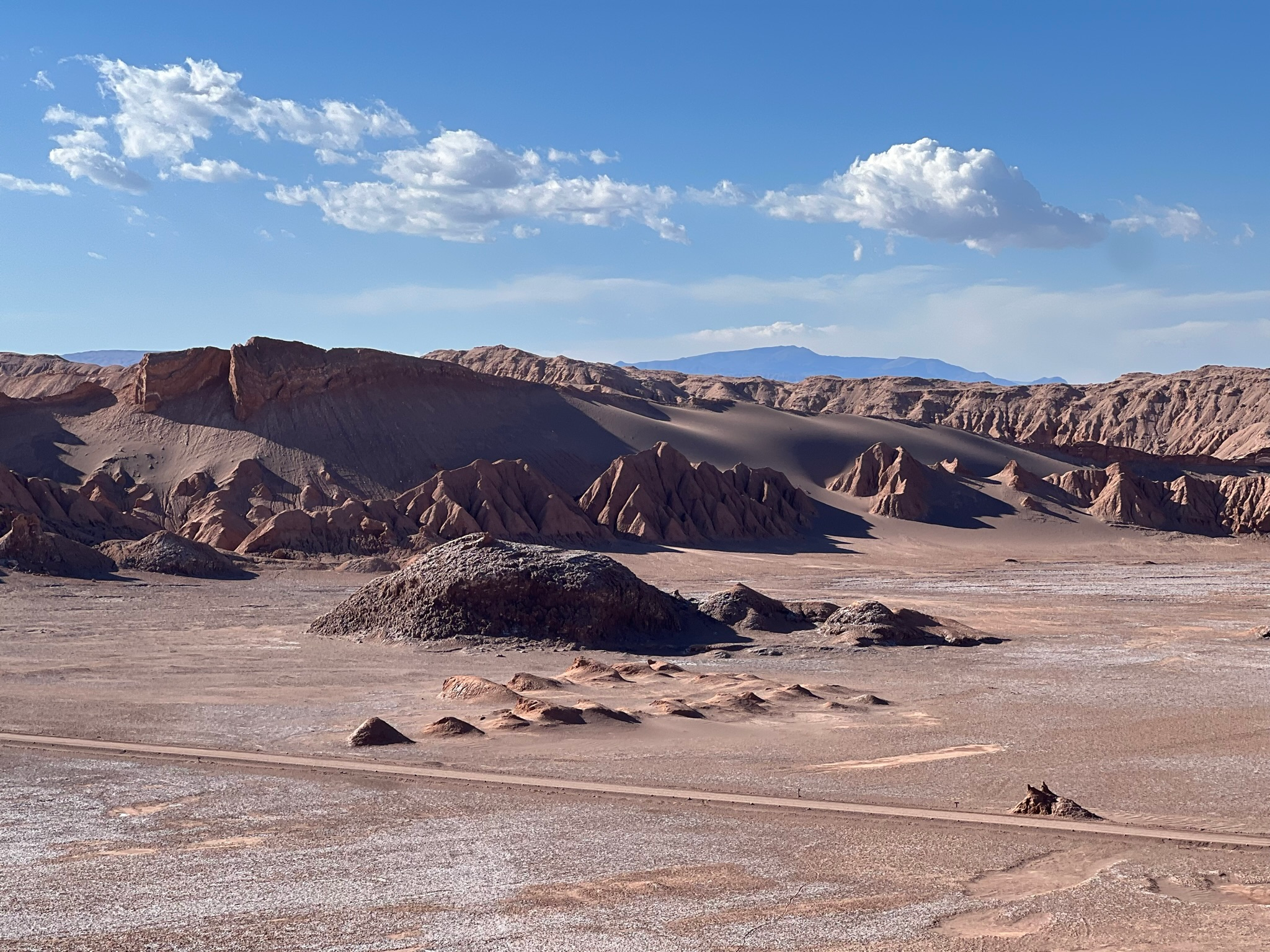
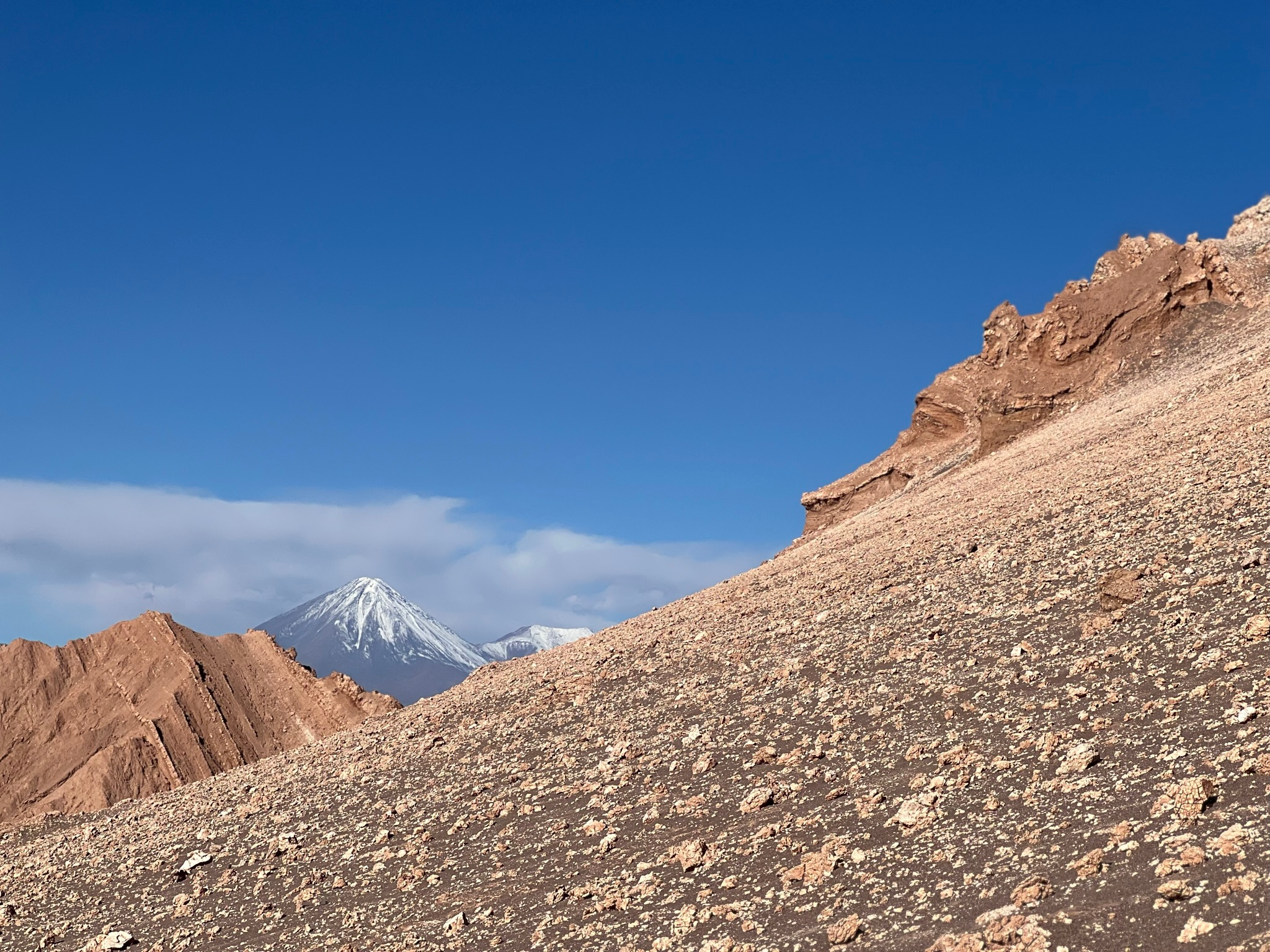
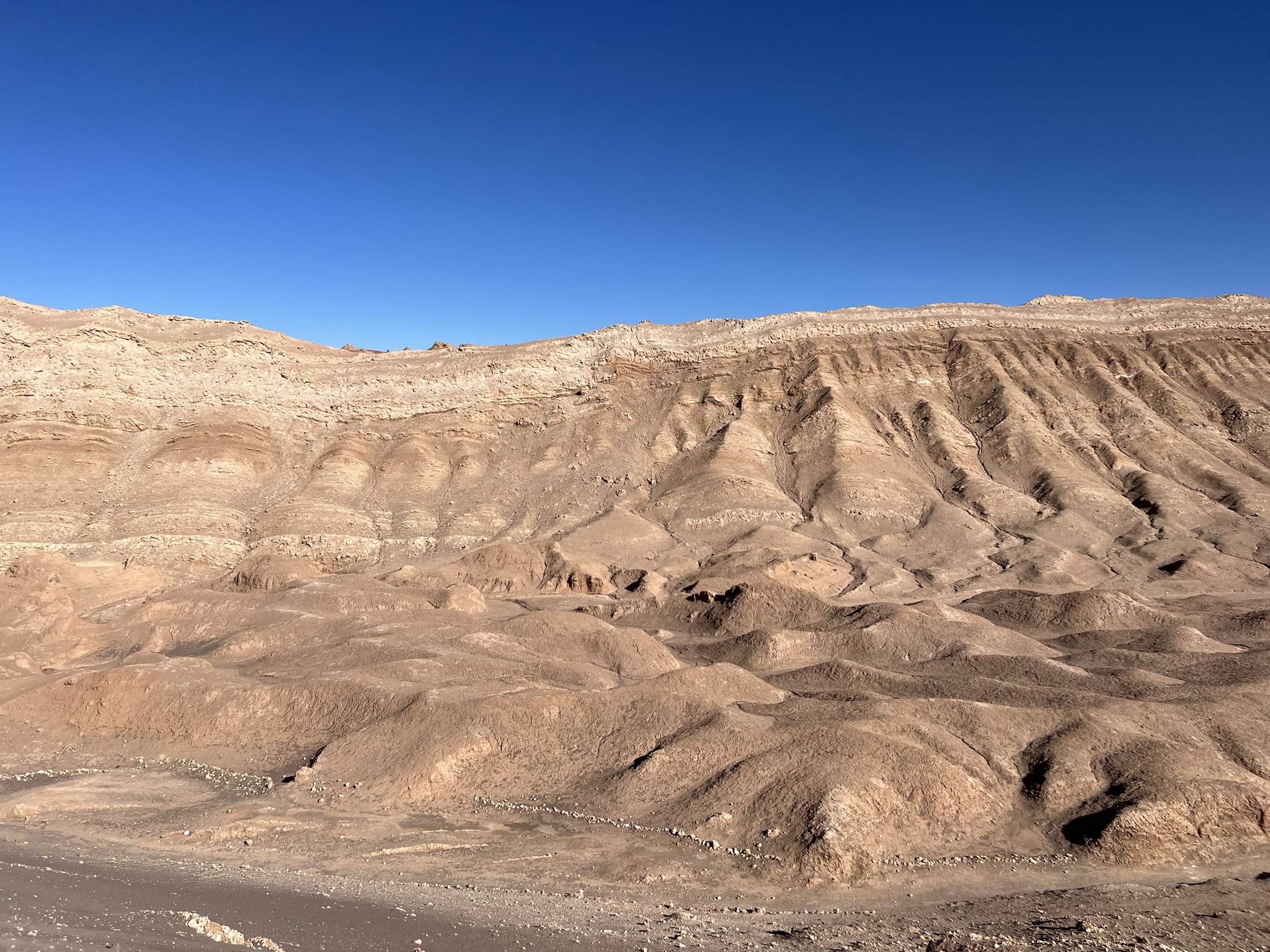
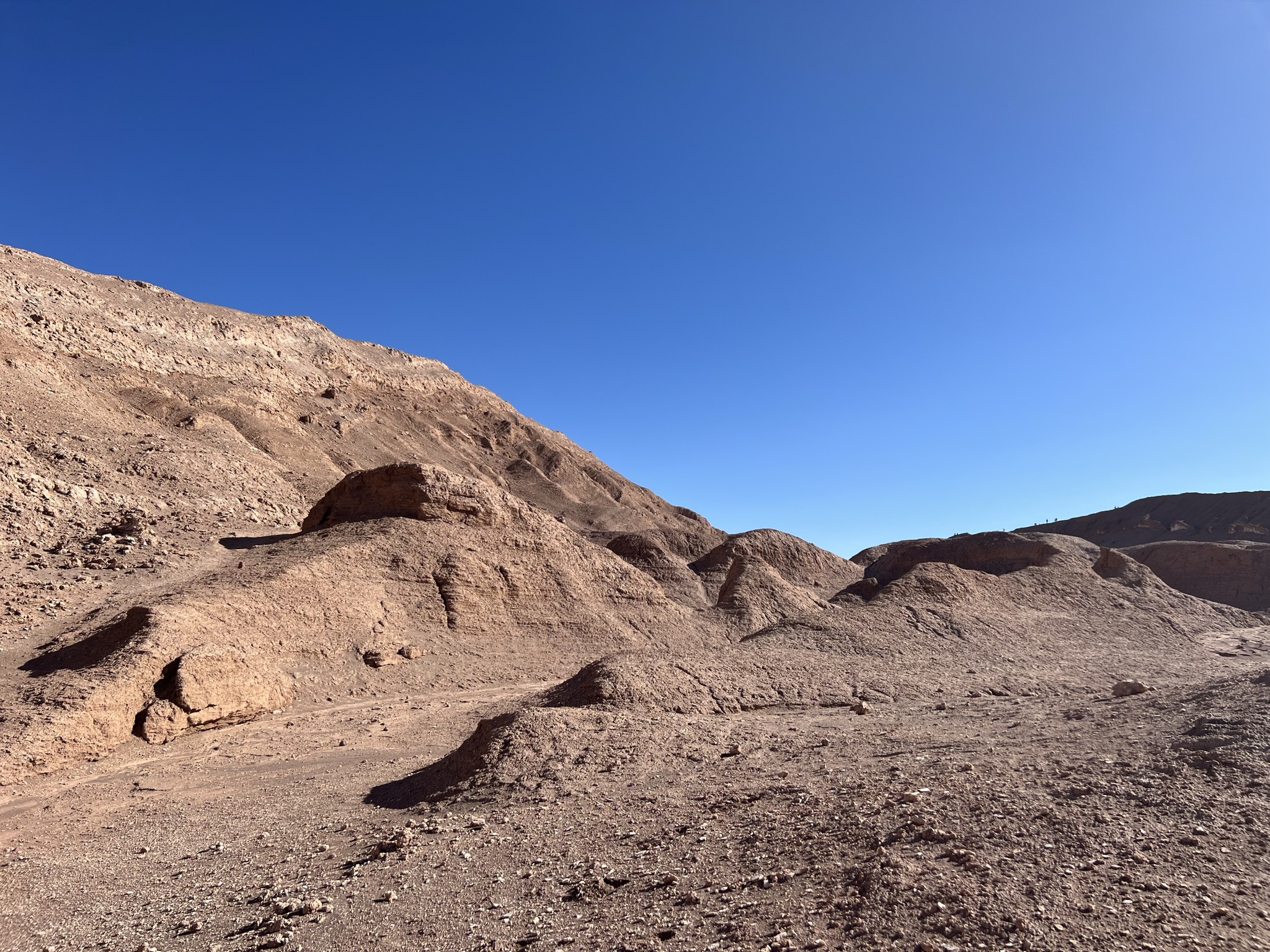
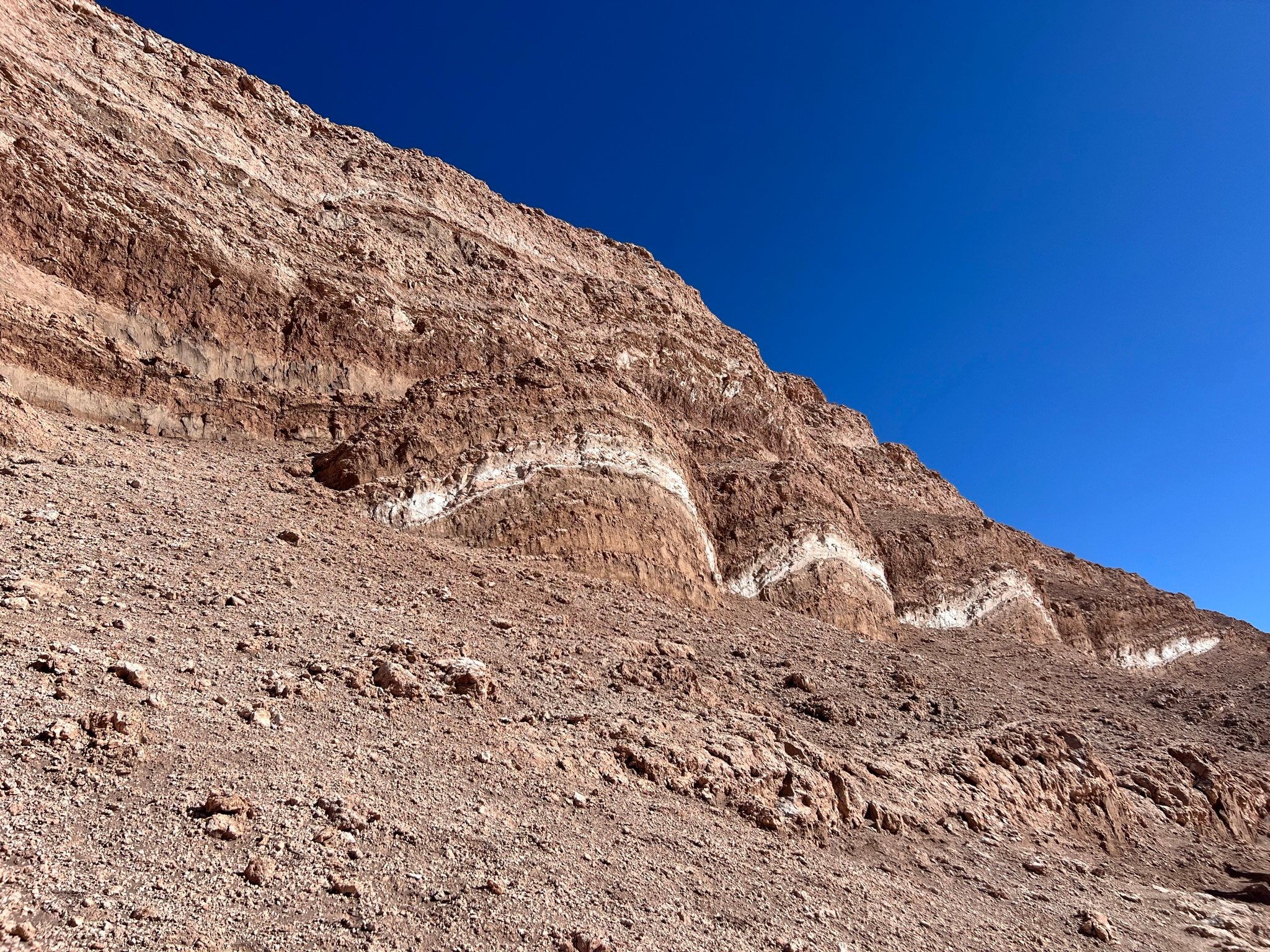
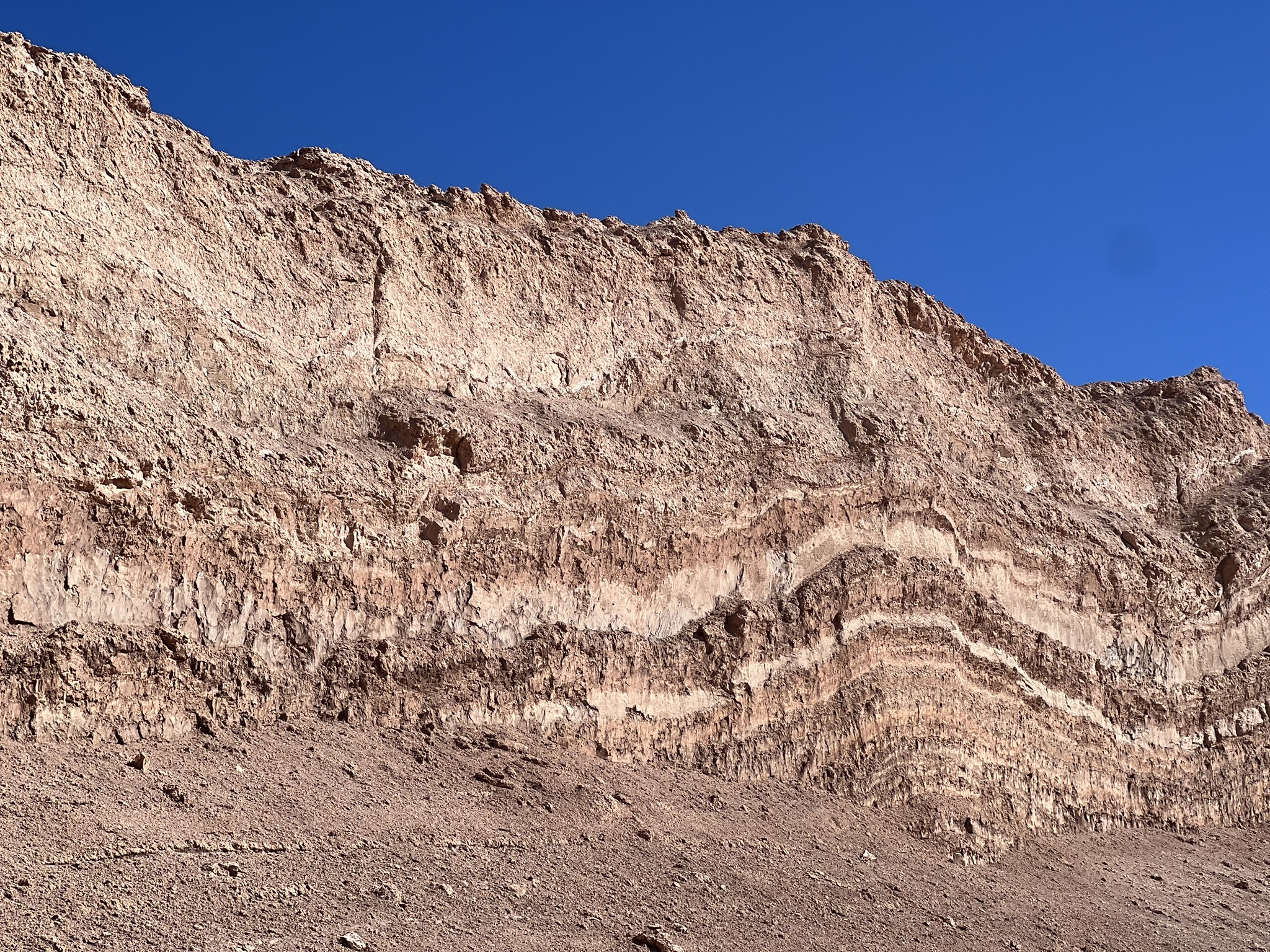
Along the walls, we could also appreciate fracture lines as a result of plate tectonic movements – with a fine layer of white sometimes being squashed in between. This, she went on, is due to gypsum-rich water that percolates through the spaces that then desiccates to leave behind the dried material. Being a plastic material with high tensile strength, these layers of gypsum tend to withstand the pressures of earthquakes and instead of breaking, they change their conformation. In addition to the white, we could also appreciate shiny, reflective specks of quartz and layers of grey – volcanic ashes that were compressed between the rocks over the years.
As we got to the top of the dune, we were met with a vista of the imposing desert below us. On one side we could observe the valley with its jagged rocky outcrops rising up from the sand making it look like a spiky floor. Then another large dune, and on the other side, a second valley – this one with a salt bed at its base. One can only try to imagine the striking contrast of the orange-brown rocks with the white of the salt and the snow-topped Licancabur volcano in the distance, together with the bright blue sky capping everything.
Dust and Pisco Sours
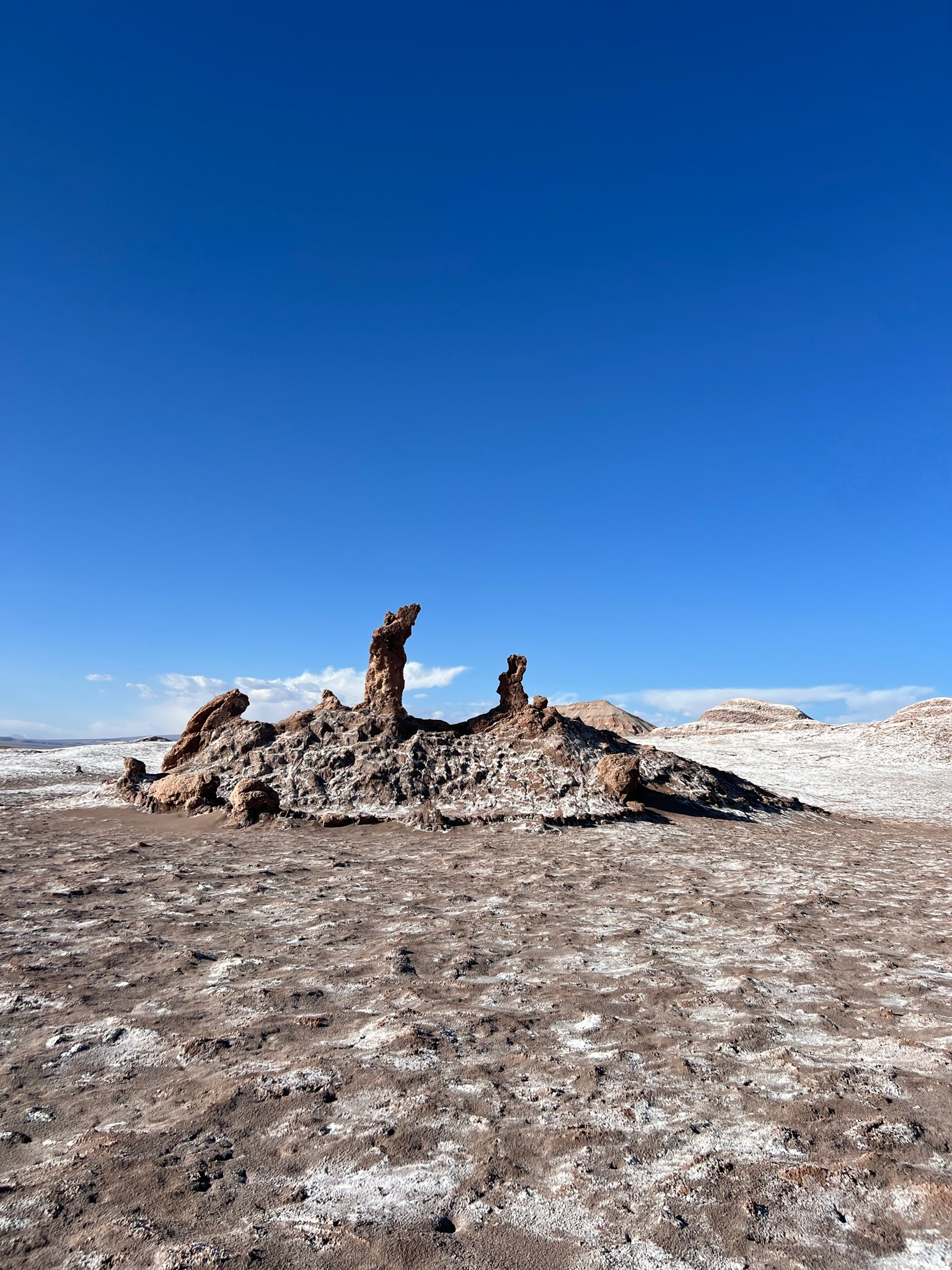
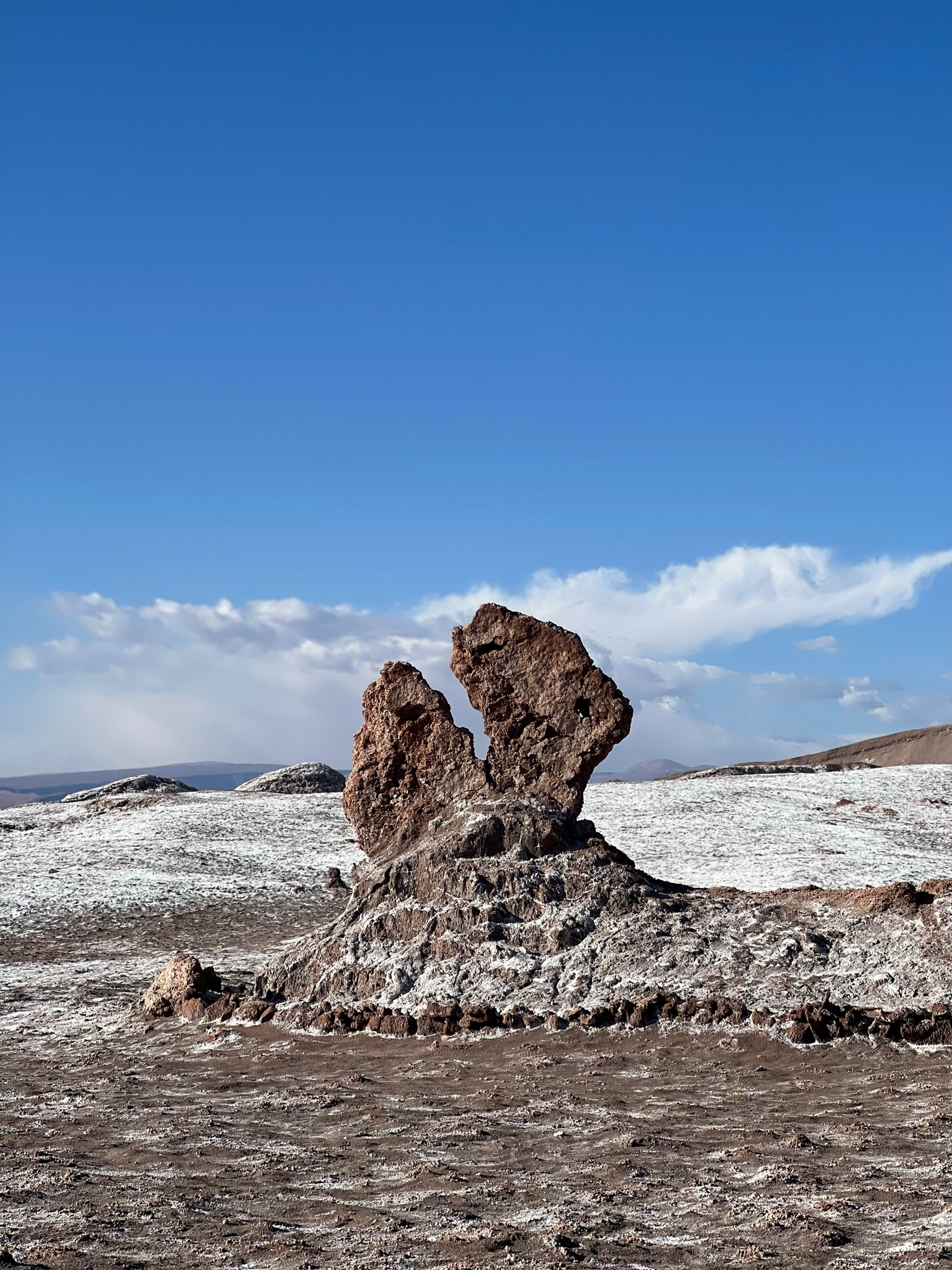
Our next stop was a site called the Crater, referring to its shape, with a white cover from all the salt and gypsum. Further on, the vast stretch of khaki was carpeted in the white of the salt and gypsum mixture that is typical of the Atacama salt flats.
I had nothing to compare this to. How could I compare the icy white and baby blue frozen dunes of the glacier to this craggy landscape? How could I compare the pure white of fresh snow fields to this arid wasteland? It was unlike anything else I had ever seen before. Also, the fascinating, anthropomorphised rock formations we stumbled upon – like the one shaped like Pac-Man or a dinosaur head, and the infamous Three Marias – a rock pedestal with three outcrops in the likeness of female figures standing on top. To be fair, they should rename the natural sculpture to the Two and a Half Marias, given that one of the figures’ heads has been broken off by a tourist who climbed on top of it a few years ago. Why must we always ruin everything? Grr.
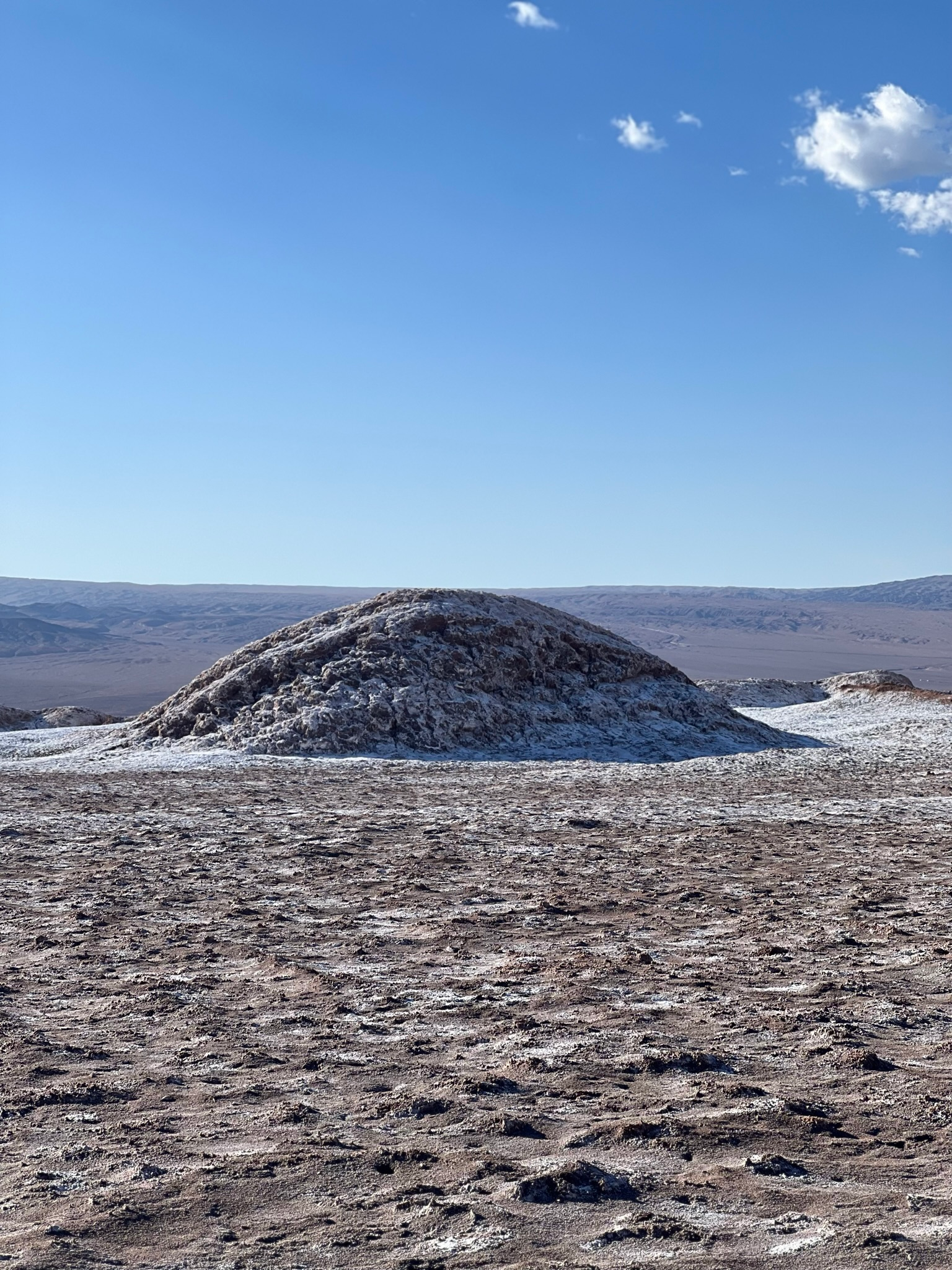
The final destination was at a viewpoint sitting atop the valley. Here, a table was laid out as they covered it in all sorts of cold cuts and, most importantly, pisco sours. As the sun set in front of us, painting the brown in all hues of orange and then pink, it was truly a marvellous way to end the day.

Stargazing in the Silence
Or so I would say, were it not for the night-time astronomy tour I had booked. Whilst back in town, I downed a quadruple espresso in hopes of it reviving me somewhat, only that was too much to expect from a single cup of coffee versus some forty hours of sleep deprivation. I swear at that point I was considering glueing my eyelids to my forehead.
With that, we were scuttled on a mini-bus and we started making our way to an observatory in the middle of nowhere. Here, Aurelio, the French astronomer, introduced himself. He began by explaining the lunar phases, telling us that the shape of the Moon is relative to the portion that is lit up by the Sun and that there are four major lunar phases, each lasting an average of around 7.5 days. A fingernail-shaped crescent Moon first appears, whose illuminated portion gradually increases, eventually forming a semicircle known as the first quarter during the waxing phase. This is followed by the waxing gibbous phase, which leads to the full Moon, and then the corresponding waning phases, resulting in the last quarter and finally a new Moon before the start of a new cycle.

At present, we’d be able to see the waxing gibbous phase, meaning the lighting wouldn’t be too ideal for stargazing. However, he emphasised, we would have a few minutes before the Moon rose and lit up the entire sky, hiding the stars we were oh so excited to see. For all its flaws, he couldn’t quite contain his excitement about this floating satellite, trembling at the very idea of the lunar landing expected in the coming years as part of NASA’s Artemis programme.
Without further ado, he proceeded to describe a tiny portion of all we could see. The Solar System we are so familiar with, containing the Sun, the four inner terrestrial planets and the four outer gas giants, along with a number of moons, dwarf planets, asteroids, comets and meteoroids, is part of the Milky Way galaxy. Galaxies, in turn, are composed of stars, gas, dust and dark matter held together by gravity, typically around a central supermassive black hole. The Milky Way is a barred spiral galaxy that appears as a luminous band in the sky, as we are located within its disc-shaped structure.
Whilst we can see roughly 3,000 stars with the naked eye under the best conditions, a number Aurelio specified he had never attempted to count himself, astronomers estimate that the Milky Way contains between 100 and 400 billion stars. Only a fraction of these can be resolved individually even with telescopes. With our galaxy being a medium-sized one and there being an estimated two trillion galaxies in the observable universe, we can literally say that there are more stars in the universe than there are grains of sand on Earth. If that ain’t mind-boggling and humbling, I don’t know what is.
In a Galaxy Far, Far Away...
He then went on to tell us that we’d be looking out for a few stars in particular. He’d mention one and then immediately point it out to us with his laser, a skill that left us all gobsmacked.
Unfortunately, he told us, the brightest star in our galaxy – the Peony Nebula Star – is invisible to the naked eye. We didn’t mind that much and instead settled for Sirius, the brightest star visible from Earth at night and one of the many Harry Potter-themed stars in our skies. Despite being farther away from Earth than Alpha Centauri (often referred to as the fourth brightest star in the sky, which is actually a triple star system), Sirius appears brighter due to its intrinsic luminosity and proximity compared to many other stars. With Canopus, the second brightest star in the night sky, being almost forty times farther away from Earth than Sirius, the inference is that the former must be an enormous and extremely luminous star – which it is.


After the brief refresher course, he started discussing various constellations, groups of visible stars forming patterns that are essentially sociocultural constructs and exercises of wild imagination. Despite this, modern scientists and astronomers still use them to navigate the night sky and orient themselves. There are many ways of grouping constellations, with one of the most commonly cited systems being the Menzel classification. This groups the 88 officially recognised constellations into eight families, some of the most important being:
Orion Family: Orion is one of the most recognisable constellations, depicted as a kneeling hunter wielding a club and shield. In Greek mythology, he was killed by a scorpion sent by Gaia and placed in the heavens opposite Scorpius, which is why the two are never seen together. Orion’s Belt, formed by Alnitak, Alnilam and Mintaka, is known by different names across cultures, with some referring to it as Las Tres Marías and others as the Three Magi. Despite appearing aligned, its stars lie hundreds to thousands of lightyears apart. While most of the stars in the constellation are hot blue supergiants, perhaps the most popular is Betelgeuse – a massive red supergiant. It is currently in the last 1% of its life, meaning that in some 100,000 years it is expected to blow up in a huge supernova explosion. That said, new research suggests its implosion might actually occur much sooner! As it is around 500 to 600 light-years away, if it were to explode now, it would still take us centuries to witness the galactic spectacle. To this, he added that there is no such thing as the “present” when it comes to the stars, as the light we process has aged significantly by the time it reaches our eyes.
Hercules Family: Amongst the many constellations, Aurelio pointed out the Southern Cross. This is made up of four well-known stars, Alpha, Beta, Gamma and Delta Crucis, arranged in the shape of a cross, with the lesser-known Epsilon Crucis completing the pattern. Whilst it carries strong Christian symbolism, the Mapuche people of Chile interpret the constellation as the footprint of a bird, once again reinforcing the idea that these patterns are largely products of cultural imagination. The Southern Cross holds great significance throughout the Southern Hemisphere and appears on the flags of Brazil, Australia and New Zealand.
Ursa Major Family: Of course, one of the most recognisable constellations is Ursa Major, the third largest constellation in the sky. Its brightest stars form the asterism commonly known as the Big Dipper, a ladle-shaped pattern used to locate Polaris, the North Star. Polaris marks the end of the handle of Ursa Minor’s Little Dipper. As Aurelio explained, this constellation is best viewed from the Northern Hemisphere, with only part of it visible from our location.
Zodiac Family: This family consists of the twelve constellations made famous by the bogus practice of astrology. They form a band-shaped region of the sky that overlaps with the ecliptic, the apparent path of the Sun across the celestial sphere over the course of a year.
All talked out, he finally earned a well-deserved break as we took turns looking through the telescopes that had been set up before our arrival. One of them was trained on the Moon’s Sea of Tranquillity, the region where Apollo 11 landed, its surface features stark and blinding under the reflected sunlight. Then came Alpha Centauri, whose three stars appeared to multiply thanks to my severely sleep-deprived eyes. Finally, we turned to the Orion Nebula, a dense, glowing cloud of hydrogen gas and cosmic dust acting as a stellar nursery where new stars are born through gravitational collapse and accretion. Even my exhaustion couldn’t compete with such pure awesomeness.