Puerto Viejo de Talamanca – Day 2: Heal the World
PUERTO VIEJO DE TALAMANCA
Day 2: Heal the World
February 04, 2023
The following morning, I woke up crippled with pain – but also with a sense of permeating peace and tranquillity, like I’d reconnected with myself.
You see, usually I do that through writing. Whenever there’s something I need to process, I run to my journal and start jotting down each and every thought, my hands guiding me towards a solution as the words flow. During this trip, however, much of my writing had been descriptive. The therapeutic aspect of writing about my emotions and feelings had been dialled down a notch to accommodate a different purpose – to create a memoir of my travels: the places I’d seen, the people I’d met, the adventures I’d had.

I realised I’d been carefully describing jungles, animals and sunsets while quietly avoiding thinking and writing about one thing that had been sitting with me since Mexico: the life I’d be leaving behind and the one I’d go back to once my gap year would come to an end. I still had months of travelling ahead of me, but sooner or later, these too would come to an end. I needed to start preparing myself for that.
The "Jaguar" Rescue Centre
Once again, I found myself in need of balance. I was neglecting one thing for the other when, in reality, I could just as easily do both. And so, after a morning spent doing some soul-searching on the same beach that had shaken me to my very core, I was ready for my next adventure.
This one took me to the Jaguar Rescue Centre, an animal rescue centre where injured, orphaned, or confiscated animals are brought so they can be rehabilitated and, where possible, released back into the wild. I’d be going around with Malena, a Nicaraguan guide who’d been working there for around nine months, and who also helps run community programmes that educate kids across Costa Rica about wildlife.
She started off with the centre’s history. A biologist from Barcelona and a herpetologist from Italy met serendipitously in Puerto Viejo, got married, and opened the rescue centre after noticing how many animals were in need of help. The centre was named after the first animal brought in by the couple – an ocelot. Ironically, the locals assumed it was a baby jaguar and refused to understand that it was a different animal altogether. As she laughed about the fact that the centre has been somewhat misleadingly named, and that they’ve never, in fact, had a jaguar there, I felt utterly cheated. I had come here specifically for the jaguar!

Completely oblivious to my emotional breakdown, she went on to tell me that their main job, apart from feeding and rehabilitating animals, is to turn them from “humans back to animals”, since domestication is one of the biggest problems rescued wildlife faces. The centre, she added, runs on community support, donations, entrance fees, and volunteers who often spend a few months helping out. Once again, I found myself wishing I had more time on my hands – I would’ve loved to do something like that at one point.
From Humans to Animals
Before starting our tour, Malena went over some house rules – no touching (to prevent transmission of microorganisms and for the safety of both animals and humans) and no speaking to parrots (to reduce domestication and stress, and to limit disease transmission).
Then she gave me a bit of a trigger warning. Many of the animals brought there are victims of attacks – usually dog bites – while others have tragic backstories, and some can’t be released either because they’re permanently impaired or because they’ve become too habituated to humans. Out of roughly 900 animals brought in the previous year, she continued, around 400 had died because they were brought too late. After that, we started the tour, moving around different enclosures, each home to different species:
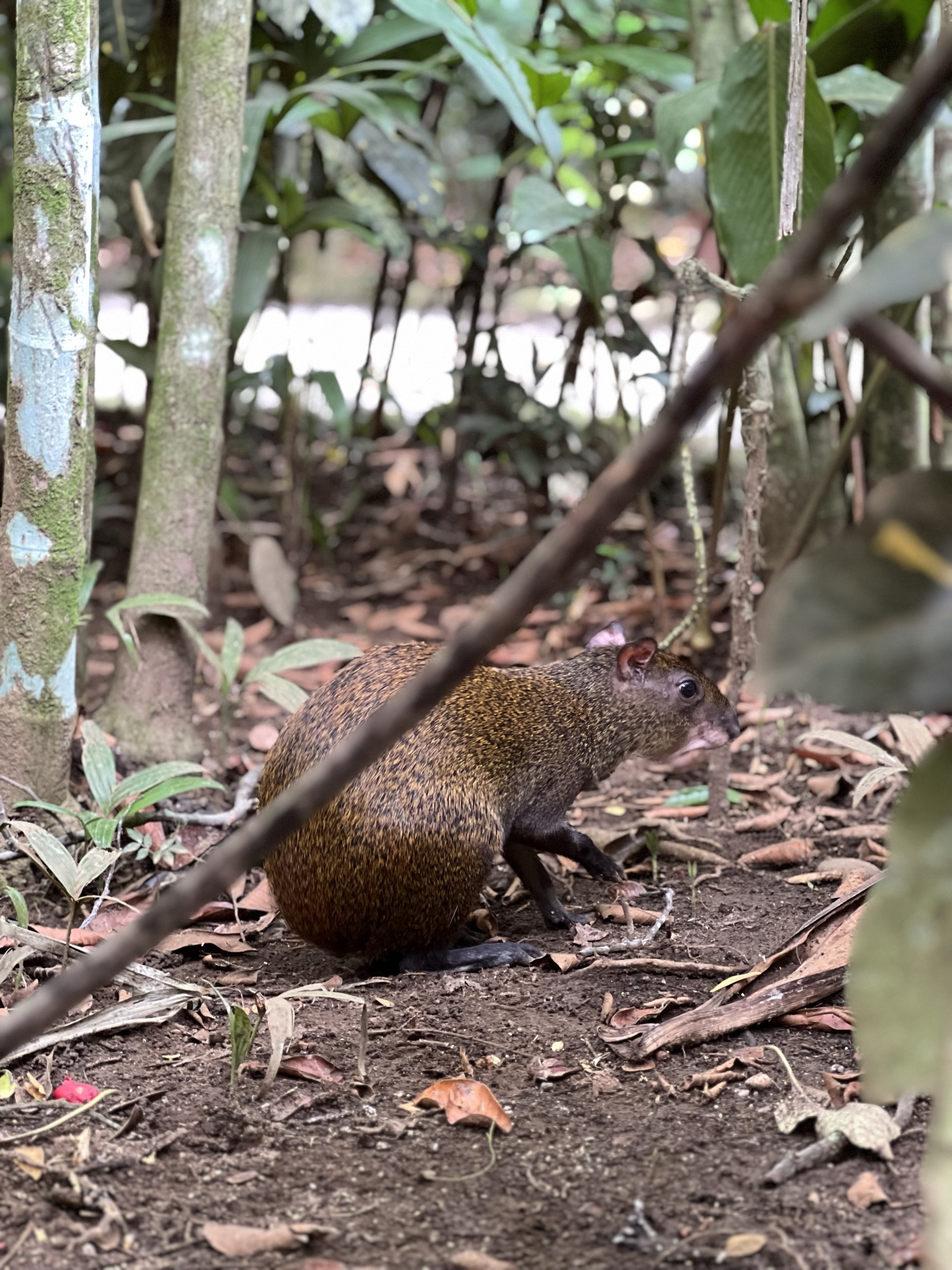
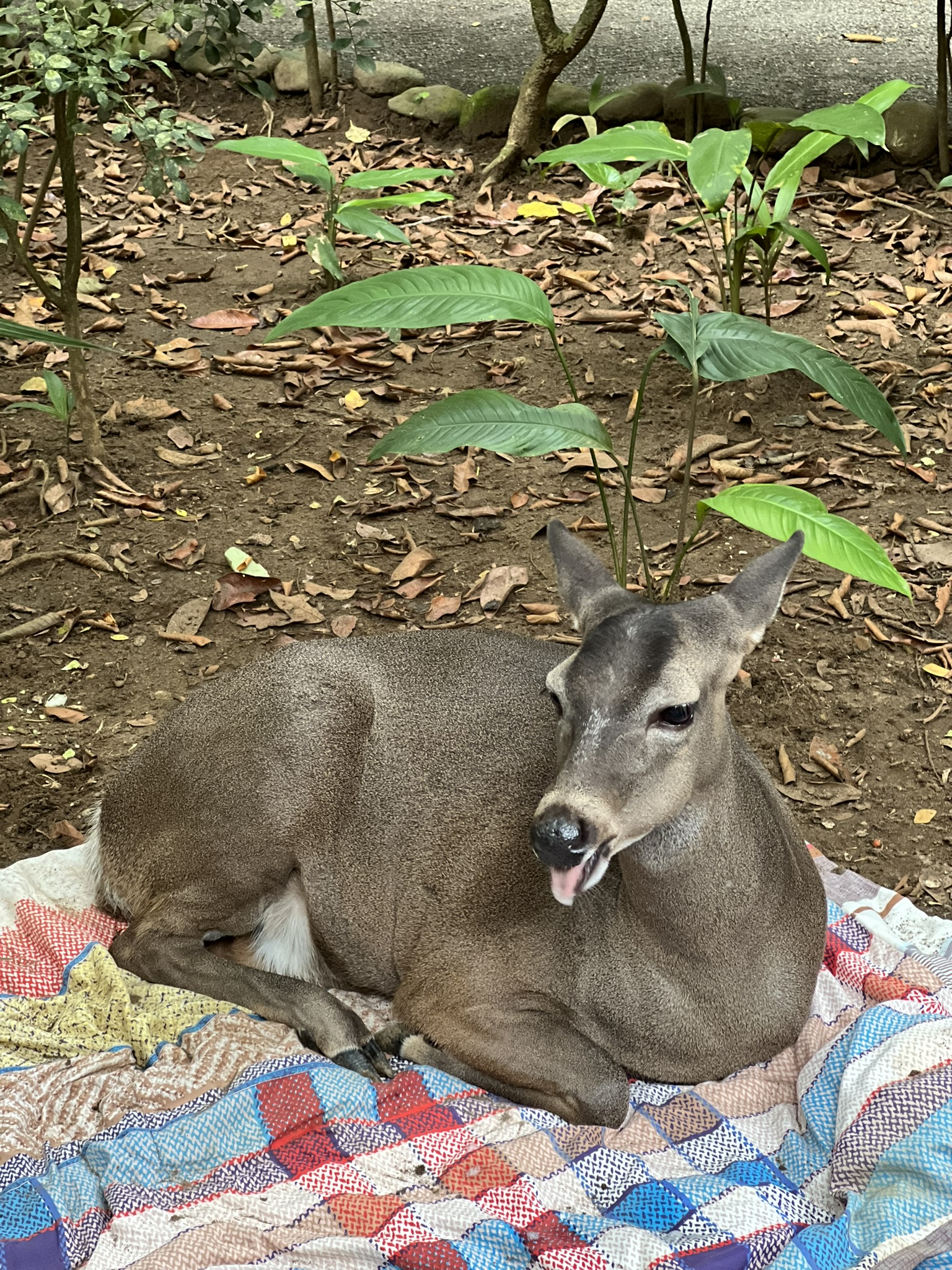
Xai: A twelve-year-old deer found still attached to her dead mother by the umbilical cord. She was adopted by locals and became domesticated. Now she roams freely around the centre and is dubbed the “princess” – a benevolent one, given that she shares her food with the agoutis found there.
Kibu: A ten-year-old ocelot found at the age of four with a broken leg in a banana plantation. He was brought in for treatment and was later found to have leukaemia and feline immunodeficiency virus (FIV), a transmissible infection requiring isolation. Luckily, he’s doing much better now, fed live prey to sharpen his hunting skills and cared for by volunteers who have to follow strict hygiene measures when entering and leaving his enclosure.
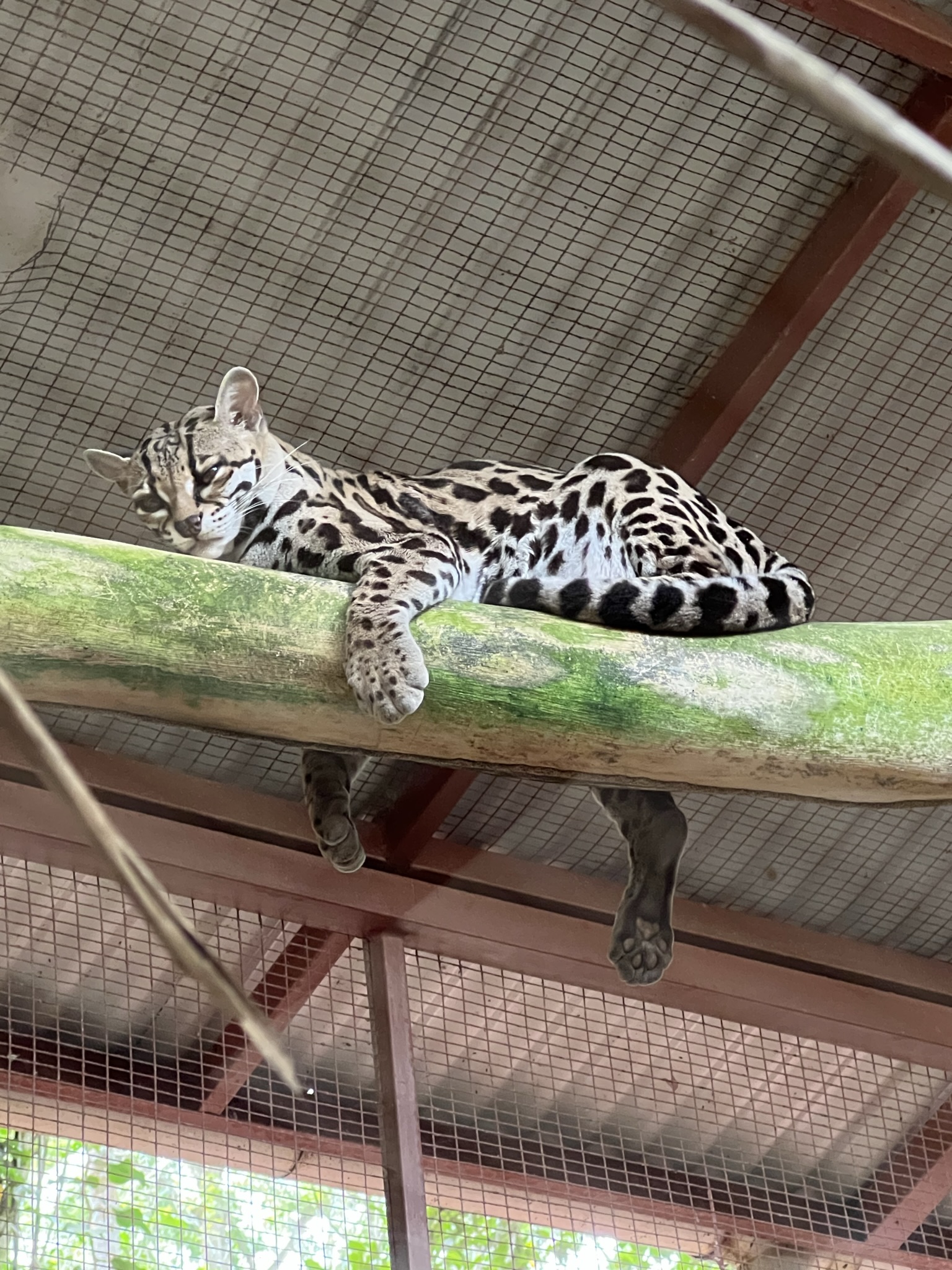
Diavolino: A fourteen-year-old margay found in a box with his brother, plus some bread and coffee, inside an abandoned car at the Panamanian border – probably destined to be sold as pets. When the box was opened, the cat lunged at Sandro, the Italian founder, and bit him, prompting the nickname “little devil”. After rehabilitation, the siblings were released, but Diavolino had grown too attached to the centre and returned. Also of note, he once escaped and killed forty chickens.
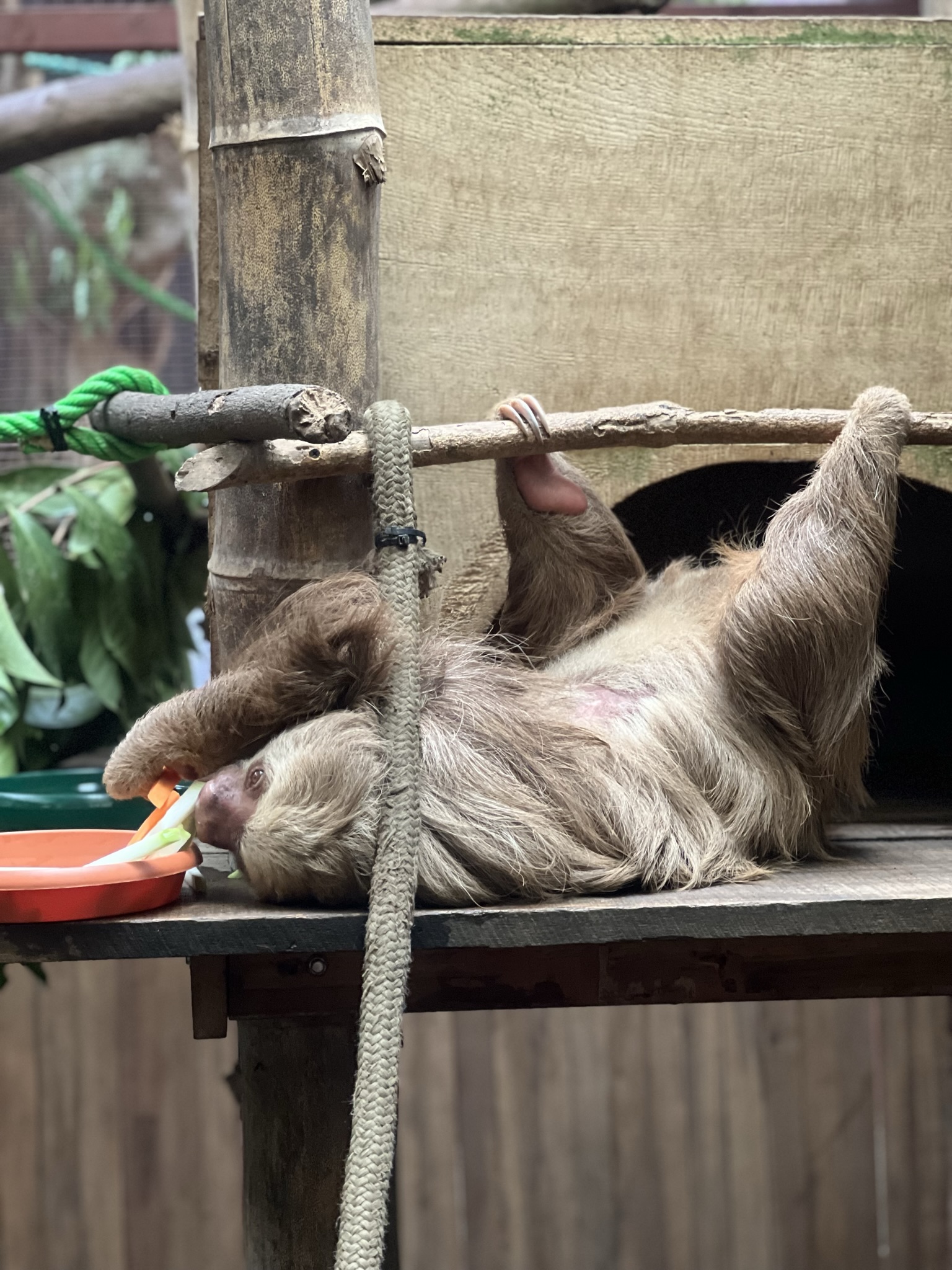
Sparky: A two-toed sloth brought in after being electrocuted on a power line, a common hazard and a major cause of injury and death for arboreal wildlife. Unfortunately, he lost some of his claws and can’t climb or defend himself anymore. Fortunately, he gets his fair share of fruit and leaves all day long. Seems like an okay trade-off, if you ask me. Cases like Sparky’s have inspired projects that create “canopy bridges” – safe routes between trees – in areas where power lines pose a risk.
Turanga and Mufasa: Two sloths with growth impairment, with the first found clinging onto his dead mother. Their condition, according to Malena, might have something to do with toxins linked to agricultural chemicals used in plantain farms.
Ceviche: A kinkajou found injured as a baby and then domesticated. He was released three times, and three times he came back.
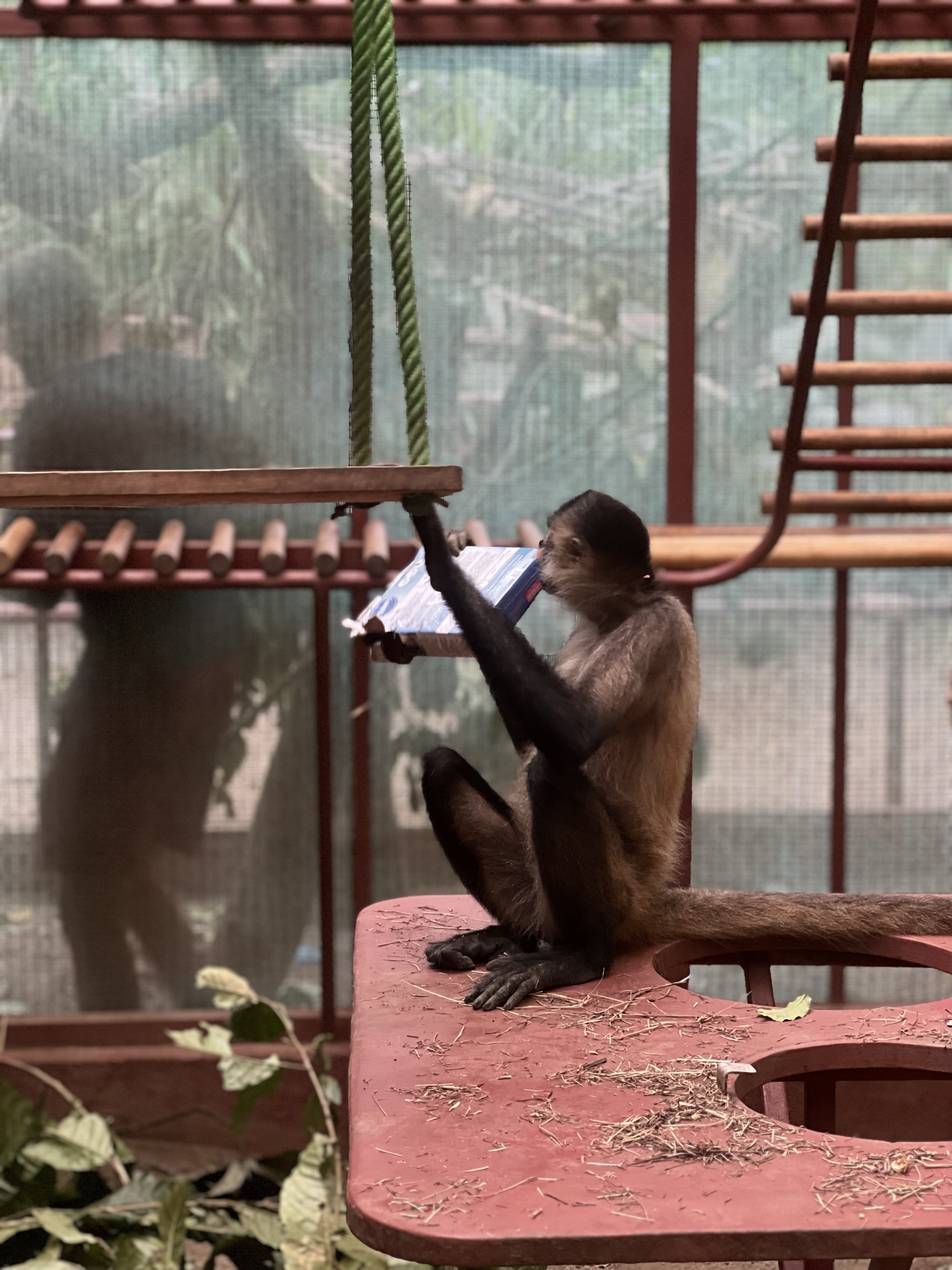
Nerea: A spider monkey kept in a bird cage for years by a guy who used her to make money from selfies. After she was confiscated and the guy was imprisoned, she was rehabilitated, although attempts to release her failed repeatedly. She now lives in an enclosure with two other monkeys she’s bonded with and is revered as the alpha female.
Paco: One of Nerea’s roommates, a 31-year-old spider monkey brought in three years earlier after 28 years locked in a garage, fed exclusively rice and beans, and given Coke to drink. He was found toothless with a misshapen body and, understandably, extremely apprehensive of people – and later his roommates too – given he’d had no normal contact with other monkeys.
Coco: A crocodile brought in on Christmas Day 2013 after being found wandering around a residential area and beaten by locals who thought it posed a threat. The one-eyed creature is a tame beast who’ll stay there until his last day.
Pancha: A ten-year-old caiman found by a German couple in their shower whilst on their honeymoon. When brought to the centre, it was still tiny and had already started showing signs of habituation.
The list goes on and on. A snapping turtle with a shell hacked by a machete. White-lipped peccaries about to be sold for meat. Macaws kept in isolation due to infectious diseases. Their heart-breaking stories are a testament to the cruelty of both nature and humans, with the work being done at the centre offsetting some of it.
Apart from the animal enclosures used for rehabilitation, the centre also features a serpentarium. Costa Rica, Malena explained, is one of the worst and best countries when it comes to snakes. Worst in the sense that there are around two dozen venomous species and some are fairly common. Best in the sense that the country is well-prepared, with antivenom produced and distributed for treating snakebite. If you’re bitten, there are only two things she really advised – keep calm and get to the nearest medical centre as quickly as possible. No gels or creams, no suctioning, no tourniquets, and no risking your life trying to take photos for identification. Here, she insisted, clinicians see snakebites often enough that treatment is guided by the bite pattern and the patient’s symptoms. How friggin cool is that?!