Montezuma – Day 2: Diving at Isla Tortuga
MONTEZUMA
Day 2: Diving at Isla Tortuga
January 23, 2023
Having booked a diving trip the previous day, I practically jumped from my bed and straight into my swimming trunks the second my alarm went off. I could hardly believe I’d be diving again – in the Pacific no less. I’d be heading to Isla Tortuga – one of the islands associated with the Islas Negritos Biological Reserve.
We met up on Montezuma Beach, where the boat would pick me up along with another eleven people. The second José, our guide, mentioned that I, along with two other guys, would be taking a different boat to go diving, this Spanish goddess named Blanca erupted in fury. Turns out she’d explicitly asked the company whether diving was possible at Isla Tortuga and had been told that snorkelling was the closest thing available. Now feeling thoroughly robbed, she passionately argued her case, with me backing her up. I’d grown to love diving so friggin’ much that I just couldn’t bear seeing her miss out. Also, I kinda wanted to hang out with her, so I’m not that selfless. I’m a sucker for petite girls with strong character – what can I say?

After the drama was sorted, we finally got on the boat and rode for about forty minutes across the azure waters of the Pacific to reach the island. Along the way, José told us there was a chance we might even spot whales. A slim one, given that it wasn’t peak season, but a chance nonetheless.
I felt no pressure about this. I’d already seen my quetzal – anything beyond that felt like pushing my luck. I was happy having crossed the whale shark and the quetzal off my bucket list and wanted to pace myself. I didn’t wanna see everything there is to see in just one trip. And so, much like my reasoning with the jaguar, I figured this too would be something for another time. Besides, I had another trip planned elsewhere – surely I’d see a few then.
Isla Tortuga: Below the Surface
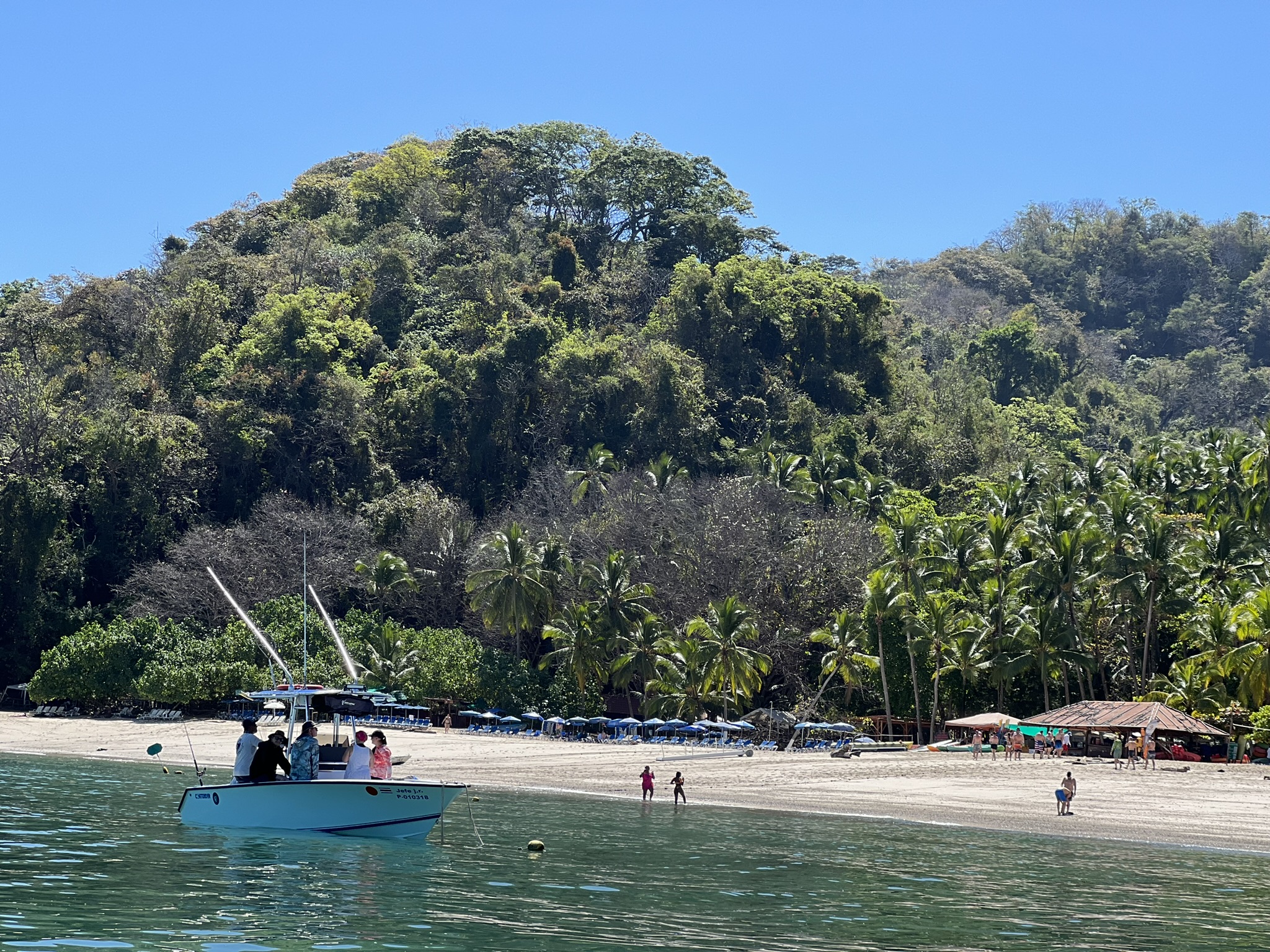
The moment we reached the island – whose beach looked eerily similar to Playa Muertos – we transferred onto a second boat, already rigged with scuba equipment. From there, we headed to our first dive site: Las Peladas – aptly named after the bare rocks found there.
With Blanca replacing Amelia as my dive buddy, we geared up, back-rolled, and suddenly I was breathing underwater once again – feeling freer than ever, like I’d finally returned to where I belong, despite it being my first time diving in the Pacific. The ocean was crystal clear, with excellent visibility. Having logged around seventy-five dives by this point, I still considered myself fairly inexperienced – diving being such a new hobby for me. This was also my first time diving somewhere without coral.
Instead, I noticed tiny blue, tube-like structures clinging to the otherwise bare rock. These, José told us, were tunicates – sac-like animals with two siphons used for filter feeding by drawing water in and expelling it. Although sessile as adults, their larval form is mobile and tadpole-shaped, complete with a notochord shared with other chordates. They’re also among the most ancient animal lineages, with their thick, gelatinous outer coat offering protection from both the environment and predators.
It was so, so different to Utila. Even familiar species looked different. Parrotfish lacked the bright, vivid colours I was used to, sergeant majors were noticeably larger, queen angelfish carried a darker purple hue, and spiny lobsters sported different white patterns. Then there were species I’d never seen before – flag cabrillas, yellow-striped goatfish, golden jacks, spotted rose snappers, reef cornetfish, scissortail damselfish, king angelfish, spinster wrasses, rainbow wrasses, spotted and freckled porcupinefish, and God knows what else. Not to mention the sheer number of triggerfish, pufferfish, octopi, starfish, sea urchins – and the absolute highlight: a stunning spotted eagle ray.
Shark Tale
Blanca, being used to diving around Málaga, seemed to be having just as much fun as I was. Once back at the surface, we couldn’t stop listing everything we’d seen. Then we cruised a few more minutes to the second dive site: Joaquín’s Rock, named after a guy who used to dive there all the time. And honestly, I don’t blame him. I would too.
Down at the seafloor, the scene was similar to the first dive – the diversity of marine life once again leaving us astounded. But this time, there was something extra. At around five metres depth, our divemaster signalled us to enter a cave right in front of us. Blanca and I went first, pushing against a strong current that seemed to be actively warning us to stay out.
We kicked and kicked until we squeezed through the narrow entrance. Inside, the cave opened into a wide hollow space and, right in front of us, was a school of whitetip reef sharks. With their long, slender bodies, white-tipped dorsal and caudal fins, broad snouts, oval snake-like eyes, and tubular nasal flaps, I couldn’t tear my gaze away. I stared for far longer than I probably should have, forcing the other divers to wait behind us. But it was just so damn cool! They circled one another calmly, one of them eventually approaching us before gliding out of the cave – prompting us to follow.
We were later told that whitetip reef sharks spend much of their time resting on the seafloor or inside caves, as they can actively pump water over their gills to breathe – unlike many sharks that must swim constantly. Mostly nocturnal, they leave their shelters at night to hunt octopi, fish, and lobsters.
Now listed as Near Threatened, whitetips are overfished for their meat, which can sometimes contain ciguatoxin – a toxin responsible for ciguatera poisoning, capable of causing a wide range of symptoms and, in rare cases, death. One of the highest-risk carriers of this toxin is the barracuda… of which I’d eaten dozens back in Caye Caulker and Utila. Had I been insanely lucky, or am I somehow impervious to ciguatoxin? I guess I’ll have to see about that…
After exiting the cave, we continued the dive, spotting several more whitetips – some resting motionless on the sand, others cruising gracefully past. It felt like an absolute privilege to share the water with them.
A Lucky Fluke
Back at the surface, it felt like we’d just woken up from a dream. But with a pristine tropical beach waiting for us, it also felt like we were about to stumble straight into another one. We spent a few hours lounging in the sun, swimming in the crystalline water, and eating a classic casado before heading back onto the boat.
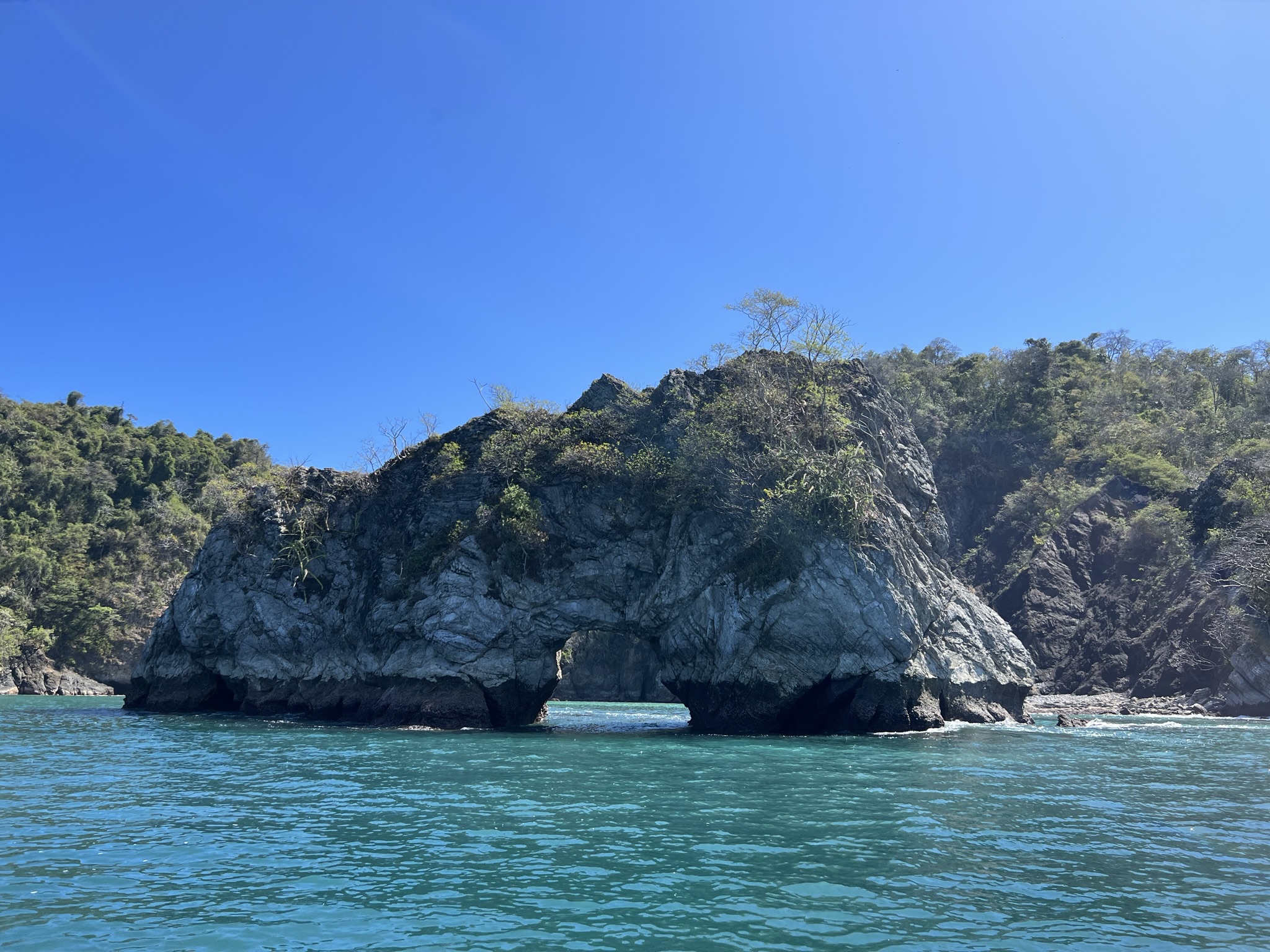
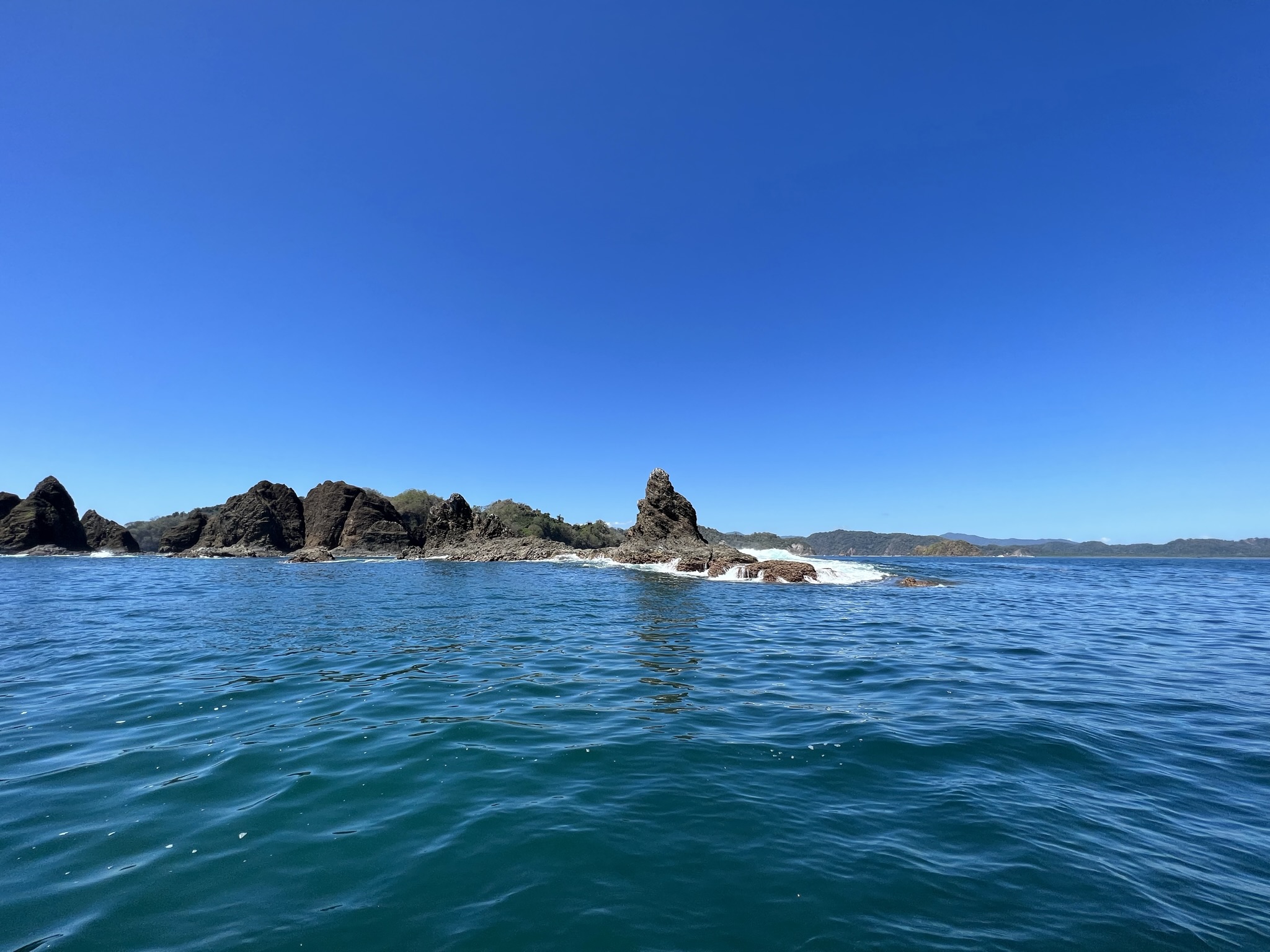
With my excitement quota for the day already fulfilled, I closed my eyes and silently thanked the heavens for yet another incredible day in Central America. That peace didn’t last long, though – the captain suddenly shouted, “You’re one lucky group!”. There, right in front of us, we saw it – an enormous fluke rising from the water before crashing back down. A friggin’ humpback whale. Also a few dolphins – but who cares when there’s a humpback?
Apparently, it hadn’t been too soon after all to tick off yet another dream. I felt immeasurably lucky. Boats returning to the mainland slowed and began circling, everyone hoping for one more fleeting glimpse. On several occasions we spotted its massive dorsal fin and tail, each appearance leaving us completely stunned. I honestly couldn’t believe my eyes – or my luck.