Santa Catalina – Day 2: The Depths of Coiba
SANTA CATALINA
Day 2: The Depths of Coiba
February 14, 2023
I could hardly contain my excitement after everything Amelia had told me about diving in Coiba National Park. And after Sabina, our dive guide from Panama Dive Centre, briefed us, I was even more amped – with the possibility of seeing manta rays, whale sharks and hammerhead sharks. As always, though, I tried to keep my expectations in check, fully aware of nature’s unpredictability.
After getting kitted out, I was introduced to the rest of the group – Dustin, Jake and Alexis from the US, who’d been diving here for almost a week, and Sivan from Switzerland, a divemaster with hundreds of dives under his belt. We walked down to the shore, where a boat was waiting to take us to a dive site called Wahoo, about an hour away.
During long boat rides like these, I’d developed a habit of closing my eyes, and with the engine revving and waves slapping the hull, I could easily picture myself back on the Miss Tamara – just like old times back in Utila. Having dived almost daily for the better part of two months, cherishing every single second, even the freezing, tempestuous days, it came naturally. I found myself reminiscing about the laughs, the stories and the fruit we shared during surface intervals, soaking up the Utilan sun with Adah’s Afro-beats playing in the background.

The Wahoo
Once at the dive site, we jumped in, geared up at the surface, and the moment I put my mask on, I could see all the way down to the seafloor some ten metres below us. The visibility alone was promising enough. Then, right beside me, a massive green turtle cruised past. I pointed it out to Sabina, who, despite doing this day in and day out, reacted with the same excitement I felt.
Once everyone was ready, we began our descent, the turtle still tagging along as a school of king angelfish fed off its shell. When we reached the bottom and got moving, I stared ahead in disbelief at the sheer volume of fish surrounding us – hundreds of grunts and jacks, snappers and groupers, scissortail damselfish and sergeant majors, butterflyfish and barberfish. Swimming in perfect synchrony, their formations were occasionally shattered by a blunthead triggerfish or a spot-finned porcupinefish, dispersing the entire school in one sudden burst whenever one of us got too close. It was a spectacular display of colour and coordination.
The bare volcanic rock looked alive, with marine life swarming around it. From rainbow wrasses to chancho surgeonfish, from bicolour parrotfish to Moorish idols, from guineafowl puffers to king angelfish, I could barely keep track – darting around in a frenzy, trying to take it all in while snapping photos.
Then we came across a whitetip reef shark. As I approached, I was hit by the coldest current I’d ever felt, sending shivers straight down my spine. The stark contrast between the warm tropical water we’d grown accustomed to and the icy layer just a metre away instantly snapped me back to reality, shattering my sense of serenity. At the thermocline, visibility dropped to just a few metres as particle-heavy cold water surged through. It didn’t take long for me to wuss out and retreat back into the warmer, clearer water, which was far more enjoyable in both temperature and marine life.
Sabina was constantly banging on her tank to point things out, so the moment she struck it harder than usual, I knew something big was up. She pointed upwards, and I found myself on the verge of hyperventilating as the silhouette of a devil ray appeared above us. I couldn’t believe my eyes, even though I knew these incredible creatures were commonly found here. For all intents and purposes, I could’ve ended the dive right then and there and been more than satisfied, watching the ray glide effortlessly overhead.
Also known as flying rays, these animals are famous for breaching, launching themselves out of the water and into the air – a truly jaw-dropping sight. Sabina later told us that although some do have a stinger, it’s usually covered by a layer of skin that renders it harmless. I was completely incredulous. I’d hoped to see a manta, but this felt like its darker, smaller cousin, complete with a subterminal mouth – meaning I was already over the moon. ¡Qué prity!
I could’ve stared at it for hours, but we had to move on. And thank god we did, because we saw more and more of them, each encounter leaving me just as stunned as the last. I was so fixated on the rays that I barely noticed my air consumption and went low on air for the first time in ages.
Lighthouse Wonders
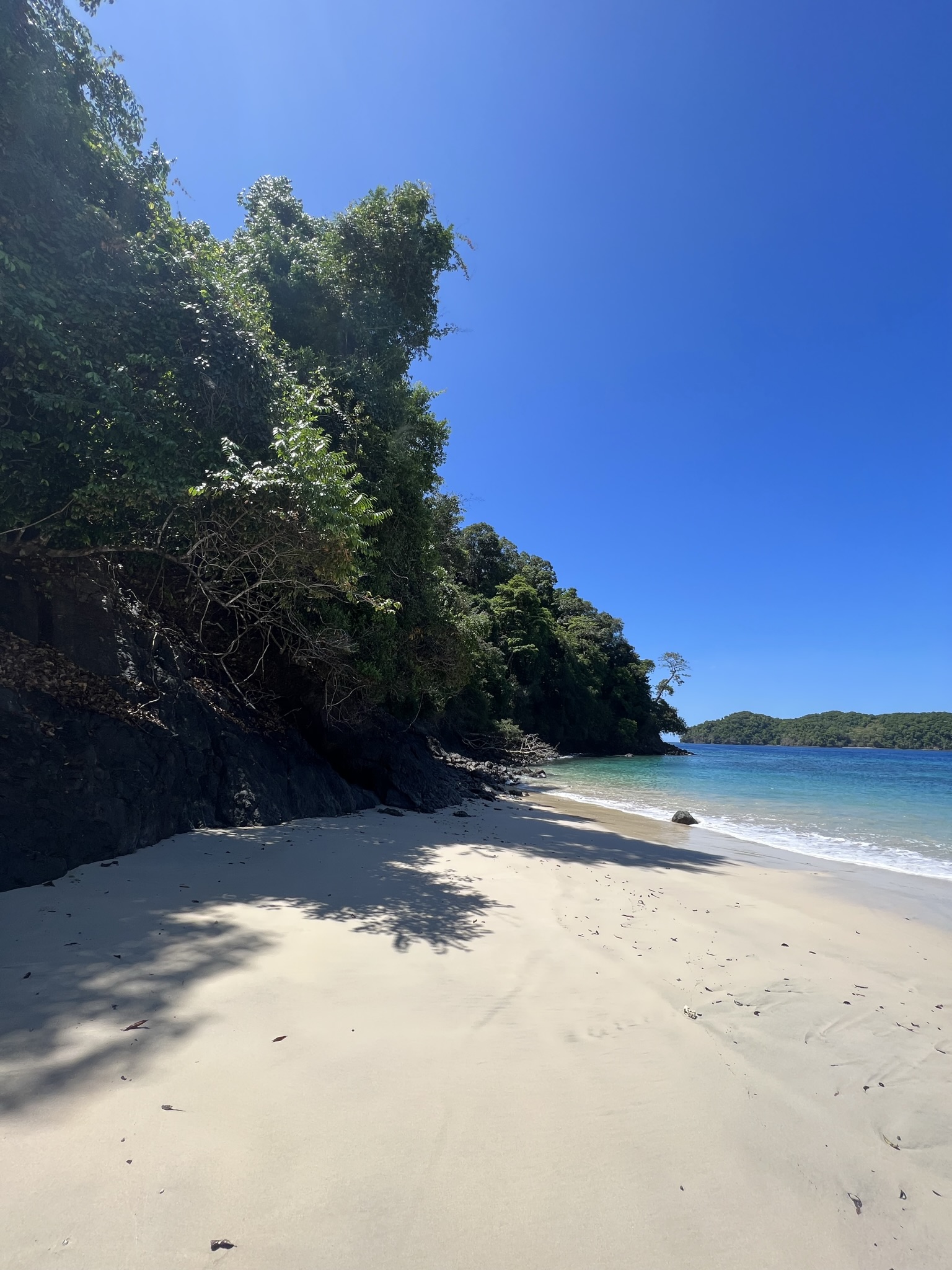
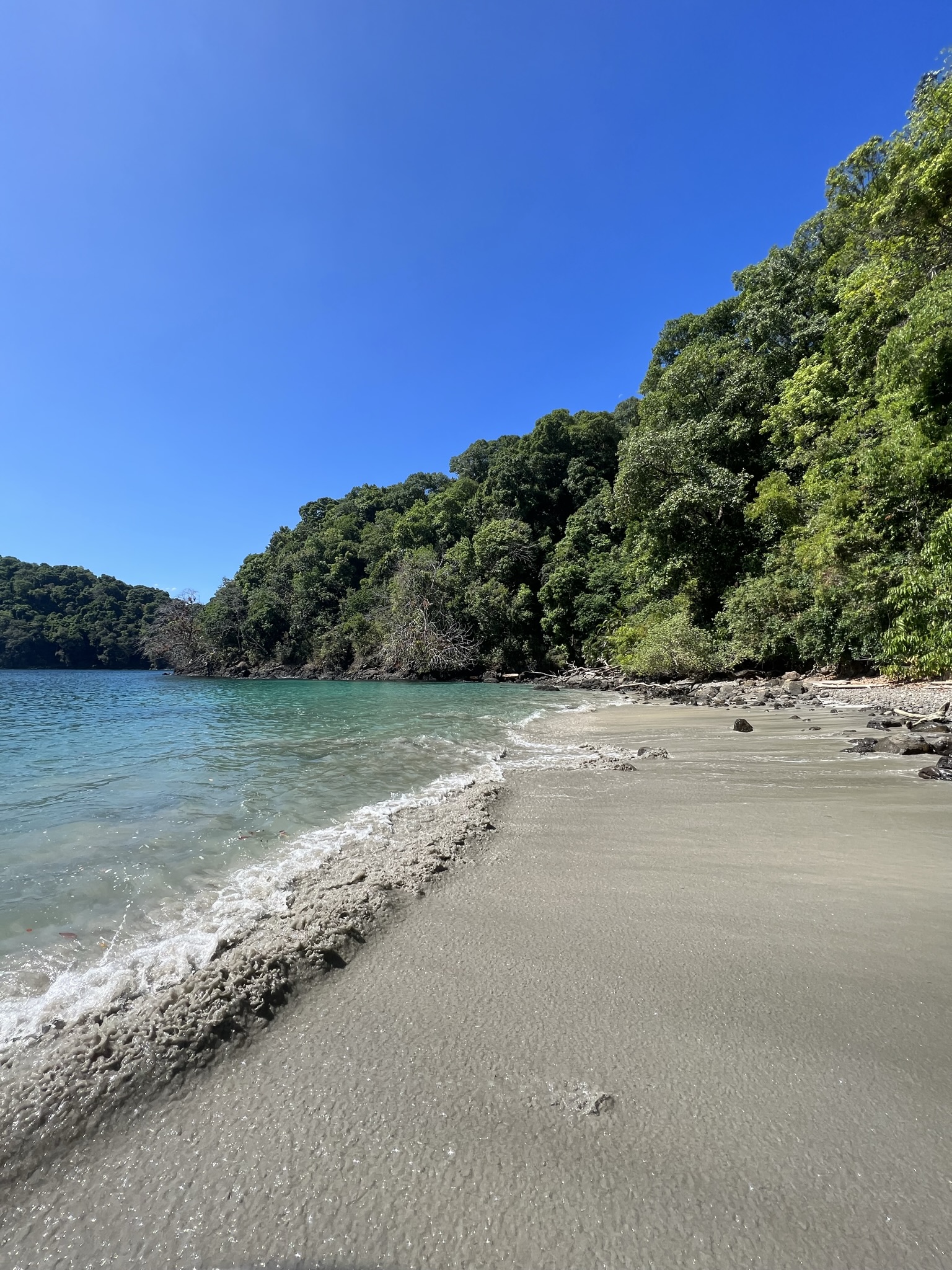
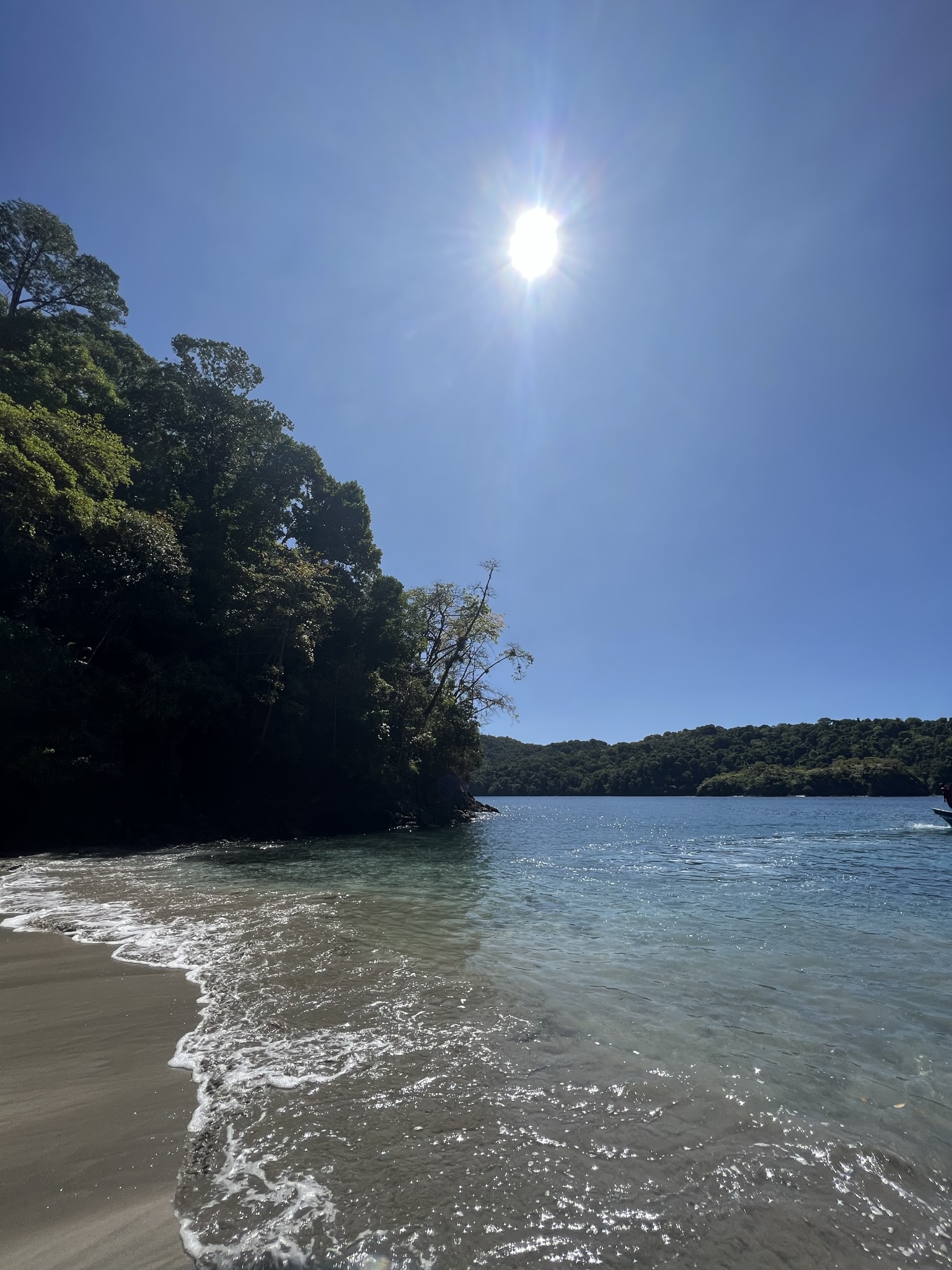
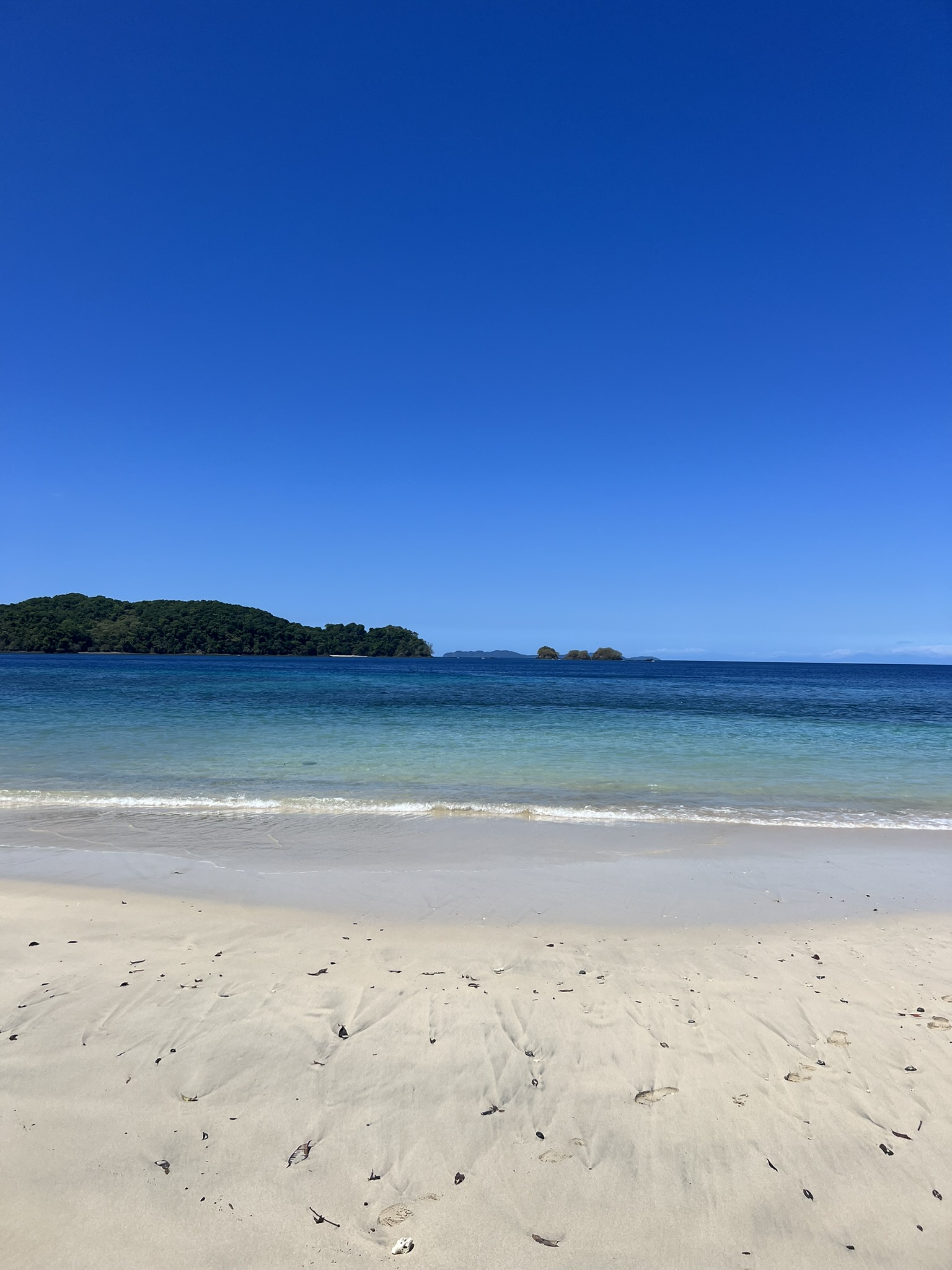
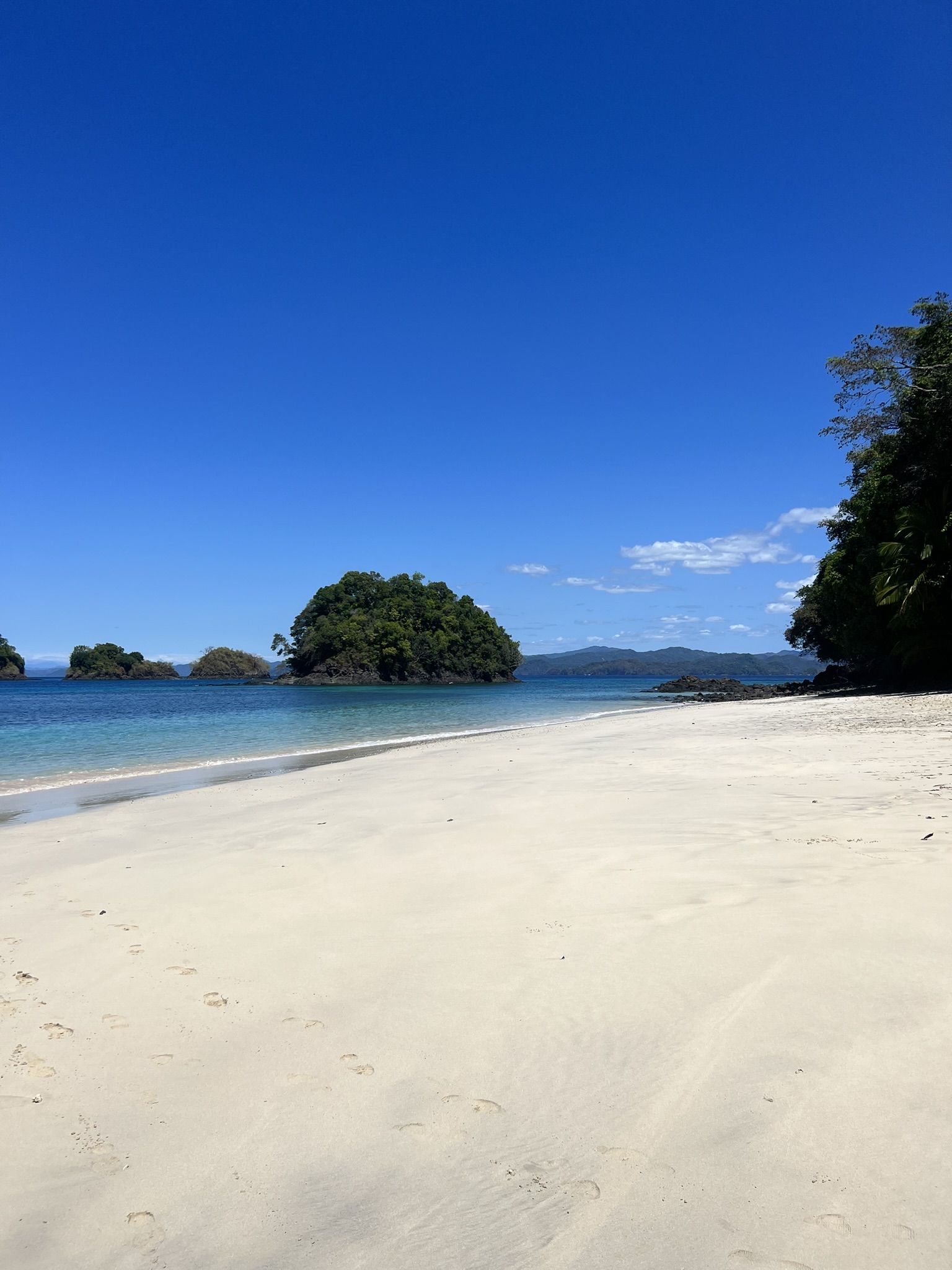
For our surface interval, we were dropped off on a beach on one of the park’s islands – a pristine stretch of white sand fringed by crystal-clear, cerulean water.
There, Sabina told us she’d been working as an instructor at PDC for eight years and that the job still felt like a dream come true, especially after spending years teaching English to thirteen-year-olds back in Germany. Having taught EFL to students ranging from teenagers to sixty-year-olds myself, I could completely relate. She went on to tell us about the many dive sites around Coiba and all the incredible things she’d seen over the years, the work never once becoming boring.
Our second dive took us to Faro, named after a rather forlorn lighthouse on a nearby island. After descending onto a sandy patch, the first thing Sabina spotted – something I couldn’t even begin to make out – was a perfectly camouflaged spotted scorpionfish. As we made our way toward a canyon where we’d do a swim-through, we were treated to an incredible array of marine life – Cortez angelfish, Pacific boxfish and even a guineafowl pufferfish in its golden phase.
Finally, I managed to spot a zebra moray eel, which had been eluding me all this time, its black-and-white stripes utterly mesmerising. More pipefish, cornetfish, scrawled filefish, whitetips – basically everything I could’ve ever hoped to see and then some. We also visited a cleaning station – an area where fish and larger animals like turtles and sharks go to have ectoparasites and dead skin removed by cleaner fish and shrimp. Here we were told we could potentially see oceanic blacktip and even bull sharks, and though we didn’t, their absence went almost unnoticed given the sheer abundance of life.
One Final Dive
Our second surface interval brought us to yet another tropical paradise, an untouched beach where we had lunch and chatted some more. After that, we geared up for our third and final dive. And by final, I mean final.
Up next, I’d be visiting either landlocked countries or ones in which conditions would be too harsh to dive in. I had no idea when or where I’d next be able to dive next. Knowing how deeply I’d fallen for the underwater world, I hoped I might squeeze in a few more dives somewhere down the line before heading home, but I couldn’t bank on it. And so, I treated this one as my last dive, at least for the foreseeable future.
The final dive took us to a site called Buffet. It felt like the culmination of everything we’d seen so far, featuring nearly all the highlights from the previous dives, including more devil rays and the largest moray eel I’d ever seen. But what truly set this site apart were the enormous schools of fish. And I don’t mean a handful – I mean entire friggin’ schools. Vast clouds of barberfish, jacks and grunts. It reminded me of that scene in Finding Nemo where the moonfish give Marlin and Dory directions. The absolute climax came with a colossal school of spot-tail grunts, thousands of silver bodies forming a living cloud, occasionally catching the light in brilliant flashes. What struck me most was how completely indifferent they were to us, the entire school enveloping us in a swirling hurricane of silver. All I could do was turn to the others and flash my best mind-blown signal as we hovered there, utterly mesmerised. What a friggin’ privilege.
By the end of the day, I hadn’t seen mantas, hammerheads or bull sharks. Was I disappointed? Not in the slightest. First off, it gave me an excuse to dive more. Second, I’d seen far more than I’d ever imagined at the outset. And somewhere during that final dive, it hit me that not only was it my last dive for the foreseeable future, it was also my last day on the Pacific coast.
A Diver at Heart
That evening, still riding the high from the dives, I met up with Sivan for dinner. He told me he’d been diving for around eight years and had completed his divemaster training in Koh Tao, Thailand.
Since then, he’d taken on various speciality courses and was now easing into technical diving. While that’s something I might consider one day, I told him that before even thinking about it, I’d need to be fully confident in my skills as a divemaster. No point overreaching and doing something that genuinely felt out of my depth. And before any of that, I’d definitely wanna get comfortable with sidemount diving first. Having finally put my dropped-tank blunder behind me, I felt ready to give it another go.
He recommended some equipment as I toyed with the idea of slowly building my own scuba kit, a conversation that admittedly felt endless given my still-limited technical knowledge. I quickly steered things back to the fun side of diving, which he happily obliged, sharing some wild stories. Like the time he went cave diving with a buddy who ran out of air. Or when he, too, dropped a weight belt during his divemaster training.
Just like that, three hours flew by, and I hadn’t even noticed it was well past my bedtime. It’s wild how diving had become such a huge part of my life in such a short span of time. And even wilder is the bond divers seem to share. People from all walks of life, united by this one thing. It’s true what they say – dive schools really are in the business of changing lives. And I’m living proof, having flipped my entire itinerary upside down just to spend more time underwater more than once!